DiscoverSchool's In
School's In
Claim Ownership

School's In

Author: Stanford Graduate School of Education

Subscribed: 71Played: 1,619
Share

Description

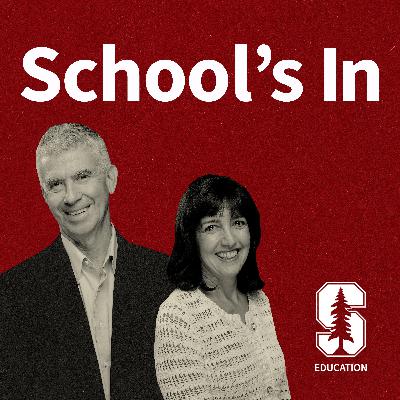
Unlock the future of learning with School’s In, your go-to podcast for cutting-edge insights and enlightening conversations in education. Presented by Stanford Graduate School of Education (Stanford GSE), this podcast is hosted by Dean Dan Schwartz and Senior Lecturer Denise Pope. They invite you to join them as they navigate the complexities of post-pandemic education and discuss the latest research in teaching and learning.

This season on School’s In, we delve into a variety of pressing topics with the help of our fellow Stanford experts. Discover how AI is transforming classrooms and personalizing learning experiences. Learn effective strategies to tackle chronic absenteeism and summer learning loss, and explore solutions for addressing educational inequality and supporting youth mental health. Additionally, we examine the role technology plays in reshaping learning environments. Join us as we discuss the incredible research being done in education today.

Dan Schwartz is a recognized expert in human learning and educational technology. As dean of Stanford GSE, he has led numerous initiatives to advance effective teaching strategies and technologies. He also serves as faculty director of the Stanford Accelerator for Learning, which aims to advance the science and design of learning to bring effective and equitable solutions to the world.

Denise Pope specializes in student well-being and engagement. A senior lecturer at Stanford GSE, her research focuses on academic stress and its consequences on students' mental health and learning. She is the author of several books and articles that support parents and teachers in creating more positive learning environments, including Doing School: How We Are Creating a Generation of Stressed Out, Materialistic, and Miseducated Students. Pope is also co-founder of the education nonprofit Challenge Success, which promotes equitable practices for balanced lives.

Together, they offer valuable observations and practical advice for parents, caregivers, educators, and anyone connected to the learning community. With a commitment to educational equity and innovation, they bring you expert perspectives and engaging conversations on the critical issues facing learners today.

Stanford GSE is a leader in education research and teaching, known for its commitment to pursuing equitable, accessible, and effective learning for all. The school’s dedication to preparing educators and researchers through interdisciplinary approaches ensures its lasting impact on the field.

“We’re here to help you navigate the complexities of post-pandemic education and stay ahead of the learning curve” says Schwartz, “so join us as we discuss practical solutions to some of education’s most challenging issues.”

Don't miss out on insightful discussions meant to keep you ahead of the learning curve! Subscribe to our newsletter now, follow us on Instagram, LinkedIn and visit our School’s In website for more updates and episodes. School’s In promises to be an essential resource for anyone passionate about learning.
175 Episodes
Reverse
Can edtech really teach kids to read? What works, what doesn’t, and what does the research say about tools for decoding versus comprehension?On this episode of School’s In, Stanford Professor Rebecca Silverman joins us to explore how educational technology can meaningfully support reading development. From helping students learn to decode words to supporting deeper reading comprehension, she explains what the latest research tells us about what works and what doesn’t – and the dangers of over-gamification. She covers several topics, including:(03:34) Differentiation: The promise of literacy edtech(05:45) Games, motivation, and what the research says(13:19) Decoding vs. comprehension, and why some skills are harder to teach with tech(18:03) Effective strategies for teaching comprehension(22:03) Practical takeaways for parents and educatorsRebecca Silverman is a professor at the Stanford Graduate School of Education. Her research explores how children learn to read and how educational tools can help improve literacy outcomes. She began her career as an elementary school teacher, and today her teaching emphasizes the importance of connecting research and classroom practice. Learn more about her work on her faculty profile.School’s In is your go-to podcast for cutting-edge insights and fresh perspectives on the future of learning. Hosted by Stanford Graduate School of Education (GSE) Dean Dan Schwartz and Senior Lecturer Denise Pope, each episode dives into the latest research, innovations, and real-world challenges shaping education today.Stanford GSE is at the forefront of education research and teacher preparation, dedicated to advancing equitable, accessible, and impactful learning experiences for all.Stay connected with the latest insights—subscribe to our newsletter and follow us on Instagram, LinkedIn, and Threads.
What does it mean to make an ethical decision in the classroom? And how can schools prepare for dilemmas that don’t have a single right answer?On this episode of School’s In, we’re joined by Stanford GSE Professor Meira Levinson, a leader in the emerging field of educational ethics. She walks us through the complex terrain of real-world ethical decision-making in schools – where competing values, pressures, and priorities often collide. From everyday classroom challenges to district-wide decisions, Meira shares how the field of EdEthics can help educators and policymakers navigate those moments with greater clarity and confidence. She covers several topics, including:(02:57) Understanding ethical decisions in education(06:19) The need for a field of educational ethics(10:00) The myth of the value-free classroom(11:15) Case study: Ethical dilemmas in the classroom(18:56) Developing ethical frameworks for educators(24:22) Ethics as community practice: Advice for working through hard decisions togetherMeira Levinson is a professor at Stanford Graduate School of Education whose work focuses on civic education, justice, and the ethics of teaching and learning. She founded JusticeInSchools.org, a site that offers real-world ethical case studies for educators and policymakers. Levinson's current mission is to formally establish the field of educational ethics, aiming to bring clarity, conversation, and support to the morally complex world of schooling. Learn more about her work on her faculty profile.School’s In is your go-to podcast for cutting-edge insights and fresh perspectives on the future of learning. Hosted by Stanford Graduate School of Education (GSE) Dean Dan Schwartz and Senior Lecturer Denise Pope, each episode dives into the latest research, innovations, and real-world challenges shaping education today.Stanford GSE is at the forefront of education research and teacher preparation, dedicated to advancing equitable, accessible, and impactful learning experiences for all.Stay connected with the latest insights—subscribe to our newsletter and follow us on Instagram, LinkedIn, and Threads.
Could the “word gap” be more myth than fact? Or is it a useful tool for understanding inequality in early childhood?On this episode of School’s In, Stanford Assistant Professor Monica Ellwood-Lowe joins the show to unpack one of the most cited – and most debated – ideas in early childhood development: the so-called “word gap,” or idea that children from lower-income families hear fewer words than those from more affluent homes. She explains what the latest research says about the quantity and quality of early language exposure, the effects of structural and economic inequities on parental engagement, and how brain development might differ not because of what children lack, but because of how they adapt. She covers several topics, including:(03:07) The word gap: Origins and controversy (05:47) Do parents just need to talk more? How financial and structural stressors affect parental attention(13:55) Beyond “motherease”: Cultural differences in child language development(18:20) Parenting, pressure, and perspective Monica Ellwood-Lowe is an assistant professor at Stanford Graduate School of Education. With a PhD in developmental psychology, she studies how the structure of society shapes caregiving and early child development. She dives into questions about children’s language and brain development that continue to drive her work today. Learn more on her faculty profile. School’s In is your go-to podcast for cutting-edge insights and fresh perspectives on the future of learning. Hosted by Stanford Graduate School of Education (GSE) Dean Dan Schwartz and Senior Lecturer Denise Pope, each episode dives into the latest research, innovations, and real-world challenges shaping education today.Stanford GSE is at the forefront of education research and teacher preparation, dedicated to advancing equitable, accessible, and impactful learning experiences for all.Stay connected with the latest insights—subscribe to our newsletter and follow us on Instagram, LinkedIn, and Threads.
What will it mean to teach and learn in an AI-powered world? Can we use artificial intelligence to enhance, but not replace, the best of what humans do?Recorded live in Los Angeles at Stanford’s Open Minds event, this episode of School’s In dives into how AI is reshaping education – its promises, pitfalls, and surprises. Dan and Denise welcome Stanford faculty members Judith Ellen Fan, a cognitive scientist, and Christopher Piech, a computer scientist, to the stage for a lively discussion that ranges from motivation and creativity to assessment and cheating. Together, they explore the deeply human elements of human learning and AI design, and the ways that Stanford is shaping the conversation about how humans and machines learn together. They cover several topics, including:(01:57) Students and AI: Inspiration and creativity (04:55) Beyond words: Why AI still struggles with human thinking(09:53) AI's impact on cheating and academic integrity(18:09) Keeping learning human: Mentors, motivation, and meaningful tasks (23:59) Designing AI for the future of learningChristopher Piech is an associate professor of computer science at Stanford University. He develops AI systems that support personalized education, working at the intersection of deep learning and classroom practice to help students learn more effectively and equitably. Learn more about his work on his faculty profile. Judith Ellen Fan is an assistant professor of psychology and the director of the Cognitive Tools Lab (https://cogtoolslab.github.io/) at Stanford University. Her research focuses on how visual communication supports learning. She bridges cognitive science, computational neuroscience, and artificial intelligence, exploring how tools like drawing can reveal and enhance human understanding. Learn more about her work on her faculty profile.School’s In is your go-to podcast for cutting-edge insights and fresh perspectives on the future of learning. Hosted by Stanford Graduate School of Education (GSE) Dean Dan Schwartz and Senior Lecturer Denise Pope, each episode dives into the latest research, innovations, and real-world challenges shaping education today.Stanford GSE is at the forefront of education research and teacher preparation, dedicated to advancing equitable, accessible, and impactful learning experiences for all.Stay connected with the latest insights—subscribe to our newsletter and follow us on Instagram, LinkedIn, and Threads.
*Please note: This episode includes discussion of youth mental health, including mentions of suicidal ideation. Listener discretion is advised.*Could the future of school-based mental health include chatbots—and should it?On this episode of School’s In, Stanford Assistant Professor Nick Haber joins the show to unpack research on AI chatbots as tools to support young people’s mental health. As an expert in learning sciences and artificial intelligence learning sciences, Haber sheds light on both the promising and the unsettling. , He covers several topics, including:(03:27) Why study AI chatbots as therapists?(06:27) The danger: AI therapists in crisis situations(11:41) Human interaction vs. AI companionship(15:04) AI and youth mental health(18:48) From risks to responsibility: Advice for parents and educatorsNick Haber is an assistant professor at Stanford Graduate School of Education. He and his research group develop AI systems meant to mimic and model the ways people learn early in life, exploring their environments through play, social interaction, and curiosity. Learn more about his work on his faculty profile. School’s In is your go-to podcast for cutting-edge insights and fresh perspectives on the future of learning. Hosted by Stanford Graduate School of Education (GSE) Dean Dan Schwartz and Senior Lecturer Denise Pope, each episode dives into the latest research, innovations, and real-world challenges shaping education today.Stanford GSE is at the forefront of education research and teacher preparation, dedicated to advancing equitable, accessible, and impactful learning experiences for all.Stay connected with the latest insights—subscribe to our newsletter and follow us on Instagram, LinkedIn, and Threads.
What happens when a school shuts down? And how do those decisions ripple through the students, families, and communities left behind?On this episode of School’s In, Stanford Assistant Professor Francis Pearman joins us to discuss the complex and often emotional issue of school closures. We dive into why schools close, who is most affected, and how these decisions ripple through communities – especially for low-income students and students of color. Pearman covers several topics including:(02:21) Why do schools close?(06:34) How school closures affect local communities(08:02) Educational consequences for students(11:25) Are school closures fair? Equity and disproportionality(16:07) Financial realities and policy tradeoffs(19:03) Is there a better way? Alternatives and considerationsFrancis Pearman is an assistant professor at Stanford Graduate School of Education. His research examines how poverty and inequality shape the life chances of children, particularly through the lens of educational opportunity and urban development. Learn more about his work on his faculty profile.School’s In is your go-to podcast for cutting-edge insights and fresh perspectives on the future of learning. Hosted by Stanford Graduate School of Education (GSE) Dean Dan Schwartz and Senior Lecturer Denise Pope, each episode dives into the latest research, innovations, and real-world challenges shaping education today.Stanford GSE is at the forefront of education research and teacher preparation, dedicated to advancing equitable, accessible, and impactful learning experiences for all.Stay connected with the latest insights—subscribe to our newsletter and follow us on Instagram, LinkedIn, and Threads.
How can AI be used as a tool that supplements, rather than supplants, the learning process? And what does research say is the most effective way to use the tool?On this episode of School’s In, we welcome GSE Assistant Professor Hari Subramonyam to discuss AI in education. He covers several topics, including:(01:41) What is critical thinking?(05:03) Beyond prompting: AI, creativity, and critical decision making(09:10) Using AI to scaffold the writing process(13:59) AI as learning tool: What the research shows(19:29) AI and assessment(22:33) AI in education: Advice for parents and teachersHari Subramonyam is an assistant professor at the Graduate School of Education, where his research focuses on augmenting critical human tasks (such as learning, creativity, and sensemaking) with AI by incorporating principles from cognitive psychology. He is also a faculty fellow at Stanford's Institute for Human-Centered AI. To learn more about his work, visit his faculty profile. Stanford GSE is at the forefront of education research and teacher preparation, dedicated to advancing equitable, accessible, and impactful learning experiences for all.Stay connected with the latest insights – subscribe to the GSE’s newsletter and follow us on Instagram, LinkedIn, and Threads.
What does it mean for students to be successful? And how can parents, schools, and educators create the conditions for students to thrive?On this episode of School’s In, we welcome co-host and GSE Senior Lecturer Denise Pope in the guest seat to discuss how to improve student wellness, belonging, and engagement. She covers several topics, including:(1:54)  Challenging a narrow definition of success: Parents and students(7:42) What the data shows: Stress, sleep, and engagement(14:02)  Belonging: Student relationships with teachers and peers(18:10)  Practical solutions: School-level change(24:37)  What parents can do, and key takeawaysDenise Pope is a senior lecturer at Stanford Graduate School of Education, where her research focuses on curriculum studies, service learning, student engagement, and school reform. She is also the co-founder of Challenge Success, a nonprofit that partners with schools to implement research-based strategies that improve student well-being and engagement. To learn more about her work, visit her faculty profile. Stanford GSE is at the forefront of education research and teacher preparation, dedicated to advancing equitable, accessible, and impactful learning experiences for all.Stay connected with the latest insights – subscribe to the GSE’s newsletter and follow us on Instagram, LinkedIn, and Threads.
Season 3 is here!

Season 3 is here!

2025-09-1801:01

Season 3 is here, and we have a great lineup for you, our listeners. We kick off the season with our very own Denise Pope in the hot seat, sharing research on what constitutes student success. This season we also bring you research on AI as an educational tool, chatbots as therapists, the impacts of school closures, and much, much more. Subscribe now. You won’t want to miss an episode!
What does the growing popularity and utility of AI tools mean for students, teachers, and schools? And what can educators do to leverage these tools to make learning stick?This week we are sharing an episode from our friends at Stanford School of Engineering – an episode of The  Future of Everything, with host Russ Altman. Originally released in August 2024, this episode features our own GSE dean and School’s In co-host, Dan Schwartz in the hot seat. Schwartz covers several topics on the future of educational technology, including:01:27  Enter AI: Opportunity and upheaval in education02:49  Teachers vs. technology: Do we still need humans?08:24  Cheating, ChatGPT, and assignments that matter12:25  Industry, EdTech, and AI’s future direction18:14  Assessment, analytics, and ethical design25:30  Embodied learning and virtual AI integrationDan Schwartz is the James Quillen Dean and the Nomellini & Olivier Professor of Educational Technology at Stanford Graduate School of Education. He is also the Halper Family Faculty Director of the Stanford Accelerator for Learning. An expert in human learning and educational technology, Schwartz also oversees a laboratory that works to prepare students to continue learning and adapting throughout their lifetimes.To learn more about his work, visit his faculty profile. The Future of Everything podcast explores how technology, science, and medicine are shaping our lives. Host Russ Altman asks his guest to discuss their role in creating the future – of everything. Learn more about this episode on the show’s website.Stanford GSE is at the forefront of education research and teacher preparation, dedicated to advancing equitable, accessible, and impactful learning experiences for all.Stay connected with the latest insights – subscribe to the GSE’s newsletter and follow us on Instagram, LinkedIn, and Threads.
How does sleep affect student academic performance? And how might school start times be setting them up to fail?On this episode of School’s In, originally broadcast in April 2019, we welcome Professor Rafael Pelayo, a  clinical professor of psychiatry and behavioral sciences. He discusses what sleep does for the brain and how it matters for learning. Pelayo tackles several topics, including:04:43  What sleep really does for us08:26  Sleep and learning: The essential link13:10  Adolescent sleep challenges17:52  The school start time debate23:45  Changing attitudes, sleep technology, and healthy habitsDr. Rafael Pelayo is a clinical professor of psychiatry and behavioral sciences at Stanford University’s Sleep Medicine Division, where his clinical focus is on sleep medicine and the neurology of children and adults. He is also the author of How to Sleep. To learn more about his work, visit his faculty profile. School’s In is your go-to podcast for cutting-edge insights and fresh perspectives on the future of learning. Hosted by Stanford Graduate School of Education Dean Dan Schwartz and Senior Lecturer Denise Pope, each episode dives into the latest research, innovations, and real-world challenges shaping education today.Stanford GSE is at the forefront of education research and teacher preparation, dedicated to advancing equitable, accessible, and impactful learning experiences for all.Stay connected with the latest insights – subscribe to our newsletter and follow us on Instagram, LinkedIn, and Threads.
How can schools help students develop digital literacy in the classroom? And how can these techniques be applied to how we consume news and identify reliable information?On this episode of School’s In, recorded live on campus in May 2025, we welcome a panel including GSE Professor Emeritus Sam Wineburg, Stanford journalism lecturer Janine Zacharia, high school teacher Valerie Ziegler, and Stanford undergraduate student Alvin Lee. The panel discusses the importance of teaching students how to accurately navigate the internet, and how this approach to digital information can be built into course curricula. Our guests tackle several topics, including:02:57  Teaching digital literacy in a changing world (panelists’ responses to Part 1 with Sam Wineburg)08:05  Truth, trust, and TikTok: Navigating information in the AI era15:08  The educator’s dilemma: Keeping up with AI in the classroom22:37  Beyond the mandate: Building digital literacy into the curriculum25:38  Creating a culture of curiosity: Advice for students, educators, and parentsSam Wineburg is the Margaret Jacks Professor, Emeritus, of education at Stanford Graduate School of Education, where his research focused on how people assess the credibility of digital content. To learn more about his work, visit his faculty profile. Janine Zacharia is a lecturer in the Department of Communication at Stanford University. She regularly appears on cable news shows and radio programs as a Middle East analyst. To learn more about her work, visit her faculty profile. Valerie Ziegler teaches U.S. history, economics, and advanced placement U.S. government and politics at Abraham Lincoln High School in San Francisco. Learn more about her work here. Alvin Hong Lee is a senior at Stanford University, where he is pursuing a bachelor’s degree in political science. A proud product of California public schools, Lee is founder and executive director of GENup, California’s largest youth-led education policy organization.School’s In is your go-to podcast for cutting-edge insights and fresh perspectives on the future of learning. Hosted by Stanford Graduate School of Education Dean Dan Schwartz and Senior Lecturer Denise Pope, each episode dives into the latest research, innovations, and real-world challenges shaping education today.Stanford GSE is at the forefront of education research and teacher preparation, dedicated to advancing equitable, accessible, and impactful learning experiences for all.Stay connected with the latest insights – subscribe to our newsletter and follow us on Instagram, LinkedIn, and Threads.
What is digital literacy? And how does critical thinking play a role in students’ ability to avoid falling prey to false information online?On this live episode of School’s In, taped in front of an audience at Stanford, we welcome Stanford Professor Emeritus Sam Wineburg to discuss digital literacy and how to help students navigate the internet in the era of AI and fake news. Wineburg covers several topics, including:02:02  What is digital literacy?05:04  Critical thinking vs. critical ignoring08:34  The challenges and potential of AI in education14:13  Digital literacy in the school curriculum19: 28  Navigating fake news, lateral reading, and using AI to check sources25:18  Parents’ role in supporting students’ digital literacySam Wineburg is the Margaret Jacks Professor, Emeritus, of Education at Stanford Graduate School of Education, where his research focused on how people assess the credibility of digital content. To learn more about his work, visit his faculty profile.School’s In is your go-to podcast for cutting-edge insights and fresh perspectives on the future of learning. Hosted by Stanford Graduate School of Education Dean Dan Schwartz and Senior Lecturer Denise Pope, each episode dives into the latest research, innovations, and real-world challenges shaping education today.Stanford GSE is at the forefront of education research and teacher preparation, dedicated to advancing equitable, accessible, and impactful learning experiences for all.Stay connected with the latest insights – subscribe to our newsletter and follow us on Instagram, LinkedIn, and Threads.
How does the average person interact with their cell phone? And what does this say about the way we process information?On this episode of School’s In, we welcome Stanford Professor Nilam Ram to discuss his research into the digital lives -- specifically, cell phone use -- of teenagers and adults, and how these findings might be used to support awareness and positive change in a person's life. Ram covers several topics, including:(03:17)  What is the Human Screenome Project?(08:33)  Digital switching and the human brain(16:50)  Generational differences: The cell phone as behavioral mirror(19:33)  Cell phones and mental health(23:16)  Positive interventions, optimization, and ethicsNilam Ram is a professor of psychology and communications at Stanford University, where his research focuses on how short-term changes, including processes like learning and information processing, develop across the lifespan, and how longitudinal studies help generate new knowledge.To learn more about his work, visit his faculty profile.School’s In is your go-to podcast for cutting-edge insights and fresh perspectives on the future of learning. Hosted by Stanford Graduate School of Education Dean Dan Schwartz and Senior Lecturer Denise Pope, each episode dives into the latest research, innovations, and real-world challenges shaping education today.Stanford GSE is at the forefront of education research and teacher preparation, dedicated to advancing equitable, accessible, and impactful learning experiences for all.Stay connected with the latest insights – subscribe to our newsletter and follow us on Instagram, LinkedIn, and Threads.
How soon can reading challenges like dyslexia be identified in children? And what role can technology play in supporting teachers as they work to develop student literacy?On this episode of School’s In, we welcome Stanford Graduate School of Education (GSE) Associate Professor Jason Yeatman to discuss advancements in dyslexia screening, and how teachers can use technology to ease the burden of assessment and focus on supporting student learning. Yeatman covers several topics, including:02:42  What is dyslexia and why is early screening important?09:11  Designing engaging assessments: Gamification research16:52  Technology’s role: Supporting teacher expertise in literacy21:05  Applying ROAR beyond the primary grades23:34  ROAR at home: Data access for parentsJason Yeatman is an associate professor at the GSE where his research focuses on understanding the mechanisms behind the learning process, especially as it relates to children with dyslexia, to help design effective literacy interventions for students with learning differences. He is also director of the Stanford Brain Development and Education Lab, where he studies how a child’s experience with reading instruction shapes the development of brain circuits. To learn more about his work, visit his faculty profile.School’s In is your go-to podcast for cutting-edge insights and fresh perspectives on the future of learning. Hosted by Stanford Graduate School of Education Dean Dan Schwartz and Senior Lecturer Denise Pope, each episode dives into the latest research, innovations, and real-world challenges shaping education today.Stanford GSE is at the forefront of education research and teacher preparation, dedicated to advancing equitable, accessible, and impactful learning experiences for all.Stay connected with the latest insights – subscribe to our newsletter and follow us on Instagram, LinkedIn, and Threads.
What does it mean to be a lifelong learner? And how might education and learning be reframed to enable flourishing across the lifespan?On this episode of School’s In, we welcome Stanford Graduate School of Education (GSE) Professor Mitchell Stevens to discuss the nature of work and learning in a world where people are living and working longer. We also touch on how parents and educators can prepare young people for futures that might involve multiple careers and continuous learning over the course of a lifetime. Stevens covers several topics, including:03:20  The impact of longevity on education and work05:48  Rethinking our front-loaded education system07:53  Lifelong careers as a thing of the past11:26  Early learning matters more than ever14:58  Beyond “skills”: Identity and reinvention across the lifespan19:42  Who pays for lifelong learning? A new social contractMitchell Stevens is a professor at the GSE where his research focuses on lifelong learning, alternative forms of education, and the formal organization of knowledge. He is also co-director of the Stanford Center on Longevity. To learn more about his work, visit his faculty profile.School’s In is your go-to podcast for cutting-edge insights and fresh perspectives on the future of learning. Hosted by Stanford Graduate School of Education Dean Dan Schwartz and Senior Lecturer Denise Pope, each episode dives into the latest research, innovations, and real-world challenges shaping education today.Stanford GSE is at the forefront of education research and teacher preparation, dedicated to advancing equitable, accessible, and impactful learning experiences for all.Stay connected with the latest insights – subscribe to our newsletter and follow us on Instagram, LinkedIn, and Threads.
Why is early childhood math important? And how can parents and teachers use research-backed, and play-based practices to encourage math learning?On this episode of School’s In, we welcome Stanford Graduate School of Education (GSE) Professor Emerita Deborah Stipek to discuss why learning and practicing math is important for young children. We also touch on ways to engage young children in playful math and how parents can incorporate learning at home. Stipek covers several topics, including:03:00  Early math as a predictor of academic achievement07:09  Math anxiety: Overcoming barriers and making math fun13:44  Everyday playful math for families18:07  Transitional kindergarten and teacher preparation in early math25:39  Early math resources for parents, caregivers, teachers, and teacher educatorsDeborah Stipek is the chair of the Development and Research in Early Mathematics Education (DREME) Network, where she works with scholars and researchers to advance math learning and skill development for young children. She is also a professor emerita and former dean at the GSE, where her research focused on early childhood and elementary education, especially as it relates to math and motivation. To learn more about her work, visit her faculty profile.For more information on the DREME Network, and to access their free resources for parents, teachers, and teacher educators, visit their website here. School’s In is your go-to podcast for cutting-edge insights and fresh perspectives on the future of learning. Hosted by Stanford Graduate School of Education Dean Dan Schwartz and Senior Lecturer Denise Pope, each episode dives into the latest research, innovations, and real-world challenges shaping education today.Stanford GSE is at the forefront of education research and teacher preparation, dedicated to advancing equitable, accessible, and impactful learning experiences for all.Stay connected with the latest insights – subscribe to our newsletter and follow us on Instagram, LinkedIn, and Threads.
*** Join us for our LIVE event May 21st on the Stanford campus. Details below. ***How can schools apply the latest research to improve learning for all students? And how can parents, school leaders, and policymakers use that research to bring about change?On this episode of School’s In, we welcome Stanford Graduate School of Education (GSE) Professor Susanna Loeb to discuss how to scale education research to have more influence in the world. We also touch on the importance of connecting research and practice, and ways parents can support students in their learning. Loeb covers several topics, including:(2:31) What does it mean to “scale” in education?(6:18) Why tutoring works—and who gets left out(9:56) The importance of context in creating a plan that works(12:44) Research that makes a difference(16:01) How parents can get involved(19:56) AI, policy, and the future of scaling knowledge in educationSusanna Loeb is a professor of education at the GSE, where her research focuses broadly on education policy and its role in improving educational opportunities for students. She is also faculty director of the SCALE Initiative at the Stanford Accelerator for Learning, and was the founding director of the Center for Education Policy Analysis at Stanford and co-director of Policy Analysis for California Education. To learn more about her work, visit her faculty profile.School’s In is your go-to podcast for cutting-edge insights and fresh perspectives on the future of learning. Hosted by Stanford Graduate School of Education Dean Dan Schwartz and Senior Lecturer Denise Pope, each episode dives into the latest research, innovations, and real-world challenges shaping education today.Stanford GSE is at the forefront of education research and teacher preparation, dedicated to advancing equitable, accessible, and impactful learning experiences for all.Stay connected with the latest insights — subscribe to our newsletter and follow us on Instagram, LinkedIn, and Threads.*** School’s In is going LIVE for an episode on digital literacy in the AI era, featuring Sam Wineburg and a panel of expert guests. Join us for a reception, interactive event, and headphone giveaway on Wednesday, May 21st on the Stanford campus. Register here, and we hope to see you there! ***
*** Join us for our LIVE event May 21st on the Stanford campus. Details below. ***What is a healthy amount of homework for a student? And how can schools, teachers and parents help students live balanced lives?On this episode of School’s In, we welcome California State Assemblywoman Pilar Schiavo to discuss the Healthy Homework Bill and students’ need to balance work and down time. We also touch on what parents, teachers and schools can do to support students when it comes to homework. Schiavo covers several topics, including:(02:40)  Why the Healthy Homework bill?(04:54)  Why homework? The pros and cons of homework(12:29)  What is the Healthy Homework bill and how does it work for schools?(19:37)  Homework, youth mental health, and family dynamics(23:49)  The characteristics of effective homework: The student point of view(26:20)  Key takeaways for parents, teachers, and schoolsPilar Schiavo is a California state assemblywoman for the 40th district, where she introduces and advocates for bills related to education, affordable housing, regional transportation, and healthcare, among others. To learn more about her work, visit her official website.School’s In is your go-to podcast for cutting-edge insights and fresh perspectives on the future of learning. Hosted by Stanford Graduate School of Education (GSE) Dean Dan Schwartz and Senior Lecturer Denise Pope, each episode dives into the latest research, innovations, and real-world challenges shaping education today.Stanford GSE is at the forefront of education research and teacher preparation, dedicated to advancing equitable, accessible, and impactful learning experiences for all.Stay connected with the latest insights — subscribe to our newsletter and follow us on Instagram, LinkedIn, and Threads.*** School's In is going LIVE for an episode on digital literacy in the AI era, featuring Sam Wineburg and a panel of expert guests. Join us for a reception, interactive event, and headphone giveaway on Wednesday, May 21st on the Stanford campus. Register here, and we hope to see you there! ***
What are effective methods that support adult learning? And how can modern tools and technology help in that effort?On this episode of School’s In, we welcome Associate Professor Candace Thille to discuss the research and design behind successful adult learning. We also touch on the importance of feedback, and how it can make AI and other technology more useful in educational settings. Thille covers several topics, including:(3:02)  The importance of feedback in learning technology(5:30)  Feedback and deliberate practice in learning(7:50)  Adult learning: Building on prior knowledge and experience(9:58)  Learning design: Targeting skills and knowledge for the adult learner(13:11)  AI, machine learning, and human agency(21:00)  The importance of motivation in learning designCandace Thille is an associate professor at Stanford Graduate School of Education (GSE), where she studies the science of human learning, with a focus on the intersection of adult and machine learning. She is also the faculty director for the adult and workplace learning initiative at the Stanford Accelerator for Learning, and a faculty affiliate of the Stanford Neurosciences Interdepartmental Program. To learn more about her work, visit her profile.School’s In is your go-to podcast for cutting-edge insights and fresh perspectives on the future of learning. Hosted by Stanford Graduate School of Education (GSE) Dean Dan Schwartz and Senior Lecturer Denise Pope, each episode dives into the latest research, innovations, and real-world challenges shaping education today.Stanford GSE is at the forefront of education research and teacher preparation, dedicated to advancing equitable, accessible, and impactful learning experiences for all.Stay connected with the latest insights — subscribe to our newsletter and follow us on Instagram, LinkedIn, and Threads.
loading
Comments