


 Claim Ownership
Sharp Strategies Sweet Success
Subscribed: 0Played: 0
Subscribe

© Tifiny Swedensky
Description
Sharp Strategies Sweet Success is a podcast for anyone working in personal injury marketing. In each episode, we interview law firm marketing experts, in-house marketers, notable legal business coaches, and more. Hosted by Tifiny Swedensky, this is the show you've been looking for if you want an inside view of personal injury marketing today.
sharpcookiedev.substack.com
sharpcookiedev.substack.com
122 Episodes
Reverse

AI can produce an answer in seconds. That does not mean it knows how your law firm works.If your templates are scattered, your processes live in someone’s head, and your matter information is out of date, a new AI subscription will not magically fix that. The foundation matters.On this episode of Sharp Strategies Sweet Success, I talk with Jennifer Case, a former litigator and AI strategist who helps small and midsize firms adopt AI. Her approach starts with a question that is easy to skip: What does your firm already have, and how is it actually being used?What documents do you use with your firm’s AI?Jennifer looks at the tools a firm already uses, how information moves between them, and where people enter the same information twice. She also talks with leadership and the people who know the day-to-day work.The most useful AI project may not be the flashiest one. You start by mapping a process like intake, identify the handoffs and bottlenecks, and then decide where automation, AI, and a person each belong. You need to understand the process before you improve it with AI.What makes an AI output unique to a business? Jennifer describes building knowledge files and playbooks in the firm’s own document system. A matter summary might capture the parties, procedural history, open items, and upcoming deadlines. A playbook can explain how the firm approaches a recurring task.The goal is portability: your team should not have to rebuild its context every time it changes tools. But a summary is only useful if someone keeps it up to date. Assign an owner, check it against the underlying records, and control who can access it. An AI-generated update is not automatically the source of truth.The same idea applies to marketing. If you want AI to help you make better decisions, give it reliable information about your firm’s actual work and results. A plausible headline is not proof that it will convert.AI is great, but you still need peopleI often say that AI raises the floor, not necessarily the ceiling. Try it on a task you know well and pay attention to where it falls short. That is where your expertise and judgment matter.Jennifer and I also discuss the risk of treating AI as a substitute for critical thinking, especially when newer lawyers need opportunities to develop their skills. Faster work is not the same thing as verified work.Before connecting a tool to client information, evaluate its security, access controls, and terms with the right people at your firm. The ABA’s Formal Opinion 512 is a useful starting point for understanding the professional responsibilities implicated by generative AI; check the rules and guidance that apply in your jurisdiction, too.The takeaway: organize what your firm knows, choose a workflow worth improving, and test with built-in human review. The tool may change. Your firm’s judgment and knowledge must still be yours.Know a firm trying to make sense of AI? Share this episode!Subscribe for more practical conversations about law-firm marketing and operations! This is a public episode. If you'd like to discuss this with other subscribers or get access to bonus episodes, visit sharpcookiedev.substack.com/subscribe
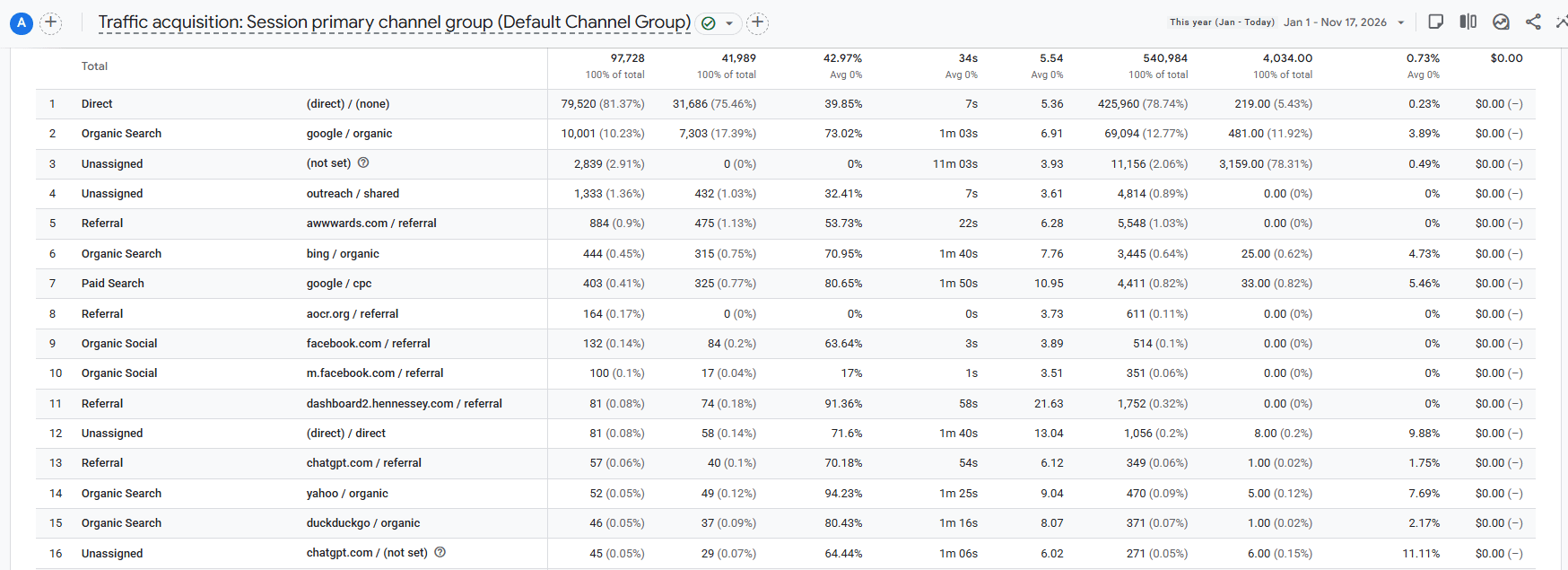
I was reviewing SEO reports this morning and came across a useful reminder: the broad traffic categories in Google Analytics are a starting point, not the whole story.If you want to see which search engines, directories, social platforms, and AI tools are actually driving traffic to your law firm’s website, add one detail to your Traffic acquisition report: Session source/medium.Look Beyond the Channel GroupsIn GA4, open Reports > Acquisition > Traffic acquisition. Above the report table, use the plus sign to add a secondary dimension, then select Session source/medium. Google’s Traffic acquisition guide walks through the report if you need help finding it.The channel group tells you the broad category: Organic Search, Referral, Direct, and so on. Source/medium gives you more detail. Instead of seeing only “Organic Search,” you can distinguish google / organic from bing / organic. Instead of just “Referral,” you can see the referring website.In the report, the list included Google and Bing, Facebook, and chatgpt.com. There were separate chatgpt.com rows with different medium values. The channel group told us a little, but we need to review the source and examine all the rows before drawing a conclusion.What AI Referrals Can and Cannot Tell YouThere is a lot of attention on AI search right now, and we still cannot measure it the way we are accustomed to measuring traditional search.This report gives you one useful signal: traffic that GA4 attributes to an AI source. OpenAI says ChatGPT search referral URLs include a chatgpt.com source parameter, which can help publishers track inbound visits. Look for other AI sources in your own report, too, but don’t assume the visible rows capture every AI-influenced visit.A directory referral is a good example. Someone could discover your firm through an AI answer, visit a legal directory, and then click through to your site. But a directory referral in GA4 does not establish that path. The report alone cannot tell you how many of those visitors started with AI.Likewise, a referring directory is a place worth investigating. Look at your listing, the information it presents, and whether it is sending traffic that matters to your firm.Don’t Ignore Direct or UnassignedDirect is not a neat list of people who typed your URL. GA4 can also classify a session as direct when referral information is unavailable. Unassigned is worth investigating as well: check your campaign tagging and source / medium values before assuming the traffic is useless.And remember that this is a session report, not a complete record of every touchpoint or a measure of your firm’s visibility inside an AI answer. Compare sources over time and, where your tracking is reliable, look beyond traffic counts to engagement and meaningful actions.The takeaway: before you buy another tool to tell you where your traffic comes from, take a closer look at the free one you already have. You may be surprised by what is sitting inside those broad buckets.Thanks for reading Legal Marketing Strategies from Sharp Cookie! This post is public so feel free to share it.Legal Marketing Strategies from Sharp Cookie is a reader-supported publication. To receive new posts and support my work, consider becoming a free or paid subscriber. This is a public episode. If you'd like to discuss this with other subscribers or get access to bonus episodes, visit sharpcookiedev.substack.com/subscribe

This is a free preview of a paid episode. To hear more, visit sharpcookiedev.substack.comLaw firm SEO has a credibility problem.Everyone has a theory about what makes a firm rank. Very few people show you the data behind it.That is why I invited Julia Hensel, CEO of Lexigate and RepSpert, to join our November Sharp Marketing Mastermind. Julia’s team studied the first-page results for “car accident lawyer” across the 50 largest U.S. cities. Then, she walked our group through what the top firms actually had in common.Some of the findings were encouraging. In Julia’s study, the map pack appeared first in 94% of these searches, and a local or regional firm held the top organic spot 90% of the time. The national firms may have more money, but they do not automatically win.Some findings were a little less comfortable. Reviews matter a LOT. Generic practice-area content is not enough. And most of the work that improves visibility in AI search is the same decidedly unsexy work good marketers should have been doing already.Paid subscribers can watch the complete LIVE recording below and use this article as the clean, Tifiny-guided version of Julia’s presentation. You will also get access to future Sharp Marketing Mastermind sessions, where you can bring your own questions into the room.
Law firm owners have no shortage of marketing ideas. Between conferences, mastermind groups, and new technology, there’s always another strategy to consider. But getting those ideas implemented back at the firm can be a different challenge.In this episode of Sharp Strategies, Sweet Success, Tifiny Swedensky talks with Gracie Howes, COO of the Personal Injury Lawyers Marketing and Management Association (PILMMA), about the operational challenges facing growing personal injury law firms.Gracie shares how PILMMA has evolved its educational programs to better support the people responsible for executing a firm’s marketing and management strategies. While firm owners may leave a mastermind meeting with ambitious plans, their teams need the training, resources, and authority to put those plans into practice.The conversation also explores one of the most persistent challenges in legal marketing: evaluating SEO vendors.Law firms frequently reconsider their marketing agencies, but switching vendors doesn’t necessarily solve the underlying problem. Tifiny explains why evaluating whether an agency is fulfilling its responsibilities and determining whether its work is producing meaningful results require two different conversations.AI is another major topic. Gracie discusses PILMMA’s shift from experimenting with numerous AI tools toward using AI for research, analytics, and operational improvements. Tifiny also shares her approach to creating highly specific website content designed to answer the increasingly detailed questions people ask AI-powered search tools.Finally, Gracie previews PILMMA’s upcoming AI for PI Expo in Orlando, where attorneys and industry experts will share practical applications of AI in law firm operations, marketing, and case management.Listen to the episode for a discussion about building stronger marketing systems, evaluating vendors, and finding practical ways to use AI inside a growing law firm.Connect with Gracie Howes on LinkedIn: https://www.linkedin.com/in/gracie-howes/AI for PI Expo registration: pilmma.org/ai-for-pi-expo (use promo code 27AIPITIFINYS to 15% off non-member tickets!) This is a public episode. If you'd like to discuss this with other subscribers or get access to bonus episodes, visit sharpcookiedev.substack.com/subscribe
Most law firms do not have a channel problem. They have a measurement problem.It is easy to convince yourself that more posts, more followers, and a polished video campaign must be good marketing. But visibility is not the finish line. If you cannot connect the work to leads, cases, or referral relationships, you may simply be funding activity.In this episode of Sharp Strategies Sweet Success, I talk with Seth Greene, founder and CEO of Market Domination, about what direct-response marketing looks like for law firms right now.His first point is refreshingly blunt: you do not need to be everywhere. You need to identify your ideal client, learn where that person spends time, and concentrate your effort there. That may mean social media, direct mail, podcast advertising, radio, or another channel entirely. The channel matters less than the audience and the result.We also get into a familiar fight: polished attorney videos versus simple, authentic creative. A courthouse shot and an expensive suit may satisfy the lawyer’s ego. A phone-recorded video or client testimonial may perform better. The answer is not another opinion. Test both and follow the numbers.That same discipline should continue after the lead arrives. Better targeting can reduce junk, but firms still need fast intake and a sensible way to prioritize promising inquiries.Finally, Seth makes a strong case for treating social media as a relationship channel. Attorneys can build trust directly while nurturing referral relationships with local professionals who serve the same people.You cannot deposit likes. You can build a system that turns attention into conversations, relationships, and cases.Are you interested in hiring the Sharp Cookie team to manage your law firm’s marketing department?Visit the Sharp Cookie website and complete our form to request a proposal. You can also contact us on LinkedIn.Thanks for reading Legal Marketing Strategies from Sharp Cookie! This post is public so feel free to share it.Legal Marketing Strategies from Sharp Cookie is a reader-supported publication. To receive new posts and support my work, consider becoming a free or paid subscriber. This is a public episode. If you'd like to discuss this with other subscribers or get access to bonus episodes, visit sharpcookiedev.substack.com/subscribe

Comments

Download from Google Play

Download from App Store
 United States