


 Claim Ownership
Sinica Podcast
Subscribed: 39Played: 300
Subscribe

© The Sinica Podcast
Description
A weekly discussion of current affairs in China that looks at books, ideas, new research, intellectual currents, and cultural trends that help us better understand what’s happening in China’s politics, foreign relations, economics, and society. Join each week for in-depth conversations that shed more light and bring less heat to the way we think and talk about China.
www.sinicapodcast.com
646 Episodes
Reverse
This week on Sinica, my good friend Samm Sacks joins me as co-host for a conversation with Matt Duss, executive vice president of the Center for International Policy and, for years, Bernie Sanders’s foreign policy advisor. Matt edited the new volume A World for All, and just after the midterms he published an essay in Foreign Affairs urging the incoming Congress to launch a foreign policy revolution. That essay never mentions China, so Samm and I asked him about China: why progressives have such trouble placing it, what to make of Trump’s détente, the fight over chips and the tech oligarchs, Taiwan, and the temptation for Democrats to run to the right in 2028.* 01:41 — Kaiser and Samm on finding themselves near Trump on China* 05:39 — The progressives’ China problem, and Trump’s détente* 11:38 — What to call China’s system; disciplining capital* 14:08 — Solidarity, labor, tariffs, and human rights* 19:53 — Three Democratic camps on China, and no settled consensus* 27:57 — Iraq, 9/11, and the suspicion of “existential threats”* 30:42 — Does the left have a China bench?* 33:56 — Bernie’s arc on China, and Gen Z’s vibe shift* 38:54 — Nvidia, Anthropic, and concentrated power; corruption as Trump’s master key* 46:40 — 2028, the select committee, and industrial policy without the China card* 54:44 — Taiwan, and AOC’s pause at Munich* 58:33 — The Democrats’ reckoning: choosing the right enemyPaying It Forward* Van Jackson and Michael Brenes, authors of The Rivalry Peril: How Great-Power Competition Threatens Peace and Weakens Democracy (Yale University Press, 2025). They also wrote the prologue to A World for All.* Julia Gledhill, a defense analyst at the Stimson Center who co-hosts the Un-Diplomatic podcast with Van and Matt. She co-wrote the book’s chapter on the defense budget with William Hartung.RecommendationsMatt: Jodorowsky’s Dune (2013), Frank Pavich’s documentary about the Dune that Alejandro Jodorowsky planned in the 1970s and never got to shoot; and the band Slomosa, stoner rock from Bergen, Norway.Samm: The Frenchmen: Or, My Life in Theory by Emily Eakin (Penguin Press, 2026).Kaiser: Benedict Anderson’s Imagined Communities: Reflections on the Origin and Spread of Nationalism (Verso), which I’m rereading. Mentioned in the episode* Matt Duss, “Democrats Shouldn’t Squander Their Chance to Launch a Foreign Policy Revolution”, Foreign Affairs, November 6, 2026* A World for All: New Visions of US Foreign Policy, edited by Matt Duss with a foreword by Bernie Sanders (OR Books, 2026). The China chapter is by Jake Werner and Sandy Shan (table of contents).* Samm Sacks, “What the west gets wrong about AI safety in China,” Financial Times, November 16, 2026 (link to add)* Bernie Sanders, “Washington’s Dangerous New Consensus on China”, Foreign Affairs, June 17, 2021* Jake Sullivan, remarks at the Brookings Institution on renewing American economic leadership, April 27, 2023* Matt Duss, “The Right Way for China and the US to Get Along”, his opening remarks at the Beijing Xiangshan Forum, September 2024* Matthew C. Klein and Michael Pettis, Trade Wars Are Class Wars (Yale University Press, 2020)* Alexandria Ocasio-Cortez on Taiwan at the Munich Security Conference, February 2026 (Bloomberg video) This is a public episode. If you'd like to discuss this with other subscribers or get access to bonus episodes, visit www.sinicapodcast.com/subscribe
This week on Sinica, I speak with Joe Studwell, whose 2013 book How Asia Works gave a generation of readers a usable account of how East Asia got rich. His new book, How Africa Works: Success and Failure on the World’s Last Developmental Frontier, is one of the most educational things I’ve read in years. We talk about why low population density, more than corruption or ethnic conflict, held the continent back; about Ethiopia, which under Meles Zenawi studied Taiwan and South Korea harder than anyone; about what is and isn’t distinctively Chinese in China’s own development; and about what Chinese firms and lenders are actually after in Africa.* 08:02 – From Asia to Africa* 11:44 – The population density constraint* 20:32 – Disease, elephants, and absent land reform* 28:12 – The education catch-up* 37:10 – Meles Zenawi’s developmental state* 49:17 – Ethiopia’s missteps: METEC, federalism, war* 01:05:08 – China on the ground in Ethiopia* 01:14:12 – Is China sui generis?* 01:17:26 – Which African states come closest* 01:22:12 – What Chinese firms want in Africa* 01:27:29 – America’s retreat, China’s openingPaying It Forward: Joe names Kurtis Lockhart, founder and director of the Africa Urban Lab at the African School of Economics in Zanzibar, for his work on urbanization; and Eric Pohlman, co-founder and CEO of One Acre Fund, which supports smallholder farmers across Africa.Recommendations:Joe: Anthony Burgess’s 1980 novel Earthly Powers.Kaiser: Made in Ethiopia (2024), the documentary by Xinyan Yu and Max Duncan, and the directors’ interview with Eric Olander and Cobus van Staden on the China in Africa Podcast; and a visit to Mexico City.Also mentioned:* Maria Repnikova, Competing for Soft Power: China’s Image-Making in Africa (Cambridge University Press, 2026), the subject of an upcoming episode* Feyi Fawehinmi’s conversation with Joe at the Africa in the World festival, and his read-along of the book at 1914 Reader* Wale Lawal, founder of The Republic This is a public episode. If you'd like to discuss this with other subscribers or get access to bonus episodes, visit www.sinicapodcast.com/subscribe
This week on Sinica, something special: a keynote from my friend Evan Feigenbaum, vice president for studies at the Carnegie Endowment for International Peace, delivered on October 5 in Ottawa at the Asia Pacific Foundation of Canada’s 2026 Indo-Pacific Forum. Four years ago I ran Evan’s talk from the same city, and it proved awfully prescient. This time he argues that Asia is headed not for American or Chinese hegemony, nor for Cold War bipolarity, but for fragmentation, and that with Washington and Beijing both behaving as “strategic narcissists,” fragmentation hands middle powers like Canada openings they wouldn’t otherwise have. My thanks to Evan and to Jeff Nankivell of APF Canada, who introduces him.07:13 – Evan looks back on his “somewhat dark” 2022 keynote and lays out the talk in three bites10:38 – America’s two speeds, hegemony or bipolarity: Obama’s “write the rules” line, primacy in Trump’s national security strategy, spheres of influence, and G2 fretting after Xi’s U.S. visit15:19 – What actually happened to TPP after the U.S. walked away, and Asia’s history of first movers not named the United States or China16:22 – Why fragmentation isn’t the same as disorder18:29 – The U.S. and China as “strategic narcissists”20:13 – How Washington “securitized” its approach to China and “China-fied” its approach to Asia, and why dual-use technology makes that so hard to reverse24:14 – Turning Richard Armitage’s aphorism upside down: Taiwan contingency planning and the changing U.S. conversations with Korea and Australia28:28 – “Long on attitude, short on strategy”: picking fights with partners, the U.S.-India trade standoff, and asserting primacy while withdrawing public goods31:14 – China’s evolving offer in Central Asia and beyond, and what Beijing has learned from the “world champion of economic coercion”36:05 – Form versus function: the trouble with trilaterals and groups that “grope around for purpose”38:24 – DEPA, and how the Quad began with nine days of tsunami relief in 200441:19 – The opening for middle powers, Evan’s advice to Canada, and his caveat on securityLinks* Watch the keynote on YouTube* Evan Feigenbaum at the Carnegie Endowment* Evan’s 2022 Ottawa keynote on Sinica* Asia Pacific Foundation of Canada This is a public episode. If you'd like to discuss this with other subscribers or get access to bonus episodes, visit www.sinicapodcast.com/subscribe
Something different this week. Since I moved back to Beijing, the question I get most often has nothing to do with trade or tech or the 15th Five Year Plan. People want to know what my life here is actually like. So I carried a mic and a portable recorder around for the weekend of October 30 to November 1 and let it roll: a Friday afternoon at Café Zarah with a new friend in from Berlin, Friday night at the Golden Weasel, a Saturday that ran from a China Unicom office to an HKU forum to a very good dinner, and Sunday lunch at Sanyang Cai with an old friend back after eight years. Along the way, conversations with Olumide Abimbola, Michael Cherney, Anthony Tao, Wang Zichen, Wang Feng, Andy Rothman, and Eric Fish, a few words on the word “expat,” and news of a new apartment near Tuanjiehu.* 01:19 – Why a weekend edition: what my weekdays in Beijing look like, informal office hours at Café Zarah, and a home full of moving boxes* 02:59 – A word about “expats”: why I avoid the word, why I don’t avoid the people, and what a city’s foreign community says about the city* 07:16 – Friday at Café Zarah with Olumide Abimbola of Berlin’s Africa Policy Research Institute: building-integrated solar in Baoding, and why Europe needs to say what it wants from China rather than just what it doesn’t* 12:40 – Friday night at the Golden Weasel: Michael Cherney on people coming back to Beijing and a creative scene finding its feet again* 14:43 – Anthony Tao on the bar as a third space, and why no one can ever paint the complete picture of something like the Mbappé controversy (plus Michael’s Schrödinger’s 猫 pun)* 20:42 – Amy on fifteen years in Beijing: the 2012 vibe, COVID, “the brickening,” and how the Weasel became a beacon* 23:38 – Saturday: a morning at China Unicom, then the HKU Talent Forum with Wang Zichen and with Wang Feng, the former FT Chinese editor-in-chief now heading up communications at the University of Hong Kong* 28:08 – My panel: the Republic of Letters, the CSC-PRC after the Nixon opening, and scientific exchange in an age of weaponized interdependence* 30:36 – Andy Rothman on why the government seems less worried than he is about income growth and consumption, the K-shaped economy, and what Foshan tells you about the property slowdown* 33:58 – Dinner with economist Zhu Ning and his theory linking the deliberate deflation of the property bubble to China’s push into AI and hard tech; a Halloween-free Saturday at the Weasel and Schwarzman Scholars at Time Keepers* 36:15 – Sunday lunch at Sanyang Cai with Eric Fish, back after eight years: what’s changed, what hasn’t, and Chinese students in the U.S. caught between “divorcing parents”* 41:21 – Monday-night open mic at Time KeepersPaying It ForwardOllie Dieckmann, a former Sinica intern and a very promising young researcher, who was in town last week with Marina Rudyak and her colleague Nadine.RecommendationsKaiser: The Master and Margarita by Mikhail Bulgakov, which I’m reading on the recommendation of Marina Rudyak, who was born in Russia and calls it her favorite Russian novel. Terrifically funny, lurching between big philosophical ideas and slapstick. Quite a contrast from the last Russian doorstop I read, Vasily Grossman’s Stalingrad. And if you’re in Beijing: the Monday-night open mic at Time Keepers (叁更) by the Drum and Bell Towers, hosted by Saso.Mentioned in this episode* Olumide Abimbola, founder of the Africa Policy Research Institute (APRI), Berlin* Michael Cherney, photographer, calligrapher, and painter* Anthony Tao, poet and co-owner of the Golden Weasel; my earlier conversation with him: Anthony Tao: The Poetry and Soul of Beijing* Wang Feng, former editor-in-chief of FT Chinese, now heading up communications at the University of Hong Kong* Zhu Ning, Shanghai Jiao Tong University (SAIF), author of China’s Guaranteed Bubble* Eric Fish, author of China’s Millennials: The Want Generation* Joe Studwell, How Africa Works (Profile Books) — my conversation with Joe is coming in two weeks* Marina Rudyak on Sinica: China, Europe, and the Russo-Ukrainian War This is a public episode. If you'd like to discuss this with other subscribers or get access to bonus episodes, visit www.sinicapodcast.com/subscribe
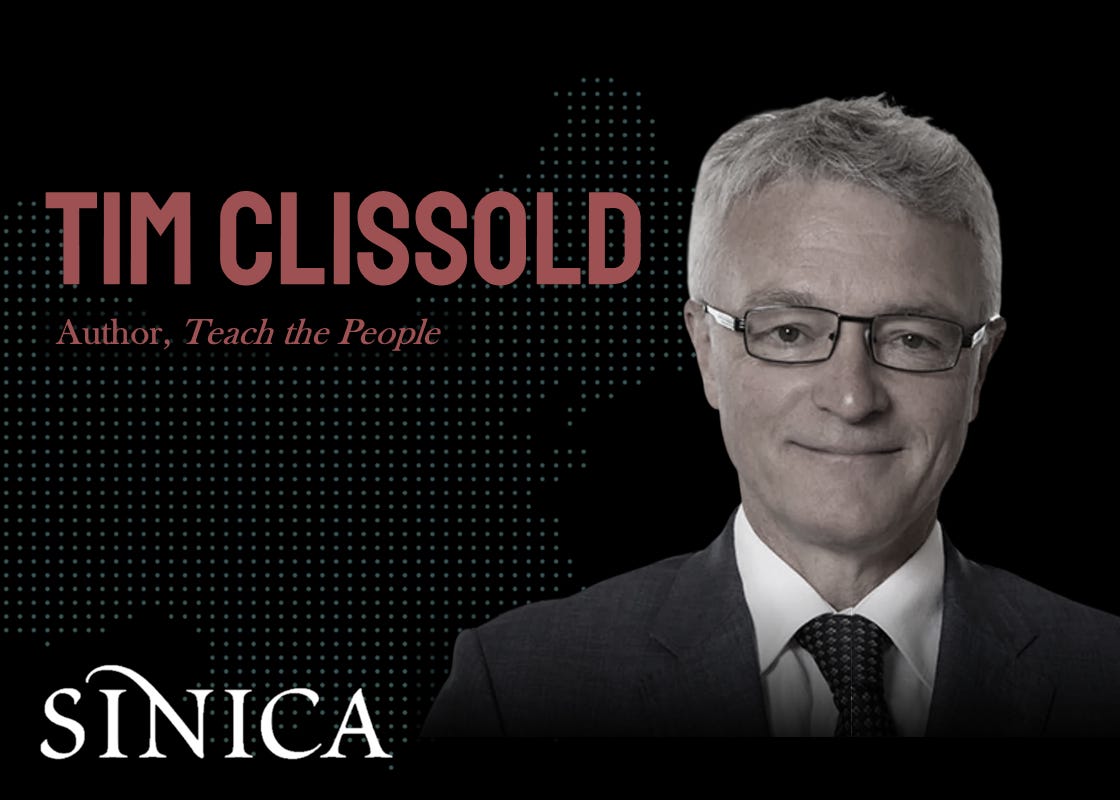
This week on Sinica, I sit down in Beijing with Tim Clissold. If you read one book about doing business in China in the 2000s, there’s a fair chance it was his Mr. China, the self-aware, admirably self-deprecating tragicomedy about standing between some $400 million of Wall Street money and twenty Chinese joint ventures that weren’t going to plan. He followed it with Chinese Rules, and for years since he’s worked mostly as a mediator between Chinese companies and the foreign investors who’ve fallen out with them. He’s a visiting fellow at Jesus College, Cambridge, and has been living, working, and thinking in and about China for nearly forty years.But that isn’t why he’s here. For twenty years Tim has been pursuing what I’ve taken to calling his Great Enterprise — his 大业 dàyè — a new A-level in Chinese Civilisation for British schools, modeled on the existing A-level in Classical Civilisation and taught entirely in English, no Mandarin required. He’s assembled a syllabus with a dozen of Britain’s leading sinologists, lined up ten vice chancellors, the chairs of some of the country’s biggest companies, and the money to pay for it. The Department for Education’s answer has so far been no. The campaign is the subject of his forthcoming, self-published book, Teach the People: How to Narrow the Knowledge Gap between China and the West, whose premise is that the Chinese know far more about us than we know about them, and that the gap is now a matter of national security. We test that premise, and then we talk about what closing it would actually look like. Along the way Tim is generous enough to cite my essay The Great Reckoning, which he says shaped the book’s historical frame.* 03:44 – Evidence of the knowledge gap* 09:18 – Is this more than the ordinary incuriosity of the bigger party? Late Qing parallels, and an energy transition the West willfully ceded* 14:49 – What was the West’s Second Opium War?* 19:35 – Feng Guifen, the Self-Strengthening Movement, and the reciprocal questions the West should be asking itself* 23:12 – The A66 and the Romans: twenty years to widen eighteen miles, a generation that can’t build wealth by working, and Hobbes as a forgotten Western strand* 26:41 – Inverting tǐ-yòng: Western values as essence, Chinese methods for use, and whether you can have the electro-state without the party-state* 30:40 – Mínzú: nation or race? Nine dictionaries, eight professors, a running battle with the FT, and the Stalin-to-Hitler op-ed that followed* 34:42 – The Woodward Scale: a tongue-in-cheek measure of China sentiment, and why knowing China ought to unite hawks and doves* 38:34 – The Great Enterprise: why Mandarin alone is pushing water uphill, collapsing language A-levels, native speakers taking all the A’s, and the Classical Civilisation model* 43:34 – Nick Gibb’s no, ten merry-go-round ministers, a chairman’s letter to the prime minister, a 272-page curriculum review that never mentions China, and “that’s in the particular”* 48:38 – Mind-enhancing and useful: would the A-level matter if China were no threat?* 55:55 – Who can say yes? Pockets in Whitehall, a British Tóngwénguǎn, Guan Zhong’s hundred-year horizon, and what a China-literate Britain would decide differently — from Mingyang to HuaweiPaying It ForwardMorrison Cleaver, Beijing-based policy analyst at the China-Britain Business Council — Cambridge Chinese Studies, Yenching Scholar, still in his twenties, and one of the very few Brits of his generation who actually studied Chinese at university. Tim calls him a trailblazer. He’s also the man who lent me his copy of Teach the People so I could read it ahead of this conversation.RecommendationsTim: Bleak House by Charles Dickens — the story of an interminable lawsuit that outlives its litigants and ruins plaintiff and defendant alike; deliberately hard to follow, Tim suspects, because the joke is on us. He’s also just read Middlemarch for the first time and loved it. (I’ll always put in a word for Middlemarch — it’s the second time Bleak House has been recommended on this show, so it goes to the top of my list.)Kaiser: Two novels by Mohsin Hamid, who’s become a friend through the Georgetown Global Dialogues. The Reluctant Fundamentalist — a short, semi-autobiographical novel told entirely as one side of a conversation in a Lahore café, by a Princeton-educated Pakistani who once understood America intimately. And Exit West, a very different and perhaps braver book about a young couple fleeing a city coming apart, in a world where doors open onto Mykonos and north London and an unrecognizable Marin County. Mohsin, I owe you a Chinese novel. This is a public episode. If you'd like to discuss this with other subscribers or get access to bonus episodes, visit www.sinicapodcast.com/subscribe

Comments

Download from Google Play

Download from App Store
 United States