


 Claim Ownership
Sky Gazing
Subscribed: 4Played: 8
Subscribe

© Tara Das
Description
|| body like mountain, heart like ocean, mind like sky ||
Contemplations, Meditations, Inspiration. Named after the Tibetan school of Dzogchen. As you watch the sky, you are freed from conceptual traps. Observe. Breathe. Be.
skygazing.substack.com
Contemplations, Meditations, Inspiration. Named after the Tibetan school of Dzogchen. As you watch the sky, you are freed from conceptual traps. Observe. Breathe. Be.
skygazing.substack.com
19 Episodes
Reverse

Patanjali’s YogasutrasSutra 1.1अथ योगानुशासनम्ATHA YOGA-ANUŚĀSANAMVED VYASAYoga here stands for samadhi, or communion, or the control over the functions of the mind. The nature of such communion is the nature of the mind. The states of the mind are: ksipita – fickle – which resides in rajas, mudha – dullness – which resides in tamas, viksipita – distracted – which occurs in sattva, ekagra – one pointed – in which all states of mind have ceased, nirudha – inhibited. Communion or yoga that happens only in the one pointed state illuminates the true nature of things, destroys afflictions, loosens karmic bonds, and brings you face to face with nirudha or the inhibited nature, that is samprajnata yoga, or concrete communion. Asamprajnata yoga or the abstract communion, is that in which all states of mind are surpassed. Such yoga is known by its characteristics of perception, conception, joy, self-consciousness. Samskara is the residue, and is left behind.SWAMI SATYANANDAExplains the line etymologically. ‘Atha’ he says is the pause. Why use ‘now therefore’? why not use ‘atra’ or here are the instructions? That is indicative, he says, that these instructions are a continuation of a previous instructions and therefore such yoga comes after purification through karma yoga and bhakti yoga, the paths of action and devotion. When you arrive at yoga after these paths, yoga is intelligible and fruitful. Wavering minds and tendencies will not achieve the unlocking of yoga. ‘Anu’ is the suffix to ‘shasanam’, which is a command. The word ‘shastra’ and ‘ishwara’ both derive from ‘shasan’, and mean instruction and he who gives the instruction. It does not mean exposition. The Yogasutras he points out are brief, concise and instructive. This is how you practice yoga. These are the conditions of the mind. This is how the individual experiments. This is the place of God in yoga. It is this that is the complete instruction.SWAMI VIVEKANANDANow, concentration is explained. He doesn’t real get into it, he treats it as a simple introductory line and goes into the second sutra. In the introduction to the sutras however, he points out the ‘now’ indicates that moment of time in the present, in which we see that we are the outcome and manifestation of an absolute condition, prior to our present relative condition, and are going forward to return again to the absolute.B.K.S. IYENGARNow, with prayers for divine blessings, procedural guidance in the codes of conduct instructions which are to be observed and which form the base from which to cultivate one’s spiritual and ethical life. He observes that these are detailed, these come step by step, in a specific and correct order, and it moves towards an end which is self-alignment for the purpose of enlightenment. Patanjali is the first to give us the new path and his use of the word ‘Now’ ‘atha’ is an expression of immediacy. Now take it up. Start now. Now it is clarified. It is also a continuation from his previous treatises on grammar and ayurveda. As grammar is a prerequisite for lucid speech and ayurveda of health of body, together these (the moksha sastras) work to support our journey to establish equilibrium, the cultivation and transcendence of consciousness, culminating in liberation from rebirth, which is the ultimate end. Atha also is the beginning of the brahma sastra, and hence it is a proclamation of the desire to know Brahman. In the Yoga sutra it is the seer who is the object of knowledge. Therefore, he points out, Yoga is a subjective art, philosophy, science. It has many meanings, but it is in the yoga sutra the state of samadhi or the indivisible state of existence.So 1.1 means: the disciplines of integration are here expounded through experience and are given to humanity for the exploration and recognition of that hidden part of man which is beyond the awareness of the senses.OSHONow the discipline of yoga. Why now? Because if your mind has reached a state of Kierkegaard’s existential anguish, a state of despair, then you are ready for yoga. If that moment has not come you can keep studying yoga but you will not be a yogi. Intellectual interest in the sutras is not the path to being a yogi. If you have come to that point where it is darkness, confusion, no path is clear and your seeking of the path is the driver, then, your time has come. If your mind has come to realise that whatsoever you have been doing up to now was just senseless, it was a nightmare at its worst and a dream at its best, then the path of discipline opens before you. Up until now you have lived as chaos, a crowd, Yoga means now you will have a harmony, you will have to become one. You will undergo a coming together, a crystallisation, a centring. And unless you attain this, everything you do is useless, fragmented, a waste of time and life. Hence, he says Patanjali says ‘Now the discipline of Yoga’. This moment can change your direction, your direction of being. Only someone with a centre can be blissful but you have to work for it. You have to earn it. A crowd he points out cannot be blissful, because there is no doer no seer, so who is going to be blissful? You see, he says, identify the locus. Then the bliss will follow. This act of centring is what becomes the discipline, what Patanjali calls the anushasanam. Discipline comes from the word ‘disciple’ Osho points out and it indicates the capacity to learn to know. But you cannot learn and know until you have attained the capacity to be. And yoga is not about asanas but about the capacity to be. Discipline is the establishing of order to the chaos, a structure. It is using yoga to crystallise a centre in you. Then he tells this amazing story about a man who goes to the Buddha and says ‘I agree with you, the world is in misery, tell me what I can do to save it'. The Buddha, who never said the world is in misery, he said you, the beings, are in a state of misery, Osho clarifies, stays silent. His disciple, Ananda, asks him why he is not guiding such a sincere aspirant. The Buddha replies, because I do not see a centre in you, I do not see you seeing your self. And unless you are centred whatever you do will create more mischief. Social service, compassion, charity all the things we do to save the world will not help. The things done through a centred being will help. When you become a disciple, you become centred, you empty yourself out and the guru can pour his instruction into you. In Yoga, the master is very important. A disciple is one who is ready to receive. A disciple is ready to be centred and he is unafraid, he becomes fearless. A disciple is a seeker who is not a crowd.BARBARA STOLER MILLERShe explains the first four aphorisms together. She translates the first one as ‘This is the teaching of yoga’. The first four aphorisms define the nature of yoga as a state of mental tranquillity and spiritual freedom as well as the means to achieve this state. She essentially treats the second aphorism as the first and doesn’t really analyse the nowness of yoga. So we will analyse her commentary when we move into the fourth aphorism or sutra.Thank you for listening. You can join the course here: https://www.shamah.co/patanjalis-yogasutras This is a public episode. If you would like to discuss this with other subscribers or get access to bonus episodes, visit skygazing.substack.com

The Course on the Yogasutras of Patanjali along with Sutra 1.1, a comparative and comprehensive study of six bhashyas now available. You can also listen to them on Apple, Spotify or wherever you get your podcasts. [Do check back in a bit for the latest episode to upload]INTRODUCTION TO PATANJALI YOGASUTRASWelcome to the course on a comparative study of Patanjali’s Yogasutras. In this course we will be looking at six bhashyas in comparative format.Each lesson will explain one sutra as it is understood by each of the six gurus. Each sutra capsule is of or just under 20 minutes for easy listening and retention. You’ll be able to take the course on our website where you will have access to the PDFs, and additional resources. You will also be able to listen to parts of it on YouTube, and as a podcast on Spotify, Apple and where you get your podcasts. Those who access it via the website as a course will also be invited to the open Q&A interactive sessions once a month.The Masters or gurus whose bhashyas we will be considering are Maharishi Ved Vyasa as translated by Sanskrit scholar Ganganatha Jha, Swami Satyananada, Swami Vivekananda, BKS Iyengar, Osho and Barbara Stoller Miller. Of course there are many more commentaries you could refer to, the more well-known ones being by Shri Vachaspati Mishra, Shri Ramananda Saraswati, Shri Ramanujacharya, King Bhojadeva, etc however these are the ones I have chosen to work with. By the end we will have a strong view of both traditional and modern interpretations of the original yoga sutras of Patanjali, such that we will have an understanding of the range, scope and breadth of their application and interpretation.Why should we do this? There is an insightful line in BKS Iyengar’s commentary in which he points out that in the yoga sutras, the seer is the object of knowledge, unlike say, the brahma sutras, in which brahman is the object of knowledge, and as such, in this quest to find the seer and the doer, which is the self, the yoga sutras become a subjective art, philosophy and science. As such the yoga sutras are open to interpretation and are mutable within the framework of individual practice. There is a tendency in the modern world as the connotations of yoga spread far and wide and become even modular where you can do a 220 hours, 550 hour teacher training and gain a certificate, or even claim to be certified in kundalini yoga, without accessing the spiritual foundations or principles of it. While it is true that in the traditional forms, yoga is a practice, not theory, even so there is a need to understand the theoretical framework inside which we may operate. Because there is one and we cannot gain the mind of the yogi by discarding the framework. We have to climb up through the framework in order to reach the state of yoga by which the framework is discarded and in the modern context we seem to think it’s the other way around. The Master’s commentaries or bhashyas reinforce that framework for us, and the range of them show us that there is still flexibility to the interpretations within the context of the discipline.Of all the bhashyas the introductions of Swami Satyananda and BKS Iyengar and Barbara Stoller Miller are the most systematic and provide a comprehensive context for gaining the knowledge. Each goes into the definitions of yoga, the categorisations into the bahiranga or external practices of yoga i.e. Yama – social code, Niyama – personal code, Asana – seating power, Pranayama – control of prana, Pratyahara – sense withdrawal, that prepare one for the antaranga or the inner practices that are attained in the last three stages of yoga - Dharana, concentration, Dhyana, meditation, Samadhi, super consciousness. Swami Satyananda sees Patanjali’s yoga sutra as a categorisation within a larger framework of raja yoga, which includes kundalini, kriya, mantra, and dhyana yogas, while others see Patanjali yoga as inclusive of these and as the same. The eight limbs steady the five koshas – annamaya, pranamaya, manomaya, vijnanamaya and anandamaya koshas i.e. the physical, the pranic, mental, intuitive and that which has the nature of bliss.The five yamas are Satya, truthfulness, Ahimsa, non-violence, Asteya, honesty, Brahmacharya, abstinence, Aparigraha or non-possessiveness. The five niyamas are Shoucha, cleanliness, Santosha, contentment, Tapas, austerity, Swadhyaya, self-study, and Ishwara pramidhana, surrender to the divine will. The yamas create external equilibrium and the niyamas create internal equilibrium and between them they encompass the sum of our engagements with the world.Osho correctly points out in his commentary that even if you can recite the sutras backwards and forwards you do not become a yogi by study alone. You have to be centred, you have to have gained the capacity to be. And yoga is not about asana alone, it is about the capacity to be. Discipline, becoming a disciple, is what in the practice of yoga gives you the capacity to be.Collectively, BKS Iyengar points out, the yoga sutras come after Patanjali’s study of grammar and ayurveda, and these three together are known as the moksha sastras. So there is an inherent progression, from lucidity of speech which can only come from lucidity of thought, health of the bodily form, and it is on that base that we can start using body and mind to reach a yoga, or communion, a state of oneness. To him the four padas coincide with the four ashramas of life, and the four gunas or states of life.Barbara Stoler Miller defines yoga as ‘that system which yokes one’s consciousness to a spiritually liberating discipline’. What Patanjali is doing is offering us the possibility of complete psychological transformation through the discipline of yoga. In the Indian view the practitioner of yoga is not a passive person, but a spiritual hero who is active and potent. From Patanjali’s perspective the truth of the human condition cannot be known rationally.So what are the yoga sutras?There are 195 sutras, or aphorisms, each concise, pithy and meaningful, and divided into four sections – Samadhi pada, Sadhna pada, Vibhuti pada and the Kaivalya pada. The Samadhi pada has 51 sutras and instructs us on definition, practice, obstacles, concrete and abstract communion. The Sadhna pada with 55 sutras deals with the kleshas or afflictions and goes into an overview of the eight limbs with a focus on the first three. Vibhuti pada has 56 sutras and details the five remaining limbs and the development of the siddhis or psychic powers. Kaivalya pada, which has 34 sutras is the deployment of all that has been attained towards clarifying perception and attaining liberation.Swami Satyananda says Brahma, Hiranyagarbha is the formulator of the yoga sutras through the agency of Patanjali in the 4thcentury. Dates differ. Some says 50 AD, others say, 400 BC, etc. He isn’t certain the Patanjali who wrote the treatises on Grammar and Ayurveda. The basis of the yoga sutras is based in the foundational Samkhya philosophy of sage Kapila. It existed before the time of Gautama the buddha, who studied Samkhya yoga in the ashram of Alarkalam, pointing out the similarities between the Samkhya eight stages of Yoga and the Buddha’s eight-fold path. Swami Satyananda concludes that yoga existed long before Patanjali who made them aphoristic and concise.Barbara Stoler Miller in her introduction tells a very interesting story of the origins of the tantra of yoga, which we often forget is a tantra, and has a strong feminine aspect to it as well. The name of sage Patanjali, she says, is derived from the small serpent that fell into the hands of his mother as she was offering worship to the sun. ‘Pata’ meaning ‘serpent’ and also ‘fallen’, and ‘anjali’, meaning ‘offering’. Thus sage Patanjali was born of a spiritually cognisant and aware woman, suggesting the tantric underpinnings of yoga. In tantra, the norms of society are overturned to liberate practitioners from worldly constraints, she points out. This releases energy. This releasing of locked energy is the process and purpose of yoga.While each of the commentators focuses on different aspects as more important than the other, and many differ on etymological interpretations, historical origins, categorisations, you will find several points of resonance between them. That yoga existed before Patanjali. That he gathered this vast and scattered and fragmented knowledge and gave it a concise shape and form. Even so much of it is ambiguous and cryptic. Again pointing to its tantric nature – knowledge that is only revealed by the initiation of a guru, even when the words and practices seem present and apparent, ripe for the picking. That yoga is common to Buddhism, Jainism, Hinduism and their aim to free humanity from suffering. That yoga is to be practiced as a continuum with bhakti yoga, the elevation through devotion, jnana yoga, the pursuit of knowledge, and karma yoga, right action in the worldly sense. Swami Satyananda in his commentary points out that having derived from the Samkhya philosophy of Purusha and Prakriti, Patanjali’s uses the term ‘viyoga’, the ‘separation’ of Purusha from Prakriti, the Seer from the Seen, untying the knots and thus deconstructing the act of creation itself.Yoga’s origins and references, and evolution can be traced through the Mahabharata, the Rig Veda, the Bhagavad Gita, in various Upanishads from the Tejo Upanishad, Yoga Tattva, Yoga Chudamani, Varaha, Darshana Upanishads etc etc…Thus, as you can tell, the purpose of this course is also to help a student understand that yoga is more than just an exercise or a posture, an asana. As my own guruji puts it, even a monkey can contort himself. Yoga is much more and cannot be divorced from its philosophy or made modular and fragmented. That is going against the spirit in which the Yogasutras were created by Patanjali. It is a wholeness of understanding, pure perception, consciousness, practice and being, that a yogi aspires t
[PUBLIC PREVIEW] LEVEL 1: THE BASICS OF BUDDHISM COURSE - THE TEN PILLARSLesson 1: The Trilakshana The Basics of Buddhism is a course in three levels to explain common terms, phrases that are commonly used without discernment. Terms such as mind, consciousness, duality are used across Hindu philosophy, Eastern philosophies, or New Age philosophy, or in popular books, blogs and articles on ‘Mindfulness’ without locating them within the specific context of usage. This course will help you understand the specific Buddhist context of the terms used. The complete course is open to a weekly subscription here: https://www.shamah.co/basics-of-buddhism This is a public episode. If you would like to discuss this with other subscribers or get access to bonus episodes, visit skygazing.substack.com
"After me repeat
Your numeration till we reach the Lakh,
One, two, three, four, to ten, and then by tens
To hundreds, thousands." After him the child
Named digits, decads, centuries; nor paused,
The round Lakh reached, but softly murmured on
"Then comes the koti, nahut, ninnahut,
Khamba, viskhamba, abab, attata,
To kumuds, gundhikas, and utpalas,
By pundarikas unto padumas,
Which last is how you count the utmost grains
Of Hastagiri ground to finest dust;
But beyond that a numeration is,
The Katha, used to count the stars of night;
The Koti-Katha, for the ocean drops;
Ingga, the calculus of circulars;
Sarvanikchepa, by the which you deal
With all the sands of Gunga, till we come
To Antah-Kalpas, where the unit is
The sands of ten crore Gungas. If one seeks
More comprehensive scale, th' arithmic mounts
By the Asankya, which is the tale
Of all the drops that in ten thousand years
Would fall on all the worlds by daily rain;
Thence unto Maha Kalpas, by the which
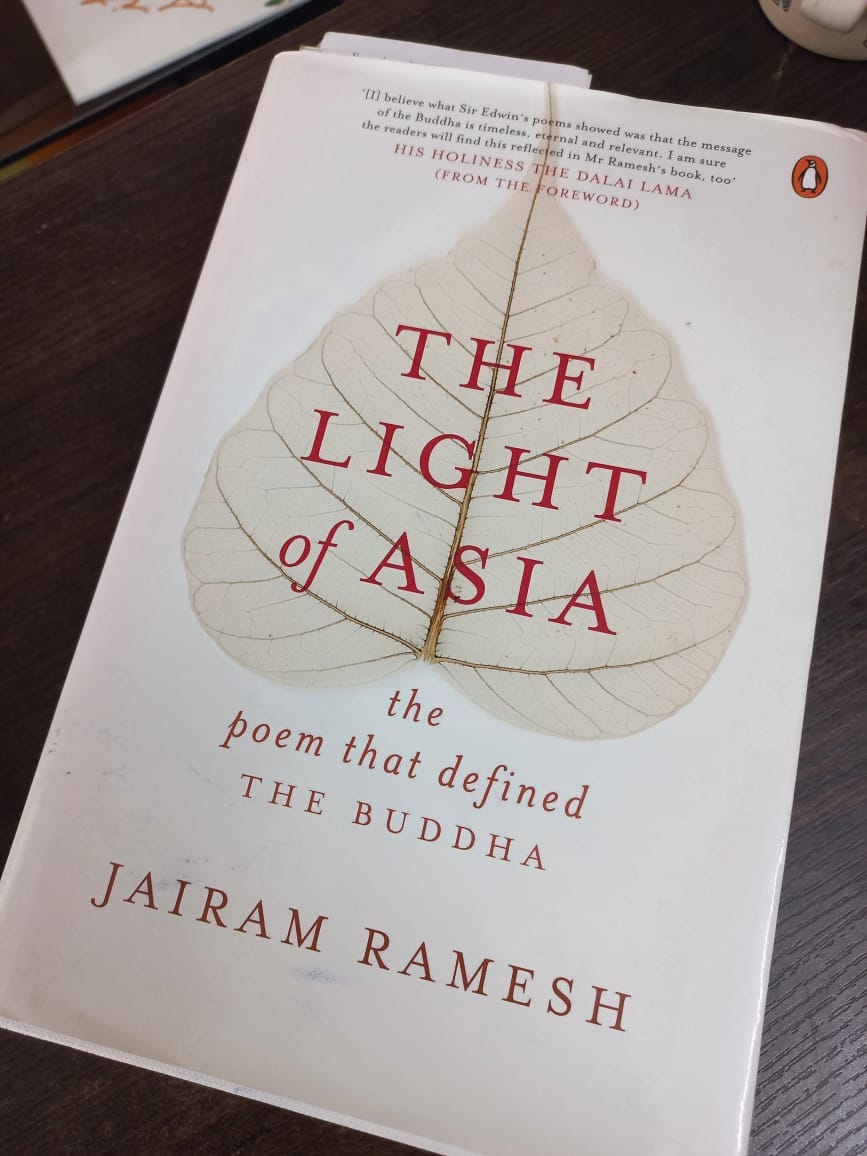
The Gods compute their future and their past."~ Book the First, The Light of Asia, by Edwin ArnoldWelcome back to SkyGazing. Sorry, I have been tardy! Well, I have been away reading some fairly large books that I hope to share with you soon enough. For starters, here’s a review of The Light of Asia; the poem that defined the Buddha by Jairam Ramesh, which is a commentary on the work of the poet, Edwin Arnold, the context in which he wrote the original poem, the deep influence it came to have upon a great many thinkers, writers and leaders of our time, from Swami Vivekananda to Jawaharlal Nehru and Mahatma Gandhi, Oppenheimer and Kitchener, Raymond Chandler, C.V. Raman, among others. The poem is written in blank verse and is divided into eight books. This commentary on it has four sections, Arnold’s pre Poona days, the influence and context of the poem, its aftermath, and Arnold’s legacy. In as such, the poem is a life apart from yet intertwined with Arnold’s. For those of you who haven't already read The Light of Asia, I would recommend you go there before you come to this work. Also do go to the Lalitavistara Sutra, which is the original epic poem that outlines the life of the Buddha in full. I would also recommend you read Sri Aurobindo’s Savitri after, to capture the similarity of the cadences. Arnold’s work is a biographical study of the Lord Buddha, but to my mind it is very westernised, casting him as the "Saviour” and divine, born again, with a very Christianised lens on divinity. So as much as Arnold believed he was travalleing away from or positing a counter to the monotheistic linearity of the church in his time, from the Indic lens, he very much remains embedded within that framework. For instance his line “And mercy cometh to the merciful” is very much a refrain of Matthew 5:7 “Blessed are the Merciful, for they will receive Mercy”. Arnold, in my opinion, was not as far removed or opposed to the constraints of his native lens as he seems to believe. So, it's important to read the poem in its original before you arrive here. Also, my one pet peeve with Ramesh's work is his use of the term ‘Mutiny’ for the Indian War of Independence or the Rebellion of 1857. I find it too irksome and jars my reading of the book, building a sort of crescendo of annoyance. While he offers a note in the book, however I find that there was no need to use ‘Mutiny’ when not directly citing Arnold. I also find that when you read a book aloud, there are some evident grammatical omissions, bit of poor editing here, a missing 'to' and 'the' that kind of thing, nothing too big, but articles that become apparent by their absence. Still, a beautifully researched edition, and well worth the read. Do remember this is just to give you an introduction to the book so I will be reading selected excerpts that I found interesting to whet your appetite, an asynchronous book club if you will. Please do engage with the book on your own. Of course I appreciate shares, comments and social media posts. Try not to tag the author if your comment is not favourable. That's just a bit rude. The first section is a biography of Arnold and his context. It was a time of the great discovery of India in Britain, and Ramesh describes at length the socio-political climate in which Arnold arrived at his insights into the life of the Buddha. Born in Gravesend, on 24 June, 1832, to landed gentry, and his work prior, anthologies such as Poems: Narrative and Lyrical, The Light of the World, and Gandhi's favourite The Song Celestial. Ramesh also locates him in Poona, where Arnold would head the Deccan College, at a vibrant time when Jyotiba Phule was organising education for all and VS Chiplunkar was mentoring Bal Gangadhar Tilak. A time when the Christian missionary movement was strong, causing Arnold himself to question the wisdom of conversions. Many brahmins too converted, he notes, at a time when back home in England, the suitability of the influence of the Good Book was in question. The Christianity of the poem is in tone, but the content of the poem is so rich with knowledge both Vedic and Buddhist, his understanding of caste, king, hierarchy, what the Buddha was upturning, and what society of the time reflected, that there was no disputing the heft of the poet. Indeed, neither may we that of the biographer who captures every painstaking nuance across continents in a deeply complex time. In such social upheaval and churn, the book reflects the way in which England and India were realigning how we thought about religion, spirituality, society. It was a time of Florence Nightinglae’s India mission, the war effort, and the need for women to both cater to and be catered to in terms of social equality. And in that time of churn, the sort of non dogmatic, non ritualistic counter to what was being set aside both in England and in India, was the wisdom of the Buddha. Much of this is beautifully contextualised in the book.To my mind, the most vital lessons, and the most relevant ones for us, in it come from the subtle but interesting comparison between the reclaiming of Ayodhya for Lord Ram and Edwin’s role in reclaiming Bodh Gaya for the Buddhists. That previous movement and hand over ended in 1953 peacefully, with the graciousness of the mahants, with joy on both sides, with the intermediations of men such as Jawaharlal Nehru and C. Rajagopalchari. There is much more in the book that I have not mentioned, the depth of influence on Rabindranath Tagore, Sri Aurobindo, the King of Siam, on film and cinema, and Arnold’s own further life, in Sri Lanka and Japan, regional Indian translations. The book is rich with reference, and personalities that intersected in and out of the meridian that The Light of Asia was. I do wish there was more about the actual poem itself actually. I would have loved to see notes that Arnold may have left about the poem, but apart from a few explanations on why he wrote it these are far and few between. It is more the perspective of this commentary that the poem rose as a product of its influences and their catalyst in its time. I also wish there was more critical referencing of Arnold and his role in the British ‘civilising’ mission. The transmission of Buddhist texts and the biography of the Buddha has been unabated since the 2nd century CE, so what was it about this poem that caught the imagination where others didn’t? Was it metre, language, Arnold’s eminence and therefore his interactions with his contemproraries? I wish this book had more contemplation of the author (Ramesh’s) insight into the wherefore of its greatness rather than a mere clinical exposition of why everyone else thought it worked and how acclaimed it was. What does he, who has been in government himself, think of the Anglicised lens of an Indian Buddha? He does give us a brief glimpse of what he’s been thinking at the end, but overall, a lot of information, but he doesn’t join too many dots for us. Which could be good or bad, depending on how you see it. One of the better non-fiction tomes on a key philosophical work, fundamentally a biography of its author. The narrative continues on to biographical nuggets like tracing the interesting circumstances surrounding the death of Channing Arnold, one of Edwin’s sons, on a farm in UP. Towards the end, Ramesh points out that Shelley’s lines from Prometheus Unbound may well have influenced the title of the poem: Asia! Thou Light of Life! Shadow of Beauty unbeheld! Hmmm. It always surprises me when the coloniser adores their subjects. How good we must have been. Have a good read/listen! Best, GayatriP.S. A bonus read for you is my short story City Whisperer that appeared in the Out of Print online journal in April. Do let me know if you enjoy it. This is a public episode. If you would like to discuss this with other subscribers or get access to bonus episodes, visit skygazing.substack.com

Deputy High Commissioner of the UK to India based in Andhra Pradesh and Telangana states, Dr Andrew Fleming has faced bullying throughout his life. It began when he was a young boy in school and continued to chase him as he got into his work life in the British civil services. His story is one of exemplary courage, resourcefulness, and self-determination. At a time when diagnoses were expensive and awareness was low, he essentially, like so many children are even today, was left to fend for himself. If it was not for the wise compassion of one teacher who spotted the indications of his dyslexia, he would have never known that his struggles were not his fault, and as he puts it that “I was not stupid”. Andrew also developed a unique ability to externalise his gaze. Turning outwards from his deep loneliness, fears, and struggle, he reached out and helped others. He found ways in which to sublimate his pain, becoming the youngest certified football referee in a soccer-obsessed country in which he could not play the sport. When the union and internal redressal systems failed him, he won the union elections and used the opportunity to help others who were being bullied. Some failures to get the aid to the people who needed it the most continue, even to this day, to stick in his mind. They serve as a reminder of why his speaking out against bullying, even in formal and structured workplaces, even in the government, even in positions of authority and influence, is so vital. Andrew’s narrative also contains within it heart-warming parental love, the kindness of teachers, friendship, romance, love and the conviviality of a supportive peer group. Also observe how, when the workplace did step up, it enabled him to put a label to his struggles and supported him by creating awareness among his colleagues. It also offered a system of redressal that works if you use it knowingly, which Andrew did. These form the network of support that help an individual overcome their challenges. If you’re a bystander, this narrative has important lessons for your role too. Andrew comes to tears at three key points during the narrative. The first, when his teacher clarifies to him that it’s not him, it’s the condition. The second, when he is appointed the youngest football referee in the UK, which finally gives him some respect from his bullies, but also protection from them. And third, when he finally gets to confirm his diagnosis of not just dyslexia but dyspraxia. Even all these years later, you can tell how great the toll of having to cope on one’s own with an undiagnosed neurodiverse condition has been. The need for diagnosis, for trained teachers, for affordable and accessible diagnosis, for resources of redressal within the workplace, and above all for the kindness and compassion of bystanders is so self-evident. Despite many small wins, bullying as we can tell from Andrew’s narrative, can continue to pursue us relentlessly. It is persistent, targeted, relentless harassment and it is harmful. It’s important to not tire of pushing back. Today, Andrew uses the example of his life in the hope it helps others both within his work space and outside it to make peace with their reality, come to terms with their diagnosis, find techniques to cope, and direct them towards reclaiming their own power. I found this an absolutely inspiring and a deeply personal story shared with kind and compassionate intention. I hope it helps you and those you may know in coping with bullying, if you are facing it. It’s a bit long but it’s a detailed lived experience and full of personal insight so do listen to the end for the key takeaways that might help you if you’re facing bullying. If you need resources, please find them in the directory listed below. Just a note on engaging with people with neurodiversity: you may notice I don’t really speak very much during the interview and have overlaid my comments later. Neurodiverse people need space and time to formulate their thoughts. It doesn’t help them to be put on the spot with questions or constantly interrupted. So, I have limited my interruptions and allowed the natural flow of the conversation. These are edited excerpts from the larger conversation. You can follow Dr Andrew Fleming on Twitter.Resource Directory For Suicide Prevention Helplines please click here.What is neurodiversity? The Indian Express did a neat explainer here.What is dyslexia? Can I get tested in India? Contact the Dyslexia Association of India for more info. What is dyspraxia? The Dyslexia Association of India also has resources for this here.If you are being cyberbullied within India, you can report it hereIf you have FAQs on what exactly constitutes bullying I found the Nebraska Government website quite comprehensive. You can look it up hereDon’t forget to subscribe to the newsletter if you are not already. We are also on Spotify, Apple and Google Podcasts. We’re small and bootstrapped and a DIY set up so we appreciate all the shares, RTs, and subscriptions you can give us! Shamah | शम: is a mind body spirit therapeutic practice founded by Gayatri Jayaraman. You can know more and book appointments online. This is a public episode. If you would like to discuss this with other subscribers or get access to bonus episodes, visit skygazing.substack.com

Comments

Download from Google Play

Download from App Store
 United States