


 Claim Ownership
 Slow Read: OUTLANDER
Slow Read: OUTLANDERSubscribed: 14Played: 294
Subscribe

© Sarah Stewart Holland
Description
Sarah Stewart Holland & Laura Tremaine slow read the books you've always wanted to tackle, at a pace you can handle. 🔹 Fall 2026: OUTLANDER by Diana Gabaldon
https://slowread.substack.com
slowread.substack.com
https://slowread.substack.com
slowread.substack.com
26 Episodes
Reverse

This is a free preview of a paid episode. To hear more, visit slowread.substack.comThe OUTLANDER adventure begins!In this first episode of our Slow Read of Diana Gabaldon’s OUTLANDER, Sarah & Laura discuss their first impressions of the novel, make guesses about where it’s going to go from here, and, of course, dissect the book chapter by chapter.FIND THE FULL READING SCHEDULE HEREReminder that you can watch the video version of our conversation on Substack HEREWe’d love for you to join us in the comments on Substack or in the Slow Read chat. (Remember no spoilers beyond the sections we’re discussing!!)Looking forward to spending the next few months with you through the stones!
We hopped on live in the middle of a Tuesday to officially kick off Season Two and hundreds of you showed ready to talk summer reading and get excited about Outlander.Laura and I had two very different reading summers. We talked about that and which books we both really loved or really didn’t. We talked about the books of the summer (looking at you Yesteryear!). We talked about the fall lineup of new releases which is insane. Also, we talked about what you need to know to tackle Outlander with us. Outlander is broken into seven parts, and we’re doing eight episodes because we split one of them. Our first episode, covering Part One, drops Monday, August 31st. Part One is about seventy pages. If you want to stay with us, have it read by the 31st.The Slow Read Outlander season is members only this time. Bookmark slowread.substack.com for the reading schedule, the meeting schedule, the Zoom links, and replays of anything you miss. The printable bookmark is here.If you’re a slow reader who’s sitting Outlander out, we’re not going anywhere — we’ve got other episodes and goodies sprinkled through the fall. But if you want in on these episodes, come join us. We don’t know yet whether we’re going to love this book. We do know we’re going to have fun.Every book we mentionedOverview* American Hagwon — Min Jin Lee* Partita — Barbara Kingsolver* Peck & Peck — Bonnie Garmus* The Art of Fighting: The Transformative Power of Conflict — Priya Parker* Exit Party — Emily St. John Mandel* Under Story — Chloe Benjamin* Big Little Truths — Liane Moriarty* The Pirate Queen — Ariel LawhonThe big three of the summer* Yesteryear — Caro Claire Burke* The Calamity Club — Kathryn Stockett* The Unselected Journals of Emma M. Lion — Beth BrowerLiterary fiction* Land — Maggie O’Farrell* Whistler — Ann Patchett* The Things We Never Say — Elizabeth Strout* North Woods — Daniel Mason* Country People — Daniel MasonNonfiction* How to Rule the World: An Education in Power at Stanford University — Theo Baker* This Land Is Your Land: A Road Trip Through U.S. History — Beverly Gage* G-Man: J. Edgar Hoover and the Making of the American Century — Beverly Gage* Famesick: A Memoir — Lena DunhamEverything else* Mad Mabel — Sally Hepworth* Dear Monica Lewinsky — Julia Langbein* Kitten — Stacey Yu* June Baby — Shannon Garvey* Girl’s Girl — Sonia Feldman* The Shampoo Effect — Jenny Jackson* The Great Wherever — Shannon SandersWhat we’re slow reading* Outlander — Diana Gabaldon* The Stand — Stephen King* War and Peace — Leo TolstoyNext Up: Our first Outlander episode covering Part One drops Monday, August 31st. It’s about 70 pages — read it however slow reading works for you. The reading schedule and printable bookmark are both waiting for you at slowread.substack.com.Thank you Stacey Loscalzo Reads, Jessie Benkert, Juli Clarner, Denise, Readingroberts, and many others for tuning in! This is a public episode. If you'd like to discuss this with other subscribers or get access to bonus episodes, visit slowread.substack.com/subscribe
We finished The Stand. Six months in Boulder, and we made it out alive — well, most of us did.And now we get to tell you what we’ve been dying to announce: our next Slow Read is Diana Gabaldon’s Outlander.Here’s the part you need to hear first, because it changes things. Unlike The Stand, which we gave away free to everyone, the entire Outlander read this fall lives behind the paywall. Every main episode breaking down the chapters, every book club meeting, every unhinged side quest — members only. If you want to take this journey with us, now’s the time to join.The Stand episodes, we had to edit ourselves — pull whole sections, watch what we said, because the internet is the internet. Outlander has one of the most intense, passionate fandoms out there (they call Diana herself, like a deity — we’ll get into it). Behind the paywall, it’s just us and you. No torching on Twitter, no walking on eggshells. Our true feelings, full unhinged selves, the way a book club is supposed to be.A few reasons we are genuinely thrilled about this one:It’s Outlander. It’s been everywhere for a decade, the TV show just wrapped, and it sits right in the cultural water — but it’s also double-intimidating: a 50-million-copy series with nine books, novellas, graphic novels, a whole universe. Reading the first one together means you finally get to be conversant in this giant piece of pop culture, without committing to all 10,000 pages alone.Diana herself is a delight. Marine biology and zoology degrees, a PhD, a side hustle writing Scrooge McDuck comics, and she wrote Outlander on a lark as practice — never thinking anyone would read it. “Science and art are two sides of the same coin,” she says. “What they both rest on is the ability to draw patterns out of chaos.” We fell a little in love.And this time, both of us are going in blind. With The Stand, Laura knew the big picture and led the way. For Outlander, neither of us has read it — so we’re discovering it right alongside you. People say it’s intense. Possibly even slightly traumatizing. (Laura says that’s a selling point.)Here’s what to do: Join as a paid member now, and you get everything. Spend the rest of the summer catching up on our side quests from the first half of the year — the one we did on death is, no exaggeration, some of our best work. Plus, we’ll have a couple fun summer episodes for you. Then our whole Outlander adventure officially kicks off August 3rd, when we release the reading schedule. Book club meetings, watch-alongs, all the bonuses — it’s all included once you’re in.We’re all going to need a good, healthy, entertaining distraction this fall. Let this be it.Happy summer reading, y’all — see you in Scotland. This is a public episode. If you'd like to discuss this with other subscribers or get access to bonus episodes, visit slowread.substack.com/subscribe
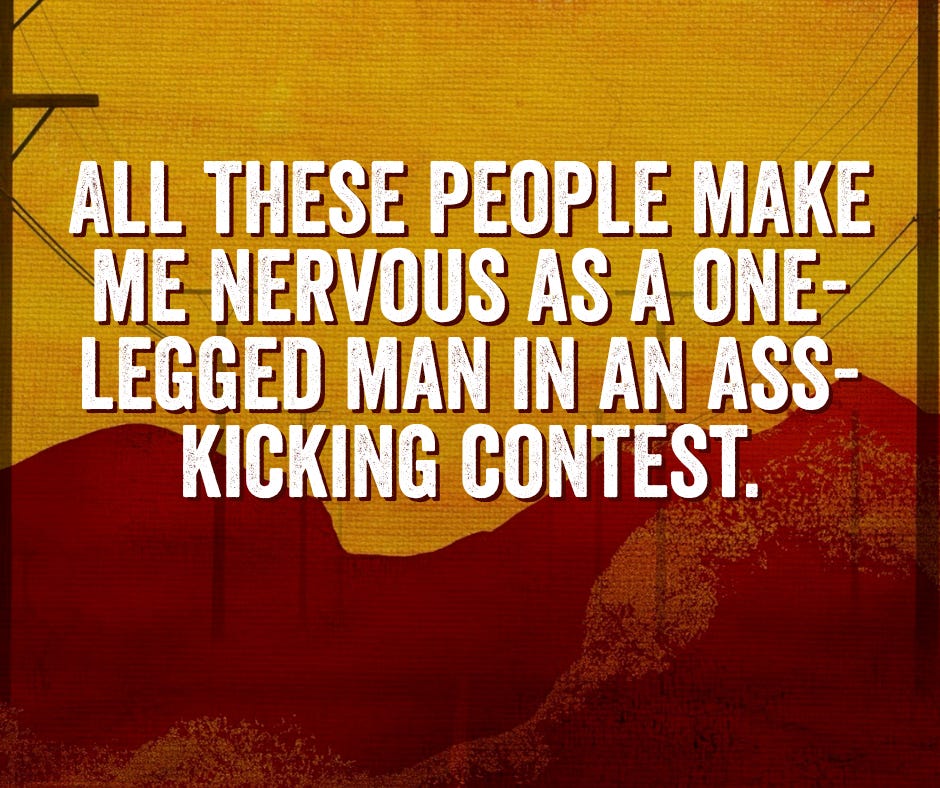
Welcome to SLOW READ, where we tackle the books you’ve always wanted to read at a pace you can handle.Hosted by Sarah Stewart Holland and Laura TremaineWe are currently reading The Stand by Stephen King (unabridged version)You can find our full Reading Schedule hereJoin the SLOW READ community on Substack for bonus episodes, book club meetings, and Side Quests with Sarah & LauraWe have come to the end of our journey with The Stand by Stephen King. In this episode, we dissect what it all meant and what we’ll remember about this experience. Make sure to subscribe on Substack for our next SLOW READ!Mentioned:Wolf HallWar and PeaceDon QuixoteBrothers KaramazovBlazing Eye Sees AllSister Helen Prejean / Dead Man Walking The Circle That Doesn’t CloseLaura: We are here today at the end of The Stand by Stephen King to close the circle.Sarah: But I think it’s a lie. Why did he say the circle closes? That’s not what happens at the end of this book.Laura: That’s true. That’s totally true. But it starts with “the circle opens.” That’s the opening. So he has to close it.Sarah: Or is it just that the circle continues? That would have been a more accurate title for this epilogue. Just saying.Laura: I do have to say that I purposely, when I made our reading schedule for The Stand — we knew we wanted to do it for six months, like January to June, which we did — I planned it to close our circle here the same week the book opens, which is the second week of June. Just because I liked that symmetry.Sarah: I love it. I love a symmetry.Laura: We have a few little pages to get through, but before we do that — we will be continuing the slow read. We have picked our next book.Sarah: I picked it and I forced it on Laura. That’s the truth.Laura: We’re going to tell you all about that next week, where you’ll hear the reveal. If you cannot wait another second to find out the book, our paid members learned last week during our book club meeting. So you can go watch the replay of that if you just can’t stand it another second. But today we’re going to tackle “dusk of a summer evening” and the circle closing — which is a lie, because it doesn’t actually close.Sarah: It doesn’t actually close, but there are things to say about how King ended this whole thing. Because if you do any sort of Reddit search, any sort of Googling about The Stand, what people want to talk about is the end.Laura: Pretty much. Whether it was a true stand, or a letdown for some people, or if it’s what people expected. There’s a lot of that.The Split Epilogue: An Epilogue for the Good GuysSarah: We get this kind of split epilogue, right? So we get “dusk of a summer evening.” The people we get to see from the Free Zone contingent — the good side — are Stu and Franny and Peter.Laura: I’m sorry, three people. Babies are people too. On their journey back to Maine, they stop at Mother Abigail’s house.Sarah: I don’t know if that path makes sense, for the record. Geographically I’m always like, where are you guys going? What are we doing? But whatever, it’s fine.Laura: Maybe there’s something about the way you’d have to travel by foot. I’ve always thought this is weird. I’m going through all this area of the country, including Nebraska, this summer on my RV road trip with my family. So maybe I can report back to us. But they do stop at Mother Abigail’s house. They’re on the porch, the baby’s playing, and they’re talking about what happened in the Free Zone and what they think is going to happen next. It’s a little epilogue for the good guys, really. Did it feel true to you?Sarah: Yeah. I think it’s true that the Free Zone would not stay together as this tight, cohesive unit. As people came together — I love this line — “all these people make me nervous as a one-legged man in an ass-kicking contest.” That’s something my grandpa would say. My grandpa always said, I want to live in the middle of 400 acres with a fence around it that says no trespassing. So to a certain contingent, living with other people is never going to be on the menu. From their perspective, the circle has closed, the threat is gone, so the need to stay close together for safety isn’t as intense. It makes sense that people would start to dissipate.Laura: I do think it’s an interesting choice that he follows the people leaving instead of staying in the Free Zone to say what happens next. Although you’re getting reporting from them on what the next phase looked like before they left. So he’s trying to get the best of both worlds.Sarah: I think he’s also addressing a natural question. If this really happened — but for the dreams about Mother Abigail drawing everyone to Boulder, or the contingent that went to Vegas — after a catastrophic pandemic like this, these little communities would be sprouting up all over. They wouldn’t all gather into one place. That’s the storytelling aspect, that it’s not very normal. So he’s addressing: okay, but in reality, people would dissipate. There’d be a lot of people like Franny who are homesick for their region, for their part of the country, who want to go back.Sarah: At their last Free Zone meeting they’re ready to have a sheriff, ready to get guns — and the progression of “when we don’t have one enemy, we have many enemies” seems pretty psychologically right to me.Do People Ever Learn Anything?Laura: He’s making the point over and over again in this ending — even in the darker parts — that the more things change, the more they stay the same. People are gonna people. Do you think people ever learn anything? That’s the question he’s posing.Sarah: I do. And look, there’s a way to look back over this book, and over the whole of human history, and say people are gonna people — they can be cruel, they can be violent. But the side of the coin I’m on is: yes, and the human species has made enormous, dramatic progress over the past 500 years. From the dark, peasant-and-serf-driven structure of society where how you’re born is how you die, the end — to an enormous ability to chart your own path and create peace and prosperity for the majority of people. The statistics on the children pulled out of poverty just in the last 30, 50 years are incredible. So I get what he’s saying, but I disagree to a certain extent that this is just an endless cycle, because we’ve made enormous progress. There’s no point in human history — unless you’re a crazy person who has this vision of the ‘50s that’s not accurate — where you’d want to go back in time. I don’t want to go back. First of all, I have a Type 1 diabetic child. The technology sucked just 10 years ago. I’m always going forward in time.Laura: There’s no doubt there’s an evolution, which means we are learning as a species. We’re learning and adapting and changing. I kind of think a better question — instead of “do you think we ever learn anything” — a bigger question that feels more complicated to me is: do we think people are inherently good?Are People Inherently Good?Sarah: Well, we know what Stephen King thinks.Laura: Do we?Sarah: Well, actually, I don’t, because I think I probably sit with him. I don’t think you can categorize all people. I think there’s a small percentage that are cruel and evil and violent and dark — and some, yes, it’s a product of their circumstances and trauma, and some I think maybe there’s something else going on, and it’s just kind of baked. He dances around this nicely with the dark man. I don’t think there’s a “dark man baby,” you know what I mean? That’s the philosophical debate — would you go back and kill Hitler as a baby? Do people spring forth fully formed? I’m not naive. I understand there are cruel, violent, terrible people out there. And on the other end of the spectrum, there are people who are just naturally nice and good — and a lot of them teach preschool, you know what I mean? They’re organized a little differently. And then there’s this messy middle, where you’re deciding day to day, moment to moment, in these sliding-door moments. You’re Harold, you’re going to fall for Nadine, you’re going to lean in. Or are you Larry and you’re going to turn Nadine down? There are lots of moments where most of us — the average, the mean — could fall either way.Laura: I think that’s one of the points of the book: most of us could fall either way. Our goodness might be circumstantial. And that’s a little bit of a hard pill to swallow, especially if you were raised to believe one of two things in a black-and-white way. If you were taught we’re all good, created in the image of God, no one can take that away — or we’re all depraved, all sinful. If you were raised with that binary, it’s hard sometimes, even if you’ve totally deconstructed, to read books like this or have conversations like this and not shake some of those old ideas. And I think he’s actually asking some of these questions in a really interesting way. Harold is a perfect and easy example, but so is Franny. If you’re raised in a certain type of home, or tax bracket, or with certain luxuries, maybe it’s easier to be good. If you’re given an opportunity for power you’ve never had, maybe it’s easier to be bad. And it’s not innate. It’s circumstantial.Holding Both Things at OnceSarah: Growing up, especially if you’re a teen inclined toward reductive thinking — if you’re an Enneagram One, forget being a teenager, if you’re just an Enneagram One — it’s taken me a long time to realize and be grateful for my upbringing and my faith that says: no, baby, the whole time both things were true. Every one of us is a child of God with a spark of the divine, deserving of inherent integrity and dignity. And we are also fallen, and can be harmful, and have to watch our pursuit of vice or distraction or selfishness or greed or you name it. I have this little piece of paper on my desk that my friend, who’s Jewish, gave me. On one side it says, “For you the world was created.” On the other side it says, “And to dust you shall return.” You have to hold both. Every moment i
Welcome to SLOW READ, where we tackle the books you’ve always wanted to read at a pace you can handle.Hosted by Sarah Stewart Holland and Laura TremaineWe are currently reading The Stand by Stephen King (unabridged version)You can find our full Reading Schedule hereJoin the SLOW READ community on Substack for bonus episodes, book club meetings, and Side Quests with Sarah & LauraREMINDER: Our final book club meeting discussing The Stand will be THURSDAY, JUNE 11 at 6pm PT / 8pm CT / 9pm ET and we’ll be announcing our next SLOW READ! You don’t want to miss it. Mentioned in this episode:* The Shining by Stephen King * Station Eleven by Emily St. John Mandel* The Crocodile Hunter * “Have Yourself a Merry Little Christmas” (”…if the fates allow”) * Noah Kahan, “Maine” * Steel Magnolias The Stand, or The Walk?Laura: How are you feeling?Sarah: Well, it’s giving Sopranos. You know how in The Sopranos it was the penultimate episode that usually contained the most action? I feel like that show set up that structure — although apparently not, because The Stand has been around a lot longer. The main action, especially a majority of the violence, the falling out between Randall Flagg and members of the Free Zone, the nuclear bomb — all of that happened in our last section. So now we’re getting that real finale. We’re caring for the characters we really loved. We’re seeing where they ended up. We’re tying up some loose ends.Laura: I felt like these last chapters post-nuclear-bomb were so arduous. I felt like King is personally trying to remind us that this whole thing is about the journey and not the destination, which is such an annoying message. I was just like, we are still walking. It should have been called The Walk, not The Stand. Honestly, the whole book is just about journeying.Sarah: Well, I will say this. It’s not standing still, that’s for sure. But there’s a moment near the end where Stu says they’ll have to stand a watch for him. So it really felt like this conclusion of the book was more a philosophy: it’s not that you have to walk forever, but that you do have to stand watch. Maybe the stand wasn’t some sort of high-noon final battle between good and evil, which is what I expected when I started the book. It’s more like standing watch — standing watch for our worst instincts, standing watch for the ways in which humans can perpetuate great cruelty and harm on each other. We’re standing sentry, keeping an eye out. And even though I’m an Enneagram One and I love a black-and-white conclusion, I thought this was truer, wiser. I really liked it.Laura: It also seems to be saying that nothing is ever really over. It might be over for you individually, if you come to the end of your story, but life just keeps on keeping on. I have always quibbled a teeny tiny bit with how we spend these last chapters with just Stu and Tom — and even primarily Stu. We’re in Stu’s mind mostly. It’s no longer an ensemble cast. We started all the way back in Arnette, Texas, at the gas station — Stu is our first point man — and then we also end with so much Stu. I love Stu as a character. It’s just, oh, he wasn’t the one I was the most attached to. How did you feel about Stu being the final stand?Sarah: I loved it. I thought it wasn’t just Stu — it was the combination of Stu, Tom, and Kojak, who I believe is the real hero of this novel. I really liked the way King put the strengths and weaknesses of these three creatures together. It didn’t feel arduous to me. I was excited to see the ways in which they were stripped away and rebuilt. I liked that Nick kept appearing. I liked that we were worried about Franny. And I liked the changing threat — that we went from the heat of the desert and the nuclear fallout to this incredible winter hellscape. And Tom is such a great addition to every scene he’s in. The way they were facing very openly “we might not make it” felt like real learning, as opposed to how people were orienting themselves when Captain Trips first started wreaking havoc.Kojak, the Real HeroLaura: Let’s do a chapter breakdown, because if you’re a regular Stephen King reader, you recognize in this section in particular that he brings out his favorites — which is to say dogs, cars. He loves a car explanation.Sarah: I did feel like there was a little too much detail about what type of car you need to get started, the manual and the automatic. I was like, buddy.Laura: No, this is one of his things. Dogs, cars, ghosts in dreams, recurring themes, and of course abandoned hotels, even if they’re just the Holiday Inn. These pop up in so many of Stephen King’s stories. It’s such a King universe that we’re in. There’s no mistaking what we’re reading.Sarah: How do you feel about Kojak just being such a convenient hero? Kojak can do everything. He can hunt, he can bring the blankets up from the washout, he can go find Tom in the snow. Kojak is a dog of all trades.Laura: Here’s my question, because you’re the Stephen King expert. Does he often use dogs the same way he uses children or people of different abilities — to say, well, they have different skills because they are different?Sarah: Yes. And so that’s what that felt like to me. This is not a run-of-the-mill dog. It’s a special dog. Laura: In the same way that he uses children, there’s an innocence to animals, dogs in particular, that feels like they’re tapped into a god, a universe, a different plane. If you’re a dog lover, you don’t even necessarily deny that. That’s why it’s a convenient tool to use a dog.Sarah: I just want to say, though, that it’s a special dog — because if it was my dog, I would have to eat her by the fire. She would be of absolutely no use. She’s currently snoring underneath my chair. She would not be able to bring me a rabbit or firewood or much else.Laura: Same.Sarah: I’ve never owned that type of dog, but I’ve known dogs like that — super capable, very smart, communicative. I read recently that domesticated dogs have existed longer than agriculture. So I think it could happen.Laura: Definitely could happen. If you’ve ever watched a working dog — a herding dog, certain hunting dogs — they are very capable. I like Kojak. More Kojak. I’m here for it. It didn’t bother me, but also I’m a dog lover. I wonder, if you’re not an animal person, if you’re like, come on with the dog. We’ll have to hear from our community about that.Chapter 74: Tom Shows UpLaura: In Chapter 74, Stu is still broken-legged, starving, and starting to get sick. He heave-hoes himself up out of the washout when he hears the boom and needs to see with his own eyes what’s going on. To me, this is the arduous part — not the plot points. Do we need two pages of him crawling up?Sarah: I didn’t think we needed that part. I get it, he needed to get up there. I was just so happy that once he got up there, Tom showed up.Sarah: Okay, but here’s the immediate thing I thought. You have read this book before. You knew this was going to happen. And still you had all those complaints about them sending Tom.Laura: My complaints about why they sent Tom are separate from Tom ending up being the savior. They sent Tom because Stephen King needed him to save Stu. I still think they took advantage of someone. And here’s the plot weakness: why does he approach Stu when he was very clearly instructed during the hypnosis to stay away from people?Laura: I think King’s implication is that they have to go the same way because they have to take tunnels — unless they’re going to crawl up and down the Rockies. So everybody’s taking the same path because they have to cross through these tunnels.Laura: I don’t mind a plot point of convenience. I get it, they need to be all on the same road. It just needs to make sense. And I like this ending because I love Tom — he’s one of my favorite characters. I just don’t want Tom to be taken advantage of in the first place.Sarah: I feel like this is Stephen King saying he’s not taken advantage of. Look how incredibly capable he is. He is a hero. I love it when Stu says, “You saved my life,” and “You don’t owe me a Christmas present? I wouldn’t be here anymore for you.”Sarah: I felt like Stu waited a month to say that. You’re just saying that now? Anyway, Tom shows back up and Stu is happy to see him, but in the same way as, is this the best helper I’m going to get? Everyone is hesitant on Tom until he shows his capabilities — like Nick with the tornado.Laura: I’ll tell you what drove me nuts about this whole section. Why isn’t Stu asking Tom more questions? He doesn’t ask him a single thing about Vegas.Sarah: Because he’s about to die, Laura. He’s on death’s door.Laura: I don’t mean in his delirium. We’re talking about a man who’s going to throw an impromptu Christmas. He is well enough at points to be like, so Tom, what was happening in Vegas? Did you get us any intel? Literally nothing. Maybe it’s just such a man thing — the man asked no questions. My husband wouldn’t ask Tom a dadgum thing.Sarah: I thought perhaps he was waiting to gather the whole story when there would be more people around, in the Free Zone, so it could be a community interrogation — so Tom doesn’t have to go through it more than once, and so there are other witnesses. I’m projecting a lot, but that was my assumption. I do think Tom is helpful in the same way Kojak is helpful — now suddenly there’s an able-bodied person who can forage in the cars to get medicine, find sleeping bags. That was a huge relief.Sarah: The hand of God. Tom was the hand of God, just like the hand of God touched the bomb. I really felt like Tom was this essential component that you can’t argue showed up out of anything but almost grand design.Laura: Did you have to google the word travois?Sarah: I did. A visual really helped, because even though Tom is brawny, he’s going to drag this man for eight miles up the hill. There are absolutely arduous components of this — climbing out of the washout, the dragging of Stu.The Hand of God and That N

Comments

Download from Google Play

Download from App Store
 United States