


 Claim Ownership
Space to Lead
Subscribed: 2Played: 27
Subscribe

© 2024 LeBlanc Leadership Group Inc.
Description
Welcome to Space to Lead—the podcast where leaders and teams come together to learn, grow, and thrive. Every episode, your host David LeBlanc will have engaging conversation with leaders, exploring fresh insights and strategies that inspire leaders to create dynamic, engaging cultures.
Space to Lead - Powered by The LIVE. LEARN. GROW. Company
We'll dive into conversations with visionary leaders and industry experts who are transforming teams and shaping the future of leadership. Whether you’re leading from the front or working within a team, Space to Lead is here to spark ideas and help you lead with purpose and passion.
So, take a deep breath, make some space, and let’s lead together!"
Space to Lead - Powered by The LIVE. LEARN. GROW. Company
We'll dive into conversations with visionary leaders and industry experts who are transforming teams and shaping the future of leadership. Whether you’re leading from the front or working within a team, Space to Lead is here to spark ideas and help you lead with purpose and passion.
So, take a deep breath, make some space, and let’s lead together!"
24 Episodes
Reverse
In this episode of the Collaborative Coaching series, David and Suzanne explore the Collaborative Maturity Continuum, a framework designed to help teams move beyond simple information sharing toward true integrated performance. They argue that collaboration is not an "on and off switch" but a fluid maturity journey that reveals its true strength under pressure. By identifying where a team sits on this five-level continuum, leaders can intentionally build the capabilities needed to handle complex, interdependent work.Key Discussion PointsThe Problem with "Collaboration" as a Catch-all: We often use the word "collaboration" to describe every interaction—from a quick email to a deep strategy session. However, different types of work require different levels of maturity. Friction often occurs when the complexity of the work requires high-level collaboration, but the team's system is only capable of basic coordination.The Five Levels of the Collaborative Continuum:Coordination: Focused on information exchange and task handoffs. Communication is often reactive, and work still happens in silos, leading to a "did my part" mentality where the collective outcome can still fail.Cooperation: Based on goodwill and helping others when asked. While it feels positive, the system is often dependent on specific individuals who "bridge the gaps," which can lead to burnout.Collaboration: The transition to shared goals and "sense-making" before decisions are made. This level requires vulnerability and the ability to work through disagreements without retreating into silos.Collective Performance: The team operates as an integrated system, making decisions with a lens on the whole organization. Trust is high enough to raise concerns early, creating a level of resilience that allows the group to adapt together when conditions change.Collaborative Excellence: Collaboration is embedded in the culture and systems, no longer dependent on a specific leader or initiative. It extends "beyond borders" to partners and stakeholders and focuses on co-creating the future.Notable Quotes"Collaboration is not an on and off switch. It develops, it strengthens, it grows, and under pressure, it reveals how much capacity has actually been built.""Maturity has to be built on so many levels... You can't expect people to adapt together if they don't trust one another to speak up.""Collaborative excellence is not about perfection. It's the ability to remain collaborative when conditions are imperfect.""Stay out of your silos. Stay in the mess. Stay in the discussion."Reflection Questions for ListenersWhere would you place yourself on the collaborative continuum today?What evidence supports that answer? Look at how decisions are made, how accountability is held, and how information travels.What happens under pressure? Do people protect their own "lane," or do they remain responsible for the whole system?If you are interested in surfacing the hidden patterns and dynamics within your team, David and Suzanne have developed a collaborative readiness assessment to help you choose your next steps intentionally. Connect with us - [email protected]
Episode Summary - Learn more at https://collaborativecoachinggroup.ca/Picking up immediately from their discussion on the foundations of trust, David LeBlanc and Suzanne Fox transition from theory to practice. This episode focuses on the "how" of building high-performing teams by exploring the Four Conditions of Collaborative Capacity: Safety, Clarity, Alignment, and Repair. They discuss how these conditions interact to transform trust from a vague concept into a functional system that allows teams to navigate complexity, surface risks early, and recover from inevitable setbacks.Key Topics & TakeawaysSafety – The Power to Tell the Truth: Moving beyond "politeness" to create an environment where risks are surfaced early, mistakes are admitted, and every member feels they belong and matter.Clarity – The Antidote to Ambiguity: Why clear roles, responsibilities, and decision-making structures are essential to prevent the "stories and assumptions" that erode trust.Alignment – Overcoming "False Harmony": The importance of declaring hidden tensions and organizational pressures so teams can make conscious trade-offs together rather than working at cross-purposes.Repair – Resilience Over Perfection: Reframing team "cracks" as opportunities for growth and why the capacity to recover from a rupture is more important than avoiding one.Trust Across the 5 Levels: A final look at how trust manifests differently at the Individual, Team, Project, Organization, and System levels.Diagnostic Action: Practical questions for leaders to identify exactly where their collaboration is getting stuck.Notable Quotes"Safety isn't an extra. It's not one of those soft things that we make room for if there's time... The quality of the outcome depends on whether people can actually contribute." — David LeBlanc"A group can be very polite and still be unsafe. They can be friendly and still silence difference very quickly and easily." — Suzanne Fox"Strong trust is not the absence of these cracks... strong trust is actually the confidence that the cracks can be addressed before they become real breaks." — Suzanne Fox"Anything can be repaired, but it doesn't require perfection. Trust, just like relationships, is something that's fluid." — David LeBlancDiagnostic Questions for ListenersTo apply this episode’s concepts to your own work, David and Suzanne invite you to reflect on these four questions regarding your current project or team:When are people holding back?Where are they getting stuck?Are there times when priorities are pulling apart?Is there something that has not yet been repaired?
Learn more about Collaborative coaching HEREEpisode SummaryIn this first half of a two-part deep dive, David LeBlanc and Suzanne Fox explore the complex architecture of trust within leadership and collaboration. Moving beyond trust as a simple personality trait, they examine how trust is actually evidence gathered from how a whole collaborative system behaves. This episode breaks down the critical distinctions between individual trust and psychological safety, explains why "good people" can struggle in broken systems, and introduces a personal tool for repairing professional relationships: the "redo card".Key Topics & TakeawaysThe Systemic Nature of Trust: Why relationship-building exercises fail when the actual problem is a lack of clarity, alignment, or safety within the organizational structure.Collaborative Readiness vs. Capacity: Readiness helps locate where an issue exists (individual, team, or system), while capacity helps diagnose what the collaboration specifically needs to function.Trust vs. Psychological Safety: Understanding trust as a one-to-one relational dynamic versus psychological safety as a shared "many-to-many" climate.The Four Dimensions of Trust: A framework to move beyond "I don’t trust them" by assessing specific gaps in competence, reliability, integrity, and care.Safety is Not Comfort: Why real psychological safety actually makes honest accountability and productive tension possible, rather than just "being nice".The Redo Card: A practical approach to vulnerability and repair when a leader makes a mistake in a conversation.Timestamped Highlights[1:56] – Defining trust beyond the abstract and its role in collaborative readiness.[3:03] – Why trust isn't just a personality issue; it involves roles, incentives, and power dynamics.[8:20] – How people adapt their behavior (filtering information or "circling the wagons") when systemic trust is low.[12:16] – Breaking down the 4 Dimensions of Trust: Competence, Reliability, Integrity, and Care.[14:09] – The interpersonal risk: What happens when people prioritize "looking competent" over telling the truth?[16:46] – Why psychological safety is the key to respectful responsibility rather than blame.[19:08] – The "Brick Wall": When a trusted relationship exists within an unsafe organizational culture.[22:23] – Suzanne’s story of the "Redo Card" as a tool for immediate repair.Notable Quotes"Trust isn't a single condition. It's evidence that people gather from how the whole collaborative system behaves." — David LeBlanc"Safety does not mean comfort. It actually doesn't mean people agree on everything... real psychological safety makes more honest accountability possible because people can talk about what is actually happening." — Suzanne Fox"A group can be very polite and still be unsafe. They can be friendly and still silence difference very quickly and easily." — Suzanne FoxWhat’s Next?Due to the depth of this conversation, we have split it into two parts. In Episode 2, we pick up immediately where we left off to apply these foundations to the Four Conditions of Collaborative Capacity: safety, clarity, alignment, and repair. Tune in to learn how to diagnose and strengthen these conditions in your own team.
Are You Ready to Collaborate?Building Collaborative Readiness for Better OutcomesEpisode DescriptionCollaboration has become one of the most frequently used words in leadership.Organizations ask for it.Projects depend on it.Leaders encourage it.Yet despite the best intentions, collaboration often feels difficult.Teams become siloed.Communication breaks down.Trust erodes.Decision-making slows.People begin protecting their own priorities instead of pursuing shared outcomes.Why?In this episode of the Space to Lead – Collaborative Coaching Series, David LeBlanc and Suzanne Fox introduce one of the foundational concepts behind the Collaborative Coaching Group's work:Collaborative Readiness.Rather than viewing collaboration as simply a skill or behaviour, they explore it as a capability that exists across multiple levels of a system—from individuals and teams to projects, organizations, and the broader ecosystem.Because successful collaboration doesn't begin when people enter a meeting.It begins long before that.It begins with readiness.Learn more about Collaborative Coaching at https://collaborativecoachinggroup.ca/
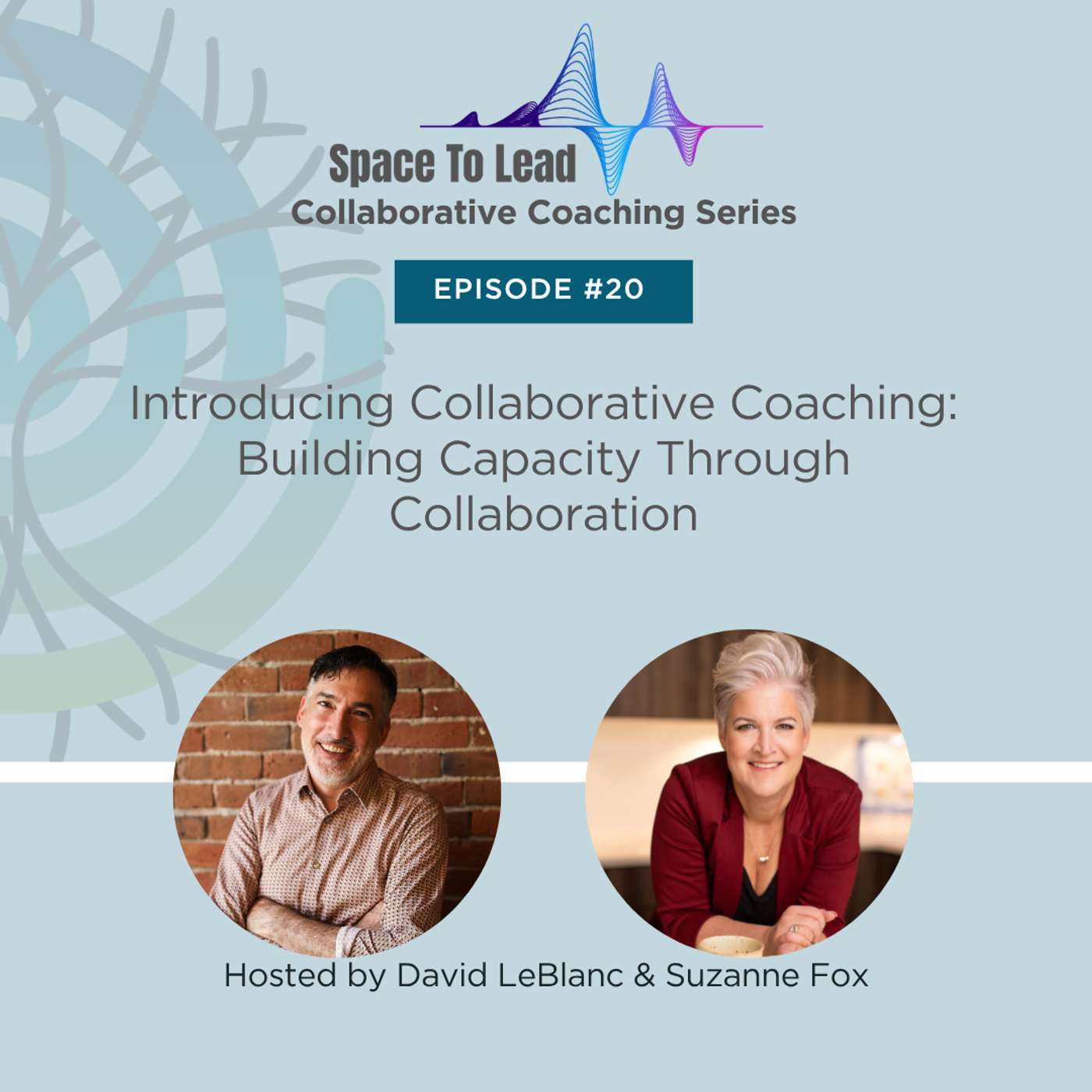
What if the biggest challenges facing your organization aren't individual problems, but systemic ones?In this episode of Space to Lead, David LeBlanc is joined by leadership consultant, executive coach, and Collaborative Coaching Group co-founder Suzanne Fox for a conversation about the growing complexity facing leaders and organizations today.Together, they explore why so many organizations struggle despite having talented people, strong intentions, and dedicated teams. From competing priorities and organizational silos to avoidance, people-pleasing, and unresolved tensions, David and Suzanne discuss the hidden dynamics that often get in the way of collaboration and performance.The conversation also introduces Collaborative Coaching - an approach that builds on the foundations of coaching, team coaching, facilitation, and systems thinking to help leaders, teams, and stakeholders work together more effectively. Sometimes described as "team coaching on steroids," Collaborative Coaching moves beyond the boundaries of a single team and focuses on the broader system in which people operate.Throughout the episode, David and Suzanne share insights from their own partnership, discuss the value of co-coaching, and explore how organizations can build greater awareness, alignment, and capacity for collaboration.In this episode:Why leaders are becoming experts at functioning while depletedThe impact of complexity, ambiguity, and constant changeHow avoidance and people-pleasing create organizational frictionWhy traditional approaches can miss important system dynamicsThe difference between team coaching and collaborative coachingThe power of co-coaching and real-time observationBuilding the capacity for productive disagreement and healthy tensionHelping teams move from transactional work to meaningful collaborationStay ConnectedThis episode marks the beginning of a new series exploring the principles and practices of Collaborative Coaching. In upcoming episodes, David and Suzanne will dive deeper into topics such as systems thinking, psychological safety, productive conflict, stakeholder alignment, collaborative readiness, leadership dynamics, and creating healthier organizational cultures.To learn more about Collaborative Coaching and the work of the Collaborative Coaching Group, visit:https://collaborativecoachinggroup.caIf you're leading a team, navigating organizational change, or working in a complex stakeholder environment, we'd love to connect and continue the conversation.

Comments

Download from Google Play

Download from App Store
 United States