


 Claim Ownership
Strictly Jazz Sounds-SJS
Subscribed: 4Played: 40
Subscribe

© 2022
Description
Strictly Jazz Sounds (SJS) features the finest legacy and contemporary jazz musicians and beyond. Every episode will feature an in-depth interview with current jazz musicians and their music, or jazz music producers, music critics and writers and jazz music venue owners/operators. SJS is about all things jazz. Host Steve Braunginn was on the air 20+ years for WORT89.9-FM.
36 Episodes
Reverse
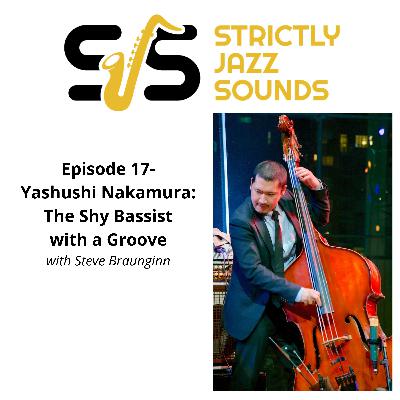
Yasushi Nakamura loves his music. And he truly loves laying down the groove lines behind a hot band like he does for almost a dozen bands. However, being one of today's first-call bassists means frequent and long show tours that can take him away from his family of two-children and spouse for weeks, even months at a time. It has resulted in an impressive list and number of recordings made on both electric and acoustic or double bass. Pianist and longtime friend, Emmet Cohen, says that Yasushi "…is known in the music community for playing in over a dozen bands and is hardly ever seen reading music." The reason, says Yasushi, is he has a photographic memory for the music. He takes one look at it and the rest he recalls. This allows him to internalize the music, a practice he highly recommends to young bassists today. Yasushi is a pretty shy guy on and off the bandstand. Watch a video of him and you'll notice he kicks it like the good bassist he is but rarely engages in any dialogue. He says he likes to lay back, be the guy behind the sound. You wouldn't know it, though, when it's time for him to step out. Sometimes a big grin will shine, but Yasushi is mostly focused on delivering a ballad or driving his bass through the high pace sounds left behind by the pianist or the horns. His discography is already enormous. Yasushi has performed in and out of the studio with many noted jazz musicians including Cecile McLorin Salvant, Emmet Cohen, Christian Sands, Amina Figarova, Shamie Royston, Jon Irabagon, Rudy Royston, Vincent Herring, and Ulysses Owners Jr. I saw Yasushi at the 2023 Monterey Jazz Festival touring concert at Denison University near Columbus, Ohio. In that show he was part of an all-star billing with Dee Dee Bridgewater, Kurt Elling, Lakecia Benjamin, and good friends and long-time collaborators, Christian Sands and Clarence Penn. Yasushi Nakamura is sharing two compositions with the podcast so thanks to him for that. They are:"Yasugaloo"-A Lifetime Treasure, Yasushi Nakamura-bass, Lawrence Fields-piano, Clarence Penn-drums; 9/29/2016 (Atelier Sawano)-7:03"Awesome Beef"-Hometown, Yasushi Nakamura-bass, Lawrence Fields-piano, Clarence Penn-drums, Bigyuki-Synths; 11/10/2017 (Atelier Sawano)-3:56 This episode is being released during Jazz Appreciation Month. What better person and humbler guy than Yasushi Nakamura to kick off this year's celebration of jazz. And thank you for listening to Strictly Jazz Sounds. Spread the word about this podcast and share it with others when you can. Finally, support live jazz wherever you are. Photo by Stephen Braunginn

Having a virtual conversation with someone like Joe Lovano invites you to take in more than the words. You find yourself looking around the room with him — the basement, the books, the CDs, maybe a few records, family photos, and a trombone resting naked on top of a bookcase like it had just stepped away from the bandstand. Behind Joe, as we begin talking, there's a music stand with sheet music on it, though I couldn't quite make out the title. Somehow, that feels right. With Joe Lovano, there is always music in view, and always something still being discovered. Grammy Award winning tenor saxophonist and composer Joe Lovano joins Steve Braunginn for an expansive conversation about artistic growth, jazz history and his new ECM recording, Paramount Quartet. After more than 50 years of touring, recording and helping shape modern jazz, Joe Lovano says he still feels that he is "on the rise." The Paramount Quartet, different from any other that he's had, features guitarist Julian Lage, bassist Santi Debriano and drummer Will Calhoun, bringing together four musicians from different generations and musical backgrounds. Lovano explains how an initial trio performance with Debriano and Calhoun inspired him to add Lage, a former student in one of his Berklee College of Music ensembles, and create what he describes as an entirely new musical situation. Lovano takes listeners inside the recording session with ECM producer Manfred Eicher in southern France. He discusses the importance of sequencing, silence, spontaneous orchestration and approaching a composition differently each time it is played. He also contrasts the "nightclub sound" of his Blue Note years with the recital-hall atmosphere he associates with ECM. The conversation reaches back to Lovano's childhood in Cleveland, Ohio and the influence of his father, tenor saxophonist Tony "Big T" Lovano. Joe discusses the scholarship fund he created in his father's honor and reflects on Cleveland's often-overlooked contributions to jazz through artists such as Tadd Dameron, Albert Ayler, Jim Hall and Bill DeArango. Lovano also shares memories of Paul Motian, Elvin Jones, Wayne Shorter, Sonny Rollins and Charlie Haden, whose composition "First Song" opens the new album. Throughout the interview, Lovano returns to a central principle: improvisation is not about displaying everything a musician knows. It is about listening, leaving space, sharing ideas and finding "the melody in your heart and your rhythm spirit." ECM Records generously provided three tracks of music for this podcast. They are in the order played: Fanfare for Unity-4:12, Amsterdam-6:30, and Congregation-5:36. Thank you for listening to this podcast. Subscribe and you become one of the first to receive new episodes, jazz articles, photos and my annual Top 20 jazz recordings.

Los Angeles has long been one of America's great jazz cities, yet its place in the music's history is often overshadowed by New Orleans, Chicago, Kansas City, and New York. In this episode of Strictly Jazz Sounds, Steve Braunginn sits down with Martin Ludlow, President and CEO of Bridge Street, Inc., to discuss the vision behind the inaugural LA Jazz Festival and why he believes it's time for Los Angeles to take its rightful place on the global jazz stage. Their conversation explores the rich legacy of Central Avenue, the Dunbar Hotel, Leimert Park, and the generations of musicians who have shaped the sound of jazz—from Dexter Gordon, Charles Mingus, and Eric Dolphy to Kamasi Washington and Terrace Martin. Ludlow also explains why the festival is designed as a community-wide celebration rather than a traditional concert event, featuring more than 160 artists from over 20 countries, free performances, youth education initiatives, and programming that reaches neighborhoods across Southern California. Steve and Martin also discuss the evolving definition of jazz, the relationship between jazz and contemporary genres, the importance of mentoring young musicians, and how festivals can strengthen both cultural identity and local economies. Whether you're planning to attend the LA Jazz Festival or simply care about the past, present, and future of jazz, this conversation offers an insightful look at one of the most ambitious new festivals in America. Photo by Joel Marasigan.

When someone says jazz is dead, or that they cannot find great jazz being made today, I always think of the artists, mentors, and leaders who continue to move the music forward. Jeremy Pelt is one of those essential voices. Welcome to Strictly Jazz Sounds, the place where the music talks. I'm your host, Steve Braunginn. In this episode, I'm honored to welcome trumpeter, composer, bandleader, educator, and author Jeremy Pelt, one of the most compelling voices in contemporary jazz. With his recent work holding the number one spot on the JazzWeek chart for eight out of nine weeks, Jeremy has built a reputation as an artist deeply committed to both the tradition and the future of jazz. His trumpet playing is powerful and expressive, and his influence extends well beyond the bandstand through his recordings, writing, teaching, and mentorship. We explore the experiences and influences that shaped him, from growing up in Los Angeles surrounded by the sounds of Michael Jackson, Prince, R&B, and soul to initially considering a classical path before discovering jazz through the music of Miles Davis. What began as curiosity became a lifelong calling. Jeremy also shares his perspective on mentorship, leadership, and what it means to guide younger musicians with professionalism, presence, and respect for the music's lineage. We discuss his acclaimed 23rd album, Our Community Will Not Be Erased, a powerful statement celebrating the resilience, beauty, and enduring strength of Black communities. The project reflects Jeremy's belief that music can honor history, affirm identity, and strengthen the connections between people. Throughout the conversation, Jeremy reminds us that jazz is more than a genre. It is a living tradition, a form of storytelling, and a community built on shared experience and collective memory. Music for this episode was graciously provided by Jeremy Pelt's label, HighNote Records, from Jeremy's latest recording, Our Community Will Not Be Erased. The album was composed and produced by Jeremy Pelt (jeremypelt.net) and features Jeremy Pelt on trumpet, Orrin Evans on piano, Buster Williams on bass, Lenny White on drums, and special guest Lasse Corson on keyboards. Playlist: "Fathers and Sons" (5:19) featuring Lasse Corson, "The March into Resilience," (8:00) and "Fathers and Daughters,"(5:09). Thank you for listening. Photo by Eva Kapanadze

Today on Strictly Jazz Sounds, we enter the musical world of violinist and composer Jenny Scheinman — an artist whose music is shaped as much by landscape and community as by jazz tradition, classical music and folk. Before collaborating with musicians like Bill Frisell, Jason Moran, and Brian Blade, Jenny grew up off-the-grid in rural Humboldt County, surrounded by redwoods, wildlife, and acoustic family music. That environment taught her the art of deep listening — something that still defines her improvisational voice today. We talk about how nature, silence, and influences ranging from Ludwig van Beethoven and The Beatles to Thelonious Monk and Miles Davis's Kind of Blue shaped her musical identity. We also dive into her acclaimed double album, All Species Parade — a sweeping work inspired by biodiversity, coexistence, and community, featuring the brilliant guitarists Frisell, Julian Lage, and Nels Cline. You'll also hear music from the album throughout the program, courtesy of Royal Potato Family. The music on this show is from Jenny Scheinman's album, All Species Parade. The quintet plays throughout the album: Jenny Scheinman-violin, Bill Frisell-guitar, Carmen Staaf-piano, Tony Scherr-bass, and Kenny Wollesen-drums. Playlist: "House of Flowers" 7:56-feat. Nels Cline-guitar; "All Species Parade" 11:01 [a party to which all animals of all sizes, colors and adaptations are invited."] closes a three-part suite, said to be Ellington-inspired; "Nocturne for 2020" 11:41-feat. Julian Lage-acoustic guitar. This is a conversation about music, ecology, identity, and collective listening. Thank you for listening to Strictly Jazz Sounds as you have many other podcasts to which to listen. Strictly Jazz Sounds, conversations that let the music breathe. Photo by Kory Thibeault.

Comments

Download from Google Play

Download from App Store
 United States