


 Claim Ownership
Supercharge Marketing
Subscribed: 8Played: 39
Subscribe

© 2022 Lumen5
Description
The Supercharge Marketing podcast is for B2B Marketers who believe in the power of brand and storytelling. Featuring no-B.S. conversations from marketing experts who dare to do things differently, this podcast will leave you feeling inspired and ready to amplify your marketing strategy to thrive and stand out in the rapidly evolving world of marketing.
---
This podcast is brought to you by Lumen5, a video creator made by marketers, for marketers. Easily make videos for content marketing, thought leadership, and brand awareness in a snap. Used by thousands of businesses, supercharge your content strategy today. Use code SUPERCHARGE for 20% off your first 3 months.
41 Episodes
Reverse

In this episode of Supercharge Marketing, host Thomas Klinger sits down with Melissa Day, who leads global marketing communications at Vishay Intertechnology and has spent her career untangling marketing operations across B2B and B2C. She's the person who gets called in when a company has too many tools, too much complexity, and not enough clarity on what's actually working.
Melissa's story starts, fittingly, with a mistake. Early in her career, she built a webinar registration page in Marketo, hit publish, and went to bed proud of herself. Two weeks later her boss asked how many people had registered. The answer was zero. There was no confirmation, no thank-you page, no email. Just a form that led nowhere. "It was such a silly mistake that had such a huge impact to our program," she says. "It's probably why I'm so focused on ownership and accountability now, because I never want to be in that position again."
That single failure shaped how she runs teams today: fewer tools, deeper trust, and a stubborn refusal to let automation replace judgment.
Why You Should Care
Every marketing team is being sold the same story right now: more automation, more AI, more tools, more speed. Melissa's conversation is a useful counterweight. She's not anti-automation. An automated abandoned cart email, the simplest kind of workflow, once helped her team connect to millions of dollars in sales for a B2B company using nothing more than an existing tool and a sharp observation in GA4. But she's just as clear about where automation quietly turns into a liability: nurture campaigns nobody remembers to turn off, one customer getting the same email seventeen times, tools that promise to replace a person entirely.
Her rule of thumb is refreshingly unglamorous. You don't need the flashiest MarTech stack. You need to know exactly which problem each tool is solving, and you need someone accountable for watching what it does after launch.
What You'll Learn
Why the best ideas are often the cheapest ones. How a simple abandoned cart email, built with existing tools and zero budget, turned into a multi-million dollar win for a B2B companyHow to turn your sales team into a marketing channel. Why every customer conversation your sales team has is a brand touchpoint, and how marketing communications can arm them for itThe case for a 7-tool MarTech stack. Melissa's rule of thumb for knowing when your tech stack has grown past what your team actually needsWhere AI genuinely helps, and where it doesn't. Why her team uses AI to draft, refine, and challenge their own thinking, but never to replace a single end-to-end processWhat an accountability culture actually looks like. The mistake that shaped her leadership style, and why she'd rather own a failure early than automate her way around noticing it

In this episode of Supercharge Marketing, host Thomas Klinger sits down with Meghan McNamara, who leads product marketing and go-to-market for Deloitte's government and public services practice, to talk about the winding path that shaped her into a sharper storyteller and a stronger strategist.
Meghan's route into product marketing was anything but a straight line. She started as a journalist on Capitol Hill, went back for a master's in creative writing, and spent years managing a wine program on the side. It turns out all three taught her the same lesson: nobody remembers a list of tasting notes, but everybody remembers a good story. In this conversation, she and Thomas dig into what that means for building a career, pitching senior stakeholders, and figuring out where AI actually earns its keep in your workflow.
What You'll Learn
Why "so that you can" is the most important phrase in product marketing: Meghan's simple test for whether your messaging is actually landing, borrowed from her time explaining wine instead of just listing its tasting notesHow to get buy-in without explaining your job title: Why she stopped defending the boundaries of "what product marketing is" and started speaking in the one language every stakeholder already understands: strategyThe difference between a strong opinion and a good guess: Meghan's approach to walking into a room with senior leadership and "bringing the receipts" instead of just a point of viewWhere AI earns its place in her workflow, and where it doesn't: Why she uses AI to pressure-test her own thinking rather than write her business cases from scratch, and how she catches hallucinations before they cost her credibilityWhat "earned intuition" is and why it can't be prompted into existence: The case for staying close enough to your own research that you can trust your gut when something feels offWhy she's stopped guarding the edges of her own role: Meghan's hot take on being a generalist in the age of AI, and why refusing to learn new skills because "that's not my job" is quickly becoming the riskier move

Josh Gillick, Senior Director of Creative Marketing at Cisco (WebEx), didn't take a straight line to get where he is—and that's exactly what makes his perspective so valuable. After building his career across freelance and contract work in design, video, storytelling, and brand, Josh eventually stepped into creative leadership roles at companies like WebEx and Cisco. Today, his team owns the creative vision for major productions including Cisco Live and WebEx One, an event his team runs end-to-end.
In this episode, host Pius Chan talks with Josh about what it actually looks like to lead a creative team inside a large enterprise—the people challenges, the stakeholder battles, the AI questions everyone is asking, and the hard-won lessons from years of doing it at scale.
What You'll Hear:
Why being a generalist can stall your career—and the mindset shift required to go from doing everything yourself to leading a team that does it better than youHow Josh hires for creative excellence: why he looks at portfolios before resumes and asks every candidate the same critical questionWhy not everyone should move into management—and why the best companies build paths for senior individual contributors who want to keep creatingThe one thing creative teams owe their internal stakeholders, forever: education, without ego, and without expecting it to ever be "done"A proven framework for presenting creative work to difficult executives—how to get them to stop interrupting and start listeningHow Josh is approaching AI at an enterprise scale: the evaluation framework his team uses, why accuracy and legal compliance come first, and why he's treating right now as a re-education phase rather than a revolution
This podcast is brought to you by Lumen5, a video creator made by marketers, for marketers. Easily make videos for content marketing, thought leadership, and brand awareness in a snap. Use code SUPERCHARGE for 20% off your first 3 months at lumen5.com.

In this episode of Supercharge Marketing, host Thomas Klinger sits down with Nora Ioane, Business Marketing Manager for Cardiac Services at SpecialtyCare, to explore how lessons from teaching translate into clearer, more trusted marketing, especially in high-stakes healthcare environments.
With a background spanning secondary education, internal communications, and healthcare marketing, Nora brings a uniquely empathetic lens to how messages are crafted, delivered, and received. She shares why effective marketing is not about saying more. It is about saying the right thing to the right audience in a way that respects their time, attention, and trust.
Drawing on her experience as a former teacher, Nora explains how backwards planning shapes her communications strategy, why reducing cognitive load is critical for busy clinicians and patients, and how code switching between audiences can dramatically improve clarity and engagement. She also dives into the hidden risks of over-explaining, the trust-destroying impact of fluff and jargon, and why consistency, not volume, is what ultimately builds credibility.
The conversation also touches on the evolving role of AI in healthcare marketing. Nora sees opportunity in ideation and personalization, but not replacement, and emphasizes the importance of human oversight, brand voice, and institutional trust.
Whether you are a marketer, communicator, or leader navigating complex stakeholder environments, this episode offers a grounded, thoughtful approach to creating messaging that actually lands.
What You’ll Learn
Why backwards planning from education is a powerful framework for marketing and internal communicationsHow reducing cognitive load and eliminating fluff directly impacts trustWhat it really means to code switch messaging across patients, clinicians, and executivesWhy over-explaining can frustrate audiences and undermine credibilityHow consistency and repetition build trust more effectively than one-off messagesWhere AI fits into healthcare marketing and where it does notWhy diverse internal reviewers act as a critical checks-and-balances system for high-stakes communications
About This Podcast
Welcome to Season 3 of Supercharge Marketing. This season is not just about choosing the right channels. It is about creating content with purpose.
We are living in a marketing-led buyer’s journey. This season explores how marketers can own the revenue conversation by building purposeful, strategic content that connects with audiences across multiple channels.
Whether you are in a startup, an agency, or a large enterprise, Supercharge Marketing delivers expert insights, tactical guidance, and real-world examples to help you harness the power of omnichannel and multichannel strategies so you can engage audiences, generate demand, and drive real business impact.
Get ready to feel like the superhero of your marketing team. 🦸♂️
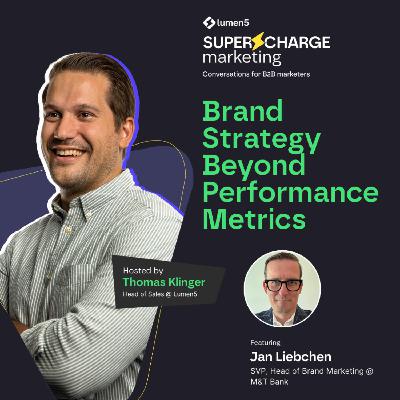
In this episode of Supercharge Marketing, host Thomas Klinger sits down with Jan Liebchen, SVP & Head of Marketing at M&T Bank, to explore how brands build trust, relevance, and measurable impact in one of the most regulated and commoditized industries: banking.
Jan shares why banking products alone don’t differentiate brands—and why trust is earned not through claims, but through customer-led storytelling and consistent delivery across every touchpoint. Drawing from his global background (Germany, East Africa, and the U.S.), Jan explains how brand leaders must balance data and emotion to align internal teams and influence decision-making. “People often arrive at conclusions emotionally before they can ever digest the data,” he explains.
The conversation also dives deep into sports sponsorships as a brand strategy, including M&T’s long-standing partnership with the Buffalo Bills. Jan reframes sponsorships as an ongoing conversation with a “naturally attracted audience,” not a logo-placement exercise—and shares how M&T measures success across brand health, engagement, and long-term revenue impact. One standout analogy compares brand investment to going to the gym: if you measure results too early, the data will lie.
From navigating AI responsibly in a regulated environment to proving the long-term ROI of brand and partnerships, this episode delivers practical, executive-level insight for marketers under pressure to justify every dollar.
What You’ll Learn:
Why banking is a “commoditized product” category—and how brand strategy creates differentiationHow customer storytelling builds trust more effectively than brand-led claimsThe role every employee plays in delivering the brand experienceWhy brand leaders must address emotion before data to influence internal stakeholdersHow to think about AI in marketing when privacy, compliance, and authenticity matterWhy sponsorships work best when treated as conversations, not media buysHow to measure sponsorship ROI beyond direct sales and short-term performanceA powerful framework for explaining why brand investments take time to pay off
ABOUT THIS PODCAST
Welcome to Season 3 of Supercharge Marketing. This season isn’t just about choosing the right channels—it’s about creating content with purpose.
We’re living in a marketing-led buyer’s journey, and today’s marketers are expected to own the revenue conversation. Each episode explores how strategic content, brand thinking, and omnichannel execution come together to drive real business impact.
Whether you’re working in financial services, B2B, SaaS, or enterprise marketing, Supercharge Marketing delivers expert insights, practical frameworks, and real-world examples to help you connect brand to growth—and feel like the superhero of your marketing team. 🦸♂️

Comments

Download from Google Play

Download from App Store
 United States