


 Claim Ownership
Systematic Selling Podcast
Subscribed: 0Played: 3
Subscribe

© Sean M. Lyden
Description
A podcast for founders and owners ready to squeeze the stress out of sales and build a business they love.
www.systematicselling.co
www.systematicselling.co
35 Episodes
Reverse

Systematic Selling's Sean M. Lyden returns to the Hole in the Wall Business Podcast, two years after Episode 111, for a conversation with hosts James Groves and Bill DeMent about building a sales system for a growing franchise network. Originally published as Hole in the Wall Business Podcast Episode 167: https://www.youtube.com/watch?v=4RhKqnIm5Ec00:00 Welcome back to the Hole in the Wall podcast01:26 Scaling sales without the chaos04:42 The budget pre-sell: no more sticker shock08:02 Sales is a craft: reps, mindset, and the words you use12:34 Coaching a franchise network, plus a $6,500 one-call close19:24 Customer experience starts before the signed estimate24:00 Slumps come from skipped steps, not lead flow26:32 The three tiers of closing and the game plan review29:05 Why "let me know if you have questions" isn't a close32:38 Relentless excellence and how to connect with Sean Get full access to Systematic Selling Newsletter at www.systematicselling.co/subscribe

Zig Ziglar said it best: “When you do the things you need to do when you need to do them, the day will come when you can do the things you want to do when you want to do them.”There are no shortcuts to sales success.Build the systems.Do the work.Let consistency create the momentum. Get full access to Systematic Selling Newsletter at www.systematicselling.co/subscribe

Today’s episode is for you if:* Revenue slows down whenever you step away from selling.* Your sales process—and too many customer relationships—still live in your head.* You worry that your company’s dependence on you could limit its growth and eventual value.A business can generate substantial revenue and still be difficult to sell.Why?Because if the owner is the sales team—holding the customer relationships, controlling the information and closing the important deals—a buyer has to wonder:Will the revenue transfer when the owner leaves?That was the focus of my recent conversation with Jackie Hirsch of Crown Atlantic Business Brokers.We discussed how owners can build a sales team without losing control—and how the right people, processes and systems can make a business considerably more valuable.Here are the eight most actionable takeaways.1. Build the System Before You Delegate the ResponsibilityOwners are often labeled “control freaks” when they struggle to delegate.But Jackie sees a different problem: Most owners have never been taught how to break down a function, communicate it clearly and create a repeatable system someone else can execute.[Watch this section: 02:11]2. Protect the Customer Data (Without Hoarding the Relationships)Giving employees access to customer relationships introduces legitimate risk. But keeping every relationship tied to the owner creates a different—and potentially larger—risk.The answer isn’t to completely withhold access but to create guardrails.Keep customer information inside a company-controlled CRM. Document every meaningful interaction. Establish appropriate agreements. Then hire people with high character and train them to represent the company well.[Watch this section: 04:08]3. Smooth the Transition Through the Three Stages of SalesAt Systematic Selling, we work with SMB founders on smoothing their transition through three stages:* Founder-led sales: The founder is the primary rainmaker.* Founder-managed sales: The founder has a sales team but still operates as the player-coach or de facto sales leader.* Professionalized sales team: The company has a sales leader, trained sellers and repeatable systems that operate without the founder’s daily involvement.The goal is to progressively transfer knowledge, relationships and responsibility until sales becomes a self-sustaining capability, not an owner dependency.[Watch this section: 06:08]4. Build Your Sales Team Around the 3CsOur conversation surfaced three factors that help owners build and retain an elite sales team:* Character: Hire for character, then train for success.* Compensation: Create a competitive, generous and crystal-clear compensation plan.* Culture: Build an environment where talented people feel valued and want to stay.[Watch this section: 11:00]5. Mine the Gold Already Sitting in Your CRMOne company Jackie worked with had decades of past customers but had never systematically contacted them again.The new owners’ initial growth strategy was simple:Reach back out to the existing customer list.That database produced new opportunities because the customers’ needs had returned, changed or expanded.Too many companies treat customers as transactions moving through a funnel. Once the transaction ends, communication stops.But customers don’t disappear after the sale. They remain in your orbit.(See: 043: Stop Selling Through a Funnel. Start Expanding Your Orbit)Continue building trust, staying visible and creating opportunities for repeat purchases and referrals.[Watch this section: 16:49]6. Understand How Sales Systems Affect ValuationJackie shared two examples that illustrated how dramatically transferable systems and recurring revenue can affect a company’s valuation.One business sold for approximately four times EBITDA.Another—with recurring revenue and consistent year-over-year growth—sold for approximately eight times EBITDA.That doesn’t mean sales systems alone automatically double a company’s multiple. Many factors affect valuation.But it demonstrates the central principle:Buyers pay more for revenue they believe will continue without the current owner.[Watch this section: 25:30]7. Start Preparing Before You’re Ready to ExitJackie recommends that owners begin thinking seriously about their exit while they still have enough time and energy to strengthen performance, develop the team and participate in a thoughtful transition.Even if you don’t plan to sell for five, 10 or 15 years, build the company today so someone else could eventually step in.[Watch this section: 32:12]8. Remember: Buyers Must Sell Themselves, TooA buyer may think the highest offer automatically wins.It doesn’t.Sellers frequently care about what will happen to their employees, customers and legacy after the transaction.Jackie shared an example of a buyer who defeated several full-price offers—including an all-cash offer—because he understood the industry, knew the customers, lived near the company and gave the seller confidence that he could take care of the team.The buyer understood something essential:Buying a business is still a sales process.The buyer must understand what matters to the seller and demonstrate alignment with those interests.[Watch this section: 43:52]The Bottom LineIf your business still depends on you to generate the revenue, hold the relationships and direct every sales activity, don’t wait until you’re preparing to sell to address it.Build the systems now.Develop the team now.Transfer the relationships now.Because the sales organization you build today won’t just determine how fast (and sustainably) your company grows.It also determines what your company is worth.Sean M. Lyden is the founder and CEO of Systematic Selling, a sales systems training company for growth-minded founders and their sales teams looking to scale their sales (without the chaos). Get full access to Systematic Selling Newsletter at www.systematicselling.co/subscribe
Today’s episode is for you if:* Your sales pipeline depends too much on finding the next customer.* You aren’t getting as many referrals or repeat sales as you should.* You've been blindsided by losing a customer you thought would never leave.Most sales conversations obsess over how to get the deal. Fewer talk about what happens the day after you sign it.That’s a problem, because that’s the part that determines whether you keep the client for one project or for ten years.David Roy and I spent our Substack Live conversation today on exactly that gap. We didn’t focus on theory but on the actual mechanics of what to do once you’re in the door...or when the door closes.Here are the most actionable moves we covered.Onboarding & Kickoff* Run a “Pre-Kick-Off Huddle” 3–7 days before any engagement starts. Walk through logistics and other action items to set up the Kick-Off—and the entire project—for success.* Get an introduction to the AP/accounts payable contact during onboarding. Don’t wait until an invoice is late to meet them. It builds a second relationship and takes payment friction off your primary contact’s plate.Proving Value On a Cadence* Set a recurring check-in cadence (weekly, biweekly, or monthly) specifically to show the customer what’s improved. Don’t assume they’re tracking it themselves.* Measure a baseline before you start (revenue, cost, whatever the relevant KPI is) so improvement is a number you can show, not a feeling you’re hoping they share.Protecting the Account* Build a simple color-coded budget/risk sheet for high-value clients. (This is especially valuable for commercial service companies.) Flag what needs attention soon (yellow) vs. now (red), with rough budget ranges. It positions you as protecting their blind side, not being pushy.* Learn each client’s budget cycle (not everyone runs January–December) so you’re recommending replacements or upgrades when there’s actually money to spend.* Build relationships with multiple people inside the account…not just the decision-maker, but the day-to-day user, the influencer, the assistant. This way, if your main contact leaves, you’re not starting from zero.Getting In / Staying In* Offer to be the “911 provider” for accounts that already have an incumbent. Even if you never win the whole account, being the emergency backup gets your foot in the door.* Keep a prospecting pipeline going even when you’re slammed. Never let your business development activity hit zero. Consistent BD protects you when an account changes hands or disappears overnight.* “Win” even with 2nd/3rd place finishes in RFPs. Staying visible and top-of-mind after a loss is often how you win the account later.Drawing Out Honest Feedback* Let upset customers vent without getting defensive. Resolving a real complaint well often builds more trust than if nothing had gone wrong.* Reframe feedback requests as aspirational. Ask: “How can we take this to the next level?” Not: “What needs improvement?” You’re asking the same question, but people open up more when they don’t feel like they’re being negative.Long-Term Account Health* Classify every account using the 4-Farmland Matrix (4FM)—new (farmland), underdeveloped, neglected, or lost. Each type calls for a different next move, whether that’s pursue, expand, staff up, or re-engage.* Don’t give up on lost accounts. Stay visible enough that when the new provider drops the ball, you’re the obvious call back.If you want the full context behind each of these — the stories, the numbers, and a couple we didn’t have room for here — the full Live conversation is where we actually walk through it. Get full access to Systematic Selling Newsletter at www.systematicselling.co/subscribe
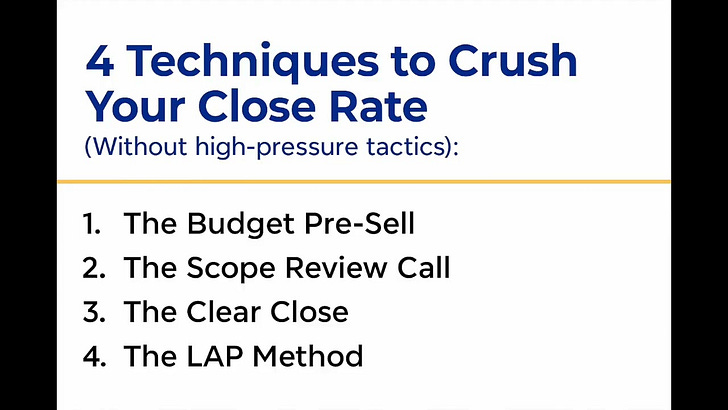
Tired of getting ghosted after sending a proposal? In this live talk from the East Orlando Chamber’s Merchant Monday, Sean Lyden breaks down his four-part framework for closing more sales the systematic way. Learn how to pre-sell the budget, review scope live, create clear next steps, and use the L-A-P Method to clarify objections—all while keeping pressure low and trust high.By the end of this episode, you’ll know how to:- Handle pricing conversations early without losing credibility- Set clear next steps that prevent prospects from ghosting- Build buyer confidence without coming across as pushy- Use the L-A-P Method (Label, Ask, Propose) to clarify objections- Create alignment between your solution and the buyer’s problem.Episode Timestamps00:00 — Intro & why prospects ghost05:45 — The 4 techniques that reduce ghosting07:00 — The Budget Pre-Sale09:00 — The Scope Review Call11:00 — The Clear Close15:00 — The L-A-P Method for Objections19:00 — Sales as alignment, not persuasion20:30 — Q&A: handling pricing pushback24:00 — Q&A: how to balance giving clients space without losing momentum26:00 — Q&A: dealing with tech overwhelm and customer resistance29:00 — Q&A: reading body language and addressing hidden hesitation31:00 — Q&A: re-engaging ghosted prospects33:00 — The importance of tone, confidence, and terminology34:00 — “Never awaken the lizard brain” — how language affects buying behavior.Get bite-sized, high-impact sales systems training delivered to your inbox: SystematicSelling.co Get full access to Systematic Selling Newsletter at www.systematicselling.co/subscribe

Comments

Download from Google Play

Download from App Store
 United States