DiscoverThe Remarkable SaaS Podcast
The Remarkable SaaS Podcast
Claim Ownership

The Remarkable SaaS Podcast

Author: Ton Dobbe

Subscribed: 86Played: 439
Share

Description

For B2B SaaS founders who are done blending in.

The Remarkable SaaS Podcast features unfiltered conversations with SaaS founders navigating the real challenges of building software that matters.

Hosted by Ton Dobbe, author of The Remarkable Effect, each episode zooms in on one of the 10 traits that define remarkable software companies—like offering something truly valuable and desirable, and aiming to be different, not just better.

Some guests are scaling fast. Others are still in the trenches—but all share hard-won lessons about what it really takes to create pull, shorten sales cycles, and become the only logical choice in their market.

Expect:

Honest conversations—no hype, no theory

Tactical insights from sales-led SaaS founders

Practical ideas you can apply to sharpen your product and your positioning

If you're building a SaaS business that deserves attention—not just more noise—this podcast is for you.
387 Episodes
Reverse
A story about how "everyone agrees" is the most dangerous lie in SaaS.This episode is for SaaS founders frustrated watching their solution solve real problems—but wondering why no one actually buys it.Most healthcare startups don't fail because their tech doesn't work. They fail because they can't find anyone willing to pay for it.Mariano Garcia-Valiño, Founder and CEO of Axenya, spent 18 months proving his preventive care model worked clinically—reducing diabetes costs by 20% and mortality risk by 18%. Then he spent another year without selling a single dollar because insurers, hospitals, and patients all had reasons not to care enough to pay.He found the answer by buying a healthcare broker and changing who he sold to: employers in Brazil who actually bear the cost and have the timeframe to benefit from prevention.This inspired me to invite Mariano to my podcast. We explore why solving the right problem for the wrong buyer kills traction—and how changing your business model changes who cares. Mariano shares how he rejected the obvious paths (selling to insurers, doctors, or patients) and instead built a broker model that aligns incentives with outcomes. You'll discover why clinical proof means nothing without economic urgency.We also zoom in on three of the 10 traits that define remarkable software companies:Acknowledge you cannot please everyoneMaster the art of curiosityAim to be different, not just betterMariano's story is proof that the best solution dies without the right buyer—and why changing your business model, not your product could be the easy way out.Here's one of Mariano's quotes that captures the challenge he faced:"It's one thing to actually see the problem and find a technical solution for the problem. It's a different thing to deploy it in the right place within a very complex value chain that has a lot of incentives that are not well aligned."By listening to this episode, you'll learn:Why solving a highly valuable and critical problem alone won't create a market without economic incentive alignmentWhat happens when you build for huge global humanity problems instead of expensive local onesWhy focusing on who pays reveals better opportunities than focusing on who usesHow buying your distribution channel creates stickiness competitors can't copyFor more information about the guest from this week:Guest: Mariano Garcia-Valiño, Founder and CEO at Axenya Website: axenya.com
A story about choosing autonomy over speed—and building something that lasts.This episode is for SaaS founders tired of chasing growth rounds—and wondering if slow, profitable building could win.Most software companies raise capital to scale fast. Rex Kurzius, Founder of Asset Panda, rejected that path entirely. His father ran a bakery. His brother built MailChimp. Rex grew up watching immigrant work ethic turn into entrepreneurial success—and applied the same principle to software.He spent 13 years building Asset Panda from startup to a world-class asset tracking platform. No investors. No board pressure. No artificial timelines. Just solving one problem—asset tracking—and letting customer revenue fund each next step.And this inspired me to invite Rex to my podcast. We explore why staying curious matters more than being right. Rex shares his thinking on positioning pivots (consumer to business, product to platform), building without investor timelines, and the inverse relationship between AI and headcount growth. You'll discover why he calls himself the turtle in the race—and what slow, steady building creates.We also zoom in on three of the 10 traits that define remarkable software companies: Master the art of curiosity Focus on the essence Turn customers into fansRex's story is proof that building slow beats chasing speed—when you solve real problems.Here's one of Rex's quotes that captures his growth philosophy:"It's not about being perfect, and it's not about being right. It's about being curious and having the ability to deal with failure, learn from that failure, and adapt to succeed."By listening to this episode, you'll learn:Why staying curious beats being right when building softwareWhat happens when you fund growth with customer revenue, not investor capitalWhy solving client problems matters more than hitting investor timelinesHow building slow creates more enduring value than chasing speedFor more information about the guest from this week:Guest: Rex Kurzius, Founder and CEO of Asset PandaWebsite: assetpanda.com
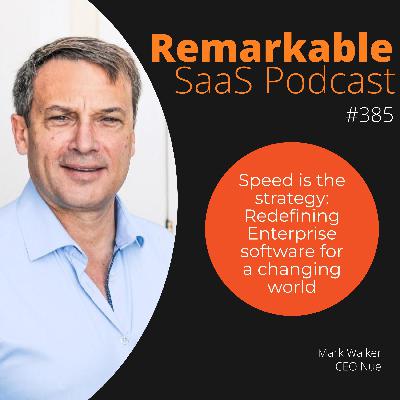
A story about speed as strategy—and why saying no to billion-dollar deals built a stronger company.This episode is for SaaS founders who feel stuck between landing big logos and building what actually scales.Most SaaS companies don't fail because they lack ambition. They fail because they chase the wrong customers.Mark Walker, CEO of Nue, took a different path. With decades in enterprise software—ERP, CRM, NetSuite—he joined Nue in March 2022 when it was pre-revenue and a "science experiment." He made one decision that changed everything: focus on speed over complexity. When Nvidia came calling, he said no. When asked to build for everyone, he picked his peers instead.And this inspired me to invite Mark to my podcast. We explore why treating speed as your core product creates defensible value. Mark shares his philosophy on saying no to wrong-fit customers, building modular systems that compress implementation from years to weeks, and why honesty beats hype when competing against legacy vendors. You'll discover why OpenAI went live in 8 weeks and Anthropic in 12—and what that speed signals to the market.We also zoom in on two of the 10 traits that define remarkable software companies:They acknowledge they cannot please everyoneThey aim to be different, not just betterMark's story is proof that when you optimize every decision for customer speed, saying no to complexity becomes your competitive advantage.Here's one of Mark's quotes that captures his approach to market focus:"If you want to be great at something, you have to be bad at something else. There are no NFL linemen who are also World Champion marathoners. They're both elite athletes, but they're not the same athlete."By listening to this episode, you'll learn:Why the fastest implementations come from saying no to features, not adding themWhat happens when you tell a billion-dollar prospect they're not the right fitWhen modularity beats monolithic systems in multi-model revenue businessesWhy traditional enterprises are preemptively switching systems before they know what's comingFor more information about the guest from this week:Guest: Mark Walker, CEO at NueWebsite: nue.io
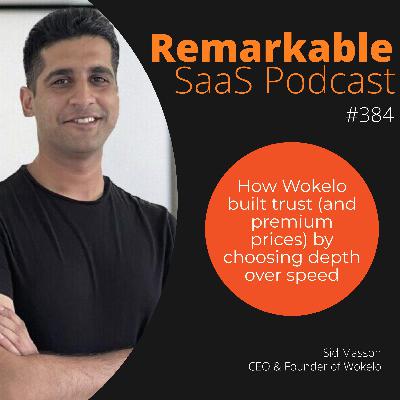
When everyone else optimized for instant answers, Sid Masson built for depth and accuracy—and enterprise customers paid more for the difference.This episode is for SaaS founders who feel trapped competing on speed—and suspect their customers actually want something else.Most SaaS companies don't fail because they're too slow. They fail because they optimize for speed over trust.Sid Masson, CEO and Co-founder of Wokelo, took a different path. He started his career as a management consultant doing private equity due diligence with dozens of tabs open, knowing how costly missed insights could be. When he began experimenting with early GPT models while pursuing his second master's in AI, he saw the potential to automate deep analysis—but refused to compromise on rigor.While others chased instant gratification, Wokelo focused on producing more in-depth, decision-grade insights. That choice became its edge. Enterprise clients quickly recognized that thoughtful, well-supported answers were worth more than instant ones.This inspired me to invite Sid to my podcast. We explore why building for accuracy rather than instant gratification creates differentiation in competitive markets. Sid shares hard-won lessons about segment selection, the hidden cost of trying to serve everyone, and why their first 10 customers taught them more about usage patterns than any growth hack could. You’ll hear how customers measured ROI not in hours logged, but in the depth of impact—renewing and expanding after a single insight shifted key client conversations.We also zoom in on two of the 10 traits that define remarkable software companies:They acknowledge they cannot please everyoneThey aim to be different, not just betterSid's story is proof that constraints drive innovation—and capital efficiency forces strategic clarity.Here's one of Sid's quotes that captures his approach to capital efficiency:"Capital efficiency for us, being slightly constrained at times, actually helps us in being more innovative. The most innovations, the most disruptive ideas, actually come out of constraints. We don't want to give our team that luxury that, hey, there's enough money on the table that I can go and do a land grab. We need to still solve a few fundamentals."By listening to this episode, you'll learn:Why accuracy at scale requires patience—not just better promptsWhat happens when you design for outcomes instead of feature parityWhen capital constraints become competitive advantages rather than limitationsWhy your first 10 customers teach you more about segmentation than any persona documentGuest InformationFor more information about the guest from this week:Guest: Sid Masson, CEO and Co-founder of Wokelo AIWebsite: wokelo.aiEmail: sid@wokelo.ai
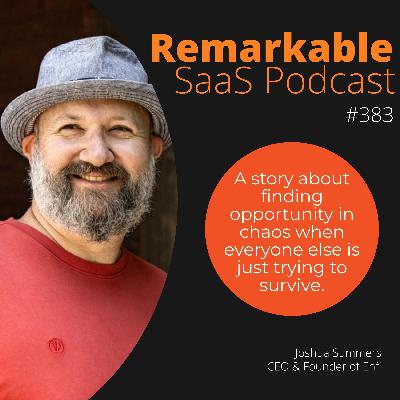
This episode is for founders stuck building features nobody asked for—who want to discover what customers actually need.Joshua Summers, CEO of EnFi, took a different path. After helping dozens of startups move their cash during the Silicon Valley Bank collapse, he discovered the real problem wasn't deposits or covenants—it was human capacity to assess risk. While others rushed to capitalize on the crisis, he spent months investigating what actually broke.And this inspired me to invite Joshua to my podcast. We explore how building from crisis reveals opportunities others miss. Joshua shares hard-earned wisdom about why founder-led sales beats hiring early, what happens when you achieve greater-than-human accuracy, and why building a culture where employees jump at the chance to work with you again matters more than your product. You'll discover why taking more capital early can save your company—even if it means more dilution.We also zoom in on two of the 10 traits that define remarkable software companies:Remarkable software companies focus on the essenceRemarkable software companies create something valuable and desirableJoshua's story is proof that the best insights come when you're not trying to sell anything.Here's one of Joshua's quotes that captures his approach to building companies:“Culture itself is an organism. It lives, it breathes, and it is impacted positively or negatively by every single thing around it. You can't design a culture. You can't say here's what our company will feel like, not look like, but feel like as an employee, it's impossible, but you can feed a culture with all the good things that hopefully help it to evolve like an organism."By listening to this episode, you'll learn:Why building in the open beats perfectionismHow 14 people can operate like a company of 150When discovering the essence changes everythingWhat makes employees want to work with you (again)For more information about the guest from this week: Guest: Joshua Summers, CEO of EnFi Website: www.enfi.ai
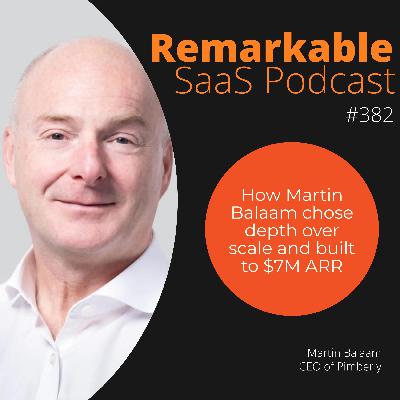
This episode is for SaaS founders tired of the "grow at all costs" playbook—who suspect there's power in saying no to the wrong customers.Most SaaS companies don't fail because of bad product. They fail because they try to please everyone. Martin Balaam, CEO of Pimberly, chose restraint over reach. Former physicist turned serial entrepreneur, he'd already scaled and exited Jigsaw24 at 3x returns. At Pimberly, he refuses customers his team can't delight—even when they're ready to sign.And this inspired me to invite Martin to my podcast. We explore how qualifying customers as rigorously as they qualify you creates compound advantages. Martin shares hard-won insights about why he walked away from license-only models, when to choose service depth over customer volume, and what happens when you give your product roadmap to customers instead of VCs. You'll discover why maintaining sub-5% churn matters more than doubling growth rates.We also zoom in on two of the 10 traits that define remarkable software companies:Aim to be different, not just betterFocus on the essenceMartin's story is proof that sustainable SaaS growth comes from doing what others call unscalable.Here's one of Martin's quotes that captures his contrarian philosophy:"I really don't want to lose customers. I know from my life experience how much time and effort, blood, sweat, and tears you have in trying to acquire a customer. We'll openly put our hand up and say I can't see that this is actually gonna add the value—even though they might be happy to sign."By listening to this episode, you'll learn:Why saying no to willing customers protects your businessWhat "VIP leads" actually means (hint: not big orders)When founder-led sales should naturally transitionWhy physical presence beats remote-first for market entryFor more information about the guest from this week: Guest: Martin Balaam, CEO & Founder PimberlyWebsite: pimberly.com
A story about winning by not competing—and why saying no creates speedThis episode is for SaaS founders who feel the weight of building something that matters—and wonder if being contrarian is worth the risk.Most software companies fail because they rush to market without questioning what they're building. They see opportunity and chase it.David Villalon, CEO of Maisa, saw the AI gold rush differently. When everyone was building faster, he spent a year building trust into the foundation. He recognized that when you can see the future—truly see it—you carry responsibility for building it right, not just first.And this inspired me to invite David to my podcast. We explore why making AI accountable matters more than making it powerful. David shares hard-won insights about choosing regulated industries first, empowering task-doers instead of technical teams, and why he positions his company to compound value from every AI model maker instead of competing with them. You'll discover why focusing on one customer before ten creates the foundation for horizontal growth.We also zoom in on two of the 10 traits that define remarkable software companies:Aim to be different, not just betterOffer something valuable and desirableDavid's story is proof that vision without responsibility is just opportunism—and real founders feel the weight of building the future right.Here's one of David's quotes that captures his entrepreneurial philosophy:"Whenever you have success, what you're going to hear is everyone saying how good you are. But if you act without that ego, without wanting to become something that you are not, everything looks much better."By listening to this episode, you'll learn:When to compound competitors' value instead of fightingWhat happens when you empower task-doers, not techniciansWhy first principles thinking requires empathy, not just logicWhen everyone wanting your product means stay focusedFor more information about the guest from this week: Guest: David Villalon, CEO MaisaWebsite: https://maisa.ai
A story about finding opportunity in the moments everyone else ignores.This episode is for founders questioning whether their personal frustration is worth building a business around.Most SaaS companies don't fail because of bad tech. They fail because they solve problems that don't actually hurt.Ken Rapp, CEO of Blustream, took a different path. When his $2,000 guitar cracked, he didn't blame himself—he questioned why no brand had ever taught him prevention. That question led to a 10-year journey building what didn't exist.And this inspired me to invite Ken to my podcast. We explore how solving your own problem first gives you conviction others lack. Ken shares why he spent years on IoT sensors before realizing the real problem was human connection, not data collection. You'll discover why category creation takes a decade—not because building is hard, but because changing behavior is harder.We also zoom in on two of the 10 traits that define remarkable software companies: – Focus on the essence – Aim to be differentKen's story is proof that unmet needs hide in plain sight—we just learn to live with them.Here's one of Ken's quotes that captures his key insight:"Once your customer is at home, that's the moment where they will be most vulnerable, and that curve of emotional connection to you drops. It's almost like the buyer's remorse is setting in. You're all excited to go home with the product, or to open the product, and right there is when you really need to conquer that new product and make it a habit, and really get what you were hoping and dreaming for out of the product. But there's no connection between you and the company."By listening to this episode, you'll learn:Why personal problems make the best businessesWhen to pivot from technology to psychologyWhy categories emerge from nerve strikes, not planningWhat 100 customer interviews actually teach youFor more information about the guest from this week: Guest: Ken Rapp, CEO & Founder of BlustreamWebsite: blustream.io
A story about rejecting the magic wand approach to AI—and building something businesses can actually use.This episode is for Mid-market SaaS founders tired of AI hype who want to build something that creates real customer value—not just impressive demos.Most SaaS companies don't fail because of bad tech. They fail because they chase hype over value.Zohar Bronfman, CEO of Pecan AI, took a different path. After years researching AI and philosophy in academia, he saw Amazon, Uber, and Spotify dominating with predictive AI—while thousands of smaller companies couldn't even get started. Instead of building another "AI for everything" platform, he focused obsessively on one thing: making predictive AI accessible to mid-market companies who couldn't afford data science teams.And this inspired me to invite Zohar to my podcast. We explore why curiosity beats strategy when building in uncertain markets. Zohar shares hard-won insights about deprecating profitable features, why small teams outperform large ones, and how to identify which enterprise capabilities actually matter for mid-market customers. You'll discover why Pecan almost never loses customers—despite operating in the brutally competitive AI space.We also zoom in on two of the 10 traits that define remarkable software companies:Trait #2: Be valuable and desirableTrait #6: Create fans, not just customersZohar's story is proof that sustainable growth comes from solving real problems—not riding waves.Here's one of Zohar's quotes that captures his philosophy:"You can sell things, especially to larger organizations. You can sell things that actually don't have ROI. You can sell things that either look shiny, sound shiny or smell shiny, or all of the above. But ultimately, if you put yourself in a rigorous test, did I make a change? Did I actually add value to the system? The answer could have been no in many cases."By listening to this episode, you'll learn:Why killing profitable features strengthens retentionWhat happens when you ignore VCs' market adviceWhen customer honesty beats sales promisesWhy hiring slower creates faster growthFor more information about the guest from this week:Guest: Zohar Bronfman, CEO Pecan AIWebsite: pecan.ai
A story about passing lucrative deals to competitors—and building something users refuse to give upThis episode is for SaaS founders exhausted from chasing every opportunity—and wondering if extreme focus actually works.Most SaaS companies don't fail because of bad tech. They fail because they can't stop building.Ray Meiring, CEO of QorusDocs, discovered this during a meeting with a bank CIO. While trying to find use cases for their generic document tool, Ray realized they had it backwards—they were hunting for problems to fit their solution instead of solving a specific problem.That realization changed everything. Ray narrowed QorusDocs from "any document" to proposals to specific verticals. He even developed a system for passing lucrative but wrong-fit customers directly to competitors.And this inspired me to invite Ray to my podcast. We explore how narrowing from documents to proposals to law firms and engineering firms created users who'd "pry QorusDocs from their cold dead hands." Ray shares why moving 10,000 miles to Seattle transformed their network, how building inside Microsoft Office became their differentiator, and why consistency beats constant pivoting. You'll discover how saying no to features actually accelerated growth.We also zoom in on three of the 10 traits that define remarkable software companies:Acknowledge you can't please everyoneAim to be different, not just betterFocus on the essenceRay's story shows how narrowing your focus can multiply your impact.Here's one of Ray's quotes that captures his philosophy:"We were trying to be everything to everyone and just build this very generic product. But as we worked with more customers, we started to see a pattern around a very specific set of documents that were challenging—proposal documents."By listening to this episode, you'll learn:Why the A-B-Z framework beats traditional segmentationWhat happens when you deprecate features instead of adding themWhen proximity to customers trumps remote efficiencyWhy integration beats innovation for enterprise retentionFor more information about the guest from this week:Guest: Ray Meiring, CEO QorusDocsWebsite: qorusdocs.com
A story about turning impatience into competitive advantage.This episode is for SaaS founders tired of building "professional" products nobody remembers—and anyone wondering if controversy beats convention.Most SaaS companies fail because they try to please everyone.They play it safe with every decision.Joao Marques, CEO of Oscar, took a different path.He quit his job, built the app in four months, then raised 70K euros to start acquiring customers. Created an on-demand home services marketplace that sends marketing messages designed to provoke action. Became Portugal's market leader in two years—by deliberately risking cancellation with every campaign.And this inspired me to invite Joao to my podcast. We explore how strategic controversy creates memorable brands faster than perfect products. Joao shares hard truths about focus, growth over features, and why being hated by some customers beats being ignored by all. You'll discover why having your entire company obsess over one metric beats any complex strategy.We also zoom in on two of the 10 traits that define remarkable software companies: – Focus on the essence – Master the art of creating momentumJoao's story is proof that market leadership often starts by doing what makes others uncomfortable.Here's one of Joao's quotes that captures his philosophy:"Just having one goal. My focus, for example, right now, is acquisition and then GMV, so volume in my app. I'm refreshing the dashboard every 10 minutes. Every decision that we make is based on that. Every goal is based on that. Everyone in my team, and we are, like, 50 people, from customer support to senior management, everyone knows GMV on a daily basis.”By listening to this episode, you'll learn:Why building features before growth is startup suicideWhat happens when you do the unscalable things competitors avoidWhen being annoying drives better retention than being niceWhy one metric beats ten strategiesFor more information about the guest from this week: Guest: Joao Marques, CEO OscarWebsite: oscarapp.com
A story about building a cult following in the unglamorous world of aviation maintenanceThis episode is for SaaS founders exhausted from building "nice-to-have" solutions.Most SaaS companies don't fail because of bad tech. They fail because they prefer to solve sexy problems instead of expensive ones.Dinakara Nagalla, CEO of EmpowerMX (acquired by IFS), took a different path. He spent 14 years in aviation watching mechanics waste 50% of their day on paperwork. Instead of building another dashboard for executives, he built tools for the technicians themselves—and turned a cost center into a profit driver with 78% gross margins.And this inspired me to invite Dinakara to my podcast. We explore how solving unglamorous problems creates fanatical customers. Dinakara shares hard truths about why productivity software beats regulatory software, how guaranteeing 10% efficiency shrinks sales cycles by 67%, and why hiring from the industry you serve changes everything. You'll discover why his customers became his sales force—without being asked.We also zoom in on two of the 10 traits that define remarkable software companies:They create fans, not customersThey sell the idea, not the productDinakara's 14-year journey proves that the most loyal customers come from solving their daily frustrations, not their strategic initiatives.Here's one of Dinakara's quotes that captures his contrarian philosophy:"Being remarkable shouldn't just be a slogan. You should make it as a responsibility. It's what you do when no one is watching. It's a system you build after the pitch is done, and it should be built with the highest level of accountability, with the most trust you can possibly put in. To me, the most remarkable companies don't scale high; they scale trust."By listening to this episode, you'll learn:How his customers became his sales forceWhat happens when you guarantee 10% productivity gainsWhen hiring only from aviation changed everythingWhy reducing organizational stress beats adding featuresFor more information about the guest from this week: Guest: Dinakara Nagalla, CEO & Founder of EmpowerMX (now part of IFS) Website: https://dinakaranagalla.com/
A story about finding freedom by solving problems others ignored—on purpose.For SaaS founders tired of feature bloat—and wondering if serving fewer people better might be the smarter path to freedom.Most SaaS companies fail because they try to please everyone.They fail because they spread themselves across every platform, every feature request, every shiny opportunity.Samy Dindane, CEO of Hypefury, took a different path.He spotted a gap nobody else cared about—Twitter thread scheduling—and built a prototype in three days. Instead of raising money or hiring fast, he chose freedom through focus.And this inspired me to invite Samy to my podcast. We explore how deliberate constraints create stronger businesses. Samy shares hard-won insights about platform dependence, community-driven development, and knowing when to say no. You'll discover why his users became product owners and how charging more actually made customers happier.We also zoom in on two of the 10 traits that define remarkable software companies: – They acknowledge they can't please everyone – They master the art of curiositySamy's story is proof that sustainable freedom comes from saying no to good opportunities—not just bad ones.Here's one of Samy's quotes that captures his philosophy:"Whatever time you spend on something, you don't spend on something else. So whatever time you're going to try to build something crazy for another platform, it's the time you're not spending improving."By listening to this episode, you'll learn: Why power users matter more than market sizeWhat happens when the platform you depend on demands $500K yearly When adding features becomes a liability Why your best product managers pay you monthlyFor more information about the guest from this week: Guest: Samy Dindane, CEO HypefuryWebsite: hypefury.comWant to dig deeper into the 10 traits of remarkable SaaS companies? Get my book The Remarkable Effect at valueinspiration.com/book Or sign up for Espresso with Ton at valueinspiration.com/daily - a 2-minute daily email to sharpen your thinking and strategy.
#374 - How Chad Rubin helps Amazon brands escape the pricing race to the bottomA story about moving from being a cost center to becoming the profit engine—by challenging assumptions no one else dared to question.This Episode is for SaaS founders who are tired of customers seeing their solution as just another expense—and those questioning whether there's a smarter way to build something customers actually want to pay more for.Most SaaS companies position themselves as efficiency tools. They help you do things faster, cheaper, better.Chad Rubin, CEO of Profasee, took a different path. After selling his previous inventory management company in 2021, he had a realization: he was always building solutions that lived on the expense side of his customers' businesses. He wanted to be on the revenue side.So he started questioning assumptions in his own struggling Amazon business. Why doesn't anyone change price dynamically? Why do sellers copy pricing from competitors who might be broke?This led him to build Profasee—dynamic pricing software that uses AI to help Amazon brands optimize pricing and ad spend together, creating a flywheel that drives profit growth.And this inspired me to invite Chad to my podcast. We explore how questioning fundamental assumptions creates breakthrough opportunities. Chad shares insights about turning your founder story into sales leverage, the shift from efficiency to effectiveness in SaaS, and why data-driven pricing decisions compound over time. You'll discover how he's building a lean organization while investing heavily in AI and quant teams to create competitive moats.We also zoom in on two of the 10 traits that define remarkable software companies: – They acknowledge they can't please everyone – They sell the idea, not the productChad's story proves that the biggest levers are hiding in plain sight.Here's one of Chad's quotes that captures his contrarian philosophy:"You have to always be a dot, a dot collector. Constantly collecting dots. Most brands are not looking at their whole system. They're not zooming out to understand the process, understand with clear thinking, how you can have some self-awareness and look at, okay, price and PPC, how do these things interconnect?"By listening to this episode, you'll learn:Why questioning belief systems creates challenger advantages What happens when you connect isolated business leversWhat happens when you refuse to compete on other people's terms • Why founder stories become leverage in sales conversationsFor more information about the guest from this week: Guest: Chad Rubin, CEO of ProfaseeWebsite: profasee.com
A story about turning personal frustration into breakthrough technology—and why great products come from pain you actually feel.This Episode is for SaaS founders struggling to identify their real target audience—and wondering how to separate urgent problems from nice-to-have features.Most SaaS companies don't fail because of bad tech. They fail because they try to solve problems they don't actually feel.Davit Baghdasaryan, CEO of Krisp AI, took a different path. Former head of product security at Twilio, he spent evenings in Armenia taking morning calls from San Francisco—dealing with background noise that existing solutions couldn't touch. One personal frustration became the foundation for technology that now processes over a billion minutes monthly and powers 80% of human-to-AI voice interactions.And this inspired me to invite Davit to my podcast. We explore how building from real pain creates unbeatable product-market fit. Davit shares insights about choosing problems with no alternatives, why great demos feel like magic, and how focusing on essence over speed built technology that companies like Discord and Twilio now license. You'll discover why their "marketing experiment" desktop app became Product of the Year—and how they accidentally created infrastructure that now processes over a billion minutes monthly.We also zoom in on two of the 10 traits that define remarkable software companies: – They focus on the essence – They offer something valuable and desirableDavit's story proves that breakthrough technology starts with problems that personally bother you.Here's one of Davit's quotes that captures his philosophy on problem selection:"In order to understand the pain, you need to understand the alternative. If you are in an office, the alternative is to go find a quiet room—probably not that painful. But if you're in an airport or call center with people speaking next to you, there is no alternative."By listening to this episode, you'll learn:Why understanding alternatives reveals true market urgency What separating horizontal from vertical markets actually meansWhen building hard technology first pays off long-termWhy great demos feel magical instead of technicalFor more information about the guest from this week: Guest: Davit Baghdasaryan, CEO of Krisp AI Website: krisp.ai Weekly Voice AI newsletter
A story about preparation beating speed—when you know what's coming.For SaaS founders tired of rushing features to market—and wondering if there's a smarter way to build lasting competitive advantage.Most SaaS companies don't fail because they move too slow. They fail because they chase shortcuts instead of building what customers actually value.Hikari Senju, CEO of Omneky, took a different path. The son of an artist with computer science training from Harvard, he focused on building real customer value while competitors rushed AI tools to market. He spent years perfecting return on ad spend and aesthetic quality that customers actually cared about. When AI quality finally improved in 2024, he was the only one delivering superior outcomes, and his signups grew 4x in one month.And this inspired me to invite Hikari to my podcast. We explore how understanding what customers actually value beats building impressive features. Hikari shares insights about why focusing on outcomes customers pay for eliminates vanity metrics, how "grow slow, grow real" keeps you from blowing it later, and why most founders optimize for what impresses other founders instead of what drives customer results. You'll discover the difference between building systems that work versus building features that sound clever.We also zoom in on two of the 10 traits that define remarkable software companies:They focus on the essenceThey acknowledge they can't please everyoneHikari's story is proof that traction often starts by doing what most others avoid.Here's one of Hikari's quotes that captures his build-real philosophy:"You can hustle and you can fake it till you make it only so far, but it's going to catch up to you. If you want to build a generation-defining company, then you have to focus on the basics. It's usually not just one hack or one thing. It's usually a million small things that you've assembled together in a way that works perfectly as a system and that is hard to replicate by a competitor, because it's built off all these teeny differentiations you've done because you've just thought way more deeply about this problem for a longer period of time."By listening to this episode, you'll learn:Why understanding what customers actually value beats building impressive features What "grow slow, grow real" means for founders chasing quick wins When building complete systems creates unbeatable advantages over feature buildersGuest Info Guest: Hikari Senju, CEO at OmnekyWebsite: https://www.omneky.com/
A story about staying connected to customers while everyone else scales away from them.For SaaS founders who feel increasingly disconnected from their customers as they scale—and anyone questioning whether growth has to mean losing touch with what made you successful in the first place.Most SaaS companies don't fail because of bad product decisions. They fail because founders lose their superpower as they scale.Eli Portnoy, CEO and co-founder of Backengine, experienced this visceral pain twice before. In his garage days, he was everything—salesperson, customer success manager, product manager. He had an incredible view into customer pain and could align his entire company around solving it. But as he grew and hired specialists, layers formed between him and customers. He started making decisions based on anecdotes instead of insight.In 2023, he decided to found Backengine and solve the problem that had haunted him: How do you preserve that founder superpower at any scale?And this inspired me to invite Eli to my podcast. We explore how customer obsession creates sustainable competitive advantage when it's embedded everywhere, not siloed in one team. Eli shares insights about building 20-year customer relationships, category creation through unique points of view, and why focusing solely on customer value makes everything else—funding, team happiness, growth—fall into place. You'll discover why the voice of the customer needs to be a living organism that works inside every tool your teams already use.We also zoom in on two of the 10 traits that define remarkable software companies: – They acknowledge they can't please everyone – They create fans, not just customersEli's story is proof that traction often starts by doing what most others avoid.Here's one of Eli's quotes that captures his contrarian approach to customers:"Every customer interaction is important. Every customer interaction is thoughtful. Every customer opinion is thoughtful and insightful, but it's not always right, and so you have to make sure you're hearing it from multiple people in multiple places, and then you have to put your own internal, sort of like translation layer on top of it, because the customer isn't always right."By listening to this episode, you'll learn: Why customer obsession beats investor optics every time What building 20-year relationships means for daily decisionsWhen you know you've created a category Why solving myopic problems can lead to bigger opportunitiesFor more information about the guest from this week:Guest: Eli Portnoy, CEO and co-founder of Backengine Website: backengine.ai
A story about choosing technical battles that create unbeatable unit economics—while competitors bleed money.This episode is for SaaS founders tired of chasing short-term monetization—and wondering if there's a smarter way to build something customers actually fight to keep.Most SaaS companies fail because they take technical shortcuts.They outsource infrastructure to move fast, then discover they can't compete on price.Richard White, CEO of Fathom, took a different path. He's the inventor of the feedback tab and builder of UserVoice before founding Fathom in 2020. White spent two years building infrastructure that competitors shortcut with expensive third-party services—creating an economic moat that lets him "bully competitors" out of the market.And this inspired me to invite Richard to my podcast. We explore how building instead of buying infrastructure creates economic warfare advantages. Richard shares insights about choosing technical battles that matter, why he'd rather have angry customers than apathetic ones, and his "external validation addiction" that drives breakthrough products. You'll discover how owning your full stack lets you set pricing rules that competitors can't match.We also zoom in on two of the 10 traits that define remarkable software companies: – They don't create customers—they create fans – They focus on the essenceRichard's story is proof that traction often starts by doing what most others avoid.Here's one of Richard's quotes that captures his contrarian philosophy:"We're the only people that run all of our own infrastructure outside of the LLMs, and that allows us a huge advantage economically, because our costs are so much lower than everyone else, which allows us to basically bully all the other competitors by setting the bar for what you can do on free."By listening to this episode, you'll learn:Why building infrastructure beats buying third-party servicesWhat choosing technical battles strategically actually requiresWhen lower unit economics become competitive weaponsWhy economic moats trump feature moats every timeGuest InfoFor more information about the guest from this week: Guest: Richard White, CEO of FathomWebsite: https://fathom.video
A story about choosing overlooked markets—and winning by design.For SaaS founders who feel stuck chasing trendy markets—and anyone wondering if there's more money in solving unglamorous problems than building the next shiny thing.Most SaaS companies chase crowded markets because they seem exciting.They fail because they're fighting for scraps in oversaturated categories.Marne Martin, CEO of Emburse, took a different path.After 30 years in software, she chose the "unsexy" expense management space when everyone else was chasing AI startups and flashy consumer apps.At Emburse, she’s helping finance teams to elevate their work by applying the focus and discipline of elite athletes to modernize spend in their organizations.And this inspired me to invite Marne to my podcast. We explore how treating your company like an elite athlete creates sustainable competitive advantage. Marne shares insights about choosing markets others avoid, building profitable unit economics in private equity environments, and applying AI where it actually drives revenue. You'll discover her simple filter that eliminated wasted innovation.We also zoom in on two of the 10 traits that define remarkable software companies: – They master the art of curiosity – They offer something valuable and desirableMarne's story is proof that traction often starts by doing what most others avoid.Here's one of Marne's quotes that captures her investment philosophy:"There are a lot of cool things that I wouldn't be willing to pay for, right? So you have to make sure you're not just doing things because you're cool or you're curious, but because there's a market for that."By listening to this episode, you'll learn:Why choosing "boring" markets eliminates competitionWhat elite athlete principles mean for SaaS companiesWhen AI investments actually drive profitable growthWhy unit economics matter more than cool featuresFor more information about the guest from this week:Guest: Marne Martin, CEO of EmburseWebsite: https://www.emburse.com/
A story about choosing the harder path—and why contrarian infrastructure decisions create unshakeable customer loyalty.This episode is for SaaS founders tired of vendor dependency—and those questioning whether the "obvious" infrastructure choices are actually the smartest business decisions.Most SaaS companies fail because they optimize for short-term convenience over long-term differentiation.Alexander Sommer, CEO of DSwiss, took a different path. He's the first non-founder CEO to lead this 17-year-old Swiss company specializing in secure digital services. Rather than following industry defaults, DSwiss runs vertically integrated infrastructure—controlling their entire technology stack from hardware up.This inspired me to invite Alexander to my podcast. We explore how contrarian infrastructure choices create unbreakable customer trust. Alexander shares insights about building fans through consistent execution, why compliance becomes a competitive moat, and how platform thinking solves the "custom request" dilemma. You'll discover why some customers now specifically seek vendors with zero ties to major cloud providers.We also zoom in on two of the 10 traits that define remarkable software companies: They offer something valuable and desirable They aim to be different, not betterAlexander's story is proof that traction often starts by doing what most others avoid.Here's one of Alexander's quotes that captures his contrarian philosophy:"We have taken a slightly contrarian view and are running a vertically oriented business. From a hardware perspective, up the software stack, we actually control the entire infrastructure. That makes us definitely not going to be impacted by some of the ties to larger technology vendors."By listening to this episode, you'll learn:What contrarian choice he made to create highly defensible differentiationWhat makes compliance a desirable outcome, not just a checkboxWhen saying "no" to custom requests leads to platform innovationWhy trust-based businesses require different growth strategiesFor more information about the guest from this week:Guest: Alexander Sommer, CEOWebsite: dswiss.com
loading
Comments