


 Claim Ownership
The AI Native Marketer
Subscribed: 1Played: 5
Subscribe

© Jacob Gustin, Johanna Fagerstedt
Description
Join hosts Johanna Fagerstedt and Jacob Gustin as they cut through the hype to explore how top marketers are actually using AI.
We don't just talk theory. We discuss the specific tools, the hard lessons learned, and the massive wins. If you want to get inspired for your own work and future-proof your career, this is the place for you.
We don't just talk theory. We discuss the specific tools, the hard lessons learned, and the massive wins. If you want to get inspired for your own work and future-proof your career, this is the place for you.
12 Episodes
Reverse
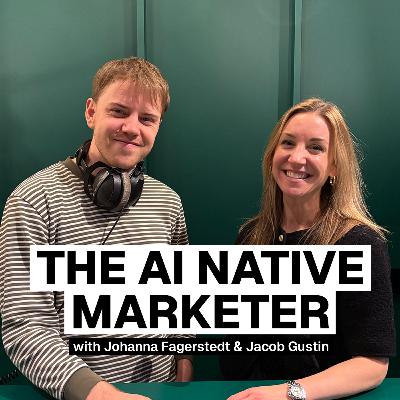
In this episode of The AI Native Marketer, host Johanna sits down with Sylwia Lindén, CMO at Quinyx (and former VP of Marketing at Tink), to explore the emerging frontier of Answer Engine Optimization (AEO) and AI Search. Sylwia breaks down how Quinyx treats AI discoverability as an integrated team discipline rather than a simple SEO add-on.The conversation covers practical strategies for tracking brand rankings across AI platforms like ChatGPT, Claude, and Perplexity, restructuring website content to answer buyer questions directly, and leveraging third-party citation sources like G2 and industry analysts. Sylwia also shares how Quinyx attributes actual revenue and pipeline directly to AI search referrals using HubSpot, and why authentic, non-salesy content is essential to winning the trust of both human buyers and AI models.Key TakeawaysAEO as a Core Discipline: Why AI discoverability spans brand, PR, thought leadership, and web infrastructure rather than sitting isolated within traditional SEO.Tracking AI Visibility: How Quinyx tracks branded and unbranded prompt rankings across major AI models using dedicated search monitoring tools.Content Restructuring: Moving away from sales-heavy copy to clear, direct, Q&A-style content that AI crawlers can index and summarize effectively.The Power of Third-Party Citations: Why AI search engines rely heavily on external credibility—such as review platforms (G2), analysts, and media—over self-hosted website copy.Closed-Loop AI Attribution: Tracking real buyer journeys from initial AI search queries (e.g., Perplexity) to demo requests and closed-won deals in HubSpot.Tools MentionedQuinyx: The workforce management platform where Sylwia serves as CMO.Searchable: An AI search monitoring and tracking platform used by Quinyx to measure prompt visibility and citation sources.HubSpot: Used by the Quinyx team to track AI-referred web traffic, demo requests, and pipeline attribution.Claude (Anthropic): Sylwia's primary day-to-day AI tool, used as a thinking partner, executive devil's advocate, and synthesis engine.ChatGPT: Used for early benchmarking, prompt testing, and AI search visibility tracking.Perplexity & Gemini: Monitored as key AI search platforms where prospective B2B buyers conduct product research.G2: A B2B software review platform highlighted as an important third-party citation source for AI engines.
In this episode, AI specialist Jacob Bergdahl from Monterro joins Johanna to share a practical, step-by-step guide to getting the most out of Claude.Jacob explains how to set up Claude properly, build a personal memory bank, create reusable skills for your tone of voice and brand, and connect Claude to the systems your organization already uses. He also walks through how to create consistent, on-brand presentations, automate recurring work, and build routing skills that help Claude find the right information across different systems.The conversation explores the most common mistakes people make with AI, why planning before prompting saves time and resources, how to avoid AI slop, and why it is still not too late for your organization to become an AI frontrunner.The AI Native Marketer is hosted by Johanna Fagerstedt, Founder and CEO of Sparketing.io, and Jacob Gustin, Product Marketing Manager at Mentimeter.Show notesConnect with the guestFollow Jacob Bergdahl on LinkedInLearn more about MonterroTools and platforms mentionedClaude: The main AI platform discussed throughout the episode.Claude Cowork: Used to work with folders, create files and complete multi-step tasks.ChatGPT: Discussed as an alternative AI platform and an example of how reusable skills can move between tools.Microsoft Copilot: Another AI platform introducing agentic and cowork capabilities.OneDrive and Google Drive: Suggested as simple places to build and maintain an external AI memory bank.Obsidian: A note-taking application that can be used to build a more advanced personal knowledge base.Microsoft PowerPoint: Used to demonstrate how Claude can create branded presentations and reusable presentation skills.GitHub: Used by more advanced organizations to store, manage and distribute skills through plugins.HubSpot and Salesforce: Examples of business systems that Claude can search and update through connectors.
Björn Ingmansson is Marketing Director at Kognic, a Gothenburg-based company building data tools for physical AI and self-driving vehicles, with customers across Europe, the US, and China. He's also the founder of The Froject, a community helping GTM teams get real value out of Claude.In this episode, Björn walks us through how he single-handedly runs a global marketing function using Claude. He's built self-hosted websites, custom sales decks, localized pitches for enterprise accounts, and personalized landing pages, all in HTML via Claude, with no coding background whatsoever.We talk about why context is everything, how he's cracking AEO for Chinese LLMs like Qwen and DeepSeek, and how he thinks about what to build vs. buy. Plus: a Game Boy-based sales tool that might just be the most unexpected ABM tactic we've ever heard.Links from this episode:The Froject: https://www.thefroject.comTella (video tool): https://www.tella.comVercel (website hosting): https://vercel.comLouise de Sadeleer (guest recommendation) on LinkedIn: https://www.linkedin.com/in/louise-de-sadeleer
This one's for anyone who wants to see AI in actual commercial use, not as a future vision, but as daily infrastructure.Kalle Mobeck is the founder of Align the Commercial Collective and one of the most hands-on AI operators in the Nordics. He built a full AI-generated campaign for a fashion brand in three weeks. It became their second best performing campaign of the year.In this episode, we get into how he thinks about creative input in a world where output has become easy, why speed is the new competitive advantage, and what three surprisingly old-school things still win in B2B marketing. (Plus: he accidentally reveals more than he meant to about his secret AI band.) An amazing episode; concrete, honest and definitely worth your commute.Key topicsAI's impact on marketing workflows and campaign speedPractical use cases of AI in creative campaignsBuilding community and thought leadership in B2BAlign's innovative agency model leveraging freelancers and AIFuture trends in marketing and AI integrationRelevant links:Align - The Commercial CollectiveChatGPTClaude AIMidjourneyZuno Music AIAim'n winter campaign
Episode DescriptionIn this episode of The AI Native Marketer, hosts Jacob and Johanna dive deep into the AI-driven strategies of Ian, Head of Growth at Tandem Health. Ian shares how his team at the Stockholm-based AI medical assistant startup has moved past simple prompting to building complex, automated systems.The discussion explores Ian’s "just do it" philosophy, which led him to build a Slack bot that allows any employee to edit website copy across 10+ languages and a sophisticated 12-step content pipeline that handles everything from research via PubMed to hallucination checks and direct publishing. Ian also discusses the future of work, where the LLM becomes the primary interface for all company tools, effectively acting as a "Context OS" for the modern professional.Tools MentionedTandem Health: The AI medical assistant platform where Ian leads growth.Claude (Anthropic): Ian’s primary tool for daily work, coding, and building internal bots.Framer: The website provider Tandem Health uses; Ian built an API connection to automate copy updates.Slack: Used as the interface for their internal translation and copy-editing bots.Notion: Utilized as a "Context OS" where Ian stores his meetings and tasks to be processed by AI.PubMed: A repository of medical journals integrated into their content workflow for high-quality research.Perplexity: Used by the team for deep research and information gathering.Zapier: Mentioned as a tool Ian initially used before transitioning to building custom connections with Claude.

Comments

Download from Google Play

Download from App Store
 United States