


 Claim Ownership
The Accounting Technology Lab
Subscribed: 10Played: 87
Subscribe

© (c) 2026 CPA Practice Advisor
Description
In-depth, honest accounting software and technology reviews capturing the real-life experiences of using particular products and solutions - presented by CPA Practice Advisor and technology experts Randy Johnston and Brian Tankersley, CPA.
44 Episodes
Reverse
The technology M&A market is sending some unusually clear signals about where the industry is headed. In ATL277, Randy Johnston and Brian Tankersley examine a wave of acquisitions involving AI, semiconductors, data platforms, streaming, automation, and accounting technology—and what those deals may mean for accounting professionals.The discussion ranges from Lattice Semiconductor's acquisition of AMI and onsemi's proposed Synaptics deal to Salesforce's acquisition of Fin, Progress Software's Domo transaction, Bending Spoons' Airtable acquisition, Sage's purchase of Bangert, NVIDIA's proposed acquisition of Hugging Face, and SpaceX's acquisition of Cursor. Stripe's agreement to acquire OpenRouter gets particular attention because AI routing could become an important layer of tomorrow's technology stack. 20261002 Tech Mergers and Acqui…But the episode isn't really about dealmaking. It's about technology strategy and vendor risk. When a product your firm depends upon is acquired, its pricing, roadmap, integrations, support, privacy practices, or even its continued existence can change. Brian's advice: treat an acquisition as a trigger to revisit your contingency plan. 20261002 Tech Mergers and Acqui…Why This Episode MattersThe common thread running through these deals is control of strategic technology layers.Stripe's OpenRouter agreement provides access to a gateway spanning 400+ AI models. Stripe Salesforce paid approximately $3.6 billion for Fin and completed the transaction September 10, the day before ATL277 was recorded. Salesforce Investor Relations NVIDIA announced its agreement to acquire Hugging Face for approximately $12.9 billion just eight days before the recording. NVIDIA BlogFor accounting firms, that means vendor due diligence cannot stop when the software contract is signed. Ownership changes are technology-risk events.Highlights:Technology consolidation is accelerating. Randy argues that M&A activity can help identify longer-term technology trends. 20261002 Tech Mergers and Acqui…AI infrastructure is becoming strategic. Stripe's OpenRouter agreement highlights the growing importance of model routing and token economics. StripeAI agents are becoming acquisition targets. Salesforce agreed to pay approximately $3.6 billion for Fin, formerly Intercom. Salesforce Investor RelationsHardware and edge AI matter too. Lattice acquired AMI, while onsemi agreed to acquire Synaptics in a transaction valued at approximately $7 billion. Lattice SemiconductorData is part of the acquisition thesis. FOX's proposed $22 billion Roku acquisition combines content with a platform reaching more than 100 million streaming households and significant first-party data. SECAccounting-adjacent M&A continues. Sage acquired longtime partner Bangert, bringing its construction implementation expertise and AskRichard AI-enabled onboarding platform into Sage. SageThe real lesson is contingency planning. Brian recommends reassessing alternatives whenever a critical vendor or product is acquired. Accounting Technology Lab Episode ATL277Wiki Page: https://wiki.cpate.ch/index.php/ATL277 Title: Technology Mergers and AcquisitionsPublication Date: October 2, 2026Recorded: September 11, 2026Hosts: Randy Johnston and Brian F. Tankersley, CPA.CITP, CGMAPresented by: CPA Practice Advisor
In ATL276, Randy Johnston and Brian Tankersley sit down with Alexis Kingsbury, author of Accrual Intentions, to unpack what he learned from building a deliberately extreme experiment: an accountancy practice staffed by eleven AI agents with their own roles, personalities, and responsibilities. Kingsbury explains that the project began as part parody and part management-science experiment, but quickly became a practical test of delegation, workflow design, controls, and human judgment.The central lesson is not that AI is either brilliant or useless. It is that AI can perform impressively on difficult tasks and still make simple, checkable mistakes. Kingsbury argues that firms should separate probabilistic AI work from deterministic processes, document workflows, insert stage gates, and decide explicitly where human review belongs. He warns leaders not to confuse delegating the work with delegating the thinking.The discussion also covers token economics, local models, model portability, and the risk of locking organizational knowledge inside one AI vendor's project environment. Kingsbury recommends keeping core context, processes, and organizational knowledge in systems the firm controls, then connecting AI tools to that context. His closing advice: do not wait for perfect AI, and do not attempt a giant transformation. Pick a painful, valuable problem, solve it deeply, learn, and expand.Key TakeawaysAI can be brilliant and stupid within the same workflow. Kingsbury describes Claude completing sophisticated work correctly and then altering an API-provided link enough to break it.Delegate execution carefully; do not accidentally delegate judgment. If AI takes over production, humans need to make the thinking, objectives, assumptions, and review gates more explicit.Deterministic controls matter. Where possible, use AI to create repeatable calculations, scripts, tests, templates, checklists, and processes.Review capacity has to scale with AI production capacity. Eleven virtual workers can generate an enormous volume of output, and that output still requires testing, prioritization, and accountable review.Your organizational knowledge should not belong to your AI vendor. Portability matters when prices, models, jurisdictions, or vendor strategies change.Token efficiency can become an economic issue quickly. AI consumption may require active optimization as usage scales.Waiting for “perfect AI” is not a strategy. Context, processes, guardrails, and review will remain necessary.Avoid the giant AI transformation project. Start with one sufficiently painful or valuable business problem, solve it well, and expand.Short Promotional CopyOne-Sentence PromoWhat happens when you give eleven AI agents jobs, personalities, responsibilities—and enough autonomy to expose everything that can go brilliantly right and spectacularly wrong?Three-Sentence PromoAlexis Kingsbury built an accountancy practice staffed by eleven AI agents and turned the experiment into Accrual Intentions. In ATL276, he joins Randy Johnston and Brian Tankersley to discuss what the experiment revealed about AI errors, delegation, controls, token economics, organizational knowledge, and human judgment. The big lesson: AI can dramatically expand what a firm can do, but only if governance and review expand with it.Promotional ParagraphYour AI agent just completed the sophisticated analysis, updated the documentation, called the right tools—and then broke the link it was supposed to give you.That kind of contradiction is at the center of ATL276: The Secrets Agents Keep. Alexis Kingsbury joins Randy Johnston and Brian Tankersley to explain what he learned building the AI-staffed accounting experiment behind Accrual Intentions. The conversation moves beyond “AI good” versus “AI bad” and gets into the management problem: how do you provide context, separate thinking from doing, design deterministic controls, scale review, manage token costs, and keep your intellectual property portable instead of trapping it inside one AI provider?Timestamped Pull QuotesTimeSpeakerPull QuotePromotional Angle05:03 | Alexis Kingsbury | “It'll just be easier if I do it myself.” | AI vs. delegation12:40 | Alexis Kingsbury | “If you want a really good decision made, you don't want two people who think the same.” | Diversity of perspective26:08 | Alexis Kingsbury | “There's value, but also risk… maximize value and mitigate the risk.” | Governance34:28 | Alexis Kingsbury | “If you can get rid of the things that we don't enjoy… you get more time on the things that do add value.” | Human value38:33 | Alexis Kingsbury | “If you are delegating the doing, you have to pull out the thinking and do the thinking up front.” | Management47:03 | Alexis Kingsbury | “I've been able to improve token efficiency by 4,000x.” | AI economics50:48 | Alexis Kingsbury | “One other big mistake I would suggest people avoid is giving the keys away to big AI firms.” | Vendor lock-in53:15 | Alexis Kingsbury | “The technology is already good enough. It's just that you need all the guardrails and the context.” | Implementation53:15 | Alexis Kingsbury | “Pick something in your business that is either incredibly frustrating and painful… or is a current missed opportunity for value.” | Where to startProduction note: Timestamps are based on the supplied transcript/SRT. Recheck them against the final edited episode before cutting promotional video.Best Short-Video PullsThe brilliant AI that breaks the easy thing — approximately 22:55–26:40Discussion of deterministic versus probabilistic work, culminating in Alexis's story about AI completing difficult work and then altering a valid link.Delegate the doing, not the thinking — approximately 38:30–45:00Alexis explains why removing the manual production step means leaders must intentionally preserve the thinking step.Tokens, local AI, and vendor economics — approximately 47:00–52:30Discussion of AI subsidies, token efficiency, local models, and changing provider economics.Don't give away the keys — approximately 50:45–53:10Governance discussion about keeping organizational context outside proprietary AI workspaces and making it accessible through tools such as MCP.How accounting firms should start — approximately 53:15–56:30Don't wait for perfect AI, don't start with an enterprise-wide transformation, and don't waste time on trivial experiments. Pick a valuable problem.Suggested Show NotesWhy Alexis created an accountancy practice staffed by eleven AI agents.Why the experiment began as both parody and serious management research.Custom GPTs and the early evolution of the virtual accounting team.Giving agents different roles, personalities, backgrounds, and perspectives.Why multiple viewpoints can improve AI-assisted decision-making.Moving from Custom GPTs to Claude Code, Claude Cowork, Codex, and agentic workflows.Why LLMs sometimes excel at complicated work but fail at simple tasks.Probabilistic AI versus deterministic calculations and processes.Using AI to build conventional software, scripts, templates, and controls.Why “I checked i...
Episode SummaryAI may feel like a flat monthly subscription today, but ATL275 argues that the economics are moving toward a metered, multi-model market. Randy Johnston and Brian Tankersley examine AI routers, token marketplaces, and agent orchestration—tools designed to let firms choose different models for different jobs rather than committing every task to one vendor.Brian explains why OpenRouter and LibreChat can make model choice resemble buying fuel: use the amount of compute you need in the engine best suited to the work. Randy connects that concept to a three-layer AI strategy spanning general productivity tools, AI embedded in accounting applications, and specialized agents.The hosts also discuss the difficulty of forecasting token budgets, the likelihood of more usage-based pricing, and a growing field of gateways including OpenRouter, Ramp Router, Factory Router, Portkey, LiteLLM, Cloudflare, Kong, AWS, Microsoft, and Google.For accounting firms, the practical issue is not merely cost. Model selection, privacy, compliance, governance, and vendor concentration all matter when agents handle sensitive workflows. The takeaway: expect AI procurement to look less like buying one software subscription and more like managing a portfolio of compute suppliers—optimizing each workload for capability, cost, risk, and control.Key TakeawaysEvery AI workload consumes compute. Whether the customer sees a monthly subscription or an API invoice, somebody is paying for the tokens behind the transaction.One model does not necessarily fit every workload. AI routers can give organizations access to different models without separately funding and administering every provider.Cost optimization will become part of AI governance. Firms may increasingly route simple work to inexpensive models and reserve expensive frontier models for jobs that justify the added capability.Per-seat pricing may not be the final economic model. As agents become more common, usage-based pricing could become increasingly important.Accounting firms need more than cheap tokens. Privacy, contractual protection, data handling, auditability, regulatory compliance, security, and vendor stability remain critical.AI gateways are becoming strategic infrastructure. OpenRouter, hyperscale cloud platforms, and newer routing competitors are competing to become the transaction layer between applications and AI models.“Bring your own tokens” may become commonplace. Software vendors can increasingly let customers supply their own API credentials and select the AI models used inside applications.Token measurement should eventually resemble cost accounting. Firms need to understand the cost of AI by workflow, agent, client, and business process—not merely the organization’s total monthly AI bill.
ATL274 — Alliances, AI, and Self-Funding! Oh My!Guest: Dan Pinkous, Founder & CEO, TrussHosts: Randy Johnston and Brian F. Tankersley, CPA.CITP, CGMAPodcast: The Accounting Technology LabPublisher/Sponsor: CPA Practice AdvisorRelease Date: September 11, 2026Approximate Runtime: 28:26Primary Topics: Tax workflow, artificial intelligence, technology partnerships, client experience, advisory services, document management, practice management, startup funding, pricing200-Word Episode SummaryIn ATL274, Randy Johnston and Brian Tankersley talk with Daniel Pinkous, founder and CEO of Truss, about a tax workflow platform built around three ideas: low-friction client experience, AI embedded throughout the workflow, and partnerships instead of trying to build every specialized capability internally. Pinkous explains that Truss began in late 2022 as an AI-native product, using large language models for document processing, client checklists, research, planning, and other tasks intended to move firms away from compliance tedium and toward advisory work.The conversation highlights Truss partnerships with Ping Assistant, Kintsugi, Filed, Byron, Magnetic, K1x, GruntWorx, CygnusAI, Bizora, and Karbon. Rather than replace every tax, practice-management, or document-management tool, Truss aims to connect the client-facing parts of intake, workpapers, preparation, and delivery while keeping the experience consistent.Pinkous also discusses adoption, saying Truss emphasizes web-based, zero-account client access and reports high client satisfaction. The episode closes with a different startup story: Truss says it is customer-funded, has taken no outside venture capital, operates profitably, and uses a simple firmwide pricing model with unlimited users, returns, e-signatures, and AI usage.For accounting firms, the question is not simply which tool wins, but how a connected ecosystem improves workflow, service, and control.Key TakeawaysPartnerships can beat territorial product strategies. Pinkous argues that accounting technology vendors have historically been too territorial. Truss's strategy is to partner where another vendor has deeper expertise instead of attempting to recreate every specialty internally.AI is most useful when it disappears into the workflow. Truss was started in late 2022 and designed around AI from the beginning. Pinkous describes large language models working “under the hood” for document naming, page rotation, document processing, tax-year validation, checklists, research, planning, and other tasks.The goal isn't merely more compliance capacity. Pinkous sees automation first eliminating tedious compliance work and then creating room for higher-value advisory services.Tax workflow is an ecosystem problem. A tax engagement can involve intake, document collection, workpapers, preparation, signatures, payments, delivery, storage, and practice management. The more those pieces live in disconnected applications, the more time staff spend hunting for information instead of doing accounting work.There is a difference between “capital-W” and “small-w” workflow. Traditional practice-management systems such as Karbon or XCM manage the firm's broader internal workflow. Truss focuses heavily on the smaller client-facing workflows surrounding an engagement—requesting documents, exchanging information, preparing and delivering returns, collecting signatures, and keeping clients informed.Client adoption is an implementation metric, not a cosmetic metric. Pinkous argues that firms cannot redesign workflow around technology that only a fraction of their clients will use. Truss therefore emphasizes a low-friction, firm-branded experience with minimal login and account-creation barriers.Tax may be the entry point, but client experience crosses service lines. Pinkous says firms sometimes extend their use of Truss into audit and CAS because clients should not need an entirely different interaction model every time they work with another department.Document management remains an unresolved piece of the modern stack. The discussion touches on FileCabinet CS, SharePoint, Google Workspace, and other repositories. Pinkous describes Truss's own document-management capabilities while acknowledging that larger firms may still need more specialized systems and integrations.Capital structure affects product governance. Truss says it has been built without venture-capital financing. Pinkous argues that being customer-funded changes priorities because management is not simultaneously optimizing for an outside investor's required growth rate or next funding round.Pricing simplicity can reduce implementation friction. Pinkous describes firmwide pricing with unlimited users, returns, e-signatures, and AI usage rather than metering every transaction.Catchy Quotes and Video/Audio LocationsTimeSpeakerPull QuotePromotional Angle03:55 | Dan Pinkous | “The first phase… save these firms from the tedium… liberate them from the compliance. Really, the second phase is now we can be free to do advisory.” | AI and advisory06:52 | Dan Pinkous | “The industry has been too territorial, and it's hurting accountants. We need to be working together. We need to be collaborating.” | Alliances07:05 | Dan Pinkous | “Ping is peanut butter and jelly with us.” | Partner ecosystem12:00 | Dan Pinkous | “Client says they uploaded something. Okay, where did they upload it? And I got to go search across four or five different systems.” | Workflow fragmentation21:01 | Dan Pinkous | “What if we start with the client experience, and we really nail that? And that's our primary north star for success.” | Client experience21:16 | Dan Pinkous | “I can't build a workflow around something where only 30% of my clients are using it… we need to push for 90% plus adoption.” | Technology adoption24:09 | Dan Pinkous | “We're really unique in that we're one of the only companies in the space that is built customer funded. We haven't taken any venture capital funding, any outside funding whatsoever.” | Self-funding24:41 | Dan Pinkous | “We get to serve just one master, and that's our customers.” | Best quote for graphics25:53 | Dan Pinkous | “Operating profitably is a much more stable future… long-term way to build.” | Vendor sustainability27:22 | Dan Pinkous | “One simple price for the entire firm, unlimited usage, unlimited e-signs, unlimited returns, unlimited users… unlimited AI usage… go crazy, have fun.”
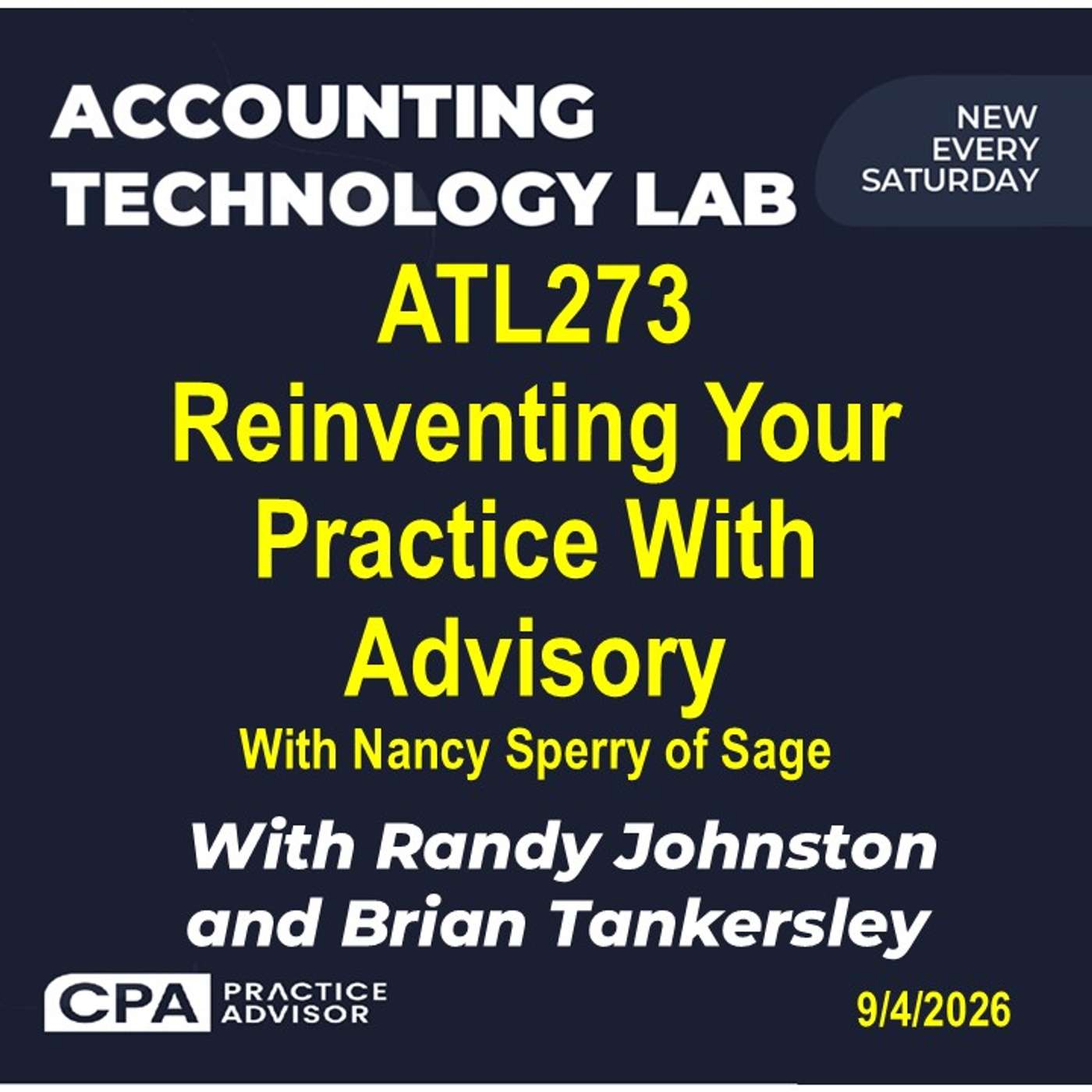
ATL273 — Reinventing Your Practice with Advisory With Guest Nancy Sperry of SageEpisode: ATL273Release date: September 4, 2026Hosts: Randy Johnston and Brian F. Tankersley, CPA.CITP, CGMAGuest: Nancy Sperry, Senior Vice President of U.S. Partner Sales, SageApproximate runtime: 33 minutesPrimary topic: Using trusted AI, agentic automation, and the Sage partner ecosystem to move accounting professionals from transaction processing toward higher-value advisory work.In ATL273, Randy Johnston and Brian Tankersley talk with Nancy Sperry, Senior Vice President of U.S. Partner Sales at Sage, about how AI can help accounting firms and finance professionals reinvent their practices around advisory services. Sperry argues that AI adoption in accounting depends on trust: systems must be explainable, auditable, secure, controllable, and subject to human approval. That “glass box” approach can reduce the time professionals spend validating transactions and manipulating data, freeing them to interpret results, advise clients, and look forward instead of backward.The discussion explores Sage Copilot, finance and close agents, partner-built agents, and a future agent marketplace where solutions created for one client may be reused across the Sage ecosystem. The hosts and Sperry also examine how AI could accelerate micro-vertical specialization in industries such as construction and nonprofit organizations, while integrations and Model Context Protocol connections may reduce dependence on traditional middleware and point solutions.The episode closes with Sage’s broader platform strategy, including Sage Intacct, Sage HCM, and acquired products, and with a clear message for firms: advisory growth will require both AI-enabled productivity and disciplined governance, security, accountability, and human oversight as firms redesign workflows and deepen trusted relationships with clients today.Key TakeawaysTrust is the gating factor for accounting AI. Explainability, auditability, approval workflows, security, and accountability matter as much as model capability.Advisory becomes more practical when the mechanical work shrinks. Automation can move professionals away from manipulating data and toward interpreting what the numbers mean.Finance will not become autonomous overnight. Sperry notes that only a small portion of finance functions are autonomous today; confidence must be earned through reliable results and controls.Agents create a new partner opportunity. Sage partners may be able to build agents for specific client problems and then distribute reusable solutions through a broader marketplace.Industry specialization can get much deeper. AI and agent builders may allow firms to move beyond broad verticals such as construction into highly specialized micro-vertical workflows.MCP and cross-system agents can change the technology stack. Agents that work across systems such as CRM, payroll, and ERP could eliminate some traditional integration layers—but also introduce new security concerns.Advisory becomes forward-looking. The opportunity is to spend less time looking through the rearview mirror and more time helping clients see through the windshield.Human oversight remains essential. The accountant, CFO, or advisor remains responsible for consequential decisions even when AI performs more of the underlying work.Sage is broadening the platform around finance, HR, payroll, expenses, construction, forecasting, practice management, and other adjacent workflows.The strategic opportunity is bigger than efficiency. AI can change the relationship between the accounting professional and the client by making interpretation, specialization, and continuous advice economically feasible.Catchy Quotes and Video LocationsTimes are based on the supplied transcript and may shift slightly if the published video contains a different intro, edit, or advertising insert.00:55 — Nancy Sperry: “AI is the most exciting and really going faster than either of those two kind of major changes.”04:34 — Nancy Sperry: “Anything that is explainable and that I can click through and see the result… gives a lot of confidence.”06:48 — Brian Tankersley: “When the math’s not mathing, it’s not good for anybody in accounting.”08:24 — Nancy Sperry: “I see it being a really big revolution in the relationship.”10:37 — Nancy Sperry: “Turn the headlights on and see into the future.”13:36 — Nancy Sperry: Partners can “solve real business problems that are really critically important to that client.”15:58 — Randy Johnston: Advisory is “looking out the windshield as opposed to looking in the rearview mirror.”20:44 — Nancy Sperry: “Partners are the intersection of that for us at Sage.”26:26 — Nancy Sperry: Sage’s “glass box approach” is designed to provide confidence, control, oversight, and accountability.31:39 — Nancy Sperry: AI creates an opportunity for partners “to just create amazing outcomes.”

Comments

Download from Google Play

Download from App Store
 United States