


 Claim Ownership
The Bureau Podcast
Subscribed: 60Played: 1,397
Subscribe

© Sam Cooper
Description
Investigative Journalism. Anti-Corruption. Counter-Disinformation. Whistleblowers. Sunlight. Connecting the dots on The Bureau's big stories with Sam Cooper and guests.
www.thebureau.news
www.thebureau.news
71 Episodes
Reverse
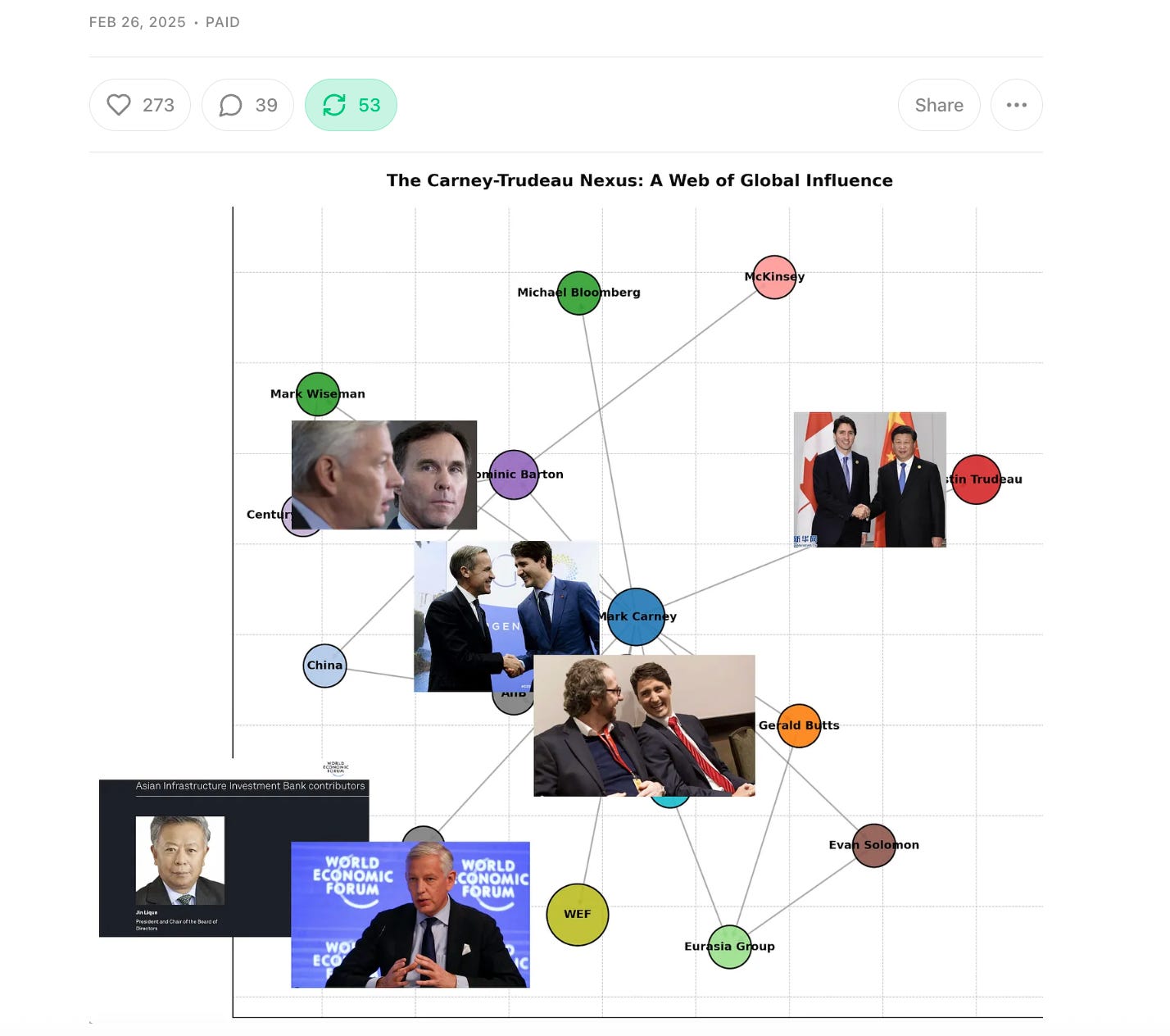
OTTAWA — For The Bureau’s 2025 Holiday Special, I sat down once again with Jason James for a long-form, two-hour conversation—our second holiday edition—to answer his questions about the elite networks surrounding Prime Minister Mark Carney and the China connections that have quietly defined his ascent.Perhaps presciently, during the federal election campaign The Bureau published a network-mapping model outlining the key figures orbiting Carney, including Dominic Barton, Jin Liqun, Mark Wiseman, and Evan Solomon. Months later, that exercise looks well founded. Wiseman has now been appointed Carney’s ambassador to the United States—a critical position as Canada tries to steer a course between the world’s two rival superpowers. And Solomon, the former CBC host once caught up in an art-dealing scandal involving Carney, is now Minister of Artificial Intelligence—another portfolio that sits squarely between U.S. and Chinese competition over advanced technology, critical minerals, and energy security.In the episode, I tell Jason that the pattern isn’t coincidental. It reflects the same constellation of influence The Bureau mapped before Carney ever took office: long-standing relationships of trust shaped through finance, global governance, and shared ambition—often paired with a marked propensity to favour deeper trade and engagement with Beijing, an authoritarian regime built on the subjugation of hundreds of millions of Chinese nationals. That context is central to how I assess Carney’s rise, including analysis I have previously provided in testimony at a Parliamentary ethics hearing.A review of corporate records showed that Brookfield—the influential Canadian investment fund from which Carney stepped away to replace Justin Trudeau as Canada’s leader—maintains many billions in politically sensitive investments with Chinese state-linked real estate and energy companies, alongside a substantial offshore banking presence. One major venture included a $750 million entry into high-end Shanghai commercial property in 2013 with a Hong Kong tycoon affiliated with the Chinese People’s Political Consultative Conference—an entity U.S. intelligence and national-security analysts have described as central to Beijing’s united front ecosystem.As that market later deteriorated—vacancies rising in Shanghai and credit conditions tightening—Brookfield secured hundreds of millions of dollars in loans from the Bank of China to refinance its Shanghai commercial holdings. The Bureau’s reporting has also noted the broader continuity: a decade earlier, Carney, as Governor of the Bank of England, publicly advanced policies designed to expand China’s financial footprint, including support for renminbi clearing in London. In a 2013 speech, UK at the Heart of Renewed Globalisation, Carney said: “The Bank of England [has] signed an agreement with the People’s Bank of China … Helping the internationalisation of the Renminbi is a global good.”In this episode, Jason adds a finding about Mark Carney’s promotion of Beijing’s Belt and Road plan—another massive boost, I argue, to President Xi Jinping’s global ambitions.The Bureau is a reader-supported publication. To receive new posts and support my work, consider becoming a free or paid subscriber. This is a public episode. If you'd like to discuss this with other subscribers or get access to bonus episodes, visit www.thebureau.news/subscribe

TORONTO — In this breaking news episode for The Bureau, I speak with political columnist Brian Lilley about the diaspora pressure networks now surfacing around Michael Ma, the Conservative MP who crossed the floor last week and left Prime Minister Mark Carney’s Liberals one seat short of a majority. Brian says his sourcing points to a straightforward explanation. Tim Hodgson, the minister of energy and the MP for Markham–Thornhill, played a key role in persuading Ma to switch sides, drawing on the pair’s business-network affinities.I tell Brian that is likely true — but it may not be the only dynamic at work. Diaspora pressure groups that have repeatedly aligned themselves with Beijing’s interests and intervened in Conservative Party politics could be operating in parallel. In both scenarios, actors advocating expanded trade with Beijing could be a shared underlying motivation.A second layer concerns the pro-Beijing ecosystem embedded in Hodgson’s riding. The Liberal executive head in Hodgson’s riding, a senior Liberal organizer and former leader of the Jiangsu Commerce Council of Canada, has already come under scrutiny after Prime Minister Mark Carney falsely denied meeting the group during his January leadership campaign. The episode is one of many concrete data points emerging from a years-long Bureau investigation into the Jiangsu council’s structure and leadership, documenting direct ties to Beijing’s United Front Work Department, and significant overlap between this pro-Beijing business network and Liberal Party organizing.Against that wider backdrop, I walk Brian through the core findings of my new reporting on Ma. Chinese-language records reviewed by The Bureau show he was part of the Chinese Canadian Conservative Association, a controversial diaspora organization that urged Erin O’Toole to resign after the 2021 election over what it called his “anti-China” stance, later urged Chinese Canadians to “vote carefully” ahead of the 2025 election, and resurfaced after the vote to call for Pierre Poilievre to step down.None of this is proof of wrongdoing by Ma, I tell Brian. But taken together, it suggests he should answer questions about the pro-Beijing supporters who endorsed his Conservative campaign this year.The Bureau is a reader-supported publication. To receive new posts and support my work, consider becoming a free or paid subscriber. This is a public episode. If you'd like to discuss this with other subscribers or get access to bonus episodes, visit www.thebureau.news/subscribe

OTTAWA — In this investigative conversation, sinologist Chris Meyer and I start with Chinese threats against Japan’s new prime minister, Sanae Takaichi—and advance the argument that Beijing’s “diplomacy” is increasingly inseparable from criminal subversion operations worldwide, and should be treated as such.The trigger is simple. Newly elected Takaichi reiterates a strategic reality Japan has been forced to confront for years. An attack on Taiwan would represent a grave threat to Japan. Chris, who writes for Wide Fountain, notes this was not some wild new doctrine, but a restatement of what former prime minister Shinzo Abe had already made public. The response from Beijing, however, does not resemble conventional state-to-state disagreement. Chris describes how China’s consul general in Osaka replied with language that reads like a street-level threat—saying that if Takaichi “sticks her dirty neck out,” it will have to be “sliced off.”What follows matters even more than the threat itself. Chris explains how Beijing then moved to the United Nations with a concerted effort to discredit Japan’s prime minister and pressure her to retract her comment—an example of how international institutions can be leveraged as tools of coercion and narrative warfare. I frame it as gaslighting: the familiar move in which Beijing provokes, threatens, and escalates, then turns around and casts the democratic target as the aggressor.Chris offers a theory for why the intimidation is so brazen. He says there is constant chatter in Beijing that Xi Jinping has been losing leverage internally—over military networks and provincial factions—while his external apparatus, especially diplomatic channels, may be less disturbed. In that scenario, Chris argues, foreign intimidation becomes one of the few levers still available. Louder, uglier, and more reckless precisely because it is meant to compensate for weakness elsewhere.From Japan we widen to the United Nations not as an abstract symbol, but as a venue where Chris and I argue the line between “diplomacy” and “criminal enterprise” has been blurred before—and where Beijing nonetheless demands to be treated as an arbiter of international law. Chris references the cases of Ng Lap Seng and Patrick Ho as part of the backdrop—figures he describes as operating around the UN ecosystem while pursuing corrupt influence projects. His core point is that China cannot plausibly posture as the guardian of international legal order while, in the same era, actors linked to Beijing were accused of bribery and covert influence schemes tied to Belt and Road ambitions.From there, the conversation becomes less about one diplomatic incident and more about a recurring operating system: intelligence-linked influence, organized-crime logistics, and the laundering of legitimacy through formal titles and institutions. The most sprawling and contemporary case we examine is Cambodia’s Prince Group. Chris describes it as an industrial-scale scam ecosystem — a network of “prison factories” where coerced workers are forced to run global fraud operations under threat of violence, their passports confiscated to prevent escape.What distinguishes Prince Group, Chris argues, is that it appears to function not merely as a criminal enterprise but as a Chinese intelligence-directed operation designed to destabilize Western nations — and it is far from the only one of its kind operating across Southeast Asia. We also note that U.S. Treasury sanctions and recent indictments highlight that players linked to Prince Group, including a United Front figure named Rose Wang and sanctioned “Hongmen” Triad boss Broken Tooth Koi, perform diplomatic functions for Beijing.Near the end, we return to North America with a detail that we both treat as chilling. I reference CBC/Radio-Canada reporting about a Chinese operative known as Eric—someone whose phone records reportedly suggested lethal targeting of dissidents, including a Vancouver-based Chinese dissident who later died in a suspicious kayaking incident.All of that sets up the ending. Canada’s leadership has spoken about re-engaging China as a strategic partner. After what we have just mapped—threat diplomacy against Japan, coercive lawfare at the UN, criminal-corporate influence systems in Southeast Asia, triad-linked “patriotic” networks, and North American beachheads that, in my view, were never checked—what does “strategic partner” even mean? Chris’s answer is unambiguous. In his assessment, there is no reset available with Xi Jinping’s system in place.The Bureau is a reader-supported publication. To receive new posts and support my work, consider becoming a free or paid subscriber. This is a public episode. If you'd like to discuss this with other subscribers or get access to bonus episodes, visit www.thebureau.news/subscribe

OTTAWA — In this episode of The Bureau Podcast, I chat with Canadian author, historian and former national security analyst Dennis Molinaro to unpack Under Assault: Interference and Espionage in China’s Secret War Against Canada — the book The Bureau has reviewed in three pieces, and which covers a vast array of cases revealing how Beijing has shaped Canada’s trajectory for more than half a century.One of the central themes of the conversation is Molinaro’s insistence that you cannot understand the evolution of Canada–China relations by looking only at diplomatic files or security reports.“We can’t just detach security from diplomacy and from relations,” he says. “So I wanted to try to tell that complete story as best I could.”That fuller picture includes a re-assessment of Pierre Trudeau and the 1970 recognition of the People’s Republic of China. Molinaro is careful with his evidence, but blunt about the pattern it reveals. On the recognition decision, he tells me: “I would say that the recognition of China, I’m comfortable in saying that likely looks like it was a foreign interference operation by the PRC … because of Paul Lin.”Molinaro walks listeners through the previously obscure figure of Paul Lin, an academic who moved between the West Coast, the United States, China and finally McGill University. Newly released RCMP and allied intelligence files show Lin under heavy surveillance and flagged as a likely Chinese Communist Party influence operator. In Molinaro’s words, the Mounties “flat out say that this is part of his task of being an agent of influence is to get China recognized.”At the same time, Beijing’s internal language about Canada’s leaders was far from neutral. Drawing on the testimony of defector Chen Yonglin, Molinaro explains how Chinese internal documents categorized Pierre Trudeau, Jean Chrétien and Henry Kissinger as “old friends” of the regime. As he tells me: “Old friends… it’s this category of an individual that is very close to the PRC in supporting the CCP… the CCP views them as a close ally, in a sense… even generations later, which is quite a substantial thing, I would say.”I push the conversation further, asking whether Molinaro’s work is forcing a broader re-evaluation of Pierre Trudeau’s ideological legacy and the way Canada’s elites still “see” China. Molinaro argues that the Hogue Commission hearings themselves became an example of how much Canada’s political class has preferred a comforting story over a harder look at Chinese Communist Party power.The discussion then turns to the Canada–China Business Council, Power Corporation and the Desmarais network of political relationships. I note my own reporting on how Power Corp, the Desmarais family and Jean Chrétien have been intertwined with senior Chinese state–investment bodies. Molinaro adds a deeper origin story, explaining that Paul Lin helped midwife the business council itself and then became a gatekeeper to “curated” deals inside China.For Molinaro, the problem is not legitimate business in 2025, but the origins and intent: “The problem becomes Paul Lin… his central interests were the CCP… it brings into all kinds of questions… mainly, if the government’s getting briefed on this guy… what was done about this?”Winnipeg, Wuhan and the lab-leak debateMidway through the episode, Molinaro and I shift to the Winnipeg Level 4 lab and the contested origins of COVID-19 — a chapter Molinaro says “was all about… Canada being this place where the PRC is just actively somehow operating … as it will.”We walk through the now-public documents on Dr. Xiangguo Qiu, Thousand Talents applications, the transfer of Ebola and other high-consequence pathogens to Wuhan, and the proposed “bat filovirus” gain-of-function project linking Winnipeg and the Wuhan Institute of Virology. Molinaro is explicit that the lab-leak hypothesis is not fringe: “I see this as probably more likely than having a virus that emerges so fast, basically overnight, that can infect humans on scale, just on a mass scale.”‘Canada is overrun’: how Washington now sees its northern allyIn the final third of the conversation, Molinaro reveals what senior United States officials told him when he asked how they now view Canada’s China file. One line that stuck with me: “I don’t want to say joke,” one official told him, “but the saying you get a lot of times here is, look to Canada if you want to see what could happen here.”Another was even starker: “Canada is overrun.” Molinaro interprets that as a quiet warning about intelligence sharing: “What they were trying to essentially say as nice as possible was we’re going to have to start thinking about how we share intelligence with you if you don’t clean up your PRC problem.”The episode closes with prescriptions. Molinaro says Canada must finally pass and use a meaningful foreign-agent registry. It needs RICO-style anti-racketeering laws: “You need a structure of laws that will target the people who are running these organizations and tie them to the individual offenses like the Americans are doing.” And the country must overhaul its security culture — including how CSIS, the RCMP and political leaders share and act on intelligence.Above all, he says, this is a leadership question: “If you don’t have good leadership, that’s going to take the lead on these things and solve them… don’t expect any changes.”The Bureau is a reader-supported publication. To receive new posts and support my work, consider becoming a free or paid subscriber. This is a public episode. If you'd like to discuss this with other subscribers or get access to bonus episodes, visit www.thebureau.news/subscribe
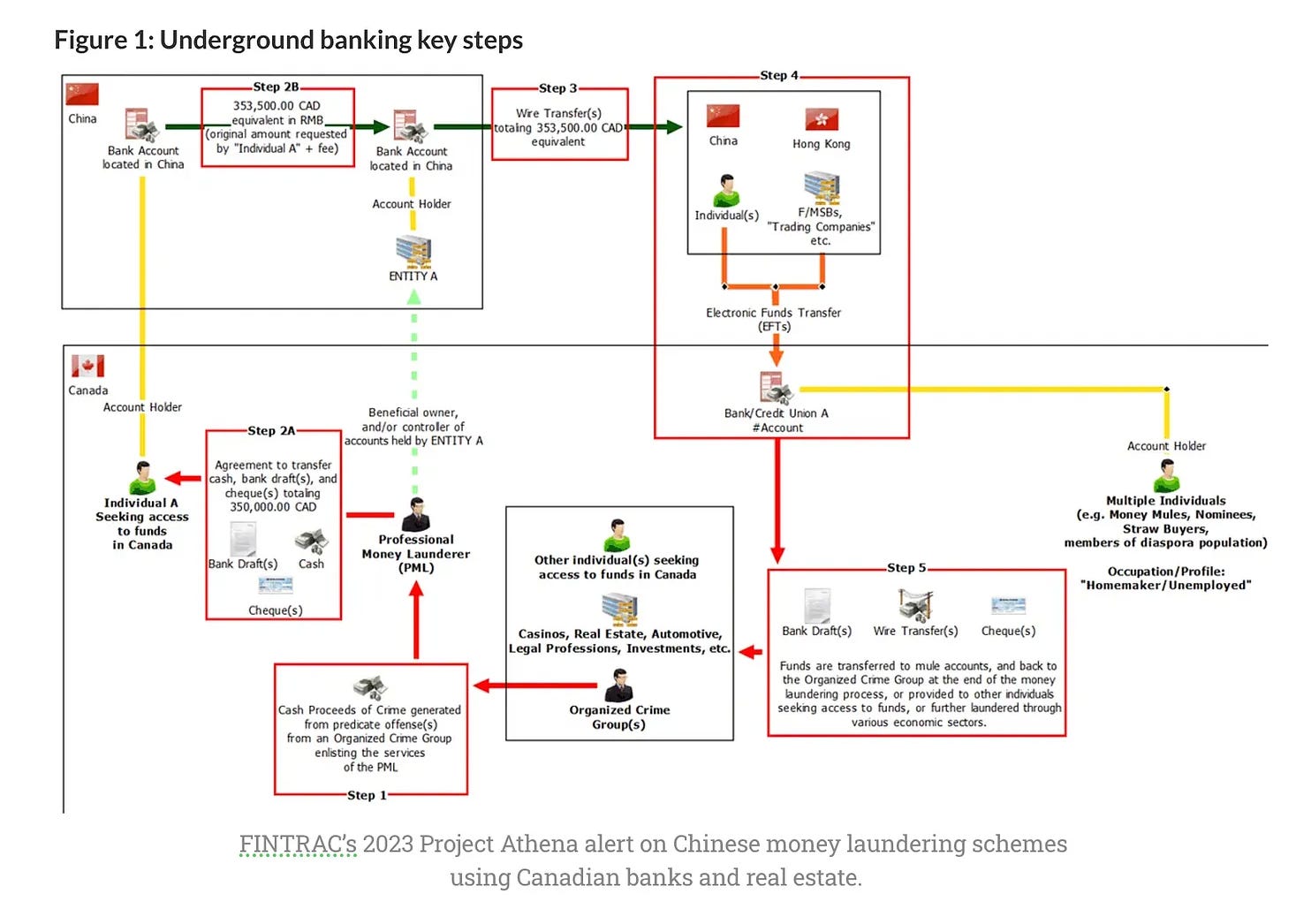
In today’s Bureau Podcast, I reconnect with my former journalism colleague Jesse Ferreras. We both came of age as reporters in Vancouver and worked together at Global News, including on an investigation into some of the most significant figures in what became known as the Vancouver Model. We don’t walk through those cases in detail on the tape, but I’ve long believed some of the people we examined could and should be the focus of deportation orders from Canada — if Ottawa’s border and security agencies fully exercised their mandates. Quietly resolving those long-ignored files would, in my view, go a long way toward rebuilding trust with Washington, where officials remain deeply concerned about certain actors embedded in Vancouver’s financial and real-estate systems.Our conversation turns on two main threads. First, we explore Jesse’s new work of fiction — a gothic horror story set in Vancouver real estate, a kind of clash-of-civilizations tale rooted in the city’s housing market. Second, we talk about how both of us, as reporters, leaned heavily on the data and analysis of B.C. urban planner Andy Yan to understand how foreign capital has dominated and distorted Vancouver’s housing market. Yan’s work on glaring income-to-home-price “incongruities” helped me see that what I once called the Vancouver Model had grown into something much larger: the “Canada Model.”The podcast goes deeper into Jesse’s story. Here in the notes, I want to unpack a bit more of Andy Yan’s seminal research, and how it intersected with confidential datasets and banking disclosures I later obtained. Two years after my 2023 investigation, the U.S. Treasury has now identified the same global Chinese underground money-laundering typologies I reported on, in a major dataset that tracks roughly $300 billion in Chinese money laundering for Mexican narco-cartels over the past four years—including more than $50 billion tied to real-estate laundering.Yan’s earlier Vancouver mortgage work supported my deep dive in Toronto, showing that the same suspicious Chinese real-estate mortgage patterns he identified in Vancouver had also become deeply embedded in eastern Canada, inside Canada’s largest banks, with virtually no enforcement response. My reporting also drew on FINTRAC’s release of a sweeping analysis of 48,000 transactions involving members of the Chinese diaspora. That study revealed massive wire transfers from Hong Kong and Mainland China moving through “money mule” accounts held by students, homemakers, and shell companies—including law firms. In a nutshell, FINTRAC found that during the pandemic, massive money laundering through Vancouver-area government casinos evolved into Canadian bank accounts, law office accounts, real-estate developer accounts, and more complex electronic transaction paths. For me, the findings showed that FINTRAC, a division of Canada’s Ministry of Finance, had complete visibility into how Canada’s banking system was being exploited at scale by Chinese transnational crime networks. At the same time, this raised serious alarms about Canada’s banking oversight, because FINTRAC’s data led to no Canadian police prosecutions and only a few minimal fines in the range of millions against several banks, including TD Canada. FINTRAC’s patterns overlapped neatly with the U.S. Justice Department’s US$3-billion TD Bank case, where international students from China and Beijing-linked United Front networks played central roles in laundering drug proceeds, according to former U.S. investigator David Asher.At the heart of my exclusive story on mortgage fraud was reporting sourced from an HSBC Canada whistleblower, who uncovered dubious Toronto-area mortgages propped up by fabricated, high “remote-work” salaries from China. The types of mortgages the whistleblower discovered—fake job titles, faked massive incomes, failed banking due diligence—in my analysis, explained the patterns behind the data that Andy Yan first uncovered in Vancouver, that FINTRAC examined in 2023, and that the U.S. Treasury flagged again in 2025.The Bureau is a reader-supported publication. To receive new posts and support my work, consider becoming a free or paid subscriber. This is a public episode. If you'd like to discuss this with other subscribers or get access to bonus episodes, visit www.thebureau.news/subscribe

OTTAWA — In this conversation with Canada’s highest-profile political columnist, Brian Lilley, I dive into how I first uncovered the improbable rise of Ryan Wedding — and how he turned Canada into a conduit for the world’s most powerful and dangerous Mexican cartels, working alongside state-adjacent actors from Iran, China, and beyond.Brian, a veteran Toronto Sun reporter, will also be sharing this videocast on his rapidly growing Substack. I recently highlighted his deep reporting on Mark Carney’s gambit for a majority through Conservative floor-crosser recruitment in a Bureau op-ed, so you may see some interesting conversations between us in the future too.The Bureau is a reader-supported publication. To receive new posts and support my work, consider becoming a free or paid subscriber. This is a public episode. If you'd like to discuss this with other subscribers or get access to bonus episodes, visit www.thebureau.news/subscribe

 1
1OTTAWA — In a recent episode of The Shawn Ryan Show, former Navy intelligence specialist Chase Hughes laid out what a psychological operation really is — and how to recognize one. He describes a psyop as a narrative-driven effort to control perception in order to shape behaviour, with the ultimate goal being identity change: getting a population to see themselves as a certain kind of person (“people like us believe X, support Y, reject Z”) and then act accordingly. His FATE model — Focus, Authority, Tribe, Emotion — shows how attention-grabbing stories, trusted voices, tribal identity and fear-driven messaging can be woven together into a sustained campaign.In this conversation with Jason James, I explain why I’ve come to believe that Canada’s last federal election carries many of the hallmarks of a successful political psyop. Mark Carney’s Liberals didn’t just win on policy; they won by persuading a critical mass of older voters that Donald Trump was determined to turn Canada into the “51st state.” That storyline — Canada as a besieged, decent nation in need of Liberal protection from an unhinged America — operated as an identity script, inviting voters to decide what “people like us” do at the ballot box.If you want visible evidence of behaviour change, look at the “Elbows Up” slogan — a deliberate nod to old-time Canadian hockey players like Gordie Howe, meant to trigger memories of hard-fought victories in Canada’s national game among an aging voter base. We saw Canadian actor Mike Myers seated rinkside with Mark Carney in hockey jerseys, talking through these themes, then later throwing his elbow in the air during a Saturday Night Live cast gathering. After that bombardment of imagery and messaging through the campaign, rallies ended with crowds literally jutting their elbows into the air in awkward, almost chicken-like poses — physically acting out the identity they were being sold.As I tell Jason, we also know from government election-threat disclosures that Chinese propaganda was pushing a parallel line, promoting Carney as the preferred champion to stand up to Trump. And I worry that this campaign hasn’t ended. Carney is now trying to convince Conservative MPs to “cross the floor” so he can secure a majority without going back to voters. I argue that would be dangerous, especially as his government promises deeper ties with Beijing as a “strategic partner” — at the very moment the United States and Japan are drawing closer militarily and politically in response to China’s growing threats against Taiwan.The Bureau is a reader-supported publication. To receive new posts and support my work, consider becoming a free or paid subscriber. This is a public episode. If you'd like to discuss this with other subscribers or get access to bonus episodes, visit www.thebureau.news/subscribe

In this episode, Charles Burton recounts his 2018 detention by China’s secret police — an ordeal that included hours of interrogation by MSS officers and a covert escape from Shanghai aided by friends who feared for his safety. One of his interrogators, Burton later discovered, resurfaced in Taiwan working with Buddhist groups tied to Beijing’s United Front network — a revelation that adds new weight to The Bureau’s reporting on transnational influence operations.Burton also delves into newly surfaced RCMP intelligence from historian Dennis Molinaro’s book Under Assault, confirming that UBC academic Paul Lin — described in those files as an alleged senior Chinese agent — “certainly influenced Pierre Trudeau.” Drawing from his own diplomatic experience in Beijing, Burton provides rare context on how Lin’s access to Zhou Enlai and Trudeau shaped Canada’s early China policy, setting patterns of engagement and elite capture that persist to this day.The conversation spans Burton’s personal confrontation with Chinese intelligence, his critique of Ottawa’s complacency in his new book The Beaver and the Dragon, and his warning that the same influence machinery that once shaped Trudeau’s worldview continues to operate across Canada’s political and cultural institutions.The Bureau is a reader-supported publication. To receive new posts and support my work, consider becoming a free or paid subscriber. This is a public episode. If you'd like to discuss this with other subscribers or get access to bonus episodes, visit www.thebureau.news/subscribe

OTTAWA — In this episode, I join Jason James of BNN to unpack The Bureau’s latest findings on the Westminster espionage scandal that has sent shockwaves through British politics — and to draw the lines connecting that case to Canada’s own national-security crisis.In the case, President Xi Jinping’s powerful ally and reported spymaster, Cai Qi, is alleged to have overseen a covert Ministry of State Security operation inside the U.K. Parliament. According to British parliamentary records and corroborating media leaks, Cai’s network cultivated a young British teacher while he was living in China, recruiting him through a front company run by the MSS. The recruit allegedly secured access to Westminster through another young Brit — a researcher and adviser who was reportedly tasked with gathering real-time intelligence on Conservative MPs critical of Beijing’s human-rights abuses in Hong Kong, Xinjiang, and Taiwan.The explosive Cash and Berry prosecution was pursued under Rishi Sunak’s Conservative government, but was later quietly abandoned by Prime Minister Keir Starmer’s Labour government. Documents and sources cited in London suggest that senior political advisers close to Starmer, including a former banker known for pro-China trade advocacy, may have influenced the decision to collapse the case — raising profound questions about ethical interference in Britain’s judicial process.I argue that this transnational case is not just a scandal but a systemic warning: the same dynamic of political suppression, elite capture, and economic dependency that has compromised the United Kingdom’s response to CCP influence has already unfolded in Ottawa. As I said in my testimony in Parliament earlier this week, similar patterns that troubled Justin Trudeau’s government on Chinese election interference could persist under Mark Carney’s leadership. And in the case of Starmer, the powerful U.S. House Select Committee on the CCP has directly lodged concerns with the British Ambassador, questioning whether the Cash and Berry case was cancelled due to pressure from China or trade and development considerations between Beijing and London.We also discuss The Bureau’s reporting from Vancouver and Toronto, where Chinese and Mexican cartel networks have built a global hub for synthetic-opioid production and shipment. These networks, operating through Canadian ports and logistics channels, are now targeting Australia and New Zealand, demonstrating how the same state-linked criminal and intelligence systems driving espionage in Westminster are simultaneously fueling a deadly global trade in fentanyl and methamphetamine.The Bureau is a reader-supported publication. To receive new posts and support my work, consider becoming a free or paid subscriber. This is a public episode. If you'd like to discuss this with other subscribers or get access to bonus episodes, visit www.thebureau.news/subscribe

OTTAWA/AUSTIN — In today’s episode of The Bureau Podcast, former U.S. Border Patrol agent Ammon Blair traces his path from military service to the front lines of America’s border—and explains why he believes Mexican cartels now function as a parallel power with expanding operations in Canada and in more than 60 countries worldwide.Blair says U.S. military sources have for years classified cartels as hybrid-war operators threatening American citizens, but only recently has Washington begun to respond to the threat as such—one he argues is greater than ISIS and, in little-understood ways, connected to Hamas and Hezbollah.The hybrid-warfare model he describes blends violence, intimidation, and corruption with corporate-style supply chains and control of legal economies, allowing these networks to move people, drugs, and money with industrial efficiency.“Their influence,” he says, “extends into sectors most citizens never associate with organized crime—agriculture, telecommunications, and financial services.” Blair adds that alliances with Chinese nationals—from precursor chemicals to laundering and human-smuggling pipelines—have tightened the system and complicated investigations on both sides of the border.The discussion then turns north. Blair warns that similar dynamics are visible in Canada—perhaps at an earlier stage of infiltration—where permissive legal gaps, vast terrain, and strategic infrastructure can be exploited for cross-border trafficking. In his view, the cartels’ footprint and financial power demand a national-security response in both countries, not a narrow criminal-justice lens.Three lines capture the scale of the problem as Blair sees it: “They control every facet of society.” “They are a non-government government.” And: “They make more than nation-states.”For policymakers, the takeaway is clear: if cartels operate like insurgent conglomerates, the response must be integrated—intelligence-led policing, financial targeting, cross-border enforcement, legal coordination—and, where necessary, integration—between the United States and Canada on special cases involving Mexican, Chinese, and Middle Eastern hybrid-warfare networks, and the political will to close the gaps that criminal organizations have mastered. Recognizing the cartels as an evolving strategic threat, Blair argues, is the first step toward containing their reach.The Bureau is a reader-supported publication. To receive new posts and support my work, consider becoming a free or paid subscriber. This is a public episode. If you'd like to discuss this with other subscribers or get access to bonus episodes, visit www.thebureau.news/subscribe

OTTAWA — In this episode, I sit down again with BNN’s Jason James to unpack one of the most powerful and underexamined networks shaping Canadian policy: the enduring influence of McKinsey & Company and Dominic Barton — former global managing director of McKinsey, former Canadian ambassador to China, and architect of the Canada Infrastructure Bank (CIB).Through meticulous reporting and newly obtained government documents, I trace how Barton’s deep connections to McKinsey form part of the mysterious backstory surrounding the CIB’s $1-billion loan to BC Ferries — a deal to purchase four vessels from a Chinese shipbuilder tied to the People’s Liberation Army’s military-civil fusion system.I explain how Barton’s long history with Chinese state-owned enterprises, through McKinsey contracts, and his advisory role with senior Liberal officials beginning with Justin Trudeau, have effectively continued to shape Ottawa’s decision-making through both formal and informal networks — long after Barton’s formal exit from the Liberal government.Jason poses the central question: is this the face of an unelected shadow government behind the more theatrical government of Justin Trudeau — a leader whom multiple former Liberal cabinet ministers, most recently Catherine McKenna, have described as almost entirely uninterested in substantive policy and preoccupied instead with appearances and tokenism in governance?Jason asks: if that’s true, wouldn’t figures like Barton — and, Mark Carney, both acknowledged advisers to Trudeau — be closer to the true centers of power, a kind of “deep state” operating within Canada’s economic and foreign-policy apparatus?That’s a loaded concept and term, no doubt. My answer draws directly from evidence — parliamentary testimony, freedom-of-information records, and the BC Ferries loan saga — to respond to Jason’s questions and let listeners make up their own minds about Barton, McKinsey, the CIB, and Carney.The Bureau is a reader-supported publication. To receive new posts and support my work, consider becoming a free or paid subscriber. This is a public episode. If you'd like to discuss this with other subscribers or get access to bonus episodes, visit www.thebureau.news/subscribe

OTTAWA — In this episode, Sikyong Penpa Tsering, President of the Central Tibetan Administration, joins me for a conversation on Tibet’s global significance.We explore Tibet’s geographical and geopolitical importance as the “water tower of Asia,” where rivers from the Tibetan Plateau sustain nearly two billion people across the region. Tsering explains why Tibet is central to Beijing’s ambitions — and why its fate matters for the international order.The discussion also turns to China’s campaign of transnational repression: from pressuring diaspora communities and intimidating student leaders abroad — including a notorious case at the University of Toronto, where Chinese students were reportedly tasked by the Toronto consulate to flood a Tibetan-Canadian student leader with hostile messages and death threats — to leveraging influence networks and corruption to sway foreign politicians. Tsering details how these tactics, first tested in Australia and New Zealand, have since spread across Europe and North America.Finally, Tsering underscores that Tibet is not only about Tibet: the world must defend Tibetan freedom if it hopes to defend its own. He warns that Beijing’s ultimate objective is to export its authoritarian system globally — a project already underway through United Front operations.The Bureau is a reader-supported publication. To receive new posts and support my work, consider becoming a free or paid subscriber. This is a public episode. If you'd like to discuss this with other subscribers or get access to bonus episodes, visit www.thebureau.news/subscribe

This week on The Bureau Podcast, I speak with Jason James of BNN about Canada’s almost completely unknown crisis: major transnational drug-trafficking and money-laundering networks that either go uninvestigated or collapse before trial. From E-Pirate to E-Nationalize, Sindicato, Project Brisa, Project Cobra, Project Endgame, and a Quebec fentanyl super-lab network—every one of these high-stakes cases failed to reach conviction, some never prosecuted at all. The fallout from the Falkland super-lab case is still reverberating in President Donald Trump’s tariffs on Canada. The collapse of prosecutions in Canadian courts—and the failures of law enforcement and lawyers and legislatures behind them—have left U.S. enforcement partners deeply frustrated with their Canadian counterparts.We examine the roadblocks: Stinchcombe’s sweeping disclosure burdens, Jordan’s strict ceilings on trial delays, and a political reluctance in Ottawa to take on globally networked cartels and their financial enablers. With evidence bottlenecks, under-resourced prosecutors, and defense lawyers weaponizing procedure, the system virtually guarantees collapse for intelligence-driven cases. What would it take—legislative reform, resourcing, specialized courts? My answer: all of the above. But nothing will change until Canadians demand action, and political leaders in Ottawa finally muster the will.The gangs involved in these cases—Mexican cartels, Chinese state-linked Triads, Italian mafias, Middle Eastern state- and terror-linked groups, transnational Indian networks, along with metastasizing home-grown facilitators such as former Canadian Olympian Ryan Wedding’s operation, which worked with all of these foreign-backed threats—have only grown stronger and more deeply embedded because of Canada’s political and legal failures, Canadian policing sources insist.The Bureau is a reader-supported publication. To receive new posts and support my work, consider becoming a free or paid subscriber. This is a public episode. If you'd like to discuss this with other subscribers or get access to bonus episodes, visit www.thebureau.news/subscribe

TORONTO — This week on The Bureau Podcast, we speak with Toronto lawyer and independent journalist Caryma Sa’d about her explosive claims that Discord — the same chat platform now under FBI scrutiny after the assassination of conservative activist Charlie Kirk — is also being used inside Canada by Antifa-aligned networks to coordinate harassment campaigns and share dossiers on political targets.Sa’d describes Discord as a central hub, where tiered servers give vetted insiders access to “dox-style” files that go far beyond what is publicly available. She argues some of this information must come from people in positions of trust — teachers, union members, bureaucrats, even political staffers — who are feeding sensitive details into activist networks.She also connects these practices to the Canadian Anti-Hate Network, a federally funded NGO that she says has “assisted Antifa” and shaped government focus in a way that overlooks the risks of left-wing extremism. Public records confirm CAHN has received more than $900,000 from Ottawa since 2020. Sa’d contends this money is effectively underwriting political targeting in Canada.In our full conversation, she goes further. Sa’d speaks about:* Her own targeting: how she was profiled after declining to work with CAHN, and how swarming campaigns have tried to undermine her legal practice.* Police reluctance: her frustration that even when harassment is “verifiable and documented,” law enforcement often shrugs off complaints as political disputes.* The protest ecosystem: how Antifa-aligned cells blend with movements for Indigenous rights, migrant rights, trans rights, encampment occupations, and pro-Palestine rallies — creating what she calls a “solidarity banner” that can rapidly pivot narratives.* Amplification abroad: her concern that hostile states seize on Canadian protest footage, using it in information operations that echo broader foreign interference campaigns.“The Canadian Anti-Hate Network. I think this is the most obvious and in my view, shocking example. It is an NGO that purports to document and fight against specifically far right hate. And in having such a narrow focus, they're obviously ignoring everything else that happens. And, you know, they would probably say that it's not equivalent. The real dangers, the real threats, the real risk of violence, comes from the right, not from the left. And I think that that has created almost a vacuum of focus and interest that has allowed the far left to metastasize in the way that it conducts itself. The Anti-Hate network has been found by an Ontario court to have assisted the Antifa movement, which that same court decision recognizes has been violent. Anti-Hate in practice takes public money to put targets on private citizens and its base then gets riled up to act on the articles that they put out, whether that's mobilizing to try and cancel events, mobilizing to try to get people fired, so on and so forth. But it is sort of a smear factory, especially, and I say this because I've been the target of one of those hit pieces.” — Caryma Sa’dThe Bureau is a reader-supported publication. To receive new posts and support my work, consider becoming a free or paid subscriber. This is a public episode. If you'd like to discuss this with other subscribers or get access to bonus episodes, visit www.thebureau.news/subscribe

Today on The Bureau Podcast: unpacking my reporting on an explosive Justice Department watchdog report that confirmed the worst kind of national security malpractice. A senior FBI counterintelligence official leaked case-critical information from the agency’s multi-year probe into CEFC China — the energy conglomerate that bribed United Nations officials while simultaneously attempting to draw the Biden family into a $100-million natural gas project in Louisiana, through a web of companies tied directly to a close associate of President Xi Jinping.On this episode I speak with Chris Meyer of Widefountain. Chris has spent years tracing CEFC’s global influence network — the money flows, the murky intermediaries — and he frames the new inspector-general findings as the latest revelation in a Chinese military intelligence operation that Chris calls a “shadowplay”: a deliberate, many-armed campaign that mixes kompromat and targeted interference aimed at dividing and distracting the U.S. government. The brilliance of China’s successful campaign — which succeeded in appropriating U.S. military technology — involves fracturing political institutions and inserting spies into those divisions to make the plunder of sensitive information easier, Chris argues.We’ll connect senior FBI agent Charles McGonigal’s leaks to the larger criminal tapestry. The CEFC probe in New York and at the United Nations touched figures charged in the Southern District — Patrick Ho and other CEFC executives — and it intersected with allegations of arms brokering, sanctions evasion, and influence peddling that prosecutors later tied to an accused operator now indicted as Gal Luft, the so-called “Target 3” in related filings. Chris ultimately links the CEFC case — in which James Biden was implicated in efforts to determine whether Patrick Ho, central to the CEFC influence play targeting the Bidens, would be arrested if he returned to the United States — to the earlier “Chinagate” scandal, which targeted the Clinton White House, and the GOP’s election fundraising networks during Newt Gingrich’s comeback era.The Bureau is a reader-supported publication. To receive new posts and support my work, consider becoming a free or paid subscriber. This is a public episode. If you'd like to discuss this with other subscribers or get access to bonus episodes, visit www.thebureau.news/subscribe

VANCOUVER — In today’s Bureau podcast, Sam Cooper joins Jason James of BNN to probe the causes of RCMP non-cooperation before a U.S. Treasury sanction forced Canada’s police to investigate the Falkland superlab. The massive site in British Columbia contained enough precursor chemicals to manufacture 95 million lethal doses of fentanyl, exposing Canada’s deep links to Chinese and Mexican cartel networks.Sam traces how the case connects to decades of failures in Ottawa: RCMP resistance to joint investigations and U.S. intelligence sharing; entrenched cartel financiers from China working with Mexican lab operators and distributors; Iran-linked laundering and trafficking and terror-financing actors; and Indian crime groups dominating Canada’s transportation infrastructure.The discussion turns to the Cameron Ortis scandal, where the former RCMP intelligence chief was convicted of selling Five Eyes secrets to some of the very Vancouver-based Sinaloa Cartel and Iranian threat networks tied to the Falkland case. For Washington, the broader concern goes beyond legal loopholes — it points to possible corruption or high-level cover for foreign threat actors operating inside Canada.The Bureau is a reader-supported publication. To receive new posts and support my work, consider becoming a free or paid subscriber. This is a public episode. If you'd like to discuss this with other subscribers or get access to bonus episodes, visit www.thebureau.news/subscribe

OTTAWA—LOS ANGELESIn today’s Bureau podcast, Sam Cooper and Chris Meyer of Widefountain dig into the dramatic escape of Zhi Dong Zhang — code-named “Chino” — from house arrest in Mexico City just as U.S. courts unsealed a 30-page detention memo. Born in Beijing in 1987, Zhang is alleged to have commanded both Chinese and Mexican wings of cartel operations, controlling 150 companies and 170 bank accounts, training operatives on U.S. soil, and bridging fentanyl precursor supply for both Sinaloa and Jalisco cartels.Sam and Chris compare Zhang’s role to Chi Lop Tse, the Toronto-based architect of Sam Gor, and Zhenli Ye Gon, the Mexico City meth baron with $207 million seized from his mansion. The discussion highlights how CCP-linked actors shaped these figures by controlling precursors, finance, and cartel connectivity — and how U.S. intelligence now openly states Beijing subsidizes fentanyl production abroad.The episode closes with reflections on Xi Jinping’s tightening but fragile grip on power. Chris details the reformist challenge inside the Party, the seaside conclave without a clear successor, and the unforgettable scene of Hu Jintao being escorted out of a Party Congress meeting. Together, Sam and Chris suggest Xi’s dominance is showing cracks, even as CCP influence over transnational crime continues to expand.The Bureau is a reader-supported publication. To receive new posts and support my work, consider becoming a free or paid subscriber. This is a public episode. If you'd like to discuss this with other subscribers or get access to bonus episodes, visit www.thebureau.news/subscribe

In this episode of The Bureau Podcast, investigative journalist Sam Cooper sits down with Chris Meyer of WideFountain to trace the stunning global patterns of cartel, Triad, and Chinese Communist Party–linked networks penetrating legitimate trade structures to launder narcotics proceeds and move fentanyl and meth invisibly around the world.Together, they examine how cartels and Chinese Triads exploit commodities, corporate shells, and international trade routes—controlling entire sectors like oil, seafood, and luxury goods—as part of a new hybrid criminal statecraft that links Mexico, Canada, China, and beyond.The Bureau is a reader-supported publication. To receive new posts and support my work, consider becoming a free or paid subscriber.Key Themes in This Episode* Cartel Oil Corruption in MexicoWe break down a new U.S. indictment from Houston, charging Mexican nationals with bribing officials at Pemex. Documents suggest the scheme is one piece of a vast conspiracy in which cartels steal and smuggle crude oil across the U.S. border, refine it, and sell it globally—while laundering fentanyl and meth profits through the same pipelines of trade.* Casino Intel: Triads & Cartels in VancouverA classified Canadian source revealed explosive evidence seized from an underground Richmond mansion casino, where a Triad operative’s phone exposed over a thousand messages with Mexican cartel counterparts. Beyond drug logistics, the communications showed how these groups use commodities—everything from avocados and limes to geoduck clams and lobsters—to wash dirty money through trade-based laundering.* Historic Parallels: The Lai Changxing Smuggling EmpireCooper and Meyer revisit the case that first brought them together—Lai Changxing’s notorious Xiamen-based smuggling syndicate. At its core, Meyer argues, Lai’s contraband empire was not just about oil, narcotics, and luxury goods, but a covert PRC military intelligence operation. The parallels to today’s cartel-Triad partnerships are striking.Why It Matters* Trade-based money laundering (TBML) has become the central node where narcotics, corruption, and geopolitics converge.* The same methods that once fueled Lai Changxing’s empire now enable Mexican cartels and Triads to move fentanyl proceeds at scale, under the radar of Western regulators.* With governments often paralyzed or complicit, these networks function as a “shadow state” embedded in legitimate economies—from Vancouver real estate and casinos, to Mexican energy, to global shipping routes.The Bureau is a reader-supported publication. To receive new posts and support my work, consider becoming a free or paid subscriber. This is a public episode. If you'd like to discuss this with other subscribers or get access to bonus episodes, visit www.thebureau.news/subscribe

In this sweeping conversation with Jason James of BNN, I discuss some of The Bureau’s biggest investigations of the summer — including the widening pattern of prosecutorial failures in major synthetic narcotics and money laundering cases in British Columbia. We spotlight the recent collapse of charges against a Chinese-state linked scientist accused of importing over 100 kilograms of precursors for MDMA production.I connect the networks involved to entities previously entangled in the RCMP’s infamous E-Pirate probe, then broaden the lens to examine organized crime's penetration of British Columbia institutions — including the province’s auto insurer.We also dig into the geopolitical and financial stakes behind Premier David Eby and BC Ferries’ controversial $1-billion deal to build vessels in China with a military-linked state shipyard — a project reportedly financed through a federal development bank overseen by Canada’s new Housing Minister, Gregor Robertson. As Vancouver’s former mayor, Robertson and his council were previously embroiled in questions surrounding Chinese political influence and real estate investment in British Columbia. The question of foreign investment in Canadian cities has returned to the forefront in Victoria and Ottawa.The Bureau is a reader-supported publication. To receive new posts and support my work, consider becoming a free or paid subscriber. This is a public episode. If you'd like to discuss this with other subscribers or get access to bonus episodes, visit www.thebureau.news/subscribe

OTTAWA — A prominent former Canadian Special Forces operator who continues to train law enforcement says his former unit, Joint Task Force 2 (JTF2), should be granted the authorities and mandate to target fentanyl superlabs and dismantle the transnational narco-terror networks now embedding across Canada — from Chinese Communist Party proxies to cartel cells crossing the southern B.C. border with grenades and Mexican passports.“This is our problem. It’s on our soil,” former JTF2 member Randy Turner says in an exchange with investigative reporter Sam Cooper of The Bureau. “And our kids are the ones that are going to feel the wrath of it. So we need to do something about it — and do something about it right now.”This unique back-and-forth interview — with Turner questioning Cooper on his expertise and prescription for better national security outcomes in North America, and Cooper in turn questioning Turner — has also been posted to Turner’s Direct Action podcast.Midway through the conversation, Cooper puts the national security question bluntly: now that Ottawa has followed the Trump administration’s lead and designated Mexican cartels operating on Canadian soil as terror entities, should JTF2 be granted clearance and authority to target transnational narco-terror threats inside Canada?Framing the discussion, Cooper notes that — just as U.S. national security officials like Kash Patel have said — it is cartel syndicates working with Chinese Communist Party and Iranian threat networks, particularly in cities like Vancouver, that encapsulate the deadly scourge of fentanyl killing tens of thousands of young North Americans every year.He presses the point: should the cartels and Chinese networks now operating in Canada be considered executable targets for JTF2, which is mandated to counter terror threats on Canadian soil?Cooper points to evidence in court records — including arrests of cartel operatives at a house in Surrey, British Columbia, where police seized grenades, dozens of Mexican passports, and heavy weaponry consistent with open warfare.Turner’s answer is unequivocal. “We have forces and people and professionals and talented individuals that have a solution to these problems. Let them do their work.”“There’s pieces and parts to ensure successful missions like this go off — but it would start with policy change,” he explained. “And it would start with having a legitimate conversation about: what action steps are we going to put into place right now? What can we change? And why have we not yet? There are some things that could have been put in place years ago.”“I think part of that is the public conversation,” Cooper responded. “First, knowing we have the capabilities. Second, admitting we have the problem.Yeah — our borders have been weak.Yeah — we do have fentanyl superlabs.Yeah — Vancouver and Toronto are laundering trillions — over a trillion dollars, my research shows — from these networks.“And it’s impacting every part of your life, and your children’s lives to come. Can they compete for a home?”Throughout the conversation, which traces both of their professional paths, Cooper explains why he sought out Turner for personal defense training. It followed a judicially authorized RCMP warning in July 2023: Cooper had been identified as a target of transnational repression due to his reporting on People’s Republic of China operations in Canada.Like some of Turner’s other private clients, Cooper chose to train with someone who understood the terrain — hostile surveillance, targeted intimidation, and potential conflict.In a wide-ranging exchange covering national security policy and what both described as Canada’s cultural blindness to foreign threats, Turner delivered a blunt message. He criticized what he sees as a passive-aggressive Canadian response to increasingly urgent warnings from U.S. intelligence and law enforcement — and called for a national shift in mindset.“Sometimes I get fired up,” Turner said. “And I will sometimes say things that are, you know, rightfully emotionally driven. It’s because I give a s**t. And I’m also very wide awake to what’s going on.“Until we start, as a Canadian collective, coming together, working together, and sharing these ideas with each other and actually taking a stance — it’s only gonna get worse. And for Canadians out there that believe otherwise, you need to get your head out of the sand, look up, and shake your head a little bit. Take heed to what’s actually happening right here in Canada.”“I’ve said before, let’s apply the passion we do to the hockey playoffs to other things going on in the country,” Cooper responded. “If someone runs your goalie, you don’t let that stand. We’re letting our country be run over.”The Bureau is a reader-supported publication. To receive new posts and support my work, consider becoming a free or paid subscriber. This is a public episode. If you'd like to discuss this with other subscribers or get access to bonus episodes, visit www.thebureau.news/subscribe

Comments

Download from Google Play

Download from App Store
 United States