


 Claim Ownership
The FreightFA Brief Podcast
Subscribed: 1Played: 0
Subscribe

© 2026 Freight Flow Advisor
Description
Turning market volatility into competitive advantage for shippers and brokers. Global carriers publish an enormous amount of financial and market data. Most shippers never see it in a form they can actually use. This publication bridges that gap.
freightflowadvisor.substack.com
115 Episodes
Reverse
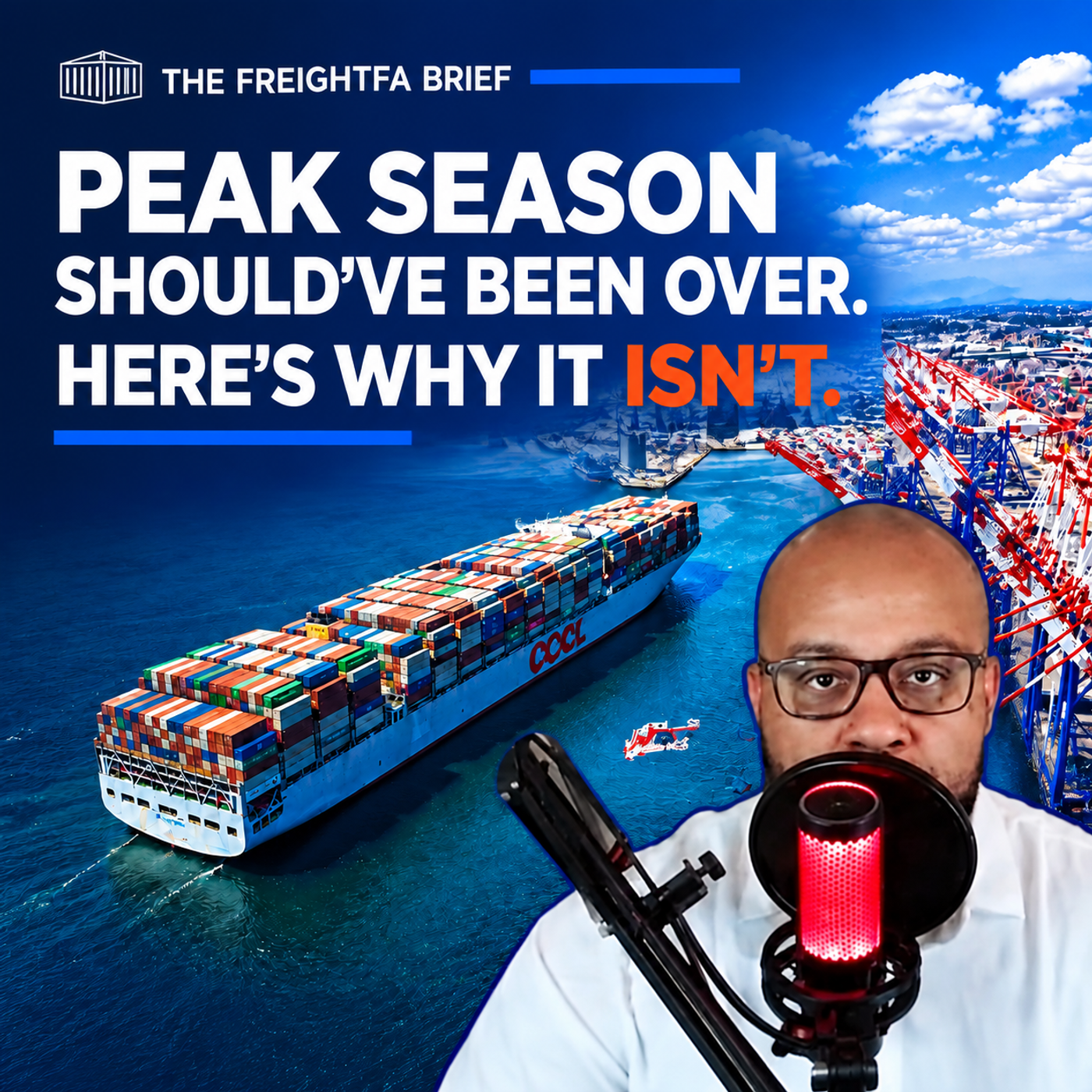
The Freight Flow Advisor Brief discusses the complexities of peak season in freight logistics, highlighting the unpredictability of import volumes and the operational challenges that arise from delays and scheduling issues. It emphasizes the importance of strategic planning and adaptability for shippers to navigate the peak season effectively.TakeawaysPeak season unpredictabilityImportance of strategic planningChapters00:00 Welcome and peak-season overview00:30 Why this year’s import season has been hard to predict01:04 Why inland handoffs—not just port arrivals—drive peak-season risk01:36 What peak season means in freight02:08 How consumer goods move from factories to stores02:38 Why peak season is a long chain of planning and transportation decisions03:20 How peak season affects consumers, shippers, carriers, and executives03:55 Why this year’s peak season looks different04:32 September import forecasts and the return of a late-summer surge05:07 Why the updated import outlook changes the narrative05:39 October through December import-volume outlook06:15 Ports versus the inland network: where the pressure lands06:50 Vessel schedule reliability and the cost of late arrivals07:21 The downstream consequences of a delayed container07:57 Why vessel schedules should be treated as estimates, not guarantees08:29 The economics of peak season: following a container from port to warehouse09:01 Drayage, rail cutoffs, warehouse appointments, and operational clocks09:32 Detention, demurrage, storage, and the hidden cost of cheap freight10:11 Airline-fee analogy: why low rates can become expensive10:44 Last year’s intermodal market and regional freight pressure11:17 Southern California congestion, peak surcharges, and lane-specific risk11:50 Why national freight trends don’t tell the whole story12:22 Intermodal versus truckload pricing during constrained periods13:01 Mixed truckload conditions and rapidly changing local markets13:32 Current intermodal and ocean-carrier signals14:05 The key takeaway: plan for lane-level volatility14:38 FreightFA mention and managing transportation trade-offs15:10 Five practical actions shippers can take during peak season15:43 Confirm inland handoffs and set expedite rules before disruptions16:15 Measure total freight cost, not just the booked rate16:52 Closing, follow/subscribe information, and sign-off

The IANA Intermodal Expo in Long Beach, California, sparked conversations about whether freight can move when the supply chain says it should. This question was explored in the context of container clearance, rail merger debates, and discussions about AI, cyber risk, cargo theft, asset intelligence, and automation. The conversations highlighted the importance of operational readiness, data sharing, and preventative measures in the freight industry.TakeawaysOperational readiness is crucial for the movement of freightData sharing and preventative measures are essential for smoother supply chain flowChapters00:00 — IANA Intermodal Expo recap: the big question facing freight01:09 — What IANA is and why intermodal matters02:14 — How terminals, drayage, rail, and chassis availability connect03:18 — Cleared vs. movable: why paperwork is not operational readiness03:50 — Using trusted data to improve container placement and access05:32 — Preventable truck safety issues and inspection culture07:18 — Day two: the rail-merger debate begins08:22 — Katie Farmer’s case for shipper choice and responsiveness09:24 — Rail pricing, commercial responsiveness, and truck-to-rail conversion11:06 — Union Pacific’s case for fewer handoffs and single-line service12:09 — The cost of lifts, drayage, dwell, and missed rail connections13:22 — What “optionality” means for shippers and railroads13:59 — Exhibit hall themes: AI, cargo theft, asset intelligence, and automation15:03 — Freight technology stack: connected equipment and asset visibility16:04 — BlackBerry Radar on tracking chassis, containers, trailers, and railcars18:44 — Asset intelligence: turning location data into action19:18 — Field AI and autonomous robots in ports, yards, and warehouses21:59 — Which freight tasks should become autonomous first?23:01 — Pedigree Technologies on equipment tracking and cargo-theft recovery24:48 — How technology and rail-network structure connect25:50 — What the Surface Transportation Board should evaluate27:33 — Final takeaways: reducing friction in intermodal freight28:40 — Where to find Freight Flow Advisor analysis and subscribe

The conversation covers the history of the speakers in the rail industry, the Union Pacific and Norfolk Southern merger, the concept of seamless rail service, the impact of PSR on service reliability, the potential savings from the merger, the concept of prima facie, and the differences between rule eleven and committed gateway pricing. The conversation covers the impact of the Union Pacific and Norfolk Southern merger on pricing, competition, and the role of shippers in the process. It also delves into the potential outcomes of the merger and the strategies employed by the railroads.TakeawaysRail industry experience of the speakersChallenges and complexities of the Union Pacific and Norfolk Southern merger Pricing and competition implicationsThe role of shippers in the merger processChapters00:00 Introduction and Rail Industry Experience02:16 The Union Pacific and Norfolk Southern Merger06:39 Seamless Rail Service and PSR Impact24:01 Potential Savings and Prima Facie28:35 Rule Eleven and Committed Gateway Pricing30:57 Pricing and Competition Implications33:37 The Role of Shippers in the Merger Process39:07 Potential Outcomes of the Merger45:09 Strategies Employed by the Railroads

Oliver Nodjoumi, Executive Vice President at ICC Logistics, discusses the history and services of ICC Logistics, the impact of inflation and tariffs on transportation budgets, the role of AI in freight analytics, and the benefits of carrier diversification. He also shares insights on negotiating transportation contracts and provides valuable advice for gaining visibility into freight exposure.TakeawaysICC Logistics provides impartial extension services to optimize transportation and logistics operations.Inflation and tariffs impact transportation budgets, and carrier diversification can create leverage and flexibility.AI is a valuable tool for freight analytics, but it should be used to enhance and validate processes, not replace them.Chapters00:00 Introduction to ICC Logistics03:33 Impact of Inflation and Tariffs on Transportation Budgets20:20 Role of AI in Freight Analytics27:00 Benefits of Carrier Diversification33:14 Negotiating Transportation Contracts and Gaining Visibility

The podcast episode discusses the impact of ocean container developments on shippers, carriers, and forwarders. It explores the shift in rate pressure from the spot market to contract rates, the factors affecting effective capacity, and the implications for the freight market. Additionally, it addresses the challenges and opportunities arising from emerging production markets and the need for strategic decision-making in logistics.TakeawaysRate pressure shifting to contract ratesFactors affecting effective capacityChapters00:00 Ocean Container Developments05:08 Rate Pressure Shift11:32 Factors Affecting Effective Capacity21:29 Challenges and Opportunities in Emerging Production Markets27:44 Strategic Decision-Making in Logistics

Comments

Download from Google Play

Download from App Store
 United States