


 Claim Ownership
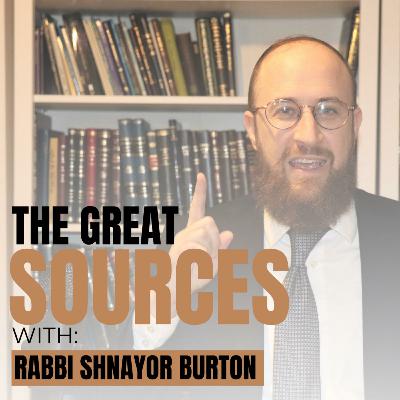
The Great Sources with Rabbi Shnayor Burton
Subscribed: 23Played: 1,556
Subscribe

© Rabbi Shnayor Burton
Description
To help support this podcast, please consider making a tax-deductible donation via Zelle to [email protected].
Lecture series in Jewish Philosophy.
What was the purpose of Creation? What is man's place in the world? What are prophecy and prayer about? What is the significance of Shabbos and the Promised Land?
Explore these fundamental questions of Judaism from their sources, and become familiar with the systems developed by the great Torah thinkers: R' Saadiah Gaon, R' Yehuda HaLevi, R' Bachya ibn Paquda, Rambam and the school of the Mekubalim.
Lecture series in Jewish Philosophy.
What was the purpose of Creation? What is man's place in the world? What are prophecy and prayer about? What is the significance of Shabbos and the Promised Land?
Explore these fundamental questions of Judaism from their sources, and become familiar with the systems developed by the great Torah thinkers: R' Saadiah Gaon, R' Yehuda HaLevi, R' Bachya ibn Paquda, Rambam and the school of the Mekubalim.
241 Episodes
Reverse
In this conversation, Zev and I discuss what role the Torah plays in the pursuit of knowing Hashem00:30 Why do we require the Torah for the pursuit of da'as Hashem?9:00 Can a person achieve da'as Hashem without the Torah?16:30 Is the Torah the exclusive method that brings to da'as Hashem?18:00 What is the Torah and to what genre does it belong?21:45 It is impossible to disentangle Jewish values from the Torah30:30 The Torah's words, narratives and practices anchor a person in da'as Hashem40:00 Does all da'as Hashem trace its roots to the Torah?51:00 Torah as Law and its difference from the Prophets: https://www.ebay.com/itm/364132946794...https://open.substack.com/pub/shnayor/p/ee-and-r-3_1-between-the-torah-and?utm_campaign=post-expanded-share&utm_medium=web52:00 Da'as Hashem is absent from the Torah; Moshe is higher than the prophets by virtue of his recognition that Hashem is actually unknowable53:30 The Law as guardrails against absolute freedom of thought54:45 We cannot and will not contemplate infinity, and therefore we need the finitude of the Law56:00 Paradoxically, restrictions allow for freedom of thought1:00:00 The Jewish People is the greatest mitzvah1:05:00 Summary of how the Torah serves da'as Hashem
In this conversation, Zev and I discuss the 1000-year era of prophecy, how the perfectly righteous man bends the world to the perfect good, and the challenges of the new prophecy.1:45 Summary of the lecture "How to Reclaim Prophecy": • The New Knowledge of Hashem: How to Reclai... 6:00 Prophecy 1.0 is the guide to prophecy 2.08:20 Why we consider the era of prophecy to begin with the Exodus despite the great prophets who preceded it10:00 The one thousand years of Jewish history recorded in Tanach stand as the paradigm of Divine Providence, when nothing occurred that lay outside its order12:30 On public and private prophecy; why widespread public prophecy requires the Ark of the Covenant and the Mikdash20:00 How the perfectly righteous man bends God's will to what is good in his eyes26:15 Tefillah is the absolute commitment to what is right32:30 The perfectly righteous man is the one who cannot abide any evil38:30 Those who forgive some evil in themselves will forgive some imagined evil in God42:30 Are we living in prophetic times?44:15 Between the Rambam and R' Yehudah HaLevi48:00 How come the great books don't discuss the new prophecy?52:45 Would someone be able to do the original kind of prophecy today?1:01:45 Today, even the greatest righteous person will accept the impersonal laws of nature as being righteous1:07:00 The challenges of the new prophecy
When the yetzer for idolatry was abolished, prophecy vanished with it. The world, once speaking, went silent. In that silence, was born science: the study of a universe that follows law but no longer reveals purpose.We follow the transformation from the enchanted world of the prophets, through the impersonal age of universals, to the modern possibility of a renewed da’as Hashem. It asks whether we can once again see the world as personal — without falling back into idolatry — and what kind of self would make that possible.00:45 The abolition of the inclination to idolatry2:00 With the abolition of the inclination to idolatry, prophecy came to an end4:30 What conditions would favor the reawakening of the inclination to idolatry and prophecy?6:20 Why are sources and texts necessary for learning about ideas or reality? 3 models15:15 The connection between the abolition of the inclination to idolatry and prophecy — the world, once enchanted, lost its enchantmentOn the enchanted world: https://shnayor.substack.com/p/how-to...18:00 Is the world personal?20:00 The question of whether the world is personal hinges on the problem of evil23:45 To converse with God through His creation is completely natural for one who conceives of His good character manifest in His creation25:00 If the good divine character is manifest in only a part of reality, polytheism results28:30 What "good" means30:00 The problem of evil for the unified personal God32:00 Moshe's request to know Hashem was a quest to understand evil: https://open.substack.com/pub/shnayor...33:30 The denial of Moshe's request is the reason the Torah teaches Hashem's unknowability: https://open.substack.com/pub/shnayor...Between the Torah and the Prophets: https://www.ebay.com/itm/364132946794...35:00 The perfectly righteous man bends Hashem's action to the good he knows in his human soul: https://www.ebay.com/itm/364134646725...38:00 The prophets see God as good in their own image; why Moshe rejected that anthropocentric goodness43:30 Free will is central to the question of whether Hashem is good on the basis of human goodness44:15 The thousand-year era of prophecy when Hashem was known in His goodness: https://open.substack.com/pub/shnayor...48:00 Why the prophetic relationship with Hashem leads imperfect people into idolatry51:45 The end of prophecy and the beginning of science53:00 Science and the depersonalization of nature54:45 In the post-prophetic era, Israel didn't need to be independent, since Hashem's impersonal unity is universal and not particular to His revelation among Israel59:25 Can we yet make the world personal again?1:00:00 The shift in the sense of self from what is temporal to that which is eternal1:02:00 The eternal moral laws are purely good, without contradiction1:08:45 Are we ready for the shift to the new prophecy?1:10:00 Why do we require a particular nation in the era of universal knowledge of Hashem? https://open.substack.com/pub/shnayor...https://www.ebay.com/itm/3744777007721:11:30 The reality of Jewish sovereignty suggests it is time for the new da'as Hashem1:13:30 Q & AWhy would the new da'as Hashem be any safer?What would idolatry look like under the new paradigm?Would religion that requires such a shift in the sense of self be meaningful to people?1:18:00 Why the prophets took the easier path at first1:21:00 Where the notion of a self came from1:23:00 On the centrality of respecting parents and how that shifts our sense of self: https://open.substack.com/pub/shnayor...Why would a soul not care about the destruction of the body?Would the new prophecy be different?
conversation # 5 of the seriesIn this conversation, Zev and I discuss how Da’as Hashem collides with politics, and what steps must follow.0:00 How would we design a political system supportive of Da'as Hashem?5:00 People who appreciate what is good and right about the current order delay the Moshiach8:00 For individuals, the most important question is Da'as Hashem; for the nation, the most important question is what systems would support Da'as Hashem11:15 Is it possible to think about Moshiach while also appreciating and supporting the current order?13:30 The division of labor between those who dream up new worlds and those who support the current world17:20 What goes wrong when politicians do Torah; Abarbanel's problematic approach to monarchy24:45 Should the political theory of Da'as Hashem utilize existing political theory?29:15 The nation of Israel is where political theory breaks down36:00 What's the next move for the Da'as Hashem movement?44:00 Can we make Hashemists? 47:45 The last time Da’as Hashem went political, it became a Golden Calf52:30 Why we can't sell Da'as Hashem55:00 Prophet school1:03:00 The secret society that will meddle in world affairs to advance Da'as Hashem1:15:15 Why there is no Sanhedrin, Beis Hamikdash, or Korbanos1:19:00 The need for working out the political theory of Da'as Hashem1:23:00 The newsletter required for developing the political theory of Da'as Hashem1:26:00 To change the world, explain to them what you're capable of explaining
Conversation # 4 of the seriesIn this conversation, Zev and I analyze the first step of the prophetic path to Da’as Hashem – its logic, practice, and universal relevance.5:00 The four-step discipline of the prophets for reaching Da'as Hashem13:00 The doctrine of Da'as Hashem is universally intelligible and meaningful even without accepting Torah or Judaism16:45 The universality of Da'as Hashem as opposed to the particularism of the Torah22:30 The secret society of Da'as Hashem 24:30 Live demonstration of the first step of the Path43:25 Purifying the soul and serving Hashem circumvents the need for having a developed philosophy of morals 48:45 The connection between tefillah and Da'as Hashem52:00 The Jewish national experience as the training ground for achieving Da'as Hashem57:30 Why pure Da'as Hashem is impossible in exile1:01:45 Why Rabbi Chiya never had kavanah during davening1:06:30 Questions on the first step1:14:15 The stark difference between those who know and those who don't: https://x.com/shnayor/status/1950646482291347817

Comments

Download from Google Play

Download from App Store
 United States