


 Claim Ownership
 The Guilty Files
The Guilty FilesSubscribed: 62Played: 2,283
Subscribe

© Copyright Paranormal World Productions LLC
Description
Welcome to The Guilty Files Podcast, where two former police officers take you beyond the headlines and deep into the heart of true crime.
Each week, Brian delivers the hard facts—laying out the case details with precision, just like he would in an investigation. Then, Dani takes those same files and flips the perspective, analyzing the psychological and sociological aspects of the crime. But he doesn’t stop there—he reimagines key moments, asking What if? to challenge the way you think about justice, motive, and the human mind.
Finally, in a third episode, Brian and Dani come together to break it all down, debating theories, dissecting motives, and revealing insights only former cops can bring to the table. If you love true crime but crave deeper analysis, unexpected twists, and expert perspectives, you're in the right place. Two Hosts. One Crime. Double The Story.
Each week, Brian delivers the hard facts—laying out the case details with precision, just like he would in an investigation. Then, Dani takes those same files and flips the perspective, analyzing the psychological and sociological aspects of the crime. But he doesn’t stop there—he reimagines key moments, asking What if? to challenge the way you think about justice, motive, and the human mind.
Finally, in a third episode, Brian and Dani come together to break it all down, debating theories, dissecting motives, and revealing insights only former cops can bring to the table. If you love true crime but crave deeper analysis, unexpected twists, and expert perspectives, you're in the right place. Two Hosts. One Crime. Double The Story.
139 Episodes
Reverse
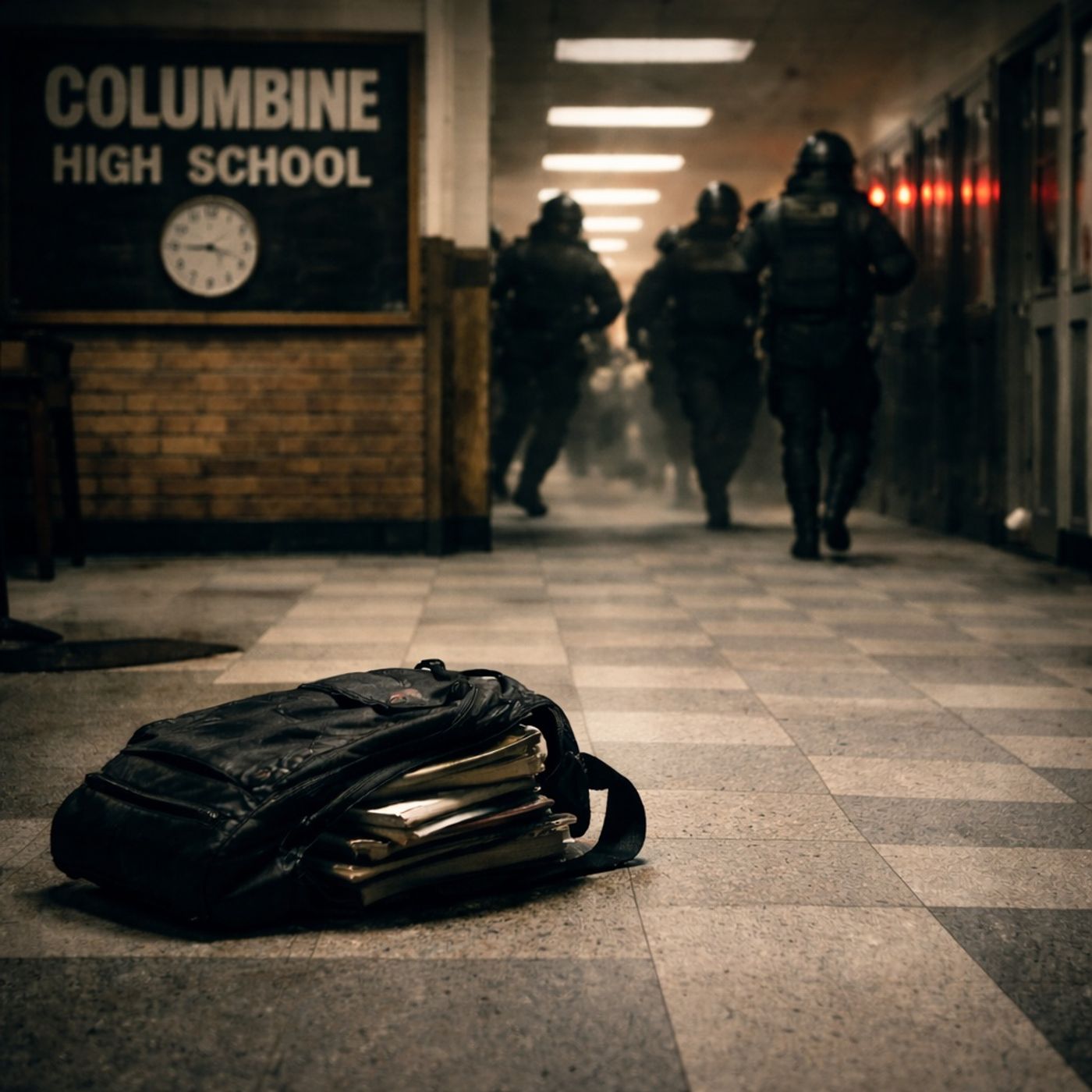
April 20, 1999 changed everything we thought we understood about safety, about schools, and about the capacity for violence within our own communities. In this episode of The Guilty Files, we take a comprehensive and unflinching look at the Columbine High School massacre, cutting through decades of misinformation to separate fact from myth in one of the most misunderstood crimes in American history. Nearly everything the public believes about Columbine has been shaped by early media errors, cultural panic, and narratives that simply do not hold up under scrutiny. The so-called Trenchcoat Mafia was never a factor. The idea that Eric Harris and Dylan Klebold targeted jocks or Christians has been largely debunked. The widely circulated story that Cassie Bernall affirmed her faith moments before her death did not occur as it was later told. And perhaps most critically, Columbine was never intended to be a traditional school shooting. It was designed as a mass bombing meant to collapse the cafeteria and kill hundreds, potentially surpassing the Oklahoma City bombing as the deadliest act of domestic terrorism in U.S. history.The shooting was a contingency plan, carried out only after the bombs failed to detonate.This episode traces the full arc of the crime from beginning to end. We examine the backgrounds of both perpetrators not to glorify them or grant the infamy they sought, but to understand the warning signs that were missed and the systems that failed. Eric Harris, a military child who moved frequently before settling in Littleton, Colorado, maintained a website filled with threats and bomb-making instructions that were known to authorities and never acted upon.Dylan Klebold, a gifted local student, struggled with severe depression and suicidal ideation that was documented in private journals but went unrecognized until after the attack. We follow the eleven months of planning that led up to April 20, including the alarming ease with which two teenagers obtained four firearms and constructed ninety-nine explosive devices. We examine the gun show loophole that allowed an eighteen-year-old honors student to purchase weapons for her underage friends, along with the illegal sale of a TEC-DC9 handgun by a twenty-two-year-old seeking quick money.At the center of the episode is a minute-by-minute reconstruction of the day itself, built from the official Jefferson County Sheriff’s Office timeline, witness testimony, surveillance footage, and forensic evidence. From Eric Harris purchasing propane tanks at a Texaco station that morning to the forty-nine minutes of violence that left fourteen people dead and twenty-four wounded, we document exactly what happened and when.But this episode does what too much coverage of mass violence fails to do. It centers the victims. Rachel Scott, whose writings on compassion inspired the global movement Rachel’s Challenge. Daniel Rohrbough, a fifteen-year-old freshman who never had a chance to escape. Dave Sanders, the beloved teacher and coach who saved more than a hundred students before being shot and left to bleed to death for over four hours while help failed to reach him. Kyle Velasquez, Steven Curnow, Cassie Bernall, Isaiah Shoels, Matthew Kechter, Lauren Townsend, John Tomlin, Kelly Fleming, Daniel Mauser, and Corey DePooter. Each had a future, a family, and a life that mattered. We also honor Anne Marie Hochhalter, who was paralyzed during the attack and whose death in February 2025 was ruled a homicide by the Jefferson County Coroner, bringing the final death toll to fourteen. We examine the catastrophic failures in the law enforcement response, including the contain-and-wait protocol that kept officers outside the school for more than an hour after the attack began. Dave Sanders was alive for hours, tended to by students as a sign in the window read “One bleeding to death.” Police snipers saw it. Dispatch communicated with people in the room. Help still did not arrive in time. His daughter later won a $1.5 million settlement against Jefferson County, and his death helped fundamentally change how police across the country respond to active shooter situations.The episode also dismantles the myths that emerged in the immediate aftermath. The Trenchcoat Mafia narrative. The revenge fantasy. The blame placed on video games and musicians. The Cassie Bernall martyrdom story. We explain what the FBI’s psychological analysis actually concluded about Harris and Klebold and why the truth, while less sensational than the myths, matters far more.Finally, we examine the lasting impact of Columbine more than twenty-six years later. The lawsuits and settlements. The evolution of school security. The gun control debates that surged and faded. Sue Klebold’s memoir and her advocacy for mental health awareness.And the phenomenon researchers now call “The Columbine Effect,” with more than seventy subsequent attacks directly inspired by or linked to what happened that day. This is not an easy episode. It is long, detailed, and emotionally heavy. But it is also an episode that refuses to give the perpetrators the notoriety they sought. Instead, it remembers the dead, honors the survivors who turned trauma into purpose, and acknowledges a community that stood together under the words “We Are Columbine.”If you take anything from this episode, let it be the names of the fourteen people who should have been allowed to grow old. Say their names. Remember their stories. That is how we push back against the darkness.Content warning: This episode contains detailed discussions of violence, death, and suicide. Listener discretion is advised.
 1
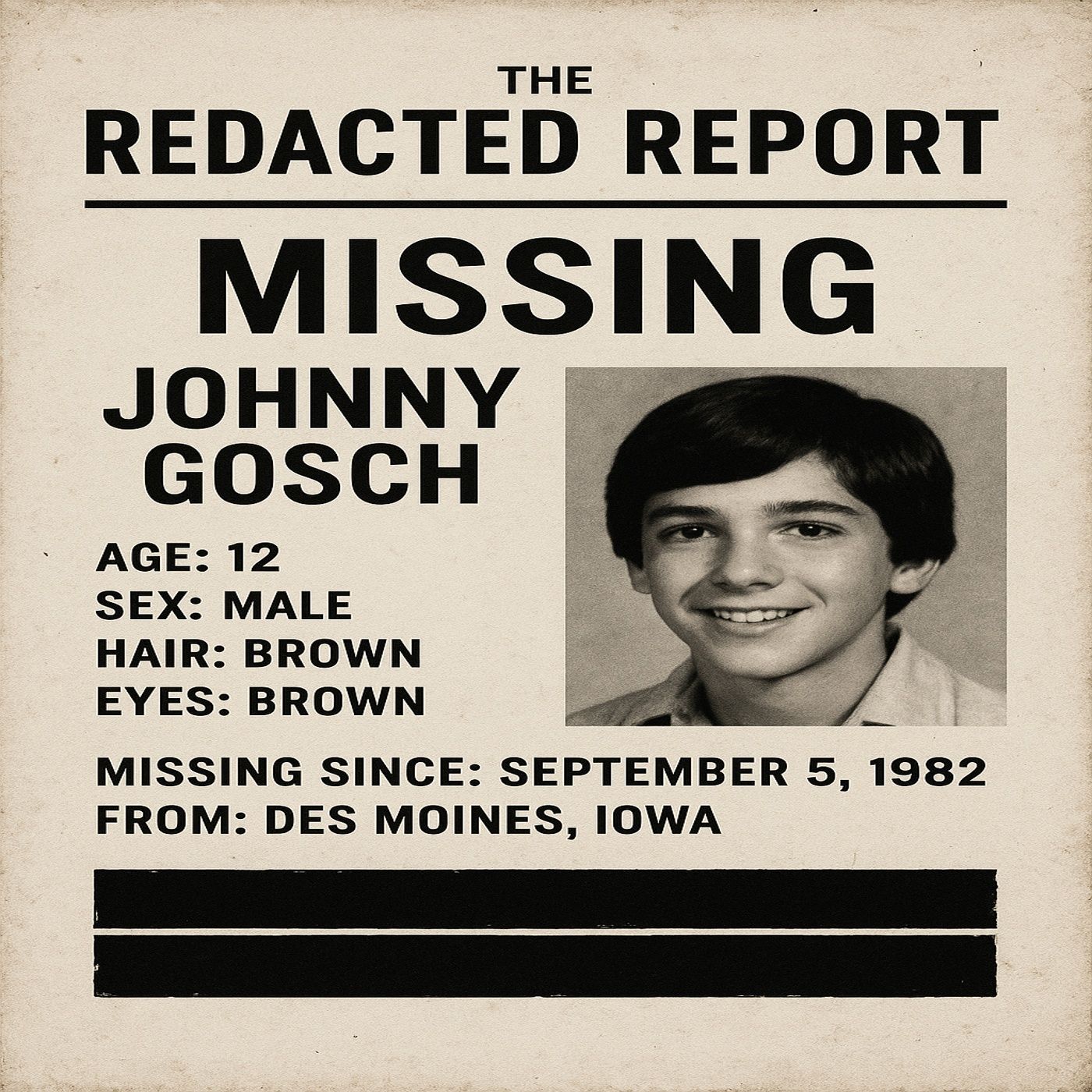
1On September fifth, nineteen eighty two, twelve year old Johnny Gosch walked out of his West Des Moines home before dawn to deliver newspapers and vanished without a trace. His case changed America forever, leading to the first missing child on a milk carton and landmark legislation that transformed how we handle abducted children.But the story most people know barely scratches the surface of what really happened.In this episode of The Redacted Report, we dig into the buried facts, the covered-up connections, and the questions that powerful people have spent four decades trying to silence.We begin with Police Chief Orval Cooney, the man tasked with finding Johnny. What most people don't know is that Cooney had a violent past, including a nineteen fifty one assault conviction. Just months before Johnny disappeared, eighteen of his own officers went on record accusing him of brutality, harassment, and drinking on duty. When volunteers searched for Johnny, witnesses say Cooney climbed onto a picnic table and told everyone to go home, calling the missing boy a damn runaway. He stonewalled the family at every turn until his sudden death in two thousand three, just as a lawsuit was about to expose what he knew. Then there's the newspaper itself. Johnny delivered papers for the Des Moines Register, the same company that employed Frank Sykora, who admitted to molesting at least seven paperboys, and Wilbur Millhouse, a former circulation manager found with a list of twenty two hundred boys' names when he was arrested. Millhouse reportedly told people for years that he knew who took Johnny and why. We examine the chilling prediction made two months before thirteen year old Eugene Martin vanished in nineteen eighty four. According to Noreen Gosch, a private investigator warned her another paperboy would be taken the second weekend of August on the south side of Des Moines. She passed this information to authorities. They did nothing. Eugene disappeared exactly when and where predicted. The episode explores the proof of life that emerged after Johnny's abduction. A confirmed sighting in Tulsa, Oklahoma, where investigators said a boy crying for help was positively identified as Johnny. A dollar bill with his authenticated signature surfacing in Sioux City three years later. Signs that Johnny was alive, somewhere, trying to send a message. We dive deep into the Franklin Credit Union scandal and the testimony of Paul Bonacci, who claimed he was forced to participate in Johnny's kidnapping. Bonacci knew physical details about Johnny that weren't public knowledge. A federal judge ruled his testimony truthful and awarded him one million dollars in a civil judgment. Yet police never interviewed him about the Gosch case.he investigation into Franklin led to tragedy. State investigator Gary Caradori was collecting evidence, interviewing witnesses, building a case against powerful people. On July eleventh, nineteen ninety, his plane came apart in midair over an Illinois cornfield. He and his eight year old son were killed. His briefcase of newly obtained evidence was never recovered. A documentary about the scandal called Conspiracy of Silence was pulled from the Discovery Channel before it could air. We trace the trafficking network run by John David Norman, a career predator whose operations spanned decades. His thirty thousand customer index cards were sent to the State Department and destroyed. His associate Phillip Paske worked for John Wayne Gacy. Investigators following witness testimony found an abandoned Colorado ranch with a hidden underground chamber and children's initials carved into the walls. The episode covers Noreen Gosch's claim that Johnny visited her in nineteen ninety seven, fifteen years after his disappearance, and the mysterious envelope of photographs left on her doorstep in two thousand six showing bound and gagged children, one of whom she believes is her son. Johnny Gosch would be fifty five years old today. No arrests have ever been made. No body has ever been found. The West Des Moines Police Department still refuses to release their complete case file. Someone knows what happened that September morning. Someone drove the blue Ford Fairmont. Someone flicked that dome light three times. And someone has kept this secret for over four decades. This is the story they buried. This is The Redacted Report.
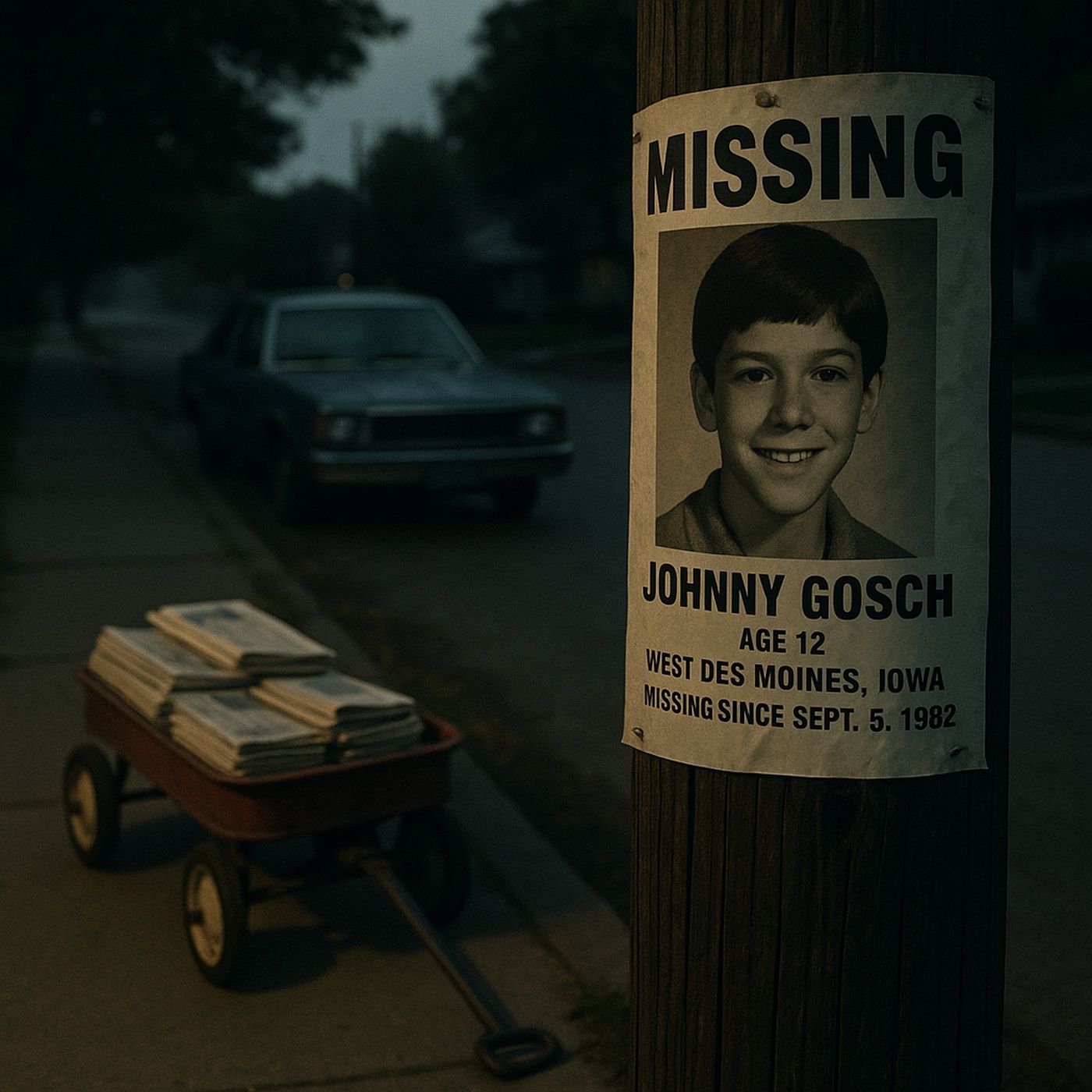
On September 5, 1982, 12-year-old paperboy Johnny Gosch left his West Des Moines home before dawn to deliver the Des Moines Register—and never returned. His red wagon was found two blocks away, still loaded with undelivered papers. Witnesses reported Johnny speaking with a stocky man near a blue two-toned car, and another man seen trailing him moments later. Within minutes, Johnny vanished.In this episode, we dig into one of America’s most chilling missing-child cases—and the fallout that changed the country. We reconstruct Johnny’s last morning, then unravel an investigation marked by early missteps and delays that fueled Noreen Gosch’s relentless campaign for reform. Her advocacy helped end mandatory waiting periods for missing-child cases through the Johnny Gosch Bill and contributed to the broader national push that led to the creation of the National Center for Missing & Exploited Children. We also examine the haunting pattern of other Des Moines-area disappearances, including paperboy Eugene Martin in 1984 and Marc Allen in 1986—cases still unsolved and often viewed through the same lens of fear and possibility. The story takes darker, more controversial turns: the testimony of trafficking survivor Paul Bonacci, who said he was forced to participate in Johnny’s abduction and later won a civil judgment after a federal judge found his account credible; Noreen’s claim that an adult Johnny visited her in March 1997; and the disputed photographs left at her home in 2006. We lay out what’s alleged, what’s documented, and why the case remains so fiercely debated.Finally, we cover Noreen Gosch’s updated allegations naming John David Norman and Phillip Paske as potential perpetrators—claims that remain unproven but continue to shape public theories about the case. As of 2025, Johnny Gosch has been missing for more than 43 years. No arrests. No confirmed sightings. Just a family still searching and a case that refuses to die.
This episode of The Redacted Report takes a hard, clear-eyed look at the Golden State Killer case, not by retelling the headlines everyone already knows, but by sitting in the uncomfortable spaces where the story actually lives.We follow the arc from Joseph James DeAngelo’s earliest known crimes in 1974 through his arrest in 2018 and sentencing in 2020, with one chilling fact threaded through every phase: while California was being terrorized, DeAngelo was also an active-duty police officer. He wasn’t just hiding from law enforcement—he was learning how it worked from the inside, and that advantage shaped the way he hunted, the way he covered his tracks, and the way he stayed untouchable for more than forty years.The episode opens by naming that truth right out loud, because it changes everything.The person stalking neighborhoods, breaking into homes, and destroying lives wasn’t a shadowy outsider. He wore a badge, carried a gun, and walked into work like any other sworn officer. From there, the story steps back to his early life—childhood trauma, military service in Vietnam, criminal justice studies at CSU Sacramento, and a marriage that, on the surface, made him look like a normal young man building a future. But behind that veneer, something darker was already forming.We then move into the Visalia Ransacker years from 1974 to 1975, when DeAngelo committed more than a hundred burglaries and his first confirmed murder, all while serving as a police officer in Exeter. It’s the first clear look at his patterns, his boldness, and the early moments when a different kind of attention might have stopped what was coming next. Instead, the case splinters, and the window closes. By 1976, just months after being hired by the Auburn Police Department, DeAngelo begins the East Area Rapist spree. Over the next several years, the Sacramento region is hit with at least fifty sexual assaults, each one escalating the fear and the stakes. The episode walks through how close investigators came—especially Detective Richard Shelby, who at one point was within arm’s reach of the suspect. And yet, even with the net tightening, DeAngelo keeps slipping through, aided by his knowledge of police tactics and the blind spots that come with assuming the predator is always “someone else. One of the most haunting turns comes in 1979, when DeAngelo is fired from Auburn PD for shoplifting dog repellent and a hammer. On paper, it’s petty theft. In reality, those items match the East Area Rapist’s known methods so cleanly they should’ve set off alarms across the department. But they didn’t. The moment passed as a minor embarrassment instead of the massive red flag it was, and DeAngelo simply moved on to the next phase. That next phase takes us south into the Original Night Stalker murders, stretching from 1979 to 1986. Here, the offender escalates from rape to routine homicide, killing victims while maintaining the same signatures and controlling routines seen in Northern California. The tragedy isn’t only the violence itself, but the fact that law enforcement agencies failed to connect these crimes to the earlier Sacramento attacks, even though the methodologies lined up like fingerprints. The episode doesn’t just describe that failure—it lingers on what it cost.The narrative then shifts to the years when the case begins to reawaken in the public eye, largely through the relentless work of Michelle McNamara. She coins the name “Golden State Killer,” brings the scattered crimes under a single identity, and spends years pushing the case back into the spotlight.Her death in 2016 adds a painful gravity to that chapter, but her book, I’ll Be Gone in the Dark, leaves behind a surge of attention and pressure that helps fuel renewed investigative energy. Finally, the episode breaks down the genetic genealogy breakthrough that ended DeAngelo’s run. Investigators upload crime-scene DNA to GEDmatch, locate distant relatives, and then do the slow, painstaking genealogical work to narrow the search. When DeAngelo becomes the focus, a covert DNA collection from a Hobby Lobby parking lot confirms it. In April 2018, he’s arrested—an ending that feels impossible until it’s suddenly real.We close with his guilty plea, the survivor testimonies that reclaim the final word from the man who tried to steal it, and a sober look at what this case forces us to confront. It exposes the dangers of law enforcement culture closing ranks, the catastrophic consequences of fractured communication between agencies, and the complicated future we’re stepping into with genetic genealogy—where justice and privacy are now forever tangled together.
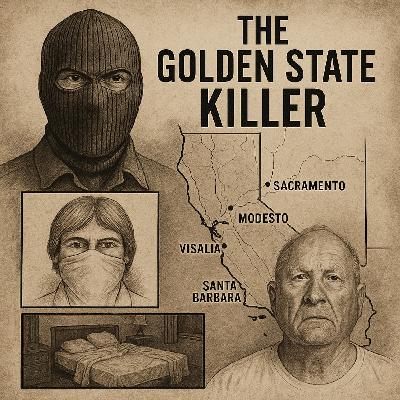
In this week’s deep-dive, we’re taking you into a case that haunted California for decades and still sends a chill through anyone who reads the details. For more than ten years, a masked predator moved through neighborhoods like a ghost — breaking into homes, stalking families, and leaving devastation behind. The numbers alone are staggering: over a hundred burglaries, at least fifty sexual assaults, and thirteen confirmed murders. He slipped between counties and police departments, stayed a step ahead of massive task forces, and then — somehow — disappeared. Not into the shadows, but into ordinary suburban life, where he lived free for more than forty years.This is the full story of Joseph James DeAngelo — the man the world would come to know as the Golden State Killer. We start back in 1974 in Visalia, a small agricultural city where a strange series of burglaries had detectives completely rattled. The person behind them wasn’t grabbing TVs or cash. He was spending hours inside people’s homes, taking small, personal things — a single earring, coins, women’s underwear — and rearranging objects in ways that felt deliberate and unsettling. It wasn’t just theft. It was a message: I was here. I know you. I can get to you.From there, we follow the escalation as the Visalia Ransacker’s crimes tip into attempted abduction and then murder. We walk through the December 1975 killing of Claude Snelling, a journalism professor who died protecting his teenage daughter from being taken.And we cover the terrifying near-capture just two days later, when Detective William McGowen fought the prowler face-to-face and survived only because the suspect’s gun misfired at point-blank range.Then the nightmare shifts north. In 1976, Sacramento is hit by a new kind of terror.The East Area Rapist begins attacking women in their homes with a level of planning and cruelty that left investigators stunned. We break down how his assaults evolved, including the moment he began targeting couples — tying up husbands and boyfriends, stacking dishes on their backs, and forcing them to listen helplessly while he raped their partners. We look at the psychological warfare he used to control entire communities: threatening phone calls, stalking routines, and the methodical surveillance he did before striking again.As the years pass, his crimes migrate south — and turn deadly. Starting in 1979, the man now known as the Original Night Stalker begins murdering couples in their homes across Santa Barbara, Ventura, and Orange counties. We go crime scene by crime scene, showing how the evidence slowly — and finally — revealed that Visalia, Sacramento, and Southern California were all connected to the same offender.We also dig into the long, frustrating decades of investigation: the dead ends, the jurisdictional chaos, and the breakthroughs that came only when DNA technology caught up to the case. And of course, we cover the seismic moment in 2018 when genetic genealogy identified the suspect, leading detectives straight to DeAngelo’s quiet home in Citrus Heights — the same kind of suburb he once terrorized.The twist that still hits like a gut punch? During the height of his crime spree, DeAngelo was a police officer, using his training and insider knowledge to stay invisible.We close with the plea and sentencing — a historic reckoning where fifty-three victims and family members stood up in court to face the man who had stolen so much from them. Their impact statements are heartbreaking, powerful, and a reminder that this story isn’t just about the monster — it’s about the people who survived him. This episode is the result of hundreds of hours of research across court records, investigative files, victim testimony, and years of reporting. Our goal was to tell this story with care, accuracy, and respect — honoring the victims and the investigators who refused to let the case die. The Golden State Killer investigation didn’t just end with an arrest. It changed law enforcement forever. Genetic genealogy opened a door to solving cold cases that once seemed impossible, and we talk about both the promise of that tool and the ethical questions that come with it.And we take a moment to recognize Michelle McNamara, whose relentless work on I’ll Be Gone in the Dark helped reignite national attention and kept pressure on the investigation. She died in 2016, two years before DeAngelo was caught, but her voice and determination are woven into the story of how this case was finally solved. If you think you know this case, stick with us — because when you lay every chapter out in full, the scale and horror of what happened, and the way it was finally unraveled, is almost impossible to comprehend.
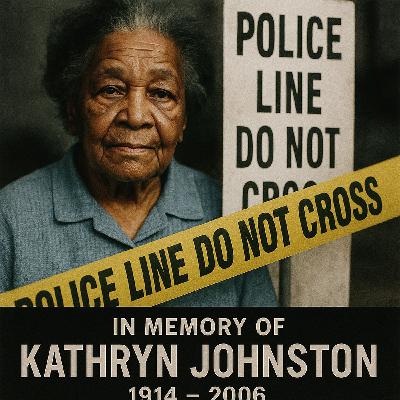
In this deeply personal and explosive episode of The Redacted Report, Brian — a former Atlanta police officer with sixteen years on the job — breaks his silence about one of the most devastating and shameful incidents in modern APD history. On November 21, 2006, ninety-two-year-old Kathryn Johnston was shot and killed in her own home during a botched narcotics raid that ultimately exposed systemic corruption inside the Atlanta Police Department.Brian goes beyond the early headlines and the department’s initial story — the one that falsely portrayed Johnston as a drug dealer who fired first — and lays out what really happened: a chain of lies, planted evidence, and institutional pressure. Three narcotics officers fabricated a warrant, forced entry into Johnston’s home, and opened fire after she fired a single warning shot in self-defense. She was struck thirty-nine times. While she lay dying on her living room floor, the officers attempted to manufacture justification for what they had done. Officers Jason Smith, Gregg Junnier, and Arthur Tesler later pleaded guilty to federal civil rights violations and received prison sentences of five to ten years — but as Brian explains, they were not the lone villains.They were the predictable outcome of a system engineered to produce tragedies like this.Drawing from his own experience, Brian exposes the department’s crushing quota-driven “productivity points” system. Officers were expected to earn seven points per day: an arrest counted as five points, while answering a call for service counted as only a quarter point. In practice, that meant an officer could respond to twenty-eight community calls and still fall short — or make two arrests, even questionable ones, and exceed expectations. The episode also highlights how confidential informant Alex White became an unlikely catalyst for the truth. Refusing to carry the cover-up forward, White contacted federal authorities and exposed the conspiracy — a decision that put his life in danger and ultimately forced him into witness protection. The resulting federal investigation uncovered a broader pattern of corruption: officers lying on warrant applications, planting drugs saved from prior arrests, inventing “informants” who didn’t exist, and stealing hundreds of thousands of dollars from seizures. One of the most damning revelations is what didn’t happen after the convictions. Brian details how the three officers went to prison, but the supervisors who shaped and enforced the quota culture faced no real consequences. Sergeant Wilbert Stallings kept his rank and pension. Lieutenant Mark Pratt retired with full benefits. Captain Dennis O’Brien was promoted just six months after the shooting. The reforms that followed, Brian argues, were largely cosmetic — the quota system was rebranded, not removed, and pressure to generate arrests only intensified as the department tried to repair its image through statistics.Brian also shares the quieter, untold casualties of the same machinery — people whose lives were shattered without ever making the news: Fabian Sheats, who served three years on planted evidence; Frances Thompson, whose family was torn apart by a false raid; and Marcus Williams, whose education and future were derailed by fabricated drug charges. Their stories never sparked investigations.They never received justice. They were simply collateral damage.The episode ends with Brian’s personal reckoning. He acknowledges that while he never planted evidence or pulled the trigger on an innocent person, his compliance and silence made him part of the machine that killed Kathryn Johnston. He reflects on the brutal irony that Johnston — born in 1914, a woman who survived Jim Crow, the Great Depression, two World Wars, and the Civil Rights Movement — was ultimately killed at ninety-two by officers chasing a daily quota.This is not just a story about three corrupt cops or one horrific night in Atlanta.It’s an indictment of a nationwide policing model that rewards numbers over humanity, treats poor communities like occupied territory, and enables predictable, preventable tragedies while the architects of the system retire with full pensions. The Kathryn Johnston case briefly pulled the curtain back — but as Brian warns, nothing fundamental has changed. There will be more Kathryn Johnstons until the structure itself is confronted.The Redacted Report is both confession and call to action. Brian challenges listeners to demand reforms with teeth: an end to arrest quotas in any form, independent oversight with real authority, accountability for supervisors and policy-makers — not just street-level officers — and the demilitarization of narcotics policing.Until those changes happen, he argues, we are all living inside a system that can turn any home into a crime scene and any innocent person into a casualty of the war on drugs.This is investigative storytelling at its rawest — told by someone who lived inside the culture, understands how the damage is manufactured, and can no longer stay silent about the redacted truth behind one of American law enforcement’s darkest moments.
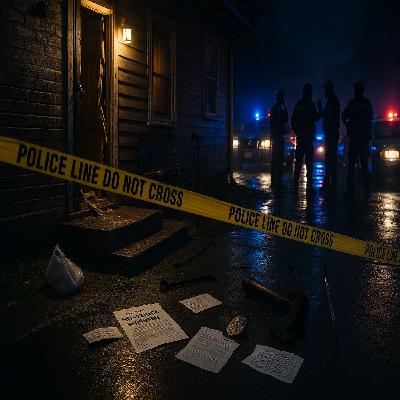
This case is personal. It happened just months before I began my career with the Atlanta Police Department, and it shaped the way I understood the job, the institution, and the stakes of unchecked power. On November 21, 2006, three Atlanta Police Department narcotics officers executed a no-knock warrant at 933 Neal Street in northwest Atlanta—the home of 92-year-old Kathryn Johnston. The warrant was built entirely on fabrication. Officers Jason Smith, Gregg Junnier, and Arthur Tesler claimed a confidential informant had bought crack cocaine from the residence earlier that day. No buy occurred. There was no dealer, no “Sam,” no surveillance. There was only an elderly woman living alone in a high-crime area, protected by burglar bars and an old revolver she kept for self-defense.Around 7:00 p.m., officers cut through the security bars and forced entry. Johnston believed she was being robbed. In the dark, unable to see who was coming through her door, she fired one shot over the intruders’ heads. Officers responded with 39 rounds, striking her five or six times. As she lay dying on her living room floor, Smith handcuffed her and then planted three bags of marijuana in her basement to manufacture justification for the raid. The officers also pressured their informant, Alex White, to lie and say he had purchased drugs at the home.White refused to participate in the cover-up and went public six days later. His decision triggered an FBI investigation that uncovered systemic corruption inside the APD narcotics unit: falsified warrant applications, planted evidence, coerced informant statements, and a quota culture demanding nine arrests and two search warrants per officer each month.Officers who failed to hit numbers faced transfers and punishment; those who exceeded them received rewards and incentives. Investigators determined the same marijuana planted in Johnston’s home had been used earlier that day to frame another man, Fabian Sheets. Sheets was then coerced into providing the false tip that sent officers to Johnston’s address. Every step leading to her death was driven by lies, pressure, and a performance system that valued arrests over truth.The legal fallout was swift but damning. In April 2007, Smith and Junnier pleaded guilty to manslaughter and federal civil rights violations, with Smith admitting to planting drugs and lying on the warrant. In October 2008, Tesler pleaded guilty to federal civil rights charges. Sentences followed: Smith received ten years in federal prison, Junnier six, and Tesler five.The scandal dismantled the narcotics unit, forced policy changes requiring multiple controlled buys before warrants, sharply restricted no-knock entries, and accelerated the creation of Atlanta’s Civilian Review Board. The city settled with Johnston’s family for $4.9 million in 2010. Her house was later demolished, and in 2019 the Kathryn Johnston Memorial Park opened near the site. Her death became a lasting symbol of the dangers of quota-driven drug enforcement and the human cost of militarized policing—foreshadowing later no-knock tragedies like Breonna Taylor’s killing in 2020.This episode examines the full chain of corruption that led to Kathryn Johnston’s death, the cover-up that followed, and the institutional pressures that made it possible. It is a case about power without accountability, policing distorted by metrics, and the irreversible consequences when truth is treated as optional.
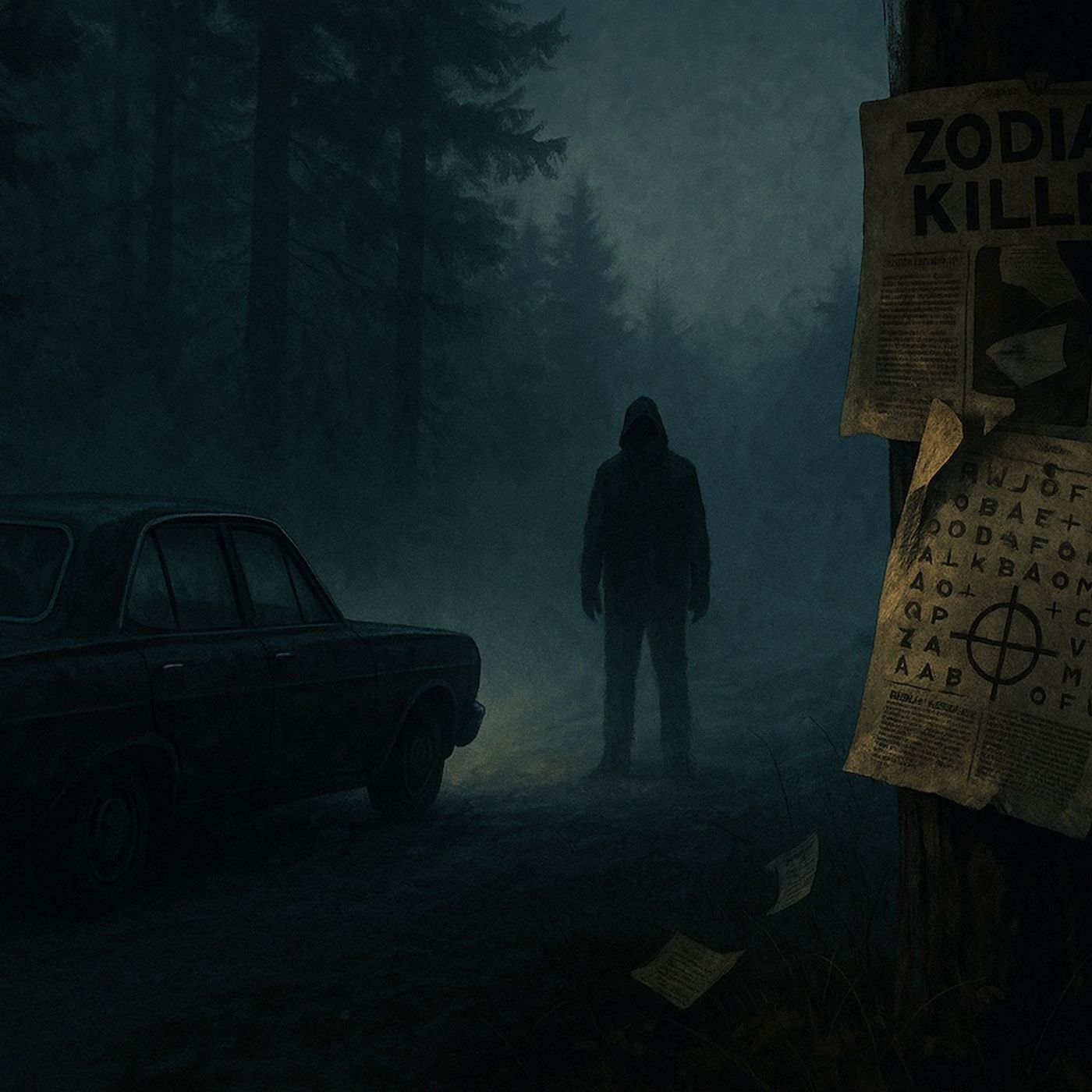
In this deep-dive episode of The Redacted Report, host Brian cuts through fifty years of myth, speculation, and misinformation surrounding America’s most infamous unidentified killer. This is the Zodiac story told without sensationalism—an investigation grounded in confirmed facts, disputed evidence, and the uncomfortable gray areas that have fueled decades of obsession.Brian begins by laying out the difference between what investigators know, what they suspect, and what the Zodiac himself claimed. He revisits the confirmed attacks—from the 1968 Lake Herman Road murders to the killing of San Francisco cab driver Paul Stine—along with the crucial survivor testimonies that shaped the early investigation. The episode also explores the long-debated question of whether victim Darlene Ferrin may have known her attacker, a claim that has lingered without proof.The narrative then shifts to the disputed cases, including the 1966 Riverside murder of a college student—claimed by the Zodiac but dismissed by police decades later—the disappearance of nurse Donna Lass, and several possible but unconfirmed victims tied to the killer by pattern or rumor. Brian also revisits the unsettling abduction of Kathleen Johns, a case still debated among investigators.The heart of the episode focuses on the most scrutinized suspect ever named: Arthur Leigh Allen.Brian details the mountain of circumstantial evidence that once made him the prime focus of the investigation, and the physical evidence—handwriting, fingerprints, and later DNA—that ultimately cleared him. Recent claims, including alleged confessions and alternative suspects promoted by documentaries and citizen groups, are examined with sharp skepticism and a commitment to factual integrity.The episode also breaks down the Zodiac ciphers, from the early Z408 to the 340 cipher cracked in 2020, and discusses the investigative failures, jurisdictional conflicts, and missing evidence that have kept this case unsolved. Brian confronts the theories—credible and absurd—and looks at how the Zodiac transformed from a real killer into a cultural phenomenon that continues to inspire amateur sleuths and wild speculation.Ultimately, this episode reveals a more grounded truth: only five murders and two attempted murders can be definitively tied to the Zodiac, and many widely accepted “facts” are nothing more than unproven theories. The case remains open across multiple jurisdictions, with thousands of suspects reviewed and no definitive answers.The victims are honored throughout the episode—teenagers on their first date, a young mother, a college student, and a working cab driver—all of whom deserve to be remembered beyond the mythology built around their killer.Survivors whose testimonies shaped the case are also acknowledged, along with the contradictions and evolving memories that complicate their accounts.This episode represents months of research and a commitment to separating fact from fiction. While many questions remain, Brian’s goal is not to solve the case, but to present it with honesty—including its dead ends, contradictions, and discomforting truths.The Redacted Report is a weekly investigative true crime podcast dedicated to uncovering the hidden layers behind notorious cases. Brian brings his background in law enforcement and his dedication to factual accuracy to each episode, reminding listeners that sometimes the real story is buried beneath decades of noise. Join us next week for another investigation where the official story isn’t the whole truth—because in every case, what’s hidden matters most.
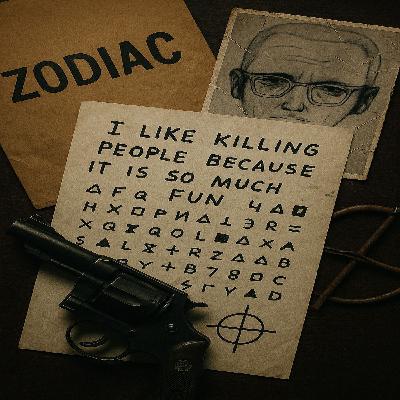
In the summer of 1969, the San Francisco Chronicle received a letter that would ignite one of the most infamous investigations in American history. Inside was a chilling confession, a cryptic cipher, and the signature that would terrify the nation: a circle with a cross through it. T We trace every confirmed attack, beginning with the Lake Herman Road murders of teenage sweethearts David Faraday and Betty Lou Jensen—an ambush that seemed random until the killer later claimed it as his own. From there, we follow the trail to Blue Rock Springs, where Darlene Ferrin was killed and Michael Mageau survived a barrage of gunfire—and the eerie phone call that linked both crimes in the killer’s own voice.We dive into the ciphers that made this case legendary: the first three-part code cracked by a schoolteacher and his wife, and the 340-character cipher solved over fifty years later.These messages revealed the killer’s delusions, obsessions, and desire to terrorize an entire region. We also break down the horrifying daylight attack at Lake Berryessa, where Bryan Hartnell survived a knife assault from a hooded figure wearing the iconic crossed-circle emblem. Then we move into Presidio Heights, where cab driver Paul Stine’s murder and a devastating miscommunication allowed police to unknowingly let the Zodiac walk right past them. We explore dozens of letters and cards sent to newspapers, including threats against school buses and claims of dozens more victims. This correspondence became the Zodiac’s greatest weapon—psychological warfare that spread fear across Northern California.We examone the massive multi-agency manhunt, forensic clues from footprints to partial prints to modern DNA extraction, and the long list of suspects: Arthur Leigh Allen, Rick Marshall, Lawrence Kane, Ross Sullivan, and more—each compelling, each flawed, none ever confirmed.We also cover unconfirmed cases like Cheri Jo Bates and Donna Lass, as well as modern developments from DNA profiling to the controversial Case Breakers announcement.We discuss whether genetic genealogy may one day identify the killer—as it did in the Golden State Killer case—and why recent results remain sealed.Beyond the crimes, we look at the cultural footprint: how the Zodiac case reshaped criminal investigation, inspired countless books and films, and created a vast community of amateur sleuths still searching for answers.At the center of this story are the victims—Betty Lou Jensen, David Faraday, Darlene Ferrin, Cecelia Shepard, and Paul Stine—whose lives and futures were stolen by a killer who turned murder into a game.It’s the story of a case that transformed American true crime, a mystery that refuses to die, and a shadow that still lingers over the Bay Area more than fifty years later. The Zodiac sought immortality—and in a grim sense, he found it.The case remains open.The cipher is not fully solved.And somewhere, the key to this mystery is still waiting to be discovered.
Tonight on The Redacted Report, we reopen the case file on one of America’s most infamous crimes—the 1966 massacre of eight student nurses in Chicago. The world knows the headline: one survivor, one killer, Richard Speck. But the real story didn’t make the newspapers, and it never made the documentaries.That story begins here.We trace Speck’s path long before the murders, uncovering early psychiatric evaluations, head trauma, and behavioral red flags buried in government archives—warnings ignored until it was far too late. Records from Texas expose a trail of violence against women that mirror the Chicago killings almost exactly, cases that were dismissed or quietly dropped. Maritime logs reveal a pattern of explosive aggression at sea, ignored by a system that kept placing Speck on new ships despite repeated danger.The week before the murders—long treated as an afterthought—comes into focus as a period of planning and preparation. Witnesses reported Speck stalking nurses, drawing layouts of buildings, and meeting with unknown individuals. The crime scene itself tells a story that never reached a jury: signs of earlier tampering, restraints brought in advance, and a timeline that points to a calculated, controlled attack rather than a spontaneous frenzy.Corazon Amurao’s survival—heroic and heartbreaking—contains details withheld from the public for decades. She heard Speck speaking casually with the victims. She heard another voice in the townhouse. And years later, she admitted what she’d been urged to conceal: she saw a second set of feet.Even the manhunt and arrest raise questions. Speck was seen calmly sitting outside the townhouse after the murders, visited multiple locations searching for someone, and suddenly had access to money. A forged medical bracelet appeared on his wrist. An anonymous caller with medical knowledge identified him at the hospital. Nothing about his capture fits the official version. The suppressed forensic evidence is equally troubling: multiple unidentified fingerprints, unexplained footprints, a phone call placed from inside the crime scene during the murders, and a controlled drug in Speck’s system he should never have had access to.Prison tapes later caught Speck alluding to “the man with the plan,” describing the killings as “the message,” and insisting he wasn’t acting alone.Patterns of similar attacks on nurses in other cities, linked locations, coordinated methods, and financial trails all point to a larger, unsettling picture—one the justice system seemed unwilling to confront. Speck may have been the hand, but the question remains: whose hand was guiding him?Richard Speck died in 1991, but the unanswered questions surrounding this case remain locked behind sealed files, suppressed reports, and the memories of those told to stay silent. Tonight, we challenge the official narrative and present the case as the evidence actually shows it.On The Redacted Report, we don’t repeat the story they told you.We expose the one they didn’t want you to hear.
On a sweltering July night in 1966, eight young student nurses gathered in their modest Chicago townhouse, studying, laughing, and planning for bright futures devoted to healing others. By dawn, all but one would be dead — victims of a crime so brutal and senseless that it forever changed how Americans understood violence, safety, and evil itself. In this powerful episode of The Guilty Files, we revisit one of the darkest nights in American history — the Richard Speck murders. We begin with Speck’s troubled childhood in rural Illinois, tracing his transformation from an abused and neglected boy into a violent, drifting man. Through court records, psychological profiles, and witness testimony, we follow the sequence of events that led him from one bar to another that night, driven by rage, addiction, and a lifetime of trauma — until he found himself at 2319 East 100th Street. Inside that small townhouse lived eight remarkable women — future nurses united by their compassion and courage. We remember Gloria Davy, Patricia Matusek, Nina Schmale, Pamela Wilkening, Suzanne Farris, Mary Ann Jordan, Merlita Gargullo, and Valentina Pasion — honoring their dreams, their kindness, and their shared commitment to care for others. Through meticulous research and survivor testimony, we recount the investigation that gripped the nation — how a simple tattoo reading “Born to Raise Hell” led detectives to their suspect. We revisit the bravery of Corazon Amurao, the sole survivor who hid beneath a bed for hours, bearing silent witness and later testifying to bring Speck to justice. The trial that followed revealed not only the depths of one man’s depravity but also the flaws and limits of the American justice system. Though sentenced to death, Speck’s life would end not at the gallows but behind bars — where years later, a shocking prison video reignited public outrage and reopened the wounds of those still grieving. Beyond the crime, this episode examines its lasting impact: reforms in nursing education and hospital security, the birth of modern criminal profiling, and the cultural shift that redefined how Americans viewed personal safety and random violence.This is not a story told to glorify evil — it is a story to remember courage, humanity, and loss. The lives of these eight women remind us that even in the face of unimaginable darkness, compassion and justice endure.
In this episode of The Redacted Report, we reopen the case of Edmund Kemper, the so-called “Co-Ed Killer,” to expose the details that were buried in thousands of pages of police files, psychiatric evaluations, and trial transcripts.This isn’t the version told in documentaries or dramatizations. This is the story of how a system failed, how warning signs were missed, and how one of California’s most intelligent predators learned to play both sides of the law .Ed Kemper wasn’t just hiding in plain sight — he was sitting at the bar with the very officers searching for him. Inside The Jury Room in Santa Cruz, he befriended Detective Johnson, Officer Martinez, and Sergeant Williams, absorbing investigative methods, forensic procedures, and common police mistakes over casual drinks. What they didn’t realize was that their “gentle giant” drinking buddy was gathering operational intelligence. Kemper collected handcuffs, police radios, and scanner frequencies, giving him real-time access to law enforcement movements — knowledge that helped him stay one step ahead for nearly a year while bodies continued to surface. Behind the charm and calm demeanor was a man who had already fooled the system once. At just 21, Kemper had been released from Atascadero State Hospital, declared no threat to society despite having murdered his grandparents as a teenager. Working in the hospital’s psychology lab, he studied mental health diagnostics, learned how to manipulate tests, and even handled real psychological profiles — including those of violent offenders. He used that knowledge to beat the system, understand his captors, and later, to outthink investigators.We trace the moments where fate nearly intervened — the traffic stops, the roadblocks, the missed connections between agencies that could have saved lives.Officers questioned him, waved him through, even trusted him, all because he seemed “too polite” to be dangerous. Through firsthand reports and redacted files, we expose how institutional blind spots and bureaucratic silos allowed a killer to thrive in plain view. From the quiet house on Ord Drive, where he dismembered victims while his mother was at work, to his Alameda apartment, where neighbors lived just feet away from unimaginable horror, we explore the forensic trail left behind — the vehicle evidence, the recovered photographs, and the chilling confession tapes where Ed bragged, analyzed, and justified every act in painstaking detail.His hours-long conversations with FBI profilers Robert Ressler and John Douglas later became the foundation of modern criminal profiling, shaping how future generations would define the term “organized serial killer.”But beneath all the psychology and procedure lies the story of his mother, Clarnell Kemper — the woman he blamed, feared, and eventually murdered. Working as an administrator at UC Santa Cruz, she may have unknowingly processed paperwork for students her son would later kill.The tragedy of their relationship — and the evidence found in her home — reveal the disturbing cycle of resentment and rage that fueled his crimes.This episode goes beyond the headlines to confront the decisions that allowed a double murderer to be paroled into his mother’s home, the psychiatric assessments that missed every danger sign, the sealed records that kept police in the dark, and the agencies that failed to communicate. It’s not a story about glorifying monsters — it’s about learning from the systems that created them. Because monsters don’t always look like monsters.They smile, they shake your hand, and they convince the world they’re harmless — until it’s too late.We close by honoring the ten victims whose lives mattered far more than the man who took them: Maude and Edmund Kemper Sr., Mary Ann Pesce, Anita Luchessa, Aiko Koo, Cindy Schall, Rosalind Thorpe, Alice Liu, Clarnell Strandberg, and Sally Hallett. Their stories remind us that behind every case file and redacted page are real lives, real loss, and the lessons society cannot afford to ignore.
In this gripping and deeply unsettling episode, we explore one of the most disturbing and well-documented cases in American criminal history — the story of Edmund Emil Kemper III, better known as The Co-Ed Killer. Between 1964 and 1973, Kemper brutally murdered ten people, including his grandparents and his own mother, leaving behind a trail of horror that still haunts true crime history. But this isn’t just another serial killer story. This is an examination of transformation — how a damaged child became a monster, how the system failed at every possible turn, and how a killer managed to hide in plain sight, even befriending the very police officers who were searching for him.The episode opens with the chilling phone call from a payphone in Pueblo, Colorado, where Ed calmly confessed to multiple murders. From there, we trace his life from the beginning — through a nightmarish childhood under the control of an abusive, alcoholic mother who locked him in a basement and convinced him he was inhuman.We uncover early warning signs of psychopathy — from animal cruelty to violent fantasies — that went ignored until it was too late. We examine Kemper’s first murders at age fifteen, the killings of his grandparents, and his time at Atascadero State Hospital, where he learned to manipulate the mental health system and study criminal behavior from the inside. Multiple psychiatrists later declared him rehabilitated — a catastrophic misjudgment that freed him to kill again.Kemper’s subsequent 1972–1973 killing spree targeted young women across California. We recount each victim’s story — Mary Ann Pesce, Anita Luchessa, Aiko Koo, Cindy Schall, Rosalind Thorpe, Alice Liu, Clarnell Strandberg (his mother), and Sally Hallett — restoring their names, lives, and humanity beyond the statistics.You’ll hear how Kemper selected his victims, how he gained their trust as a gentle giant with a calm demeanor, and the unspeakable acts that followed. We also expose his obsession with law enforcement culture — drinking with police officers at the Jury Room bar, collecting police equipment, and nearly being caught several times, always talking his way out with chilling ease.Finally, we follow Kemper’s confession, trial, and incarceration, where he requested the death penalty but instead became a model inmate who later helped the FBI pioneer its criminal profiling techniques.Yet, at the heart of this story lies not the killer, but his victims. This episode is a memorial to their stolen lives — a reminder of the innocence destroyed, and of the families who still live with the weight of his crimes more than fifty years later.⚠️ Content Warning: This episode contains explicit descriptions of violence, murder, and disturbing psychological themes. Listener discretion is strongly advised.

For over thirty years, Wichita, Kansas lived in fear of a man who called himself BTK — Bind, Torture, Kill. He murdered ten people, including children, and then vanished for years at a time, taunting police and the press with letters that were as cruel as the crimes themselves. But the most disturbing part of this story isn’t just the brutality of his murders — it’s how Dennis Rader, the man behind BTK, managed to live a perfectly ordinary life right in plain sight. He was a husband. A father. A church council president.A city compliance officer. And behind all of it — a sadistic killer who hid in the open for more than three decades. In this episode of The Redacted Report, we dig into the full story of Dennis Rader — not just the crimes, but the psychology and deception that let him walk unnoticed among his victims’ families and his community. We trace his path from a disturbed Kansas kid fascinated by control and bondage to the day he finally slipped — undone by his own arrogance and a floppy disk that revealed his name.You’ll hear how Rader meticulously planned each murder, how he craved attention more than anything else, and how his need to be recognized ultimately destroyed him. We revisit the detectives who refused to give up on the cold case, the technological breakthroughs that caught him decades later, and the haunting question that lingers: how does someone capable of such horror look so normal?From his chilling phone calls to the police to his bizarre confessions in court, this is the story of a man who wanted to be remembered — and of the investigators who made sure he would be, but not in the way he imagined.The Redacted Report: BTK – The Killer Next Door pulls back the curtain on one of America’s most terrifying killers — and exposes how easily evil can hide behind a familiar smile.
In this gripping episode of The Guilty Files Podcast, we go beyond the headlines and dive deep into one of America’s most haunting true crime stories — the life and legacy of Dennis Rader, the BTK Killer. “Bind. Torture. Kill.” Three words that held an entire city hostage for more than three decades while a monster disguised himself as an ordinary man.Dennis Rader wasn’t the drifter or loner that popular culture paints as a serial killer. He was a husband, a father, a Boy Scout leader, and the council president of his church. By day, he enforced city ordinances in Park City, Kansas, measuring grass heights and citing residents for leaving trash cans out too early. By night, he fed a sadistic fantasy life that would claim ten lives and terrorize an entire community. His obsession with control and his ability to mask it behind a façade of normalcy made him one of the most chilling killers in modern history.This episode traces Rader’s story from his early years in Pittsburg, Kansas — where his fascination with bondage and cruelty took root — to his years of military service, marriage, and eventual descent into a life of hidden predation. We explore how his childhood acts of animal torture and fetishism went unrecognized as red flags, how he weaponized his day jobs at ADT Security and as a municipal compliance officer to study his victims, and how his twisted need for power became ritualized in his killings.We follow the trajectory of BTK’s crimes, beginning with the horrifying Otero family murders in 1974 and continuing through his series of killings that left Wichita living in fear. We unpack the infamous letters, poems, and packages that he sent to police and the media — the communications that transformed the murders into a decades-long psychological game. We also examine the eerie fourteen-year period of silence where Rader appeared to vanish, though he was in fact living quietly among the very people who feared him most.From his eventual return to taunting law enforcement in 2004, to the digital blunder that led to his downfall — a single floppy disk containing traceable metadata — this episode brings listeners inside the meticulous investigation that finally unmasked BTK.You’ll hear how decades-old DNA from the Otero crime scene and a sample taken from Rader’s daughter’s medical record closed one of America’s most elusive cold cases.We break down the courtroom confession that stunned the nation, where Rader clinically detailed each murder with chilling composure. We highlight the courage of survivors and the families of victims like Charlie Otero, who has carried the weight of trauma since discovering his family’s murder at age fifteen. We also look at the profound role of forensic innovation and patience — how careful evidence preservation and evolving DNA technology turned a forgotten case file into the key that finally locked BTK away for good.Beyond the crimes, this episode delves into the mind of Dennis Rader — a study in compartmentalization, ego, and deviance.We examine how he managed to separate “Dennis the family man” from “BTK the killer,” why he craved recognition more than escape, and what his case reveals about the psychology of control. We also confront the unanswered questions: Were there more victims? How did he suppress his urges for years at a time? And how does someone who claims to love his family justify the systematic destruction of others?Finally, we explore the aftermath: Rader’s life inside the El Dorado Correctional Facility, where he remains in protective custody and continues to seek attention through letters and interviews. We discuss his daughter Kerri Rawson’s memoir, A Serial Killer’s Daughter, her path toward healing, and the broader impact of the BTK case on law enforcement and society’s understanding of how ordinary evil hides in plain sight. The Guilty Files delivers not just the crimes, but the psychology, the investigation, and the enduring questions that still surround Dennis Rader. This is more than a true crime story — it’s a chilling reminder that the most dangerous predators can look just like us, and that justice sometimes depends on the details we refuse to ignore.
Keith Hunter Jesperson wanted the world to know his name.He wanted the spotlight, the ink, the infamy—so badly that when his first murder was pinned on someone else, he couldn’t stand it. That’s when the crude smiley faces started showing up on letters to police and the media, signed by the man who would become known as the Happy Face Killer.But in this ReWired episode, we dig beneath the sensational headlines and handwritten taunts to ask the bigger questions: What makes someone so desperate for recognition that they risk everything just to be seen? How do ego, power, and psychological compulsion turn into a deadly cocktail?And why does society sometimes feed the very monsters it claims to fear? From truck stop highways to the dark corners of a killer’s mind, Dani pulls apart Jesperson’s calculated confessions, his manipulative tactics, and the sociological threads that tie this case to a culture obsessed with notoriety.It’s a story about murder, ego, and the uncomfortable truth about our fascination with both.This isn’t just the story of a killer—it’s the anatomy of an attention addict.

In this week’s Uncovered episode, Brian dives into the chilling case of Keith Hunter Jesperson—better known as the Happy Face Killer.Jesperson was a long-haul trucker with a deadly double life, using the open road to mask a cross-country killing spree in the early 1990s.While police and the public remained unaware, Jesperson began anonymously confessing to his crimes—signing his letters with a chilling smiley face.But this is more than just a story of a murderer on the move. It's a cautionary tale of missteps in criminal justice, a media frenzy that targeted the wrong suspects, and a manipulative killer who craved recognition as much as control.From his first known victim, Taunja Bennett, to the infamous confession letters and the unraveling of a case that left innocent people behind bars, Brian breaks down the timeline, exposes the procedural failures, and pulls apart the tangled truth behind one of America's most disturbing serial killers.No theories. No speculation. Just the cold, hard facts—delivered with the precision and depth only a former cop can bring.
In this haunting episode of The Guilty Files: Rewired, Dani pulls back the layers of the infamous Clutter family murders—not just to revisit the crime, but to reimagine the emotional and psychological shockwave it left behind.This isn’t a retelling of the facts—that’s already been done.Instead, Dani dives deep into the psyche of Perry Smith and Richard Hickock, the two drifters whose fractured paths led them to one brutal night in Holcomb, Kansas. What made them tick? How did childhood trauma, cycles of poverty, and a hunger for significance culminate in the cold-blooded execution of a family they’d never met?But the story doesn’t end there. Dani also explores the impact of Truman Capote’s In Cold Blood—how it blurred the lines between journalism and narrative, empathy and exploitation. Was Capote shining a light on the forgotten corners of the justice system, or was he romanticizing killers for the sake of literary fame?Through speculative storytelling, psychological analysis, and a few chilling “what ifs,” Dani rewires this case with fresh questions:What if someone had intervened in Perry’s youth?What if the Clutters had never opened their door that night?What if In Cold Blood had never been written?This episode reimagines the Clutter murders not just as a crime—but as a mirror reflecting the fragility of safety, the failings of society, and the cost of trying to humanize the inhumane.Content Warning: Contains discussion of murder, trauma, and speculative depictions of violence.🎧 Listen now on your favorite podcast platform.💭 For deeper dives and exclusive bonus content, join us on Patreon.📘 Follow @TheGuiltyFiles for behind-the-scenes insights and upcoming episodes.
In this episode of The Guilty Files: True Crime Uncovered, Brian takes us back to the heartland of America—Holcomb, Kansas—where one of the most chilling and senseless mass murders in U.S. history occurred. On the night of November 15, 1959, four members of the Clutter family were brutally murdered in their own home, sending shockwaves through a tight-knit farming community and eventually capturing the nation’s attention.Brian lays out the cold, hard facts of the case—from the meticulous planning by ex-convicts Perry Smith and Richard Hickock, to the terrifying final hours of Herbert, Bonnie, Nancy, and Kenyon Clutter. We follow the timeline of events that led up to the murders, the aftermath that devastated the town, and the cross-country manhunt that brought the killers to justice.You’ll hear about the calculated cruelty behind the crime, the seemingly motiveless brutality, and the forensic and investigative work that cracked the case wide open.Brian also touches on how this horrific story caught the eye of author Truman Capote, who would later immortalize it in his genre-defining nonfiction novel In Cold Blood.This episode is a sobering look at the violence that can lurk behind a calm exterior—and a stark reminder that no place, no matter how peaceful, is ever truly safe from evil.Content Warning: This episode contains detailed descriptions of a home invasion and the murder of multiple family members, including a minor.🎧 Available now on all major podcast platforms.📚 Based on real case files and firsthand accounts.🔍 Follow @TheGuiltyFiles for more behind-the-scenes content.
In this gripping ReWired episode, Dani peels back the layers of Randy Steven Kraft’s chilling legacy as the Scorecard Killer. With a twisted ledger of cryptic notations and a pattern of meticulously targeted victims, Kraft wasn’t just killing—he was keeping score.This isn’t about gore for gore’s sake. It’s about decoding power, control, and the dark psychology that drives a killer to turn murder into a methodical game.Dani challenges listeners to look beyond the headlines and into the structured chaos of Kraft’s mind. What does his scorecard truly reveal about the way he viewed his victims—and himself?How did a man operating in plain sight elude justice while racking up one of the highest known body counts in California history? And what role did institutions, from the military to law enforcement, play in enabling his path of destruction?With signature wit and razor-sharp analysis, Dani reimagines this case not just as a timeline of horror but as a study in behavioral obsession, symbolism, and system failure. This is true crime, rewritten for those who want to understand the deeper why—not just the who, what, and when.Prepare for a deep psychological dive into the dangerous intersection of sadism, secrecy, and symbolism. By the end, you’ll never look at a simple list the same way again.

Comments

Download from Google Play

Download from App Store
 United States