


 Claim Ownership
The Industry Forward Podcast
Subscribed: 4Played: 25
Subscribe

© Siemens Digital Industries Software
Description
Join industry experts to explore the key trends, transformative technologies and real-world innovations that are reshaping fields from aerospace, industrial machinery and semiconductors to pharmaceuticals and beyond. Each episode delivers an in-depth discussion on the dynamic challenges industries are facing and how digitalization driven by AI, software and the comprehensive digital twin is meeting those challenges today and redefining the global industry of tomorrow.
69 Episodes
Reverse

Every moment matters in the racing world, both on the track and behind the scenes. Between compressed development cycles, constant rule
changes and the relentless pursuit of performance, race car designers and
engineers cannot afford any delay in building the perfect vehicle. They need the right tools that will connect teams and data and enable them to make the best design decisions with as little uncertainty as possible. That is where Digital Transformation comes into play.
In this episode of The Industry Forward Podcast, host Kate Eby is joined by Mark Bringle and Jon Rittle, Marketing Director and Aerodynamics Engineers, respectively, for Joe Gibbs Racing. They explore how the racing world is using digital tools such as the comprehensive Digital Twin, simulation and industrial artificial intelligence (AI) to accelerate race car
design and performance, as well as how it paves the way for digital innovation for the automotive industry and beyond.
In this episode, you will learn:
How the comprehensive Digital Twin influences
engineering decisions
The ways simulation has evolved over time
Where AI plays a role in race car design and
engineering
An outlook on Digital Transformation in racing
and beyond

Semiconductors are rapidly growing in complexity. This growth in complexity is outstripping the ability of current tools and engineering methods, straining teams as they attempt to keep pace with modern demands for cutting edge chips. The arrival of industrial AI, however, can help these teams by accelerating tools and aiding engineers.
In this episode of the Industry Forward Podcast, host Dale Tutt, Vice President of Industry Strategy at Siemens Digital Industries Software, sits down with Ankur Gupta, Executive Vice President of EDA Integrated circuit Software at Siemens EDA, to explore how the semiconductor industry is responding to an era of exponential complexity and how AI will help companies navigate the design of future chips.
This episode will cover:
Three ways industrial AI is changing EDA tools
Multi-physics analysis and system-level design
automation in modern chip development
How AI-native EDA accelerates simulation speeds and
connects data across domains
The comprehensive Digital Twin approach in EDA
And more!

Unlike many other industries, data is overly abundant in the life sciences. Biological data, literature data, clinical data, formulation data, regulatory data and more flood the industry with information. But gaining insights from the intersections of these large data volumes is difficult as they are often isolated between disparate systems.
The digitalization journey of the life sciences industry is about contextualizing and connecting this data so that the innovations available to other industries – like digital twins, simulations and artificial intelligence (AI) – are adapted for medical applications. The aim is to bring people, processes and products together to deliver better, more individualized therapies that are approved faster, administered earlier and as effective as possible.
In this podcast you will learn:
• 00:54 – How data generated for life sciences differs from data of other industries
• 06:36 – What role Siemens plays helping life sciences digitalize
• 10:08 – How the digitalization of life sciences compares to other industries
John Nixon - Global Vice President of Process Industries at Siemens Digital Industry Software
As Group Vice President for Process Industries at Siemens, John leads a global team that helps process industries leverage digital solutions that enhance efficiency, accelerate innovation and achieve sustainability goals.
John has over three decades of experience in strategy, operations and technology deployment for energy, chemicals, life sciences and CPG. He is well versed in the operational and business pressures of industry, including regulatory demands, decarbonization, talent gaps and the push for innovation.
Connect with John on LinkedIn
Patrick Ansems - Global Head of Life Sciences at Siemens Digital Industries Software
As Global Head of Life Sciences at Siemens, Patrick helps pharmaceutical and medical device organizations build comprehensive Digital Twin technology that spans development to manufacturing, and beyond. These tools accelerate innovation and deliver better therapies to patients.
Patrick has 25 years of experience ranging from wet labs to digital transformation. He understands the complexity of scientific workflows and how to translate them into strategies that deliver business outcomes.
Connect with Patrick on LinkedIn
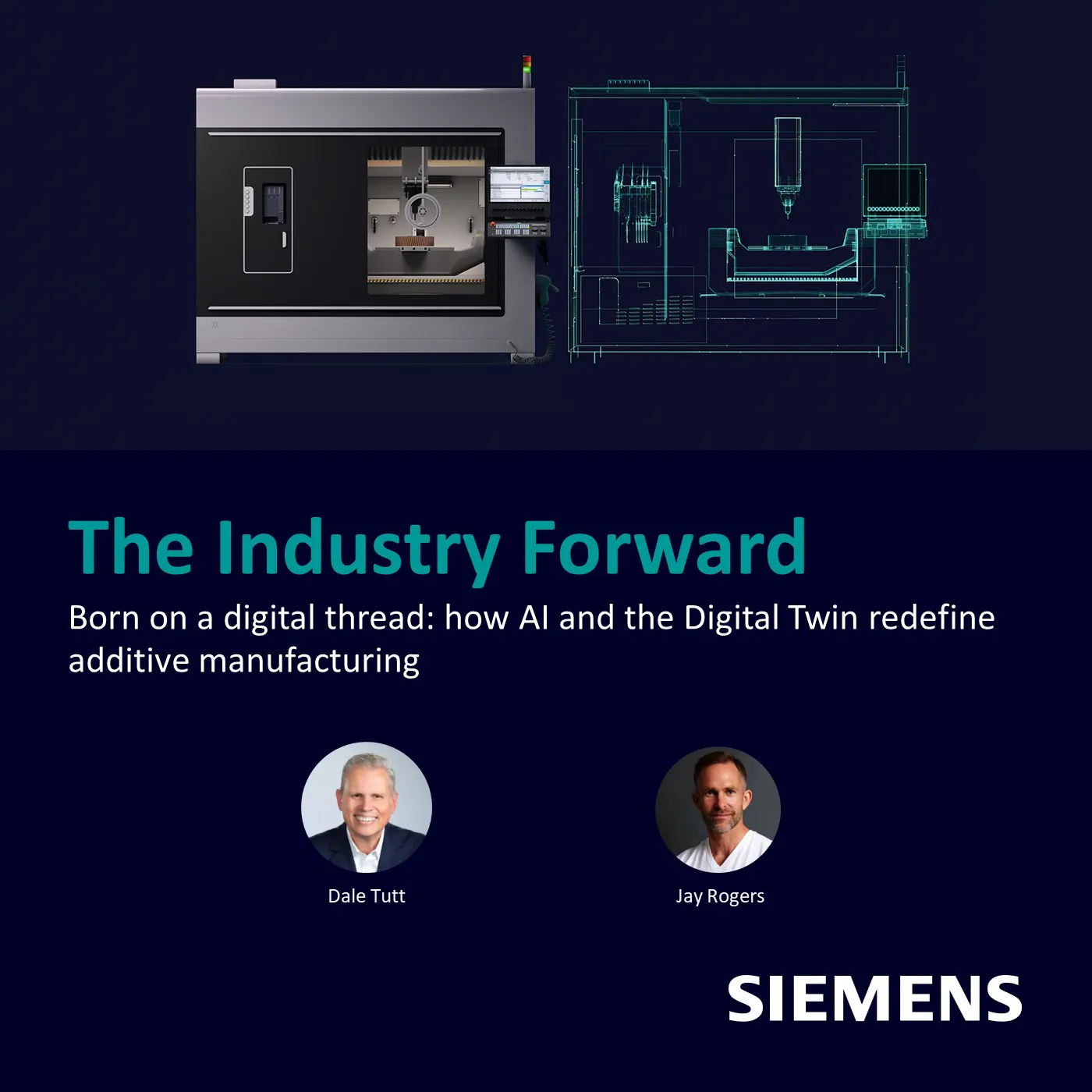
Additive manufacturing can be a great boon for the manufacturing industry as profit margins shrink, regulations increase and
sustainable production accelerates in importance. Successful additive
manufacturing requires a focus on speed and scalability, and software-defined manufacturing built on the Digital Twin and AI connect business operations while optimizing automated design and manufacturing processes.
In this episode of the Industry Forward podcast, host Dale
Tutt, Global Vice President of Industry Strategy, Siemens Digital Industries Software, and guest Jay Rogers, CEO of Haddy, discuss how digital technologies and artificial intelligence are converging to transform product development and production.
This episode will cover:
The parts machine learning and simulation play in optimizing
additive manufacturing processes
How to apply AI across maintenance, design, quality
assurance, process optimization and future autonomous product creation
Ways advanced digital tools and robotics can help drive the
next generation of manufacturing

Semiconductor complexity is accelerating at a pace that traditional design methods struggle to handle. As transistor counts race toward one trillion per chip, the tools and workflows that engineers rely on must evolve to keep pace.
In this episode of the Industry Forward Podcast, host Dale Tutt, Vice President of Industry Strategy at Siemens Digital Industries Software, sits down with Ankur Gupta, who oversees Siemens' integrated circuit design portfolio, to explore how the semiconductor industry is responding to an era of exponential complexity and how AI will help companies navigate growing complexity.
This episode will cover:
Ankur's career journey from mathematics and control systems to leading AI-driven EDA solutions at Siemens
What electronic design automation (EDA) is and why it is foundational to every chip in every device we use
Why traditional EDA methods are no longer sufficient as chip designs grow more complex, more interconnected, and more constrained by physical and thermal realities
A preview of how AI is beginning to change the EDA tools and solutions that semiconductor teams depend on

Comments

Download from Google Play

Download from App Store
 United States