


 Claim Ownership
The Information Bottleneck
Subscribed: 5Played: 13
Subscribe

© 2025 Ravid Shwartz-Ziv & Allen Roush
Description
Two AI Researchers - Ravid Shwartz Ziv, and Allen Roush, discuss the latest trends, news, and research within Generative AI, LLMs, GPUs, and Cloud Systems.
20 Episodes
Reverse

Yann LeCun – Why LLMs Will Never Get Us to AGI"The path to superintelligence - just train up the LLMs, train on more synthetic data, hire thousands of people to school your system in post-training, invent new tweaks on RL-I think is complete bullshit. It's just never going to work."After 12 years at Meta, Turing Award winner Yann LeCun is betting his legacy on a radically different vision of AI. In this conversation, he explains why Silicon Valley's obsession with scaling language models is a dead end, why the hardest problem in AI is reaching dog-level intelligence (not human-level), and why his new company AMI is building world models that predict in abstract representation space rather than generating pixels.Timestamps(00:00:14) – Intro and welcome(00:01:12) – AMI: Why start a company now?(00:04:46) – Will AMI do research in the open?(00:06:44) – World models vs LLMs(00:09:44) – History of self-supervised learning(00:16:55) – Siamese networks and contrastive learning(00:25:14) – JEPA and learning in representation space(00:30:14) – Abstraction hierarchies in physics and AI(00:34:01) – World models as abstract simulators(00:38:14) – Object permanence and learning basic physics(00:40:35) – Game AI: Why NetHack is still impossible(00:44:22) – Moravec's Paradox and chess(00:55:14) – AI safety by construction, not fine-tuning(01:02:52) – Constrained generation techniques(01:04:20) – Meta's reorganization and FAIR's future(01:07:31) – SSI, Physical Intelligence, and Wayve(01:10:14) – Silicon Valley's "LLM-pilled" monoculture(01:15:56) – China vs US: The open source paradox(01:18:14) – Why start a company at 65?(01:25:14) – The AGI hype cycle has happened 6 times before(01:33:18) – Family and personal background(01:36:13) – Career advice: Learn things with a long shelf life(01:40:14) – Neuroscience and machine learning connections(01:48:17) – Continual learning: Is catastrophic forgetting solved?Music:"Kid Kodi" — Blue Dot Sessions — via Free Music Archive — CC BY-NC 4.0."Palms Down" — Blue Dot Sessions — via Free Music Archive — CC BY-NC 4.0.Changes: trimmedAboutThe Information Bottleneck is hosted by Ravid Shwartz-Ziv and Allen Roush, featuring in-depth conversations with leading AI researchers about the ideas shaping the future of machine learning.
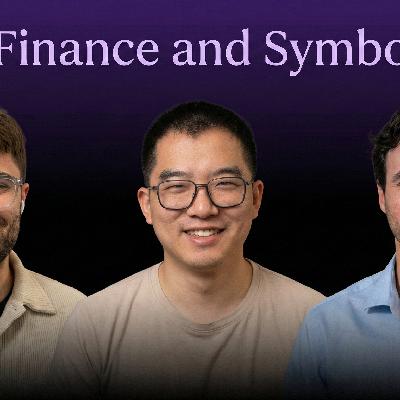
Atlas Wang (UT Austin faculty, XTX Research Director) joins us to explore two fascinating frontiers: the foundations of symbolic AI and the practical challenges of building AI systems for quantitative finance.On the symbolic AI side, Atlas shares his recent work proving that neural networks can learn symbolic equations through gradient descent, a surprising result given that gradient descent is continuous while symbolic structures are discrete. We talked about why neural nets learn clean, compositional mathematical structures at all, what the mathematical tools involved are, and the broader implications for understanding reasoning in AI systems.The conversation then turns to neuro-symbolic approaches in practice: agents that discover rules through continued learning, propose them symbolically, verify them against domain-specific checkers, and refine their understanding.On the finance side, Atlas pulls back the curtain on what AI research looks like at a high-frequency trading firm. The core problem sounds simple (predict future prices from past data). Still, the challenge is extreme: markets are dominated by noise, predictions hover near zero correlation, and success means eking out tiny margins across astronomical numbers of trades. He explains why synthetic data techniques that work elsewhere don't translate easily, and why XTX is building time series foundation models rather than adapting language models.We also discuss the convergence of hiring between frontier AI labs and quantitative finance, and why this is an exceptional moment for ML researchers to consider the finance industry.Links:Why Neural Network Can Discover Symbolic Structures with Gradient-based Training: An Algebraic and Geometric Foundation for Neurosymbolic Reasoning - arxiv.org/abs/2506.21797Atlas website - https://www.vita-group.space/Guest: Atlas Wang (UT Austin / XTX)Hosts: Ravid Shwartz-Ziv & Allen RoushMusic: “Kid Kodi” — Blue Dot Sessions. Source: Free Music Archive. Licensed CC BY-NC 4.0.

In this episode, we hosted Judah Goldfeder, a PhD candidate at Columbia University and student researcher at Google, to discuss robotics, reproducibility in ML, and smart buildings.Key topics covered:Robotics challenges: We discussed why robotics remains harder than many expected, compared to LLMs. The real world is unpredictable and unforgiving, and mistakes have physical consequences. Sim-to-real transfer remains a major bottleneck because simulators are tedious to configure accurately for each robot and environment. Unlike text, robotics lacks foundation models, partly due to limited clean, annotated datasets and the difficulty of collecting diverse real-world data.Reproducibility crisis: We discussed how self-reported benchmarks can lead to p-hacking and irreproducible results. Centralized evaluation systems (such as Kaggle or ImageNet challenges), where researchers submit algorithms for testing on hidden test sets, seem to drive faster progress.Smart buildings: Judah's work at Google focuses on using ML to optimize HVAC systems, potentially reducing energy costs and carbon emissions significantly. The challenge is that every building is different. It makes the simulation configuration extremely labor-intensive. Generative AI could help by automating the process of converting floor plans or images into accurate building simulations.Links:Judah website - https://judahgoldfeder.com/Music:"Kid Kodi" — Blue Dot Sessions — via Free Music Archive — CC BY-NC 4.0."Palms Down" — Blue Dot Sessions — via Free Music Archive — CC BY-NC 4.0.Changes: trimmed

In this episode, we talk with Will Brown, a research lead at Prime Intellect, about his journey into reinforcement learning (RL) and multi-agent systems, exploring their theoretical foundations and practical applications. We discuss the importance of RL in the current LLMs pipeline and the challenges it faces. We also discuss applying agentic workflows to real-world applications and the ongoing evolution of AI development.Chapters00:00 Introduction to Reinforcement Learning and Will's Journey03:10 Theoretical Foundations of Multi-Agent Systems06:09 Transitioning from Theory to Practical Applications09:01 The Role of Game Theory in AI11:55 Exploring the Complexity of Games and AI14:56 Optimization Techniques in Reinforcement Learning17:58 The Evolution of RL in LLMs21:04 Challenges and Opportunities in RL for LLMs23:56 Key Components for Successful RL Implementation27:00 Future Directions in Reinforcement Learning36:29 Exploring Agentic Reinforcement Learning Paradigms38:45 The Role of Intermediate Results in RL41:16 Multi-Agent Systems: Challenges and Opportunities45:08 Distributed Environments and Decentralized RL49:31 Prompt Optimization Techniques in RL52:25 Statistical Rigor in Evaluations55:49 Future Directions in Reinforcement Learning59:50 Task-Specific Models vs. General Models01:02:04 Insights on Random Verifiers and Learning Dynamics01:04:39 Real-World Applications of RL and Evaluation Challenges01:05:58 Prime RL Framework: Goals and Trade-offs01:10:38 Open Source vs. Closed Source Models01:13:08 Continuous Learning and Knowledge ImprovementMusic:"Kid Kodi" — Blue Dot Sessions — via Free Music Archive — CC BY-NC 4.0."Palms Down" — Blue Dot Sessions — via Free Music Archive — CC BY-NC 4.0.Changes: trimmed

In this episode, we discuss various topics in AI, including the challenges of the conference review process, the capabilities of Kimi K2 thinking, the advancements in TPU technology, the significance of real-world data in robotics, and recent innovations in AI research. We also talk about the cool "Chain of Thought Hijacking" paper, how to use simple ideas to scale RL, and the implications of the Cosmos project, which aims to enable autonomous scientific discovery through AI.Papers and links:Chain-of-Thought Hijacking - https://arxiv.org/pdf/2510.26418Kosmos: An AI Scientist for Autonomous Discovery - https://t.co/9pCr6AUXAeJustRL: Scaling a 1.5B LLM with a Simple RL Recipe - https://relieved-cafe-fe1.notion.site/JustRL-Scaling-a-1-5B-LLM-with-a-Simple-RL-Recipe-24f6198b0b6b80e48e74f519bfdaf0a8Chapters00:00 Navigating the Peer Review Process04:17 Kimi K2 Thinking: A New Era in AI12:27 The Future of Tool Calls in AI17:12 Exploring Google's New TPUs22:04 The Importance of Real-World Data in Robotics28:10 World Models: The Next Frontier in AI31:36 Nvidia's Dominance in AI Partnerships32:08 Exploring Recent AI Research Papers37:46 Chain of Thought Hijacking: A New Threat43:05 Simplifying Reinforcement Learning Training54:03 Cosmos: AI for Autonomous Scientific DiscoveryMusic:"Kid Kodi" — Blue Dot Sessions — via Free Music Archive — CC BY-NC 4.0."Palms Down" — Blue Dot Sessions — via Free Music Archive — CC BY-NC 4.0.Changes: trimmed

In this episode, we sit down with Alex Alemi, an AI researcher at Anthropic (previously at Google Brain and Disney), to explore the powerful framework of the information bottleneck and its profound implications for modern machine learning.We break down what the information bottleneck really means, a principled approach to retaining only the most informative parts of data while compressing away the irrelevant. We discuss why compression is still important in our era of big data, how it prevents overfitting, and why it's essential for building models that generalize well.We also dive into scaling laws: why they matter, what we can learn from them, and what they tell us about the future of AI research.Papers and links:Alex's website - https://www.alexalemi.com/Scaling exponents across parameterizations and optimizers - https://arxiv.org/abs/2407.05872Deep Variational Information Bottleneck - https://arxiv.org/abs/1612.00410Layer by Layer: Uncovering Hidden Representations in Language Models - https://arxiv.org/abs/2502.02013Information in Infinite Ensembles of Infinitely-Wide Neural Networks - https://proceedings.mlr.press/v118/shwartz-ziv20a.htmlMusic:“Kid Kodi” — Blue Dot Sessions — via Free Music Archive — CC BY-NC 4.0.“Palms Down” — Blue Dot Sessions — via Free Music Archive — CC BY-NC 4.0.Changes: trimmed
In this episode, we talked about AI news and recent papers. We explored the complexities of using AI models in healthcare (the Nature Medicine paper on GPT-5's fragile intelligence in medical contexts). We discussed the delicate balance between leveraging LLMs as powerful research tools and the risks of over-reliance, touching on issues such as hallucinations, medical disagreements among practitioners, and the need for better education on responsible AI use in healthcare.We also talked about Stanford's "Cartridges" paper, which presents an innovative approach to long-context language models. The paper tackles the expensive computational costs of billion-token context windows by compressing KV caches through a clever "self-study" method using synthetic question-answer pairs and context distillation. We discussed the implications for personalization, composability, and making long-context models more practical.Additionally, we explored the "Continuous Autoregressive Language Models" paper and touched on insights from the Smol Training Playbook.Papers discussed:The fragile intelligence of GPT-5 in medicine: https://www.nature.com/articles/s41591-025-04008-8Cartridges: Lightweight and general-purpose long context representations via self-study: https://arxiv.org/abs/2506.06266Continuous Autoregressive Language Models: https://arxiv.org/abs/2510.27688The Smol Training Playbook: https://huggingface.co/spaces/HuggingFaceTB/smol-training-playbookMusic:“Kid Kodi” — Blue Dot Sessions — via Free Music Archive — CC BY-NC 4.0.“Palms Down” — Blue Dot Sessions — via Free Music Archive — CC BY-NC 4.0.Changes: trimmedThis is an experimental format for us, just news and papers without a guest interview. Let us know what you think!

In this episode, we host Jonas Geiping from ELLIS Institute & Max-Planck Institute for Intelligent Systems, Tübingen AI Center, Germany. We talked about his broad research on Recurrent-Depth Models and latent reasoning in large language models (LLMs). We talked about what these models can and can't do, what are the challenges and next breakthroughs in the field, world models, and the future of developing better models. We also talked about safety and interpretability, and the role of scaling laws in AI development.Chapters00:00 Introduction and Guest Introduction01:03 Peer Review in Preprint Servers06:57 New Developments in Coding Models09:34 Open Source Models in Europe11:00 Dynamic Layers in LLMs26:05 Training Playbook Insights30:05 Recurrent Depth Models and Reasoning Tasks43:59 Exploring Recursive Reasoning Models46:46 The Role of World Models in AI48:41 Innovations in AI Training and Simulation50:39 The Promise of Recurrent Depth Models52:34 Navigating the Future of AI Algorithms54:44 The Bitter Lesson of AI Development59:11 Advising the Next Generation of Researchers01:06:42 Safety and Interpretability in AI Models01:10:46 Scaling Laws and Their Implications01:16:19 The Role of PhDs in AI ResearchLinks and paper:Jonas' website - https://jonasgeiping.github.io/Scaling up test-time compute with latent reasoning: A recurrent depth approach - https://arxiv.org/abs/2502.05171The Smol Training Playbook: The Secrets to Building World-Class LLMs - https://huggingface.co/spaces/HuggingFaceTB/smol-training-playbookVaultGemma: A Differentially Private Gemma Model - https://arxiv.org/abs/2510.15001Music:“Kid Kodi” — Blue Dot Sessions — via Free Music Archive — CC BY-NC 4.0.“Palms Down” — Blue Dot Sessions — via Free Music Archive — CC BY-NC 4.0.Changes: trimmed

In this episode of the Information Bottleneck Podcast, we host Jack Morris, a PhD student at Cornell, to discuss adversarial examples (Jack created TextAttack, the first software package for LLM jailbreaking), the Platonic representation hypothesis, the implications of inversion techniques, and the role of compression in language models.Links:Jack's Website - https://jxmo.io/TextAttack - https://arxiv.org/abs/2005.05909How much do language models memorize? https://arxiv.org/abs/2505.24832DeepSeek OCR - https://www.arxiv.org/abs/2510.18234Chapters:00:00 Introduction and AI News Highlights04:53 The Importance of Fine-Tuning Models10:01 Challenges in Open Source AI Models14:34 The Future of Model Scaling and Sparsity19:39 Exploring Model Routing and User Experience24:34 Jack's Research: Text Attack and Adversarial Examples29:33 The Platonic Representation Hypothesis34:23 Implications of Inversion and Security in AI39:20 The Role of Compression in Language Models44:10 Future Directions in AI Research and Personalization

In this episode we talk with Randall Balestriero, an assistant professor at Brown University. We discuss the potential and challenges of Joint Embedding Predictive Architectures (JEPA). We explore the concept of JEPA, which aims to learn good data representations without reconstruction-based learning. We talk about the importance of understanding and compressing irrelevant details, the role of prediction tasks, and the challenges of preventing collapse.
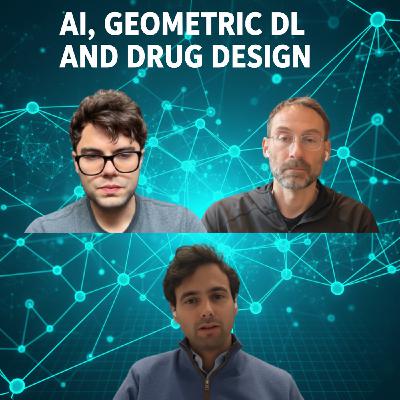
In this episode, we talked with Michael Bronstein, a professor of AI at the University of Oxford and a scientific director at AITHYRA, about the fascinating world of geometric deep learning. We explored how understanding the geometric structures in data can enhance the efficiency and accuracy of AI models. Michael shared insights on the limitations of small neural networks and the ongoing debate about the role of scaling in AI. We also talked about the future in scientific discovery, and the potential impact on fields like drug design and mathematics
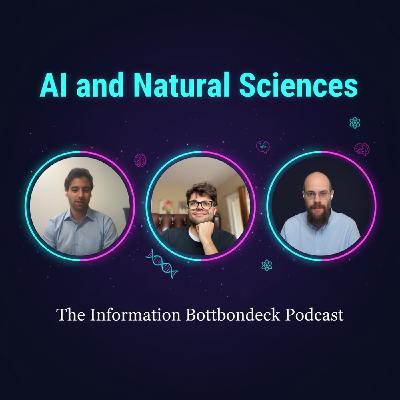
In this episode we host Tal Kachman, an assistant professor at Radboud University, to explore the fascinating intersection of artificial intelligence and natural sciences. Prof. Kachman's research focuses on multiagent interaction, complex systems, and reinforcement learning. We dive deep into how AI is revolutionizing materials discovery, chemical dynamics modeling, and experimental design through self-driving laboratories. Prof. Kachman shares insights on the challenges of integrating physics and chemistry with AI systems, the critical role of high-throughput experimentation in accelerating scientific discovery, and the transformative potential of generative models to unlock new materials and functionalities.

In this episode, we talked with Ahmad Beirami, an ex-researcher at Google, to discuss various topics. We explored the complexities of reinforcement learning, its applications in LLMs, and the evaluation challenges in AI research. We also discussed the dynamics of academic conferences and the broken review system. Finally, we discussed how to integrate theory and practice in AI research and why the community should prioritize a deeper understanding over surface-level improvements.
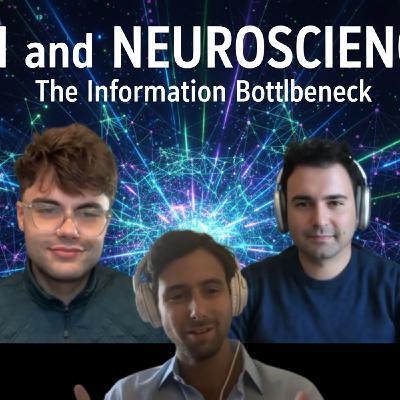
In this episode of the "Information Bottleneck" podcast, we hosted Aran Nayeb, an assistant professor at Carnegie Mellon University, to discuss the intersection of computational neuroscience and machine learning. We talked about the challenges and opportunities in understanding intelligence through the lens of both biological and artificial systems. We talked about topics such as the evolution of neural networks, the role of intrinsic motivation in AI, and the future of brain-machine interfaces.

We talked with Ariel Noyman, an urban scientist, working in the intersection of cities and technology. Ariel is a research scientist at the MIT Media Lab, exploring novel methods of urban modeling and simulation using AI. We discussed the potential of virtual environments to enhance urban design processes, the challenges associated with them, and the future of utilizing AI. Links:TravelAgent: Generative agents in the built environment - https://journals.sagepub.com/doi/10.1177/23998083251360458Ariel Neumann's websites -https://www.arielnoyman.com/https://www.media.mit.edu/people/noyman/overview/

We discussed the inference optimization technique known as Speculative Decoding with a world class researcher, expert, and ex-coworker of the podcast hosts: Nadav Timor.Papers and links:Accelerating LLM Inference with Lossless Speculative Decoding Algorithms for Heterogeneous Vocabularies, Timor et al, ICML 2025, https://arxiv.org/abs/2502.05202Distributed Speculative Inference (DSI): Speculation Parallelism for Provably Faster Lossless Language Model Inference, Timor et al, ICLR, 2025, https://arxiv.org/abs/2405.14105Fast Inference from Transformers via Speculative Decoding, Leviathan et al, 2022, https://arxiv.org/abs/2502.05202FindPDFs - https://huggingface.co/datasets/HuggingFaceFW/finepdfs
In this episode, Ravid and Allen discuss the evolving landscape of AI coding. They explore the rise of AI-assisted development tools, the challenges faced in software engineering, and the potential future of AI in creative fields. The conversation highlights both the benefits and limitations of AI in coding, emphasizing the need for careful consideration of its impact on the industry and society.Chapters00:00Introduction to AI Coding and Recent Developments03:10OpenAI's Paper on Hallucinations in LLMs06:03Critique of OpenAI's Research Approach08:50Copyright Issues in AI Training Data12:00The Value of Data in AI Training14:50Watermarking AI Generated Content17:54The Future of AI Investment and Market Dynamics20:49AI Coding and Its Impact on Software Development31:36The Evolution of AI in Software Development33:54Vibe Coding: The Future or a Fad?38:24Navigating AI Tools: Personal Experiences and Challenges41:53The Limitations of AI in Complex Coding Tasks46:52Security Vulnerabilities in AI-Generated Code50:28The Role of Human Intuition in AI-Assisted Coding53:28The Impact of AI on Developer Productivity56:53The Future of AI in Creative Fields

Allen and Ravid discuss the dynamics associated with the extreme need for GPUs that AI researchers utilize. They also discuss the latest advancements in AI, including Google's Nano Banana and DeepSeek V3.1, exploring the implications of synthetic data, perplexity, and the influence of AI on human communication. They also delve into the challenges faced by AI researchers in the job market, the importance of GPU infrastructure, and a recent papers examining knowledge and reasoning in LLMs.

Allen and Ravid sit down and talk about Parameter Efficient Fine Tuning (PeFT) along with the latest updated in AI/ML news.
Allen and Ravid discuss a topic near and dear to their hearts, LLM Sampling!In this episode of the Information Bottleneck Podcast, Ravid Shwartz-Ziv and Alan Rausch discuss the latest developments in AI, focusing on the controversial release of GPT-5 and its implications for users. They explore the future of large language models and the importance of sampling techniques in AI. Chapters00:00 Introduction to the Information Bottleneck Podcast01:42 The GPT-5 Debacle: Expectations vs. Reality05:48 Shifting Paradigms in AI Research09:46 The Future of Large Language Models12:56 OpenAI's New Model: A Mixed Bag17:55 Corporate Dynamics in AI: Mergers and Acquisitions21:39 The GPU Monopoly: Challenges and Opportunities25:31 Deep Dive into Samplers in AI35:38 Innovations in Sampling Techniques42:31 Dynamic Sampling Methods and Their Implications51:50 Learning Samplers: A New Frontier59:51 Recent Papers and Their Impact on AI Research
Comments

Download from Google Play

Download from App Store
 United States