


 Claim Ownership
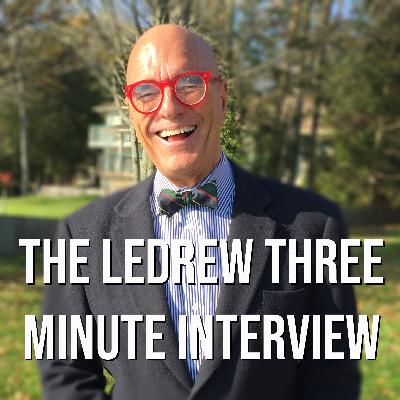
The LeDrew Three Minute Interview
Subscribed: 20Played: 2,668
Subscribe

Description
The LeDrew Three Minute Interview is a daily podcast featuring insight on the news that matters to you, with views you won't hear anywhere else. Stephen LeDrew is a lawyer, broadcaster, responsible father, and a believer in fairness and good manners and liberalism(in the best sense of the word), and good government and civic responsibility.Stephen LeDrew is an enemy of bureaucratic busybodies, know-it-all “idealogues”, pontificating politicians who tell everyone else how to run their lives, woke idiots, and politically correct, milquetoast, sanitized media outlets.
Hosted on Acast. See acast.com/privacy for more information.
804 Episodes
Reverse
Public provocateur Robin Bredin joins Stephen LeDrew to discuss a question increasingly confronting Canadians: how do we rebuild social cohesion in a country that feels increasingly divided?Bredin argues that restoring Canadian society begins with individual liberty, independent thinking and a stronger education system. He and LeDrew discuss whether schools have abandoned fundamentals, whether parents have become too distracted to challenge institutions and how cultural and political divisions have weakened a common Canadian identity.The conversation also turns to immigration and integration. LeDrew and Bredin contrast previous generations of newcomers who maintained their cultural roots while embracing a Canadian identity with what they see as a more fragmented society today.Bredin ultimately argues that citizenship cannot be based solely on rights. Canadians must also accept civic responsibilities — protecting institutions, participating in society and maintaining the norms that allow a diverse country to function.Topics covered in this episode:Canada’s weakening social cohesionEducation and independent thinkingParents and institutional accountabilityIntegration versus cultural divisionBuilding a shared Canadian identityThe legacy of multiculturalismRights versus responsibilitiesCivic participation and citizenshipPolitical and cultural fragmentationRebuilding common values Hosted on Acast. See acast.com/privacy for more information.
John Capobianco of FleishmanHillard joins Stephen LeDrew to discuss one of Ottawa’s most persistent problems: a federal bureaucracy that can make even major government priorities extraordinarily difficult to deliver.The conversation begins with the departure of the Prime Minister’s handpicked official tasked with military procurement after roughly a year on the job. LeDrew argues that the episode raises a larger question: what happens when even people given a direct mandate from the Prime Minister struggle to move through the federal system?Capobianco says Canada needs a strong professional public service, and stresses that many bureaucrats do valuable work. But he argues that government becomes dysfunctional when departments grow too large, political leadership and the bureaucracy become disconnected, or procurement systems become so complicated that businesses simply walk away.Military procurement is the clearest example. Both argue that repeated attempts at reform have failed to solve a problem that has persisted across governments of different political stripes.The question is no longer whether Ottawa has a bureaucracy problem — but what government is prepared to do about it.Topics Covered:Ottawa’s expanding bureaucracyWhy bureaucrats outlast governmentsPolitical leadership versus the public serviceCanada’s military procurement problemsWhy government projects get bottleneckedThe consequences of oversized departmentsBusinesses abandoning procurement processesWhere bureaucrats provide real valueWhy previous reforms haven’t lastedWhether more dramatic change is required Hosted on Acast. See acast.com/privacy for more information.
Conservative strategist Michael Diamond joins Stephen LeDrew to tackle a frustrating question for the Conservative Party: if Canadians are unhappy with the economy, housing, transportation and the direction of the country, why isn’t the opposition further ahead?LeDrew argues that Mark Carney may understand strategy but has failed to deliver good government. Diamond pushes back, arguing that Conservatives make a mistake if they underestimate Carney’s political ability.The two debate Carney’s handling of Donald Trump, his political momentum, Parliament, military procurement and whether standing up to the United States has become the defining issue for Canadian voters.This is the first Three Minutes. Become a member to watch the full debate between LeDrew and Michael Diamond.Topics CoveredWhy Carney remains politically strongThe Conservatives’ polling problemTrump’s impact on Canadian politicsCarney’s political skillsParliament and the PMOCanada’s economic frustrationMilitary procurement bureaucracyThe challenge facing Conservatives Hosted on Acast. See acast.com/privacy for more information.
In this LeDrew rant, Stephen LeDrew argues that Canada needs more accountability, more public participation and far more scrutiny of the people elected to govern.Pointing to Alberta Premier Danielle Smith’s push for faster project approvals and citizen-initiated votes, LeDrew asks whether Canadians should have more direct ways to influence government between elections.That could include referendums on major issues — or even recall mechanisms when politicians fail to deliver on important promises.LeDrew also argues that Canadians themselves need to take politics more seriously: looking beyond personality, asking tougher questions about policy and understanding what politicians actually plan to do once elected.He says Canada has suffered from years of poor federal governance, excessive bureaucracy and too little accountability — and argues that both politicians and the media should face much tougher scrutiny.The bigger question: should Canadians have more power to hold governments accountable before the next election arrives?Topics Covered:Political accountability in CanadaRecall electionsCitizen-initiated referendumsDanielle Smith’s approach in AlbertaCutting bureaucracy and regulationHolding politicians to their promisesVoter responsibilityPersonality versus public policyTrudeau’s impact on the Liberal PartyIndependent media and political scrutiny Hosted on Acast. See acast.com/privacy for more information.
Alberta Premier Danielle Smith joins Stephen LeDrew to discuss Donald Trump, the Canada-U.S. trade war and why she believes Canada needs to stop thinking only about Washington.Smith argues that the strongest advocates for Canadian trade are often Americans themselves — governors, legislators, businesses and workers who benefit directly from doing business with Canada.She points to Bombardier as an example of how U.S. political pressure can change when American jobs and investment are at stake, and says every premier should be building stronger relationships south of the border.The conversation also turns to energy, critical minerals, defence, interprovincial trade and whether Trump’s pressure has forced Canada to take its own economic potential more seriously.Smith says Alberta is now moving ahead with dozens of investment projects, faster provincial approvals and a new working relationship with Ottawa — including hopes for a major West Coast oil pipeline.Topics Covered:Danielle Smith’s strategy for dealing with TrumpWhy American allies matter more than Washington aloneGovernors and U.S. business relationshipsBombardier and cross-border jobsEnergy and critical mineralsCanada’s east-west trade potentialAlberta investment projectsCutting approval timesProvincial autonomyA possible West Coast oil pipeline Hosted on Acast. See acast.com/privacy for more information.

Comments

Download from Google Play

Download from App Store
 United States