



 Claim Ownership
The Little Red Podcast
Subscribed: 2,350Played: 16,260
Subscribe

© 2026 Graeme Smith and Louisa Lim
Description
The Little Red Podcast: interviews and chat celebrating China beyond the Beijing beltway. Hosted by Graeme Smith, China studies academic at the Australian National University's Department of Pacific Affairs and Louisa Lim, former China correspondent for the BBC and NPR, now with the Centre for Advancing Journalism at Melbourne University. We are the 2018 winners of podcast of the year in the News & Current Affairs category of the Australian Podcast Awards. Follow us @limlouisa and @GraemeKSmith, and find show notes at www.facebook.com/LittleRedPodcast/
124 Episodes
Reverse

In the fifth episode in the China Rules series, we look at China’s efforts to reshape to global financial system. One milestone has been the recent designation of Deutsche Bank as a renminbi clearing house. China is pushing hard to increase its influence inside international institutions and to internationalize the renminbi, driven by the Iran war and uncertainty about the US dollar. But with a tradition of strict capital controls and limited liquidity, it’s not clear whether the CCP would be able to underwrite the international order. To ask how China is trying to reshape global finance, Louisa and Graeme are joined by Gregory Chin and Kevin Gallagher from Boston University’s Global Development Policy Centre, authors of China and the Global Economic Order. Image: c/- Dilok Klaisataporn, iStock, 2018. Transcripts available at https://ciw.anu.edu.au/podcasts/little-red-podcast See omnystudio.com/listener for privacy information.

In our fourth episode of the China Rules series, we look at the State Council’s brand-new rules on overseas investment. These formalize central control over outbound investment, addressing the Party’s concerns about sensitive technologies and data, while sending a chilling signal to Chinese tech companies looking to move abroad. Beijing is now the first major capital exporter to run outbound investment as explicit industrial policy with legal retaliation tools. To explain the likely impact of these regulations on the global financial system, Louisa and Graeme are joined by Stefanie Kam from Nanyang Technology University in Singapore and Lizzi Lee from the Centre for China Analysis at the Asia Society Policy Institute. Image: c/- iStock Transcripts available at https://ciw.anu.edu.au/podcasts/little-red-podcastSee omnystudio.com/listener for privacy information.

In the latest episode in our China Rules series, we look at the rise and potential fall of China’s electric vehicle (EV) industry. Once scoffed at by Elon Musk, China’s EV industry is charging ahead in international markets with its top car brand, BYD, selling more cars than Tesla in 2025. Massive government subsidies and consistent policy have brought China to a point where it now leads in a range of technologies, from batteries to robotaxis. Yet headwinds are emerging, with domestic demand tanking and protectionism surging in the US and Europe. To discuss the rise, and potential demise, of China’s EV behemoth, Louisa and Graeme are joined by Fengming Lu from the Australian National University and Yu Yang, Principal Lead Analyst of Automotives and Robotics at Yole Group, a company that analyses tech markets. Image: DarthArt, iStock. Beijing, China - February 25, 2026: Modern small city car Wuling Hongguang Mini EV. Transcripts available at https://ciw.anu.edu.au/podcasts/little-red-podcastSee omnystudio.com/listener for privacy information.
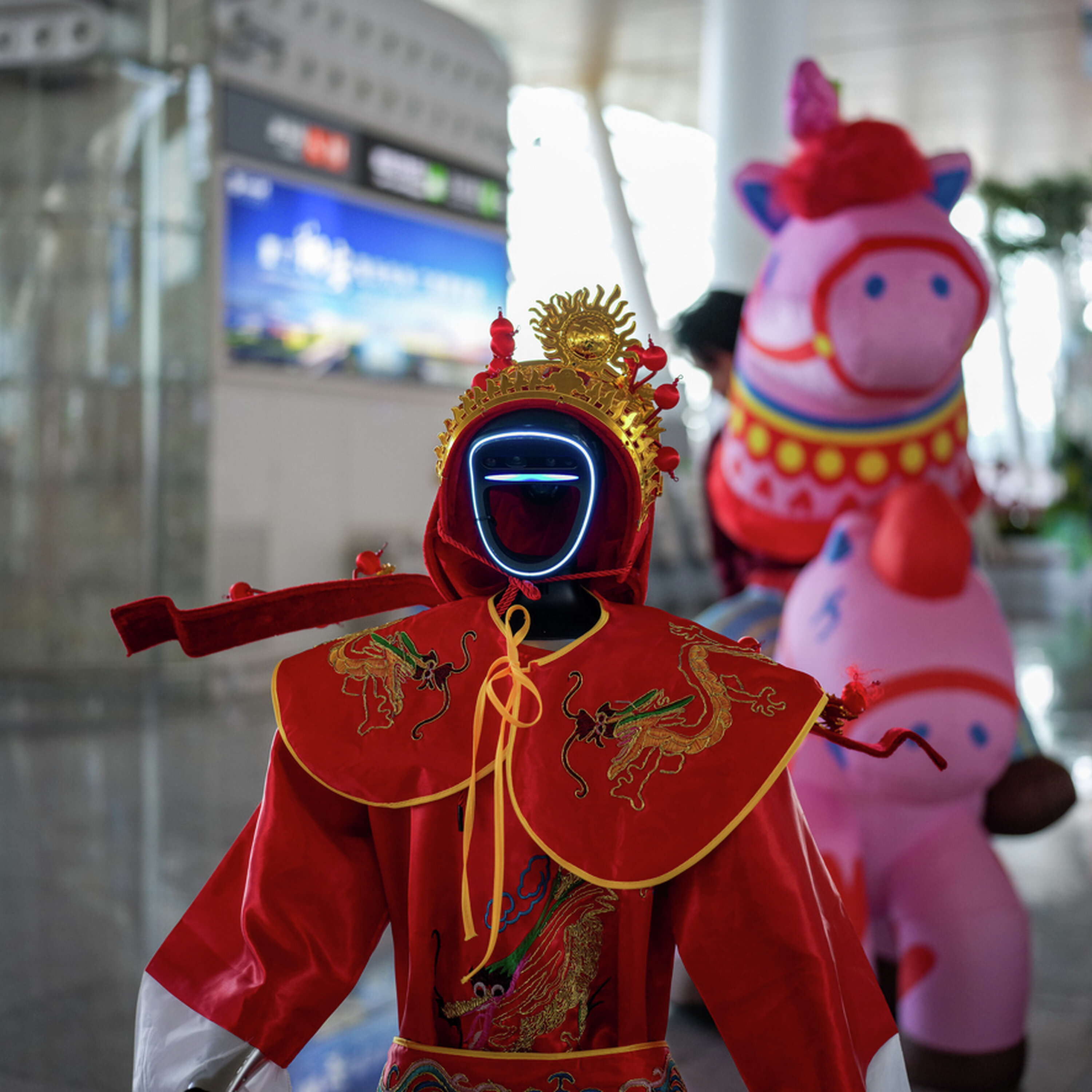
In the second episode of our series, China Rules, we look at an industry dominated by China: humanoid robots. Beijing’s running, dancing and fighting robots are more than just a gimmick; the country’s 15th Five-year Plan puts robotics right at the heart of its modern industrial system. China already accounts for 80% of global humanoid robot installations. In a recent half marathon, a humanoid robot called Lightning left the real humans behind for the first time, breaking the tape in just over 50 minutes. To discuss the future of the robot wars, Louisa and Graeme are joined by Alberto Moel, former Vice President of Veo Robotics, now with the University of Hong Kong, and Chang Che, a freelance writer who was formerly the Asia technology correspondent for the New York Times. Image: Robot in Traditional Attire at Airport Hall, c/- iStock photos, Daqian Wang, 25 February 2026. Transcripts available at https://ciw.anu.edu.au/podcasts/little-red-podcastSee omnystudio.com/listener for privacy information.

In our new series—China Rules—we look at how China is a global exporter, not just of goods, but also of standards, ideas, technologies and mechanisms of control. We’re starting with politics, and whether China is exporting its brand of “smart authoritarianism”. China’s heady mix of extractive political institutions and pro-growth economic policies makes for an attractive recipe to would-be imitators, just as China borrowed these ideas from South Korea and Singapore. Coupled with its edge in AI, digital surveillance and emerging technologies, China has moved from a passive exemplar to marketing—and profiting from—its blueprint for staying in power. Louisa and Graeme are joined by Jennifer Lind from Dartmouth College, the author of Autocracy 2.0: How China’s Rise Re-Invented Tyranny, and Bethany Allen from the Australian Strategic Policy Institute and author of Beijing Rules: China's Quest for Global Influence. Image: China’s Police Liaison Team demonstrates martial arts during a community engagement event in Honiara, Solomon Islands. RFA/AFP/Royal Solomon Islands Police Force (RSIPF), June 2025 Transcripts available at https://ciw.anu.edu.au/podcasts/little-red-podcastSee omnystudio.com/listener for privacy information.

Comments

Download from Google Play

Download from App Store
 United States