


 Claim Ownership
The Match Tennis Cast
Subscribed: 0Played: 0
Subscribe

© Match Tennis App
Description
Join our deep dives into the Match Tennis App and learn how to boost your tennis game!
11 Episodes
Reverse

In this episode, we explain the step-by-step process for getting an ITF Junior Ranking, starting with registering for an International Player Identification Number (IPIN) and competing in official ITF junior tournaments.We cover how ranking points are earned based on tournament level, round reached, and match results, how often rankings are updated, and what players need to do to improve or maintain their position.A clear, practical guide for junior players, parents, and coaches navigating the ITF Junior Circuit for the first time.
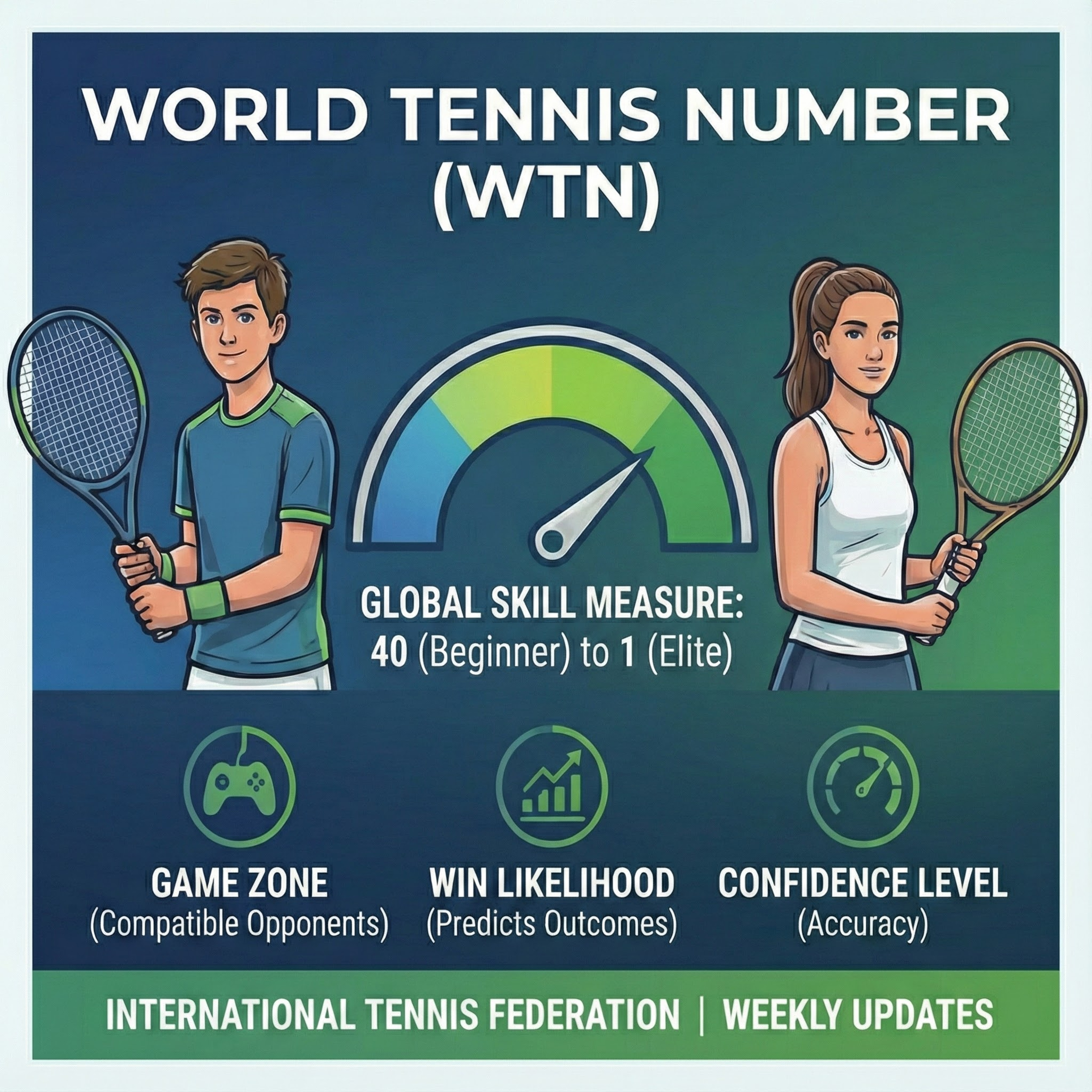
What is the World Tennis Number—and why is it changing how tennis measures skill worldwide?In this episode, we break down the World Tennis Number (WTN), the global rating system developed by the International Tennis Federation (ITF) to create a single, consistent measure of playing ability across all levels of the sport.Using a scale from 40 (beginner) to 1 (elite professional), WTN evaluates match results at the set level and updates weekly to track progress and predict match outcomes. We explain how the algorithm works, what the Confidence Level really means, and how tools like Game zONe and Win Likelihood help players find competitive, well-matched opponents.You’ll also learn how features such as head-to-head comparisons, personal watchlists, and the ability to record casual match scores fit into the broader WTN ecosystem—and why organizations like the USTA are adopting WTN for tournaments, player development, and college recruiting.Whether you’re a player, coach, parent, or tennis administrator, this episode gives you a clear, practical understanding of the system shaping the future of competitive tennis.
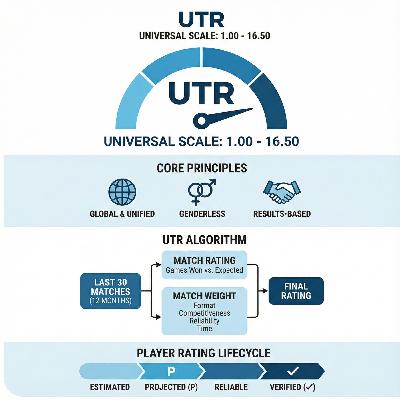
The Universal Tennis Rating (UTR) Explained is a deep-dive podcast dedicated to understanding the world’s most accurate and widely used tennis rating system.Designed on a single global scale from 1.00 to 16.50, the UTR Rating evaluates tennis players of all ages, genders, and backgrounds based purely on match results and performance. In this podcast, we break down how the UTR algorithm works, why it’s considered a modified Elo system, and how factors like match competitiveness, opponent strength, format, and recency shape a player’s rating.Listeners will gain a clear understanding of:How UTR calculates ratings using a rolling 12-month, 30-match windowWhy winning games matters just as much as winning matchesHow ratings can change even when you don’t playThe difference between projected, reliable, and verified UTR ratingsHow UTR impacts tournament seeding, player development, and college recruitingWhether you’re a junior player, college prospect, parent, coach, tournament director, or competitive adult, this podcast demystifies rating fluctuations, strategic match play, and the real-world decisions driven by UTR data.Endorsed by top professionals and trusted by college coaches worldwide, the Universal Tennis Rating has become the gold standard for measuring tennis ability. This show helps you understand it — and use it — with confidence.

Match Book: AI Scouting Reports breaks down how competitive tennis players and coaches can gain a real edge using data, observation, and artificial intelligence. This episode explores how Match Book transforms the traditional tennis “black book” into a private, modern intelligence system—capturing match statistics, player notes, and AI-generated scouting reports to build smarter game plans. Designed for players, parents, and coaches who want to prepare better, compete smarter, and stay one step ahead.
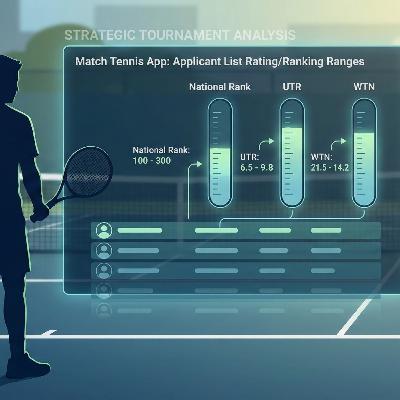
This episode explores a powerful feature in the Match Tennis App (MTA) that gives players an instant snapshot of applicant list ratings and ranking ranges for tournaments. Learn how dynamic updates for National Rank, UTR, and WTN help users quickly assess competition levels, search tournaments with confidence, and make smarter entry decisions for more competitive and rewarding matches.

Discover the secrets behind junior tennis success. Learn how many tournaments top players compete in, their match counts, and the strategies that develop champions.

This deep dive explores the Match Tennis App's strategic features designed to provide players, parents, and coaches with an edge in tournament planning and decision-making. Central to this is the NEW AI Tournament Comparison Tool, described as "Decision-Making On Steroids", which is a game-changer for saving time and assisting in making well-informed entry decisions based on goals like advancing a USTA Ranking, WTN, or UTR rating, or improving match count volume. This tool allows users to multi-select and compare data for up to 25 events, instantly personalizing the data to show where the player stands (This is "GOLD"), while auto-generating crucial logistics like event distance, draw type, and the WTN and UTR range output for registered players. Furthermore, the analysis covers the premium Rankings Snapshot tool, which auto-calculates a player's top 6 singles and top 6 doubles results on a rolling 52-week basis and highlights points that are chronologically falling off next5..., alongside the powerful search functionality that allows users to find tournaments based on specified desired participant UTR or WTN ranges.
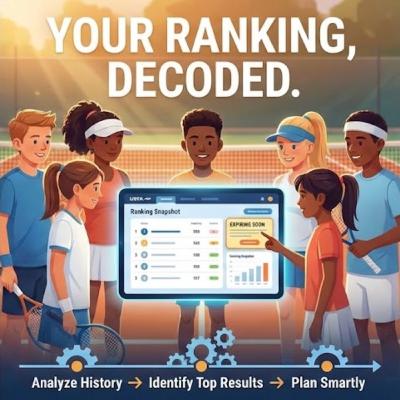
This deep dive focuses on the Rankings Snapshot tool, a premium feature (formerly the “Tournament Rankings Results” tool) designed to evaluate a player’s earned points from each tournament to rapidly determine the top 6 singles and doubles results that contribute to a USTA ranking1. The tool auto-calculates complex ranking rules, which are based on a player’s top 6 singles and top 6 doubles results from junior tournaments over a rolling 52-week period. A key feature is the display, often using bold bright colors or red/orange highlighted rows, to show which singles and doubles tournament points are chronologically falling off next, thereby assisting in decisions on which tournaments to play. Ultimately, this tool, along with other features like the "Ranking Forecaster" and "Tournament Scheduler," helps save parents and players hours of time planning tournaments and working toward specific ranking goals.

This deep dive explores the USTA Junior Team Tennis (JTT) program, a team-based format that unites boys and girls, generally ages 5 to 18, to compete in singles, doubles, and mixed doubles. Unlike typical individual tournaments, JTT champions teamwork and provides a structured, progressive competitive pathway extending from local leagues to national championships. This level-based environment is designed to promote comprehensive skill enhancement by boosting technical proficiency and strategic understanding, accommodating a wide spectrum of skill levels from beginners to advanced players. Ultimately, JTT prioritizes individual growth, social development, and the instilling of life skills like unity and sportsmanship, where success is defined by how players work together and respond to challenges.

This deep dive explores the USTA Junior Circuit Events, which provide an excellent stepping stone for young tennis players ready to delve into individual match play. These events utilize a non-elimination, round-robin draw format that guarantees individual match play for all participants, allowing them to gain valuable experience by playing between two and four matches per event. The circuit is designed to help players develop skills and understand good sportsmanship in a competitive yet friendly environment, and players aged 10 and under receive PlayTracker points for consistent participation. Ultimately, the Junior Circuit serves as an essential transitional step, bridging the gap between preparatory programs like USTA Team Challenges and advancing toward competitive, ranked USTA Junior Tournaments.

This deep dive focuses on the Net Generation PlayTracker Assessment Guide for Coaches, outlining the essential steps for evaluating players aged 7-8 years old as they transition from orange to green ball levels. To begin this process, coaches must meet specific Certification and Requirements, including being USPTA or PTR certified, maintaining good standing, having a usta.com profile, and completing or renewing their Safe Play status. The evaluation follows an 11-step procedure within the Net Generation app, requiring the coach to watch a training video and administer the assessment, which the player must pass with a score of 85% or above. Upon successful completion and subsequent skill level update in the app, the player is then enabled to register for green ball competitive events appropriate for their newly assessed level.

This deep dive examines the USTA Net Generation Pathway, a comprehensive system designed to introduce youth aged 5-18 to tennis competition while emphasizing fun, teamwork, and adherence to the American Development Model (ADM). The system guides players through color-coded competitive stages—including Red, Orange, Green, and Yellow Ball Tennis—with specific regulations governing court size, ball usage, and racket length at each level. Central to the progression for players under age 11 is the Net Generation PlayTracker, an innovative tool that records participation and results from sanctioned programs like USTA Team Challenge and USTA Junior Circuit. The PlayTracker uses accumulated Play Points and Win Points to determine when a young player meets the specific requirements, such as accumulating 1,500 points, needed to become eligible to progress to the higher levels of competition, including Yellow Ball events.

This deep dive provides a comprehensive summary of the Universal Tennis Rating (UTR), which is a modified Elo rating system designed to promote fair and competitive play by accurately measuring skill level between 1.00 and 16.50. The calculation methodology uses a weighted average of up to 30 recent match results, where the system calculates both a match rating and a match weight for each player. The match rating primarily reflects whether a player performs better than the algorithm's expectation based on the percentage of total games won relative to the opponent's rating difference. Key factors determining match weight include the format length, the competitiveness of the match (based on the closeness of opponent ratings), and the reliability of the opponent's existing UTR. Ultimately, players can improve their UTR by playing well—winning more games than expected regardless of the opponent's level—and playing often so the rating quickly reflects their current form.

This deep dive provides a step-by-step guide on How to get an ITF junior ranking, emphasizing that the process starts with registering for an IPIN (International Player Identification Number) on the ITF website. After registering the required identifier, players must participate in ITF junior tournaments held across the world, which are categorized into different grades reflecting competition level and point allocation. A player's ranking is determined by the ranking points accumulated, which are awarded based on the tournament grade, the round reached, and the strength of the opponent. Achieving and maintaining a successful rank requires dedication, consistent performance, and familiarity with the ITF Junior Circuit Regulations, which govern tournament eligibility and detailed point allocation rules.
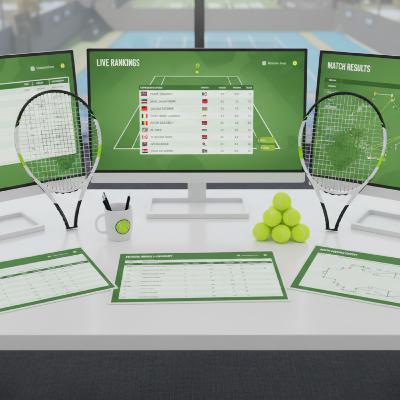
The sources detail a feature within the Match Tennis App (MTA) that provides an instant view of Applicant List Ratings/Rankings Ranges, which is essential for evaluating the competition level of a tournament. This tool offers a comprehensive overview of player skill levels by summarizing National Rank Ranges, UTR ranges, and WTN ranges at the top of the list, giving users a quick overview of the competition. The Applicant List Ratings Ranges automatically employ dynamic updates whenever a user modifies the division using the dropdown menu. By utilizing this rapid evaluation tool after searching for a desired tournament, users can make well-informed decisions about which tournaments to participate in to maximize their chances of engaging in competitive and rewarding matches.
Comments

Download from Google Play

Download from App Store
 United States