


The Photo Ethics Podcast
Subscribed: 30Played: 684
Subscribe

© Any redistribution or reproduction of part or all of the contents in any form must acknowledge the Photography Ethics Centre as the source.
Description
This podcast is all about the ethics of photography. Each week we will hear from an accomplished photographer about what ethics means in their practice. We will talk about how these photographers have handled challenging situations, we will hear how their different experiences have shaped the way that they use their camera, and we will ask the big questions to find out why they photograph what they photograph. We will cover topics like consent, dignity, power, responsibility, impact, and collaboration. This podcast is hosted by Savannah Dodd, founder of the Photography Ethics Centre.
77 Episodes
Reverse
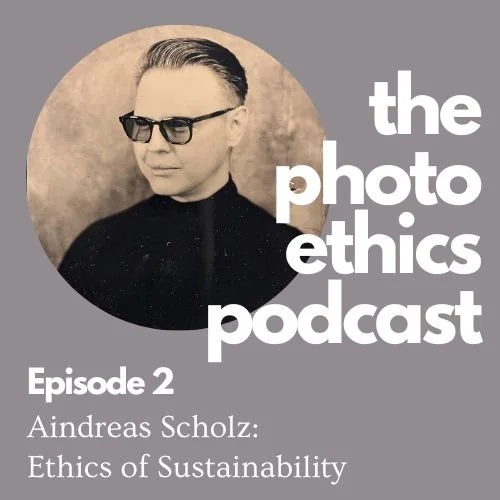
In this episode, we talk with Aindreas Scholtz about sustainability, materiality, and the future of photographic practice. Aindreas discusses how his camera-less photographic work, drawing on historical processes such as cyanotype and anthotype*, has shaped his research. He reflects on photography as a material practice, exploring the ethical implications of the resources and environments entangled in photography. Aindreas discusses the value of working collaboratively with communities and scientists, the importance of embracing slow methodologies, and why photographers should be transparent about the environmental impact of their work. He shares how reflecting on his own practice has led him to see photography ethics as an ongoing process of imagining better futures through more thoughtful choices.*Cyanotype is a camera-less photographic process that creates photograms by placing objects on light-sensitive paper, coated with iron salts and exposing them to ultraviolet light. After washing with water, the process produces distinctive blue and white images. Anthotype is a camera-less photographic process that uses light sensitive pigments extracted from flowers, leaves or fruits. Objects placed on the coated surface create images as the exposed plant pigments gradually fade in sunlight.What you'll find inside:On discovering sustainable photographic practice after breaking his camera: 'That was the best thing that ever happened to me… I had plenty of sunlight, I had plenty of water… I thought, I'm not going to use tap water, I'm going to use seawater because I'm surrounded by the sea. I want to allow the environment to come into the process.' (12.26)'When you work with a community and you've got ten people coming together, the knowledge they produce in that very short amount of space is amazing. You just have to remove yourself, watch, and learn.' (14.56)'I know that my work has a footprint. I know that my work is not 100% eco-friendly or sustainable… First you address it, you admit it, you problematise it, and then you ask what can be done better.' (25.56)‘I'm informed by science, because photography came out of science, but it can have very creative applications…it can change people's minds about our behaviour’ (28.18)What does photography ethics mean to Aindreas?'To me it means to be more reflective about my choices and behaviours, to reflect on the past and to imagine a future inspired by ethical choices, and to make things, hopefully, better.' (33.35)Links:The Sustainable DarkroomAnna Atkins ArchiveDr Melanie King, Ancient Light
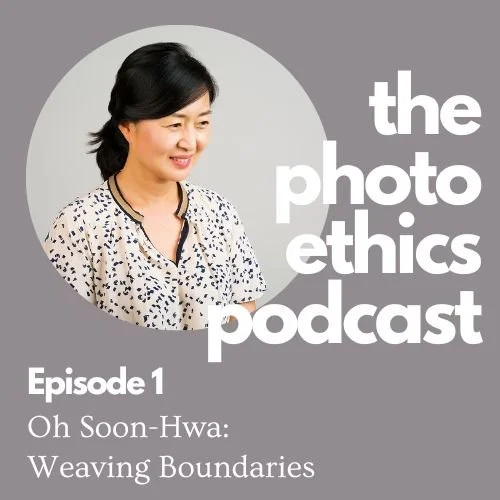
In this episode we talk with Oh Soon-Hwa about long-term documentary practice, research, and ethical responsibility. Soon-Hwa reflects on her personal experience of migration and its influence on her photographic work, discussing the importance of curiosity, sustained engagement, and research when working with communities. She explores the ethical challenges of photographing private lives, balancing public visibility with private wellbeing, and explains why care, rather than consent alone, is at the heart of her photographic practice.What you’ll find inside:“I’m photographing a certain perspective … I’m really narrowing down to one aspect rather than portraying the entire culture or the whole community” (10.25)“Although I had all the legal consent, I took it down for the participant because it wasn't about legal issues. It was about ethical issues, and I didn't want to harm her in any way” (22.27)“Through the project I really saw the limits of my own thinking and perception, my own prejudice … just one or two conversations became awakening moments” (26.26) “I think something that I’ve done is not necessarily focusing on disseminating the photographs themselves, but using them as an intervention…so I think that’s a way we can expand our impact without focusing solely on the visibility of the images (27.44) What does photography ethics mean to Soon-Hwa? “Caring. I care, so I photograph [them]. Whatever protects the participants or subjects that I photograph, I shall do it. That’s photo ethics to me; to make sure they are not harmed by my picture or by my actions. They allow me to photograph them because they care, maybe about me as a stranger and what I want to do, so I try to exchange that same care” (30.23)Links:Oh Soon-HwaDarlingQuiet DreamThe Steep PricePhotographic Collections as Visual MethodLiminal Landscapes 1940s - 1960s
For season 7, we are bringing you a mini edition of the podcast to focus on our biennial Photography Ethics Symposium. Back in June, the 2026 symposium was hosted at Queen’s University Belfast and produced in partnership with the academic journal, Photographies, with funding from the ESRC. This event brought together photographers, curators, archivists and researchers to critically consider the messy endeavour of photography ethics.This season, we invited a selection of the poster presenters to share more about their research, spanning decolonial archiving practices to the ethical considerations of boudoir photography. We hope you enjoy this season and the fascinating insights that the speakers have to offer. We’re looking forward to sharing the special issue of photographies with you in 2027.

In this episode, we talk with Tanya Habjouqa about reevaluation and responsibility. Tanya shares how her Circassian background motivates her work as she feels the diasporic community’s story was never told. She reflects on how the process of printmaking has allowed her to forge a deeper physical connection with her art which can be healing. Tanya explains the countless ethical considerations involved in photographing Palestine including the topic of embedding as well as the targeting of journalists. She also discusses the different levels of involvement and responsibility involved in photographing a community and the impact of parachute journalism.What you’ll find inside: “I need to care about the community that I’m photographing, there needs to be a stake a personal stake.” (13.17)On printmaking: “There was something healing about that process but it was also just wow I can take a faint archival picture I can utilise images that I could not in our traditional photography realm.” (14.29)On art books: “It was this moment where I understood I was in a position where I could bring my documentary work and ethics but find new ways of layering bringing in history and overlaying texts.” (15.16)“The community who’s story you’re telling they should recognise themselves. You should invest time before picking up your camera, I really see photography as an intellectual practice.” (19.24)“You have the power and the responsibility of that archive, I don’t think you shouldn’t take the picture. Sometimes if there is something happening take it and then carefully carry that close to you and unpack where that should go or if it should go.” (21.02)“I think we have a responsibility to try to innovate in our image making and to be as layered and nuanced as possible.” (39.22)What does photography ethics mean to Tanya? “It’s a process of being thoughtful, evolved emotionally intelligent human beings and understanding that this is not a right, you worked very hard to get access. You can tell there’s a difference between a parachute journo drop in snapshot, you can tell when you’ve been invited into the house and that there’s a degree of trust it’s very clear in the image and what’s reflected. It’s just a constant evaluation checking in with stake holders. There’s no key formula you also end up developing an intuition and trusting your intuition.” (40.33)Links:The Unseen Truth: When Race Changed Sight in America by Sarah LewisDarcy PadillaMaureen CumminsSean HillenThe Book as the Trojan Horse of Art: Walter HamadyBetty BrinkThese macaques are used for entertaining. They’re also endangered.Tomorrow There Will Be Apricots

In this episode, we talk with Tiffany Fairey about visualising peace. Tiffany warns of the dangers of binaries and hierarchies in terms of the different forms of photography as it negates the importance of different perspectives. She highlights the complexity of the politics of visibility and the ethical considerations required when marginalised groups become visible through photography. Tiffany also explains peace photography and how it can be used to depict a desired future in contexts where conflict is still present.What you’ll find inside: “I felt really uncomfortable I guess about this idea of who’s taking the pictures and who’s telling the story. That idea that taking photos of someone is almost like putting words into their mouth.” (7.37)“Often in these projects a lot of the kind of benefits and the outcomes aren’t really anything to do with the image… really about facilitating something beyond the photography but also facilitating through and via photography.” (12.28)“It’s not like peace photography is against war photography and we must have one or the other. I think there’s a danger sometimes in photography that we have to think in terms of binaries or in terms of hierarchies.” (16.06)“The politics of visibility basically can not be straight forward when you’re working with groups that are traditionally silenced suddenly becoming visible and having their stories heard. It’s complicated as well because a lot of the times they’re not listened to, so there’s dangers of raising expectations that can’t be met through these projects. We’ve had complications around finances as well.” (22.25)“Within peace photography that is one of the key considerations are these images to be shared or not? There shouldn’t be an assumption that these projects are always about sharing images.” (32.31)“I think the idea of peace photography is asking us to really reassess what we think of as visually significant.” (40.17)“A photography of peace can make visible all these elements of peace that we might not always consider.” (41.03)What does photography ethics mean to Tiffany? “Essentially for me ethics means accountability and transparency in how you deal with others and communicate your work. There’s always the danger that the language of ethics end up obscuring what is actually happening, we can make it more complicated than it is. I worry a lot about people talking the talk about ethical photography but we don’t always walk the walk and it’s not simple to do that. I would say it’s this idea of ethics being grounded in transparent and accountable relationships with the people that we work with.” (41.52)Links:PhotoVoice Street Vision Anna BlackmanVoices in Exile TAFOS FotokidsNancy McGirr Ingrid Guyon PhotoVoice Statement of Ethical Practice - PhotoVoice - Projects, Training, Photography and Consultancy for Social ChangeLiz OrtonPeace Photography Guide | Imaging PeaceImaging Peace Everyday Peace IndicatorsAriella Azoulay

Comments

Download from Google Play

Download from App Store
 United States