


 Claim Ownership
The PolicyViz Podcast
Subscribed: 198Played: 4,953
Subscribe

Description
Learn how to be a great data communicator and visualizer with host Jon Schwabish. Hear from experts in the fields of data science, data visualization, and presentation skills to improve how you and your organization collect, analyze, and communicate your data in better, more efficient, and more effective ways.
319 Episodes
Reverse

In this week's episode of the show, I talk with Mike "SullyDawg" Sullivan, the viral creator behind the cup pyramid videos that turn massive federal budget numbers into something you can actually see. Mike spent decades as a teacher and coach before a bike ride inspired his first video stacking Solo cups to explain government spending — and it took off almost overnight. We dig into why three-dimensional scale succeeds where bar charts and line graphs fail, how he sources and cross-checks the data behind every video, and the four-part formula he swears by: topic, data, energy, and visual. Mike also opens up about the physical work of stacking thousands of cups in his garage, the unpredictable swings of the social media algorithms, and what's next for his growing platform. It's a fun, thoughtful conversation about making enormous numbers finally make sense.
Subscribe to this podcast. [https://pod.link/982966091] Follow this show and everything dataviz on Instagram [https://www.instagram.com/jschwabish/?hl=en], LinkedIn [https://www.linkedin.com/in/jonathanschwabish/], Substack [https://jschwabish.substack.com/], X [https://x.com/jschwabish], and YouTube [https://www.youtube.com/c/JonSchwabish]. Check out the PolicyViz website [https://policyviz.com/]to learn more about data and data visualization.
Questions? Comments? Pitch ideas? Email me at: [email protected]
Hosted by Zencastr [https://www.whispertranscribe.com/?ref=jon] where you can record, transcribe, edit, and automatically publish your meetings, podcasts, and more.
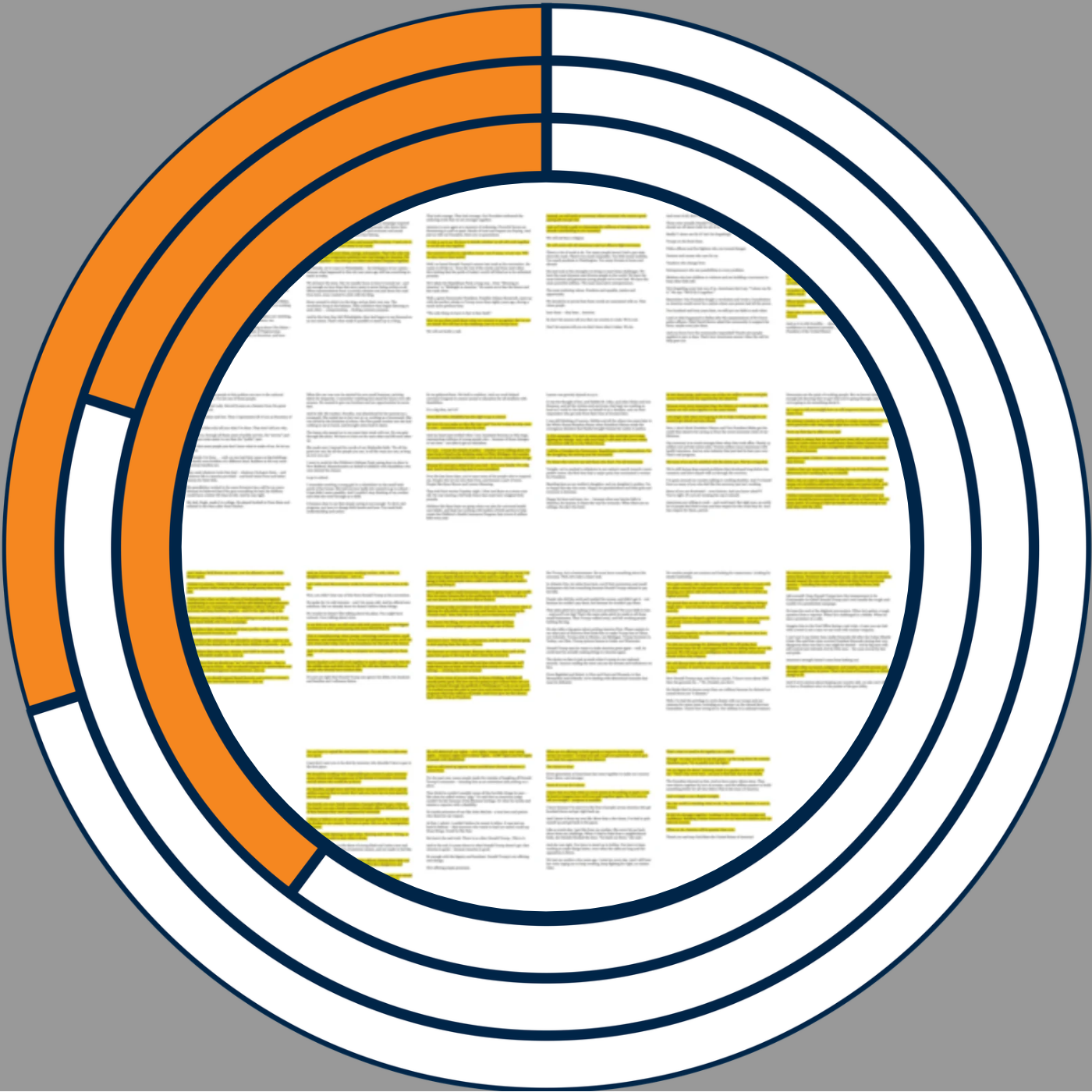
In this My Favorite Graphs episode, I revisit a 2016 New York Times visualization comparing the convention speeches of Donald Trump and Hillary Clinton. I explain why highlighting phrases across miniature pages can reveal themes in qualitative data that word counts and bar charts can miss. I share how I have used a simple version of this technique in my own work and discuss tools for creating similar views. Alicia contributes a voice note about the project's development, including the highlighted Google Docs behind the finished graphics. I also discuss how pairing an overview with example quotes can help readers see the broader context of an interview, focus group, or speech.
Subscribe to this podcast. [https://pod.link/982966091] Follow this show and everything dataviz on Instagram [https://www.instagram.com/jschwabish/?hl=en], LinkedIn [https://www.linkedin.com/in/jonathanschwabish/], Substack [https://jschwabish.substack.com/], X [https://x.com/jschwabish], and YouTube [https://www.youtube.com/c/JonSchwabish]. Check out the PolicyViz website [https://policyviz.com/] to learn more about data and data visualization.
Questions? Comments? Pitch ideas? Email me at: [email protected]
Hosted by Zencastr where you can record, transcribe, edit, and automatically publish your meetings, podcasts, and more.

Lauren Klein joins me to talk about her new book, Data by Design [https://link.amazon/B01DQgByh], co-authored with a team of student collaborators. Over more than a decade of work, Lauren set out to place the history of data visualization in its full historical and political context, going well beyond the familiar "great men" narrative of Playfair and Snow. We talk about how she chose which historical visualizations to feature and redesign, the ethical questions that come up when working with data about the transatlantic slave trade and Indigenous mapping, and what it actually took to track down high-resolution scans of centuries-old charts. Lauren also shares what she wants readers, especially working data visualization designers, to take away: that visualization is only as powerful as how, and by whom, it's put to use.
Subscribe to this podcast. [https://pod.link/982966091] Follow this show and everything dataviz on Instagram [https://www.instagram.com/jschwabish/?hl=en], LinkedIn [https://www.linkedin.com/in/jonathanschwabish/], Substack [https://jschwabish.substack.com/], X [https://x.com/jschwabish], and YouTube [https://www.youtube.com/c/JonSchwabish]. Check out the PolicyViz website [https://policyviz.com/]to learn more about data and data visualization.
Questions? Comments? Pitch ideas? Email me at: [email protected]
Hosted by Zencastr [https://www.whispertranscribe.com/?ref=jon] where you can record, transcribe, edit, and automatically publish your meetings, podcasts, and more.

This week I kick off a new series on the show: My Favorite Graphs. I'm going to walk through the projects that shaped how I think about data visualization, data communication, and data storytelling. I'm starting with the Guardian's "Bussed Out: How America Moves Its Homeless," published in December 2017, an 18-month investigation into the one-way bus tickets that US cities hand out to homeless people. There's a special treat at the end too!
My Favorite Graph: Bussed Out [https://www.theguardian.com/us-news/ng-interactive/2017/dec/20/bussed-out-america-moves-homeless-people-country-study]
Subscribe to this podcast. [https://pod.link/982966091] Follow this show and everything dataviz on Instagram [https://www.instagram.com/jschwabish/?hl=en], LinkedIn [https://www.linkedin.com/in/jonathanschwabish/], Substack [https://jschwabish.substack.com/], X [https://x.com/jschwabish], and YouTube [https://www.youtube.com/c/JonSchwabish]. Check out the PolicyViz website [https://policyviz.com/]to learn more about data and data visualization.
Questions? Comments? Pitch ideas? Email me at: [email protected]
Hosted by Zencastr [https://www.whispertranscribe.com/?ref=jon] where you can record, transcribe, edit, and automatically publish your meetings, podcasts, and more.

In this very special episode of the podcast, I talk with my wife, Lauren Schwabish, a speech-language pathologist who helps adults recover communication after stroke, traumatic brain injury, and other neurological conditions. We discuss person-centered care, translating medical jargon into plain language for patients and families, and the visual tools and assistive technology Lauren builds to help people with aphasia communicate — with real lessons for anyone designing data visualizations, dashboards, or reports for a broad audience.
SHOW NOTES
Neuro Speech Services [https://www.neurospeechservices.com/] | @NeuroSpeechServices on Instagram [https://www.instagram.com/neurospeechservices/] | National Aphasia Association [https://aphasia.org/] | Aphasia Access [https://www.aphasiaaccess.org/] | BYU Aphasia-Friendly Research Resource [https://aphasia.byu.edu/resources-for-people-with-aphasia] | Stroke Association (UK) Aphasia-Friendly Guide [https://www.stroke.org.uk/aphasia-accessible-information-guidelines.pdf]
Subscribe to this podcast. [https://pod.link/982966091] Follow this show and everything dataviz on Instagram [https://www.instagram.com/jschwabish/?hl=en], LinkedIn [https://www.linkedin.com/in/jonathanschwabish/], Substack [https://jschwabish.substack.com/], X [https://x.com/jschwabish], and YouTube [https://www.youtube.com/c/JonSchwabish]. Check out the PolicyViz website [https://policyviz.com/]to learn more about data and data visualization.
Questions? Comments? Pitch ideas? Email me at: [email protected]
Hosted by Zencastr [https://www.whispertranscribe.com/?ref=jon] where you can record, transcribe, edit, and automatically publish your meetings, podcasts, and more.

Comments

Download from Google Play

Download from App Store
 United States