


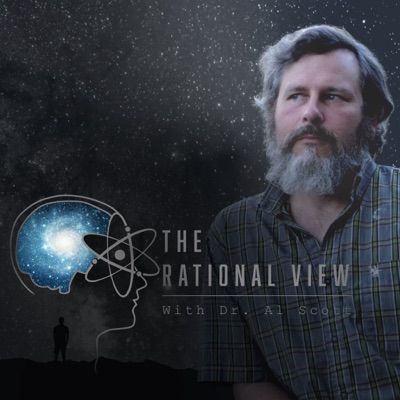
The Rational View podcast with Dr. Al Scott
Subscribed: 47Played: 2,259
Subscribe

© Copyright 2021 All rights reserved.
Description
An evidence based rational viewpoint and discussion on science and society, focusing on important current issues. I hope to provide a clear voice for the quiet moderate majority on highly polarized issues such as climate change, social inequity, and the growth of anti-science sentiment. #therationalview #science #tok #evidencebased #climatechange
261 Episodes
Reverse

Artificial intelligence isn't just getting better at answering questions. It's getting better at understanding the people asking them. As AI learns to recognize our emotions, behaviors, and vulnerabilities, the line between helping us and influencing us gets increasingly difficult to see.
Today we're talking about the future of artificial intelligence with Rana Gujral. Rana is the author of The AI Instinct: The Future of AI and Human Decision-Making and former CEO of Behavioral Signals, where he worked on AI technologies that analyze human communication to understand intent, emotion, trust, and cognition.
We discuss whether today's AI systems actually think, what AI may reveal about human intelligence and consciousness, and how machines can already detect emotional and behavioral signals in our voices. We also explore the risks of AI learning our triggers, what happens when we outsource more of our judgment to machines, deepfakes and emotional manipulation, the coming collision between AI and brain-computer interfaces, and how we can preserve human agency as these systems become increasingly embedded in how we think and make decisions.

Why does the United States spend more on healthcare than any other advanced nation while producing some of the poorest health outcomes?
In this episode of The Rational View, I speak with Dr. John E. McDonough about the history behind America's uniquely expensive healthcare system and the argument at the center of his new book, America's Wrong Turn: US Health Care in the Neoliberal Era.
John E. McDonough, DrPH, MPA, is Professor of the Practice of Public Health in the Department of Health Policy and Management at the Harvard T.H. Chan School of Public Health. He previously served in the Massachusetts House of Representatives and played a key role in Massachusetts health reform and the development of the Affordable Care Act.
John traces the shift from the New Deal era to the free-market philosophy that gained political power under Ronald Reagan. We discuss deregulation, Milton Friedman's influence, shareholder value, the rise of for-profit healthcare and private equity, and why these ideas had a different impact in the United States than in countries with universal healthcare.
We also look at what actually works. John explains why neither public nor private healthcare is automatically efficient, what the U.S. can learn from other countries, and why seemingly promising models like capitation can create their own perverse incentives.

I initially found the idea of “decolonizing science” troubling. Does it mean treating personal revelation as equal to evidence? Does it require rejecting the scientific method because it developed largely within European institutions?
Rather than argue against a caricature, I spoke with Innu astrophysicist Dr. Laurie Rousseau-Nepton.
We discuss what decolonization actually means in science, how culture influences the questions researchers ask, and whether Indigenous oral traditions can preserve legitimate astronomical knowledge.
We also explore dreams, scientific bias, the controversy surrounding telescopes on Maunakea, and the difference between scientifically explaining the universe and finding meaning within it.
Can science include more perspectives without compromising evidence and rational inquiry?

Is being a billionaire morally defensible?
In this episode, Dr. Al Scott digs into extreme wealth, corporate power, executive pay, inherited fortunes, and the way modern capitalism rewards people at the top.
He looks at how much a billion dollars actually represents, why CEO compensation has exploded, how companies squeeze workers and customers in the name of growth, and why basic necessities still feel out of reach in societies with enormous wealth.
The episode also gets into philanthropy, wealth taxes, universal basic income, the Nordic model, and the argument that billionaires create jobs and drive innovation. Find out who benefits from the current system, who pays for it, and what a fairer economy might theoretically look like.

This episode is a fun book review with a new author who provides a comprehensive review of astrology, the source of generic horoscopes and perhaps serves as a gateway drug to astronomy for the anti-science crowd. We’ll find out about the history of this occult practice and why people believe that the month of their birth might have an impact on who they should date.
Carlos Orsi is an award-winning Brazilian journalist with more than thirty years of experience in science writing. He’s currently editor-in-chief of Revista Questão de Ciência (Question of Science Magazine), author of the Substack Idea Smasher, and the author of several books of science popularization in Portuguese, with essays translated into Spanish and English. What Science Says About Astrology is his first book in English.

Comments

Download from Google Play

Download from App Store
 United States