


 Claim Ownership
The Retrospective
Subscribed: 1Played: 2
Subscribe

© Jeremy Brown & Péter Szász
Description
The Retrospective: A Podcast for Engineering Leaders
If you want to learn more about leading engineering teams, this podcast can help you improve your skills and grow in your role.
We are Péter Szász and Jeremy Brown, experienced technology leaders and your hosts.
We created this podcast to help people who manage tech teams or want to learn how to do so.
We cover principles and concepts, provide how-to guides and tools to help you meet common challenges, share stories from our experiences, and offer advice on how to be effective leaders in the tech world.
Each 20-30-minute episode discusses one topic.
We aim to cover all areas related to engineering leadership:
- How to grow your career and become an engineering manager
- Starting to manage a new team and helping new people join your team
- Delivering results that align with the business goals
- Working well with other teams in the company
- Enabling team and individual success
- Building and maintaining a strong organizational culture
- Hiring practices and growing your team
- Managing managers and scaling leadership
- Team topologies and organizational structure
The podcast is helpful for:
- Engineering managers and those who want to become engineering managers.
- Those on the technical leadership track and who want to grow their leadership skills.
- Senior managers who want to improve themselves and the managers they coach.
21 Episodes
Reverse
Should Engineering Managers Code?
In this episode, we explore different perspectives, considering both current job market trends and organizational needs. We emphasize the advantages of managers being technical, covering scenarios where coding might be beneficial or detrimental. We outline the main areas engineering managers should focus on: execution, team health, and individual development. Towards the end, we touch on the concept of career pendulums between management and coding roles, and share insights from Git Guardian’s approach to balancing manager duties with coding. We conclude by acknowledging the complexities and advocating for context-aware, principle-driven decisions.
Share your thoughts about the episode (and the podcast) at feedback@the-retrospective.com!
Effective Delegation Using Task Relevant Maturity
In this episode of the Retrospective podcast, Jeremy and Peter kick off the third season by discussing the concept of task relevant maturity in engineering leadership. They explore the common challenges new managers face, such as micromanagement and hands-off leadership. Jeremy introduces the idea from Andy Grove’s book ‘High Output Management,’ emphasizing the need to adjust management styles based on the maturity of a person and the task at hand. They delve into how to assess an individual’s maturity, the benefits of pairing team members, and the importance of maintaining a balance between autonomy and oversight. They also provide actionable insights on how to help team members grow and how to use task relevant maturity to improve overall team performance.
00:00 Introduction to Season Three
00:38 Understanding Task Relevant Maturity
00:56 Challenges Faced by New Managers
03:05 Framework for Assessing Task Relevant Maturity
10:51 High Task Relevant Maturity
26:21 Balancing Critical Projects and Personal Growth
30:22 Conclusion and Resources
Links from the episode:
High Output Management by Andy Grove - The original source of Task-Relevant Maturity
The Most Important Management Concept You’re Missing: Task Relevant Maturity
The Most Important Aspect of Task Relevant Maturity Many Leaders Forget
The Manager’s Path by Camille Fournier - Builds on TRM concepts for engineering leadership
Share your thoughts about the episode (and the podcast) at feedback@the-retrospective.com!

In this episode of the ‘Retrospective’ podcast, we discuss the importance of taking breaks of various lengths to maintain energy, resilience, and mental health. We explain the concepts of macro breaks (e.g., vacations), meso breaks (e.g., long lunches, proper day-closing rituals), and micro breaks (e.g., standing up, brief stretches). We share actionable tips on planning and executing these breaks, emphasizing the need to disconnect truly during vacations, the benefits of time-blocking in your calendar, and using tools like Pomodoro for maximizing productivity. The episode also touches on the physical and mental health benefits of these practices and briefly mentions team-based breaks.
Timeline
00:00 Introduction
00:30 The Importance of Taking Breaks
01:16 Burnout in Middle Management
03:42 Types of Breaks: Macro, Meso, and Micro
05:11 Planning and Executing Effective Vacations
11:14 Incorporating Meso Breaks into Your Day
18:57 The Power of Micro Breaks
27:01 Conclusion and Season Wrap-Up
Links from the episode
Engineering Managers at risk of burnout in The Pragmatic Engineer and Fortune.
Study: A systematic review and meta-analysis on the efficacy of micro-breaks for increasing well-being and performance.
Study: Does the 52-17 rule really hold up?
Share your thoughts about the episode (and the podcast) at feedback@the-retrospective.com!
In this episode, we explore a challenge that plagues every engineering team: the constant stream of interruptions that disrupt our workflows. Drawing from our combined experiences working with dozens of engineering teams, we introduce the concept of the “firefighter” role - a structured approach to managing unplanned work that’s transformed how teams handle interruptions.
We dive into the science behind context switching, examine why solutions often fail, and explore a practical framework that turns interruptions from productivity killers into opportunities for systematic improvement.
Key topics we cover:
The true cost of context switching in engineering teams
Why common interrupt-handling approaches break down
How to implement and rotate the firefighter role
Turning interruptions into systematic improvements
Measuring success and avoiding common pitfalls
Show Notes:
How engineering teams handle unplanned work - this article captured my thoughts exactly and includes some really good visualisations of the different approaches.
The Cost of Interrupted Work: More Speed and Stress - UC Irvine study
And a FastCompany article about the study.
Share your thoughts about the episode (and the podcast) at feedback@the-retrospective.com!
In this episode, we discuss the topic of technical dept. We start with the basic definition, then share techniques about measuring, arguing about and addressing tech debt. A key concept is connecting the issues of technical dept to business goals, to show the concrete pain it causes to organizations. We also discuss prioritization tips and various good and bad examples we saw in our experience.
Share your thoughts about the episode (and the podcast) at feedback@the-retrospective.com!

In this episode of The Retrospective podcast, co-hosts Jeremy and Peter delve into the characteristics that define a senior software engineer. They explore the multifaceted nature of seniority, emphasizing that it is not just about years of experience but a blend of technical expertise, business awareness, team impact, and leadership skills. Through analogies and personal anecdotes, they illustrate how senior engineers are not just adept at coding but also act as multipliers of their team’s success. They discuss the holistic view and forward-thinking mindset expected of senior engineers, drawing on examples from their own careers. The episode also touches on the importance of fostering growth in others, handling technical debt pragmatically, and effectively communicating complex technical topics.
Advice is offered to engineering managers on how to guide team members aspiring to reach senior levels, emphasizing the importance of demonstrating these traits consistently over time.
Here are some articles and further food for thought:
Senior Engineers Reduce Risk
Levels of Seniority
Why senior engineers get nothing done
An incomplete list of skills senior engineers need, beyond coding
Looking a bit further ahead of the Senior level:
What a Senior Staff Software Engineer Actually Does
VP, Director, what?
00:00 Intro
00:36 Overview
01:40 Senior People Operate on a Different Time Horizon
05:07 The Impact a Senior Engineer Can Have
06:38 Technical Expertise
08:16 Team Impact
11:44 Business Awareness
16:02 How They Behave
18:34 Demonstrating Leadership
20:29 Advice for Engineering Managers
25:42 Summing it up!
26:18 Outro
Share your thoughts about the episode (and the podcast) at feedback@the-retrospective.com!
In this episode of the ‘Retrospective’ podcast, Jeremy and Peter explore crucial strategies for engineering managers transitioning to new teams. Emphasizing the importance of early trust-building, quick wins, and effective communication, they reference ‘The First 90 Days’ by Michael D. Watkins. They discuss understanding team dynamics, emotional intelligence, and the role of the previous manager in easing transitions. Key topics include assessing team strengths, managing technical debt, aligning with business goals, and fostering a safe-to-fail culture. The episode concludes with practical advice for new managers navigating stakeholder relationships and ensuring team member growth.
Share your thoughts about the episode (and the podcast) at feedback@the-retrospective.com!
In this episode of The Retrospective, Peter and Jeremy discuss ‘quiet quitting’ in the workplace, a situation in which employees lose motivation and only do the minimum required.
They discuss how to spot the signs and the reasons behind them, such as changes in company culture or personal struggles.
The conversation also covers how managers can help motivate their team and maintain a positive environment, using strategies like giving feedback and recognising good work.
They also mention the challenges of dealing with quiet quitting, especially when working remotely, and share tips on effectively supporting your team.
00:00 Introduction
00:25 Quiet Quitting
03:07 Situations that can trigger quiet quitting
05:55 It’s not always the company!
06:18 What Motivates People?
07:11 How circumstances can trigger quiet quitting
08:09 Recognising the signs in a remote and in office team members
09:08 Cultural differences
11:44 The consequences of quiet quitting
15:41 How to handle quiet quitting as a manager
20:19 Don’t forget to focus on the whole team
21:11 What are the levers managers have?
25:35 Don’t get sucked in!
27:22 Remove blockers
28:03 Provide Clarity
28:29 One to ones are critical
28:54 Praise and encourage
30:12 Get in touch if you are struggling
30:32 You can’t save everyone!
30:57 Summary
Share your thoughts about the episode (and the podcast) at feedback@the-retrospective.com!
Join Peter and Jeremy as they kickoff the first episode of Season 2, reflecting on their learnings from Season 1 and outlining exciting changes and plans for the new season.
They discuss their experiences with podcasting, the challenges of editing, and the valuable feedback they received.
This episode covers their motivation to provide focused, impactful content for early-stage engineering managers and leaders, and introduces format changes like shorter, more focused episodes, audio-only format, and potential guest interviews around relevant topics.
00:00 Intros
00:29 Reflections on Season One
01:23 What We Learnt and the Feedback We Got
03:57 Plans for Season Two - focusing on Engineering Managers
04:38 Format Changes - 20 - 30 mins, Audio Only
05:50 One Episode Per Topic
07:13 Interviews and Special Episodes
08:31 Wrapping Up
Share your thoughts about the episode (and the podcast) at feedback@the-retrospective.com!
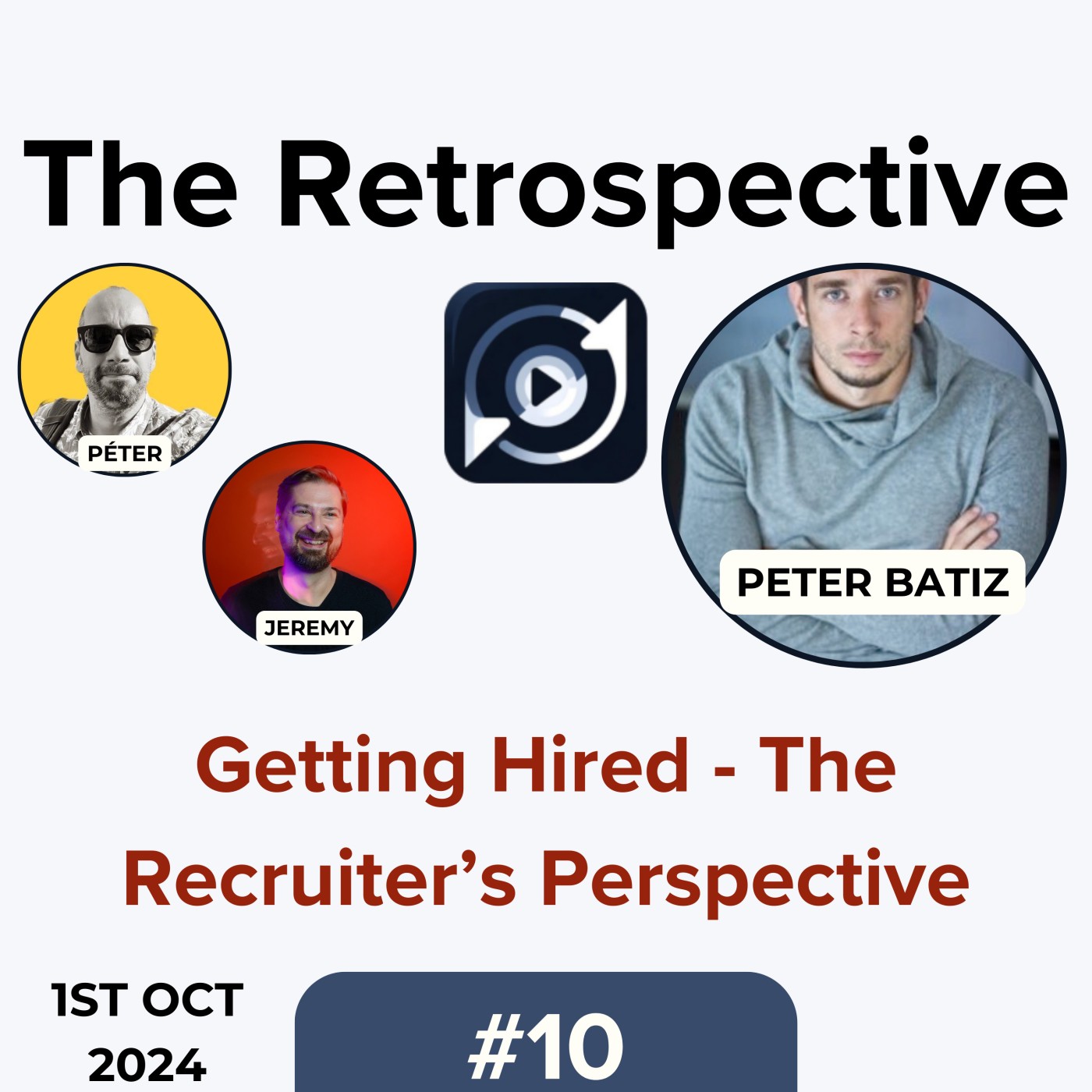
Getting Hired: The Recruiter's Perspective with special guest Peter Batiz
This episode covers the challenges and opportunities engineering managers face, the importance of adapting to market changes, and building strong relationships with recruiters. Learn strategic negotiation tactics, key questions to ask during the interview process, and how to leverage publicly available information for informed decision-making. Whether you're employed and contemplating a change or actively seeking new opportunities, gain invaluable insights and practical tips to excel in today's tech job scene. Plus, get a sneak peek into the exciting changes coming in season two.
00:00 The Retrospective S1 E10: Getting Hired - The Recruiter's Perspective with Peter Batiz
00:13 Introduction
02:44 Hiring Scene Shifts after 2022
04:00 Technical Skills in Managerial Positions
08:17 Other Differentiators like Remote and Domain Experience
11:24 Quality vs. Quantity of Applications
13:53 Flexibility: The Number One Differenciator to Get The Job
15:38 Remote Work in the Current Climate
17:37 2024 August Hiring Market Improvements
21:56 Economic Reasons of the Current Hiring Climate
23:23 Current Climate is a Return to Normal
27:22 Expectations from Managers in the Current Climate
31:00 Company Culture Shifts
35:23 AI and Kubernetes experience is a Differenciator
39:58 Career Security vs. Job Security
41:32 Successful CV Characteristics
44:13 The role of AI in Hiring
48:57 Show your Impact to Stand Out
52:06 Automatic Job Application Bot
55:14 Job Sites beyond LinkedIn
56:33 Inteviewing Advices
01:01:06 Recruiter Relationships
01:07:40 Advice for EMs Considering Quitting
01:11:19 How to Validate an Offer
01:14:51 Negotiating
01:21:47 Outro Share your thoughts about the episode (and the podcast) at feedback@the-retrospective.com!
Péter and Jeremy discuss the last stage of the interviewing process: the offer. They include strategies for managing job transitions, including securing roles, negotiating offers, and resigning professionally. The conversation shifts to the transformation of content creation with the rise of social media platforms like Facebook and TikTok, examining the initial advantages and later toxicities induced by engagement-driven algorithms. The discussion concludes with Péter's new website, whatistiling.com.Share your thoughts about the episode (and the podcast) at feedback@the-retrospective.com!
In the second part of the 8th episode of the podcast, Jeremy and Péter discuss engineering manager interview strategies, focusing on Péter’s co-authored article about interviewing for an EM position. They emphasize the importance of the hiring manager interview for showcasing decision-making trustworthiness and delve into technical tests, case studies, and the role of psychometric tests and AI-assisted coding in interviews. To round off, they discuss effectively handling job offers and meeting the prospective team to ensure a cultural fit.Share your thoughts about the episode (and the podcast) at feedback@the-retrospective.com!
In this episode of 'The Retrospective' podcast, engineering leaders Jeremy and Peter discuss Peter’s series on getting hired as an engineering manager, focusing on the interview process. The conversation covers preparation strategies, building relationships with recruiters, adapting to the current job market, and the importance of diversity in hiring. Throughout, Jeremy and Peter provide practical advice on handling technical screenings, in-office interviews, and telling compelling career stories. They emphasize the need for thorough preparation, understanding the company, and presenting oneself effectively in interviews.Share your thoughts about the episode (and the podcast) at feedback@the-retrospective.com!
In this episode of the 'Retrospective' weekly podcast, Jeremy and Peter discuss key engineering leadership topics. Jeremy delves into his latest article on the four essential weekly ceremonies for engineering managers to ensure smooth and predictable execution. The ceremonies include the weekly kickoff, daily sync, one-on-one meetings, and the weekly review.
Peter shares his recent experiment with AI-assisted coding, using ChatGPT for a Google Apps Script project, highlighting the benefits and challenges of leveraging AI in software development.
Show notes:
Jeremy’s article on the Four Must-Have Weekly Meetings for Engineering Managers: https://www.jeremybrown.tech/the-four-must-have-weekly-meetings-for-engineering-managers/
Jeremy’s earlier article about sharing at 20%: https://www.jeremybrown.tech/the-20-percent-rule/
Explainer on Task Relevant Maturity: https://getlighthouse.com/blog/management-concept/
John Cutler on Troubleshooting Status Updates: [https://cutlefish.substack.com/p/tbm-252-how-to-troubleshoot-status](https://cutlefish.substack.com/p/tbm-252-how-to-troubleshoot-status?ref=jeremybrown.tech)
Peter’s updates including AI-assisted coding experiences: https://peterszasz.com/week-24-2024-ai-coding-search-and-creativity/
BI dashboard and tools article Jeremy mentioned: https://briefer.cloud/blog/posts/self-serve-bi-myth/ - AI Summary “Sales pitches often oversell the idea of "self-serve dashboards," but in reality, it often falls short as non-technical users lack the context to interpret data accurately. The key to successful self-serve BI lies in technical support for business stakeholders using flexible tools that cater to their needs efficiently. Providing technical people with tools like LLMs, Python, and easy data sharing capabilities can bridge the gap between technical complexity and business user needs.”
00:00 Intros
00:37 4 Weekly Meetings for Engineering Managers
01:59 Why Work to a Weekly Cadence?
03:30 Projects and Milestones
09:03 The Weekly Team Kick-off / Planning Meeting
20:06 Daily Sync (Standup) and Team Connection
33:21 One-on-One Meetings
37:16 Monthly Career Focus and Continuous Feedback and Coaching
38:11 One-to-One Frequency
40:15 Task Relevance Maturity Framework
41:35 The Weekly Review Meeting
46:04 Stakeholder Communication and Status Updates
58:02 Retrospectives and Team Health
01:03:23 Using AI for Coding Projects
01:12:14 Wrapping up!Share your thoughts about the episode (and the podcast) at feedback@the-retrospective.com!
In this episode, we discuss the critical importance of career security over job security in the changing tech landscape, highlighting strategies for sustaining and advancing one's career in 2024. Then, we explore the Innovation Framework based on the Möbius Loop for balancing discovery, delivery, and options in the software development life cycle. We also urge organisations to consider capturing structured practices with the Open Practice Library. Additionally, we discuss the value of pair programming and mob programming for strengthening collaboration, learning, and problem-solving.
00:00 Hey!
00:25 We Are Slowing Figuring Out The Show Format and Target Audience
02:09 Politics - The Morning After The Night Before - EU and Hungarian Election Results
04:21 Artistic Pairing - The Twin Peaks Soundtrack
12:30 Pair Programming and Collaboration
24:08 What's Old Is New in Tech
30:36 How to maintain career security in the 2024 tech climate?
46:22 A Framework for Innovation
50:37 Implementing Standard Practices
01:08:47 Wrapping UpShare your thoughts about the episode (and the podcast) at feedback@the-retrospective.com!
Jeremy’s article on How to Innovate: https://www.jeremybrown.tech/how-to-innovate
Clayton Christensen’s books on Disruptive Innovation (Jeremy was referring to “The Innovator's Dilemma: When New Technologies Cause Great Firms to Fail”): https://www.goodreads.com/book/show/19203217-disruptive-innovation
Lex Fridman and Mark Zuckerberg interview in the Metaverse: https://www.youtube.com/watch?v=EohIA7QPmmE
Perplexity, an AI search engine: https://www.perplexity.ai/
Kagi, the search engine Jeremy uses: https://kagi.com/
Tom Demarco’s book about slack: https://www.goodreads.com/book/show/123715.Slack
2018 study on slack and innovation: https://pubsonline.informs.org/doi/full/10.1287/orsc.2018.1215
Peter’s article about Getting hired as an EM / Searching and applying: https://peterszasz.com/get-hired-as-an-engineering-manager-part-3-searching-and-applying/
Craft Conference: https://craft-conf.com/
Book on Platform Strategy: https://www.goodreads.com/book/show/208871782-platform-strategy
Search Engine podcast episode on the media apocalypse and how to survive it, part 1: https://overcast.fm/+BBVQRBOVak part2: https://overcast.fm/+BBVQTfeXl4
Example of a hyper-local website: Les Pépites du 19e - https://www.lespepitesdu19e.fr/ and Instagram (@lespepitesdu19e)
00:00 Introduction and Greetings
00:34 What the hell is this show?
02:47 Jeremy's article on "How to Innovate"
07:25 Do you need a healthy Culture to Innovate
09:55 Can big companies innovate?
18:53 Is slack (time) needed to innovate?
28:57 Peter - Getting hired as an EM / Searching and applying
44:55 Get ahead of the crowd strategies for job seekers
47:08 An example of a great cold outreach
48:54 Can networking at conferences help me get a job?
50:54 Experiences at Craft Conf
52:21 Emerging trends from the talks at Craft Conf?
55:17 AI will replace developers!
01:01:19 Supporting Conference Attendance as a leader
01:05:13 The Media Apocalypse and Ethical Consumption
01:07:44 The Role of AI in Content Creation
01:14:16 The Importance of Local News and Media
01:25:35 Reflections and Closing ThoughtsShare your thoughts about the episode (and the podcast) at feedback@the-retrospective.com!
Chapters (notes below):
00:00::00 Awkward intros
00:00:51 Reflecting on Benoit's (CPTO of Lunii) guest appearance last week and the 4 day work week
00:14:28 What correlates with happiness?
00:28:59 Peter's articles on getting hired as an EM - part 1 & 2
00:32:32 Hands on/Hands off Engineering Managers
00:39:02 You need to have multiple CVs!
00:44:07 Drop some nuggets in your CV
00:46:34 Is AI being used to screen me?
00:51:16 Should I use AI to write my CV?
00:53:01 Hot tips for how to use AI
00:58:08 Clickbaity AI
01:01:59 Four Key Questions for Managers That Boost Team Performance
01:09:32 Trust and performance management
01:15:26 Should I share my answers?
01:18:11 Layoffs and low performers
01:22:58 Low performers, the vampire in your team
01:24:25 Retention risk and tracking over time
01:25:40 Give it three months
01:26:23 How to get started
01:28:09 Share your work at 20% done
01:31:55 Being right the first time and the Ikea Effect
01:34:09 Jeremy's pivot
01:36:48 Should our newsletters be perfect?
01:39:49 Homelabbing woes
01:48:44 Looking forward to next week
Show notes
Our previous show about Lunii’s 4-day workweek experiment: https://www.linkedin.com/feed/update/urn:li:activity:7199358260410245121/
Peter’s earlier article about a Hungarian company trying the same: https://peterszasz.com/the-end-of-a-4-day-workweek-experiment/
Timsons, a family-owned business focusing on employee happiness: https://www.timpson.co.uk/ you can read more about how they are run here: https://www.bbc.co.uk/programmes/articles/1J7x50pDt5DrcPJ57B7kkM9/6-things-we-learnt-from-the-ceo-of-timpson-s
The History of Guinness and it’s social impact - https://faithandleadership.com/stephen-mansfield-god-and-guinness
Peter’s newsletter including the activities / happiness correlation research: https://peterszasz.com/week-21-2024-frustration-and-happiness/
Not the article Peter mentioned, but a great talk on why we should not send money to Africa: https://www.carnegiecouncil.org/media/series/39/20090409-dead-aid-why-aid-is-not-working-and-how-there-is-a-better-way-for-africa
Hungarian charity giving targeted help to specific homeless people: https://vanesely.hu/english/
Peter’s articles about Getting Hired as an EM:
Women less likely to apply for jobs they don’t feel fully qualified for: https://hbr.org/2014/08/why-women-dont-apply-for-jobs-unless-theyre-100-qualified
Jeremy: AI prompting article to ask for clarifying questions: https://www.descript.com/blog/article/11-best-chatgpt-prompts
Growth design website to give tips in design experiences: https://growth.design/
Jeremy’s recent Performance Questions article: https://www.jeremybrown.tech/four-key-questions-for-managers-that-boost-team-performance/
…and the original one about debunking performance rating myths: https://www.jeremybrown.tech/17-debunking-performance-rating-myths/
Nine Lies about Work book: https://goodreads.com/book/show/40086702-nine-lies-about-work
Jeremy’s article about the Baseline Principles for Teams: https://www.jeremybrown.tech/21-baseline-principles-for-teams/
The Five Dysfunctions of a Team book: https://www.goodreads.com/book/show/21343.The_Five_Dysfunctions_of_a_Team
The 9-Box Performance Evaluation Model: https://www.bamboohr.com/blog/9-box-grid
Jeremy’s article about sharing your work early: https://www.jeremybrown.tech/the-20-percent-rule/
…and his earlier one about the IKEA Effect: https://www.jeremybrown.tech/the-ikea-effect/
Peter’s article about Homelabbing for Engineering Leaders: https://peterszasz.com/homelabbing-for-engineering-leaders/
Craft Conference 10: https://craft-conf.com/2024
Share your thoughts about the episode (and the podcast) at feedback@the-retrospective.com!
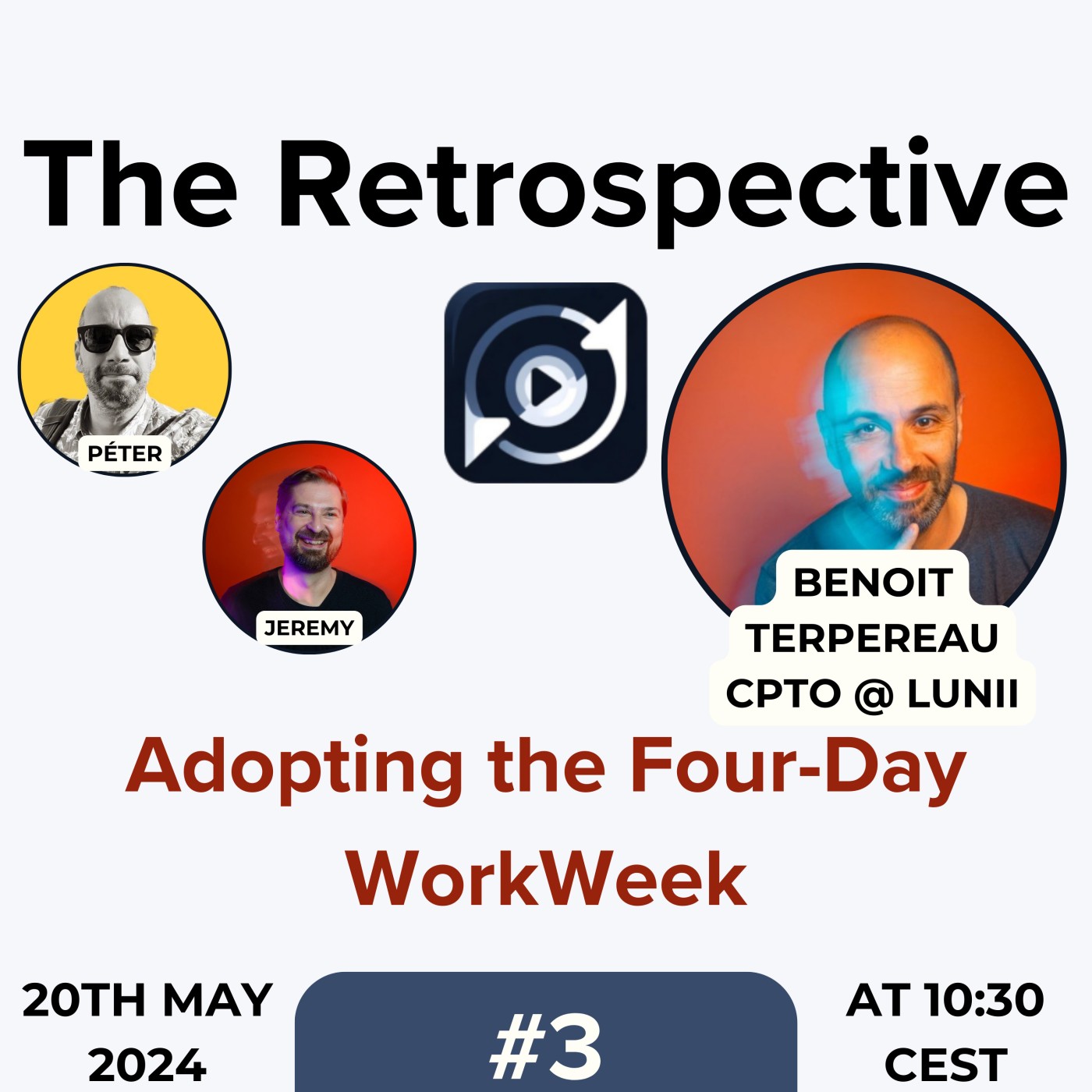
Show Notes:
Lunii, where our guest Benoit is CPTO: https://lunii.com/
Lunii’s LinkedIn announcement about going 4-day a week: https://www.linkedin.com/feed/update/urn:li:activity:7196425731042693121/
Two other French companies mentioned who do 4-day a week: https://www.ldlc.com/ and https://www.welcometothejungle.com/
Péter’s article about a 4-day workweek experiment at Magyar Telekom: https://peterszasz.com/the-end-of-a-4-day-workweek-experiment/
00:00:00 show intro
00:02:06 Benoit joins us
00:06:34 4-day workweek and Peter's article
00:09:52 Lunii's journey to the 4-day workweek
00:13:33 Why did it take a year to implement?
00:15:27 Lunii's model - 80 100 100
00:16:11 How have you started to adapt?
00:18:27 Async
00:20:39 Monday is not the same
00:21:36 Time to learn
00:32:12 What about Customer Support?
00:36:29 Early responses
00:43:19 Performance management
00:46:55 Levelling Up Individual productivity
00:51:37 Lunii is hiring
00:54:12 Screentime and kids
00:56:42 AI, Storytelling and translation
01:05:18 The person using AI will take your job
01:06:26 bye!Share your thoughts about the episode (and the podcast) at feedback@the-retrospective.com!
Episode #2 of The Retrospective Live Show
Show Notes:Apple ad: https://www.youtube.com/watch?v=ntjkwIXWtrc
Peter's Focus article: https://peterszasz.com/why-cant-i-focus/Linktree: https://linktr.ee/,
OSS alternative: Link Stack https://linkstack.org/
Tom Demarco: Slack https://www.goodreads.com/book/show/123715.Slack
Timeboxing hobby article - https://bulletjournal.com/blogs/bulletjournalist/how-to-set-boundaries-using-time
quotes:
Time-boxing creates boundaries that force us to think inside the box, that is, at a much more granular level. If we can only dedicate thirty minutes, three times a week to something, we have to figure out what we can get done in that short amount of time. That shift in thinking can make all the difference.
By only granting ourselves a limited amount of time, we’re primed to make the most of it, and we’re left wanting more. This is a powerful way to stay motivated, and gives us something to look forward to each day.
Lastly, time-boxing can be very practical for those whose passions often get in the way of their commitments.
Article on questions to ask ceo - https://getlighthouse.com/blog/questions-to-ask-a-ceo-healthy-culture/
CTO survey: https://ss-usa.s3.amazonaws.com/c/311833600/media/1935663a48f6d7f0702329394031256/CTO Craft Compensation Survey Report 2024.pdfShare your thoughts about the episode (and the podcast) at feedback@the-retrospective.com!
Jeremy & Peter discuss their weekly newsletters.Share your thoughts about the episode (and the podcast) at feedback@the-retrospective.com!

Comments

Download from Google Play

Download from App Store
 United States