


 Claim Ownership
The Rule of Law Brief
Subscribed: 1Played: 1
Subscribe

© Nate Charles
Description
A principled defense of constitutional governance, civil liberties, and professional ethics in the face of rising authoritarianism—anchored in legal rigor, national security insight, and a commitment to nonviolent resistance.
natecharles.substack.com
natecharles.substack.com
47 Episodes
Reverse
In today’s Rule of Law Brief, we dive into one of the most revealing contradictions in American foreign policy: the United States champions human rights and the laws of war, yet refuses to join the International Criminal Court—and in recent years has shifted from polite non-participation to open hostility.Drawing on the history of the Rome Statute, the post-9/11 security environment, and the evolution of U.S. power, this episode examines:* Why the United States helped build the ICC’s legal architecture but refused to join it.* How the ICC almost certainly has valid jurisdiction over U.S. nationals for crimes committed on ICC-member territory—yet the U.S. has made clear it will not allow prosecutions.* The role of hegemony, sovereignty, and strategic calculation in shaping U.S. resistance.* Why complementarity doesn’t calm U.S. fears—and why the ICC doubts U.S. internal accountability.* How U.S. allies became caught between their support for international justice and American pressure.* How the Trump administration abandoned decades of diplomatic restraint and retaliated directly against ICC officials.* Why this issue becomes even more acute as the United States drifts toward authoritarian tendencies.* And finally, the uncomfortable truth: justice for thee, but not for me.This is where the idealistic narrative of American rule-of-law leadership runs headlong into the realities of geopolitics.If you care about human rights, national security, the rule of law, or how American power actually operates in the world, subscribe to the Rule of Law Brief. I cut through the mythology, challenge the comfortable narratives, and explain how law, war, and politics collide in the real world. Get full access to The Rule of Law Brief at natecharles.substack.com/subscribe
In this episode of The Rule of Law Brief, Nate Charles breaks down one of the most widespread misconceptions circulating online: the idea that Donald Trump “can’t be authoritarian” because critics are still able to post about him on social media. Drawing on operational doctrine—not punditry—Nate explains why authoritarianism is not a binary condition but a spectrum along which countries drift over time.Using the U.S. Army’s Human Factors: Considerations of Undergrounds in Insurgencies as the analytical backbone, Nate outlines the inverted-U relationship between regime type and political violence: stable democracies on one end, stable autocracies on the other, and maximum instability in the hybrid middle—what political scientists call anocracy .He then applies this framework to the United States, arguing that rising extremism, political violence, and the normalization of coercive tactics are not random. They are precisely what the doctrinal research predicts as a country slides away from full democracy but has not yet reached full authoritarianism .Finally, Nate addresses the predictable pushback—that this is all just academic hand-waving or partisan rhetoric—by noting the doctrine’s provenance: originally published by the Special Operations Research Office, republished by Johns Hopkins Applied Physics Lab, and supported by U.S. Army Special Operations Command J3X, the Unconventional Warfare Directorate .This episode is a clear, sober look at the mechanics of authoritarian drift and why America’s political landscape is showing exactly the warning signs the literature expects.Stay ahead of the curve on national security, democracy, and the rule of law. Subscribe for rigorous, accessible analysis grounded in real doctrine—not partisan noise. Get full access to The Rule of Law Brief at natecharles.substack.com/subscribe
This episode dismantles a basic—but now politically weaponized—misunderstanding: that the President can use military force simply by designating a group as a Foreign Terrorist Organization under the Immigration and Nationality Act. That claim is legally false, constitutionally indefensible, and is being pushed in bad faith to justify unlawful military strikes, including the recent attacks on drug boats in the Caribbean.We walk through the actual statutory framework of the INA:* what an FTO designation requires,* what legal consequences attach to it,* why those consequences are immigration and financial in nature, not military.We also clarify the Treasury Department’s Specially Designated Global Terrorist label—an entirely separate sanctions regime under the International Emergency Economic Powers Act. It has zero bearing on authorizing military operations.Then we turn to the one domestic-law instrument that does authorize force:the Authorization for Use of Military Force (AUMF) passed after 9/11.That statute narrowly authorized operations against the people and organizations responsible for the attacks—essentially al-Qaeda and its lineage. It has nothing to do with drug cartels, nothing to do with immigration law, and nothing to do with unilateral presidential claims of inherent wartime authority.The bottom line:Rebranding immigration tools as war powers is unconstitutional, reckless, and illegal.If the United States is going to wage war on a new target, Congress must pass a new AUMF. Shortcuts aren’t lawful. And they aren’t acceptable.Stay ahead of the legal and national-security issues politicians keep misrepresenting. Subscribe for sharp, unvarnished analysis grounded in actual law—not internet mythology. Get full access to The Rule of Law Brief at natecharles.substack.com/subscribe
In this episode of The Rule of Law Brief, Nate Charles breaks down what actually went wrong during the U.S. drug-boat strikes in the Caribbean — and why the legal failures weren’t subtle, debatable, or ambiguous.Drawing on his experience as a former Navy SEAL officer assigned to JSOC, Nate explains how a lawful land-warfare tactic — the “double-tap” used against armed combatants inside a declared theater of active armed conflict — appears to have been blindly imported into a maritime interdiction context where it absolutely does not apply. The result: strikes that were illegal under the Geneva Conventions, likely constituted war crimes, and reflected a catastrophic misunderstanding of basic international humanitarian law.He also discusses:* How the AUMF and DTAC framework governed lawful counterterrorism strikes — and why none of those authorities existed here.* What “hors de combat” actually means, and why Geneva draws a bright line between land warfare and naval engagements.* Why a disabled vessel — and especially sailors in the water — are legally protected shipwreck survivors who cannot be targeted under any circumstances.* The deeper institutional problem: senior leaders who simply didn’t understand the law they were operating under.* Why accountability is necessary, and why incompetence — not malice — is the most plausible explanation.This episode is blunt, legally grounded, and unsparing in its assessment: the strikes were illegal, avoidable, and the direct product of professional negligence at senior levels.Stay ahead of the curve on national security, rule-of-law failures, and the places where policy, ethics, and power collide. Subscribe to The Rule of Law Brief for sharp analysis without euphemism — from someone who’s been inside the system. Get full access to The Rule of Law Brief at natecharles.substack.com/subscribe
In this second installment of our series on international criminal accountability, Nate Charles addresses the most fundamental question in atrocity law: Who is actually responsible for enforcing war crimes and crimes against humanity?It’s a harder question than it sounds. As Nate explains, everything turns on the doctrine of state sovereignty—the principle that gives each nation supreme authority within its borders and ensures that no state is legally subordinate to another. That doctrine is not abstract philosophy; it is the architecture that determines why no world government, no global police force, and no universal prosecutor exists to handle violations of the laws of armed conflict.Under the Geneva Conventions, sovereign states bear primary responsibility for investigating, prosecuting, or extraditing individuals who commit grave breaches, and they must regulate their own forces in good faith. The system assumes that states will police themselves—an assumption that often fails in practice.Nate also examines the limited and highly conditional role of the International Criminal Court, which can prosecute both war crimes and crimes against humanity only when jurisdiction exists and when states are unwilling or unable to act. He also explains the distinct legal authority behind earlier ad hoc tribunals such as the ICTY and ICTR—institutions created by the UN Security Council to handle specific outbreaks of mass atrocity.This episode lays the groundwork for Part III, which will address why the United States—despite its global power—refuses to participate in the ICC.Subscribe for clear, unsentimental analysis on war crimes, crimes against humanity, and the modern international system that struggles to regulate them. Get full access to The Rule of Law Brief at natecharles.substack.com/subscribe
In this episode of The Rule of Law Brief, Nate Charles responds to a listener’s questions about the recent U.S. military strikes on Venezuelan vessels in the Caribbean. Instead of treating the questions in isolation, Nate reframes the discussion to explain—clearly and directly—the difference between a war crime and a crime against humanity, where these concepts come from, and why the distinction matters.Drawing on centuries-old laws of armed conflict, the Geneva Conventions, and the post-WWII legal architecture that emerged from the Nuremberg Trials, Nate breaks down why a single unlawful act can be a war crime, but crimes against humanity require a sustained, organized policy of persecution against civilians. He also previews a second video that will examine the far more contentious question of enforcement, including the United States’ complicated relationship with the International Criminal Court.If you want a grounded, legally accurate explanation of how international criminal law actually works—without rhetoric or hype—this episode lays the foundation.Stay ahead of the noise. Subscribe for clear, uncompromising analysis on the rule of law, national security, and how power really operates. Get full access to The Rule of Law Brief at natecharles.substack.com/subscribe
In this episode, I address a persistent and misguided argument: the claim that the Geneva Conventions do not apply because the United States is not in a formally declared war. That view collapses the moment you read the text of the treaties themselves. Common Article 2 applies in any armed conflict—“even if the state of war is not recognized by one of them.” And Common Article 3 applies in non-international armed conflicts, including counterterrorism operations.I also explain the binding U.S. Supreme Court precedent in Hamdan v. Rumsfeld, which held that Common Article 3 does govern U.S. operations against Al Qaeda and other non-state actors. In short: the minimum humanitarian protections of the Geneva Conventions attach automatically whenever organized armed force is used.Finally, I address the good-faith argument that many of these operations may have been unlawful from the outset. I don’t disagree. But that is a separate legal question. The Geneva Conventions do not condition humane-treatment obligations on the legality of the underlying mission.A “no survivors” directive is illegal every time, in every context.This episode breaks down the law with clarity and precision—and confronts the excuses head-on.Get clear, unvarnished analysis at the intersection of national security, human rights, and the rule of law—grounded in my experience as an attorney, a former federal prosecutor, and a former JSOC/SEAL officer. Subscribe to stay informed without the spin. Get full access to The Rule of Law Brief at natecharles.substack.com/subscribe
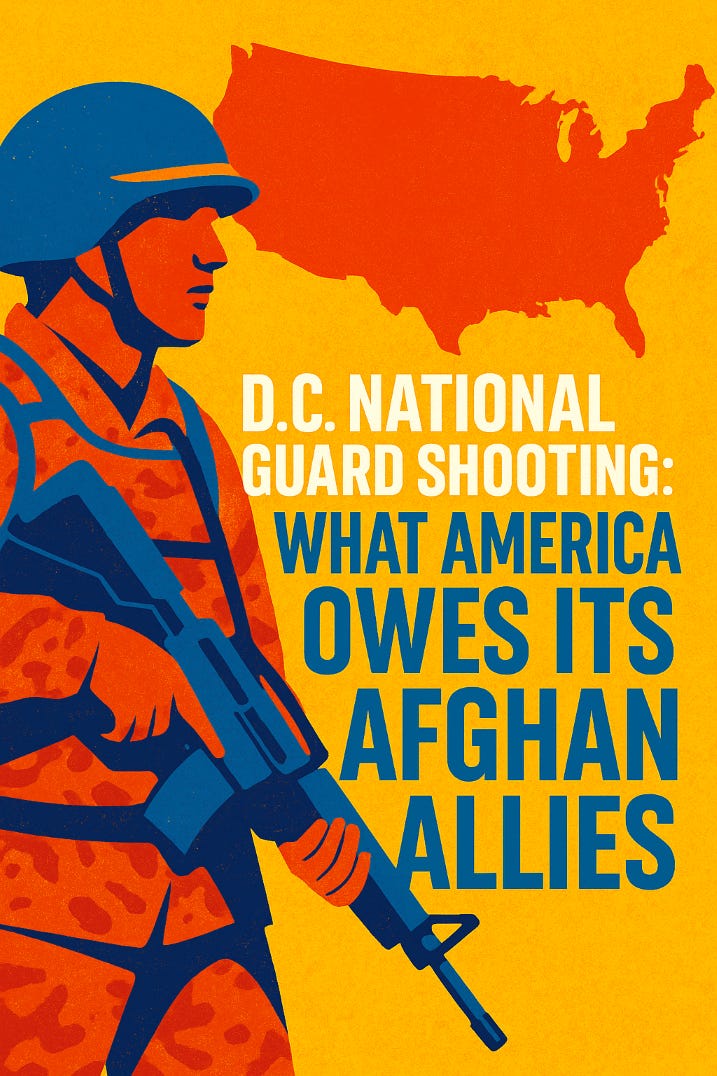
In this urgent Thanksgiving-week briefing, Nate Charles — former Navy SEAL, counterterrorism officer, and federal prosecutor — addresses the shooting of two National Guard soldiers near the White House by an Afghan national. He explains why this incident demands seriousness, accuracy, and moral clarity.Drawing on three Afghanistan combat tours and years inside the National Security Division of DOJ, Nate breaks down what we actually know, what we don’t know, and why this moment cannot be hijacked to fuel bigotry or collective punishment.He details the reality facing Afghan allies who fought alongside U.S. forces, the xenophobic policies now trapping their families under Taliban rule, and the legal and moral boundaries that must not be crossed — no matter how unsettling this incident is.If you care about national security, rule of law, or America’s obligations to those who bled beside us, this is a necessary and unflinching analysis.Stay informed with national-security-level analysis, not pundit noise. Subscribe for sharp, uncompromising briefings on the rule of law, democracy, and America’s obligations to its allies. Get full access to The Rule of Law Brief at natecharles.substack.com/subscribe
In this episode of The Rule of Law Brief, I answer a direct question from a follower: Who can stop Donald Trump at this point? The honest answer is uncomfortable—and it exposes the structural vulnerabilities in our constitutional system.I walk through the basic checks and balances the Framers designed: judicial review, the power of the purse, and impeachment. Then we examine how each of those mechanisms has broken down—largely because they depend on voluntary compliance and political courage that simply aren’t present today.We look at Trump’s rejection of judicial authority, Congress’s collapse on the budget standoff, and the modern degeneration of impeachment into political performance art. We also discuss Caroline Leavitt’s recent remark that Trump “will be impeached” if Republicans lose the midterms—a line that accidentally reveals an important truth about the system’s fragility.Ultimately, the answer isn’t the courts, and it isn’t Congress. The only people who can stop a lawless president are the voters—up and down the ballot, at both the federal and state levels. Because the Constitution is only as strong as the people entrusted to enforce it.If you want sober, unfiltered analysis on national security, rule of law, and democratic resilience—subscribe and stay ahead of the curve. No theatrics, no sugar-coating, just clear-eyed assessments and practical insight. Get full access to The Rule of Law Brief at natecharles.substack.com/subscribe
In this urgent briefing, I break down new Associated Press reporting that the FBI’s counterterrorism division has opened an inquiry into Members of Congress who appeared in a video urging U.S. service members to refuse illegal orders. I explain why this is far more than a political dispute: it strikes at the core of the FBI’s own governing rules—the Domestic Investigations and Operations Guide (DIOG) and the Attorney General’s Guidelines for Domestic FBI Operations.These documents prohibit opening any FBI investigation based solely on First Amendment–protected political speech. As someone who worked counterintelligence and counterproliferation cases at DOJ headquarters, I describe how these rules function in practice, why they matter, and why the Bureau’s reported actions represent a direct collision with its legal framework.The timing—immediately after President Trump publicly accused the lawmakers of “sedition” and invoked the death penalty—raises serious questions about political pressure influencing federal law-enforcement operations.If political dissent becomes acceptable predication for federal intelligence activity, the democratic guardrails that protect civil society begin to fail. This episode explains what’s happening, why it’s dangerous, and what Congress must demand now.If you want clear, unsentimental analysis on the rule of law, democracy, and national security—without partisan spin—subscribe to The Rule of Law Brief and stay ahead of the headlines. Get full access to The Rule of Law Brief at natecharles.substack.com/subscribe
In this episode of The Rule of Law Brief, I break down the sudden firing of Capt. Gilbert Clark, the Commandant of Midshipmen at the U.S. Naval Academy. The official reason—“loss of confidence”—is the Navy’s most opaque euphemism, a phrase that conceals far more than it reveals.I explain what that term actually means inside the fleet, and why it tells us nothing about what really happened. I talk openly about my own experience being “relieved for loss of confidence” after refusing an illegal order, and why the phrase has become a container for everything from routine misconduct to political retribution.I also look at the broader concern: the increasing erosion of the firewall between military professionalism and partisan interference. The Hatch Act may be on the books, but its deterrent effect has collapsed. When senior officers are removed abruptly with no explanation, the question of political motive is unavoidable.Finally, I highlight the fleet-up of Capt. Austin Jackson—an excellent SEAL officer and a contemporary of mine—and why the Brigade is in capable hands even as the circumstances behind Clark’s removal remain opaque.If you are in Annapolis, connected to the Brigade, or aware of even scuttlebutt, drop it in the comments or send a message. Transparency matters, especially now.Get sharp, unvarnished national-security analysis and commentary—grounded in law, experience, and plain truth. Subscribe to stay ahead of the curve. Get full access to The Rule of Law Brief at natecharles.substack.com/subscribe
In this episode of The Rule of Law Brief, Nate Charles breaks down two explosive developments from the past 24 hours:1. A federal judge has dismissed the indictments against James Comey and Letitia James after finding that Donald Trump’s hand-picked interim U.S. Attorney was unlawfully appointed. Every action she took—including the indictments themselves—was legally void. The Comey charges are now dead forever due to the expired statute of limitations.2. The Pentagon has opened an investigation into Senator Mark Kelly that could theoretically lead to recalling him to active duty for a court-martial—simply for appearing in a video stating the obvious: U.S. military personnel must refuse illegal orders. Retired military lawyers quoted by NPR call the move “very rare,” “politically charged,” and legally absurd. Kelly’s statements are squarely protected by the Speech and Debate Clause.From there, Nate walks through the authoritarian logic behind these actions, the parallels to non-violent civil disobedience, and why “standing in the breach” sometimes matters more for the country than for the individual under attack.If you care about the rule of law, constitutional government, and calling authoritarianism by its name—subscribe. Every episode cuts through noise, exposes abuse of power, and explains what’s actually at stake for American democracy. Get full access to The Rule of Law Brief at natecharles.substack.com/subscribe
In this episode of The Rule of Law Brief, attorney and former Navy officer Nate Charles dismantles the latest wave of Republican attacks on Democratic lawmakers who reminded U.S. servicemembers of a simple legal truth: troops must obey lawful orders and refuse unlawful ones.Drawing on his own training at the U.S. Naval Academy—where within the first week midshipmen are taught the distinction between lawful and unlawful orders—Nate walks through the bedrock principles of military leadership, the controlling Supreme Court precedents, and the UCMJ provisions that demand refusal of manifestly illegal commands.He then explains, with precision and legal clarity, why Republican accusations of “sedition” collapse instantly under modern First Amendment doctrine, and why the Democrats’ message is not only correct but essential. The episode highlights the narrow scope of federal sedition statutes, the constitutional protections that limit them, and the Brandenburg standard that governs all advocacy-based prosecutions.Finally, Nate lays out a concise but devastating catalogue of illegal or unconstitutional orders issued by Donald Trump, including:* Illegal domestic troop deployments* ICE arrest quotas and unconstitutional mass detentions* Pentagon gag orders on congressional communications* Unauthorized use of military force* National Security Presidential Directive–7 targeting lawful dissent* Antideficiency Act violations* Government retaliation against protected speech* Unlawful ICE raids on protected locationsEach example is grounded in established law and public record—not speculation or rhetoric.This episode ends with a blunt warning to anyone still enabling unconstitutional conduct inside the national-security and military community: those who support violations of the Constitution are acting as enemies of the rule of law.Stay ahead of the rising constitutional crisis.Subscribe for grounded, legally rigorous analysis at the intersection of national security, the rule of law, and democratic resilience. Every episode cuts through political noise and explains exactly what the law requires—no spin, no sugarcoating. Get full access to The Rule of Law Brief at natecharles.substack.com/subscribe
In today’s episode of The Rule of Law Brief, I break down a problem that has infected American political debate for decades: the rampant misuse of the words “communism” and “socialism.”We start with the actual Merriam-Webster definitions—not the pop-culture ones, not the partisan caricatures, but the authoritative economic and political meanings of these terms. From there, we examine how the modern political right routinely collapses “socialism” and “communism” into a vague accusation of authoritarianism, borrowing imagery from the Soviet Union and the People’s Republic of China while ignoring what those terms actually describe.Then we turn to the political left, which has increasingly embraced the label “socialist” even when the policies they advocate—universal healthcare, tuition-free college, market regulation, and a stronger social safety net—have nothing to do with collective ownership of the means of production. In reality, most of these policies fall squarely under the Merriam-Webster definition of government, not socialism.The result? Two sides talking past each other, armed with terms they do not understand, generating polarization instead of clarity.If we want real solutions—on regulation, on public spending, on the balance between market freedom and public welfare—we need precision, not slogans. Because words matter, and sloppy language produces sloppy thinking.If you value clear thinking, accurate terminology, and serious analysis of how political rhetoric shapes public policy, subscribe to The Rule of Law Brief. You’ll get grounded, evidence-based commentary that cuts through the noise and keeps our democratic discourse honest. Get full access to The Rule of Law Brief at natecharles.substack.com/subscribe
In this episode of The Rule of Law Brief, I take a moment to recognize a major achievement by my brother, Jordan Charles—Vice President of the New Glenn Business Unit at Blue Origin—and the entire team responsible for yesterday’s New Glenn launch and booster recovery.But this isn’t just a family milestone. It’s a chance to examine what spaceflight represents for a democratic society: curiosity, perseverance, long-range ambition, and the kind of creative problem-solving that complex engineering demands.I also explain why space exploration remains one of the best drivers of American education and scientific aspiration, inspiring generations of children to push harder, think bigger, and pursue difficult things. These values aren’t luxuries. They’re strategic essentials for a country that intends to remain competitive.Join me as I explore national security, democratic resilience, and the values that keep a free society functioning—even in turbulent times. Get full access to The Rule of Law Brief at natecharles.substack.com/subscribe
In this episode of The Rule of Law Brief, Nate Charles examines the latest congressional release of Jeffrey Epstein’s emails — including Epstein’s own statement that Donald Trump “spent hours at my house” with one of the young women later identified as a trafficking victim.Rather than focusing on the salacious details, this episode explores a far more dangerous dynamic: the deliberate “slow drip” strategy that numbs the public into indifference. Through controlled disclosure and incremental normalization, outrage becomes background noise. The moral baseline shifts.What begins as horror ends in apathy — and that’s exactly the point.I’m Nate Charles — an attorney and former Navy SEAL who writes and speaks about national security, rule of law, and the psychological machinery of propaganda. Subscribe for analysis that cuts past headlines and exposes how power shapes what we feel — and what we stop feeling. Get full access to The Rule of Law Brief at natecharles.substack.com/subscribe
In this Veterans Day message, Nate Charles speaks candidly about the tension between pride in service and disillusionment with the nation’s current direction.He explains that the oath of service was never to a person or a party, but to the Constitution — a document meant to outlast any single leader.Drawing from his own experience as a Navy SEAL and federal prosecutor, Charles explores the authoritarian nature of military life, the moral meaning of sacrifice, and the betrayal felt when citizens — including fellow veterans — support leaders who scorn the rule of law.He reminds listeners that service is not about glorifying power, but about protecting freedom from it.“The purpose of military service was never to glorify power. It was to protect freedom from it… The oath still matters.”Join Nate Charles on The Rule of Law Brief — where national security, constitutional law, and moral courage meet. Subscribe for honest commentary from a veteran and former federal prosecutor who still believes the oath matters. Get full access to The Rule of Law Brief at natecharles.substack.com/subscribe
In this deeply personal episode of The Rule of Law Brief, I share the hardest lesson I’ve ever learned.Two years after starting my own law firm, my marriage collapsed — and it was my fault. In the aftermath, as I faced false allegations, isolation, and loss, I discovered something I hadn’t expected: that my ability to recover, to rebuild, and even to love again was itself a reflection of privilege.Privilege isn’t about guilt. It’s about gratitude — and responsibility.Because the real divide in this country isn’t left or right, rich or poor. It’s about what we do with the advantages we have. When you hold privilege, do you use it to lift others up — or to serve yourself?A confession, a reckoning, and a challenge: privilege isn’t something to feel guilty about — it’s something to use wisely. Get full access to The Rule of Law Brief at natecharles.substack.com/subscribe
Summary:In this episode of The Rule of Law Brief, Nate Charles challenges one of the most emotionally charged debates in American politics: whether it’s fair to compare the MAGA movement to the Nazis. His answer? Absolutely.Charles explains that critics of the comparison are looking at the wrong era. The relevant parallel isn’t Nazi Germany in 1945—it’s Germany in the early 1930s, when Hitler’s movement weaponized propaganda, fear, and resentment to erode democratic institutions from within. Step by step, they used democracy itself to dismantle democracy, and today’s MAGA movement follows that same playbook: demonizing minorities, discrediting elections, and elevating one man above the law.This is not hyperbole—it’s history repeating itself. And ignoring that history, Charles warns, is how democracies sleepwalk into tyranny.Key themes:* Why the MAGA–Nazi comparison is about trajectory, not atrocity* The historical stages of authoritarian consolidation* Propaganda, crisis politics, and the cult of personality* How denial of these parallels enables democratic decaySubscribe to The Rule of Law Brief for sharp, historically grounded commentary on democracy, justice, and national security—hosted by former Navy SEAL and federal prosecutor, Nathan M. F. Charles. Get full access to The Rule of Law Brief at natecharles.substack.com/subscribe
In this No Kings Day edition of The Rule of Law Brief, Nathan M. F. Charles reflects on a day that was ebullient, peaceful, and profoundly human. From the sidewalks of Veterans Park in Lebanon, Pennsylvania, he shares an on-the-ground view of a rally that drew hundreds — neighbors, veterans, families, and students — standing shoulder to shoulder for democracy and decency.Nate explains why he rejects the notion that America is “divided.” The real struggle, he argues, isn’t between left and right, but between those who still believe in the Constitution’s promises and those who’ve abandoned them.This episode captures gratitude, hope, and the moral courage of ordinary citizens who showed up peacefully to defend the principles that have bound the United States together for nearly 250 years.Highlights:* A first-hand account of the Lebanon No Kings Day rally* Why peaceful civic participation matters now more than ever* The danger of calling America “divided”* The enduring unifying power of the U.S. Constitution* A call to keep showing up — at rallies, in communities, and at the pollsIf this conversation resonates with you — if you believe in defending democracy, in the rule of law, and in the idea that America’s strength lies in both principle and peace — subscribe to The Rule of Law Brief. Join a growing community of citizens determined to keep showing up for what matters most. Get full access to The Rule of Law Brief at natecharles.substack.com/subscribe

Comments

Download from Google Play

Download from App Store
 United States