


The School Room
Subscribed: 3Played: 32
Subscribe

© Copyright 2023 All rights reserved.
Description
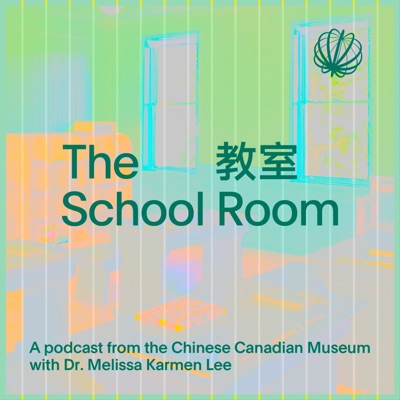
Recorded inside the historic school room in the Wing Sang Building, The School Room shares stories connected to the Chinese Canadian Museum’s exhibitions and programming. Join host Dr. Melissa Karmen Lee, CEO of the Chinese Canadian Museum, and a special guest each month as they go in-depth on Chinese Canadian experiences.
24 Episodes
Reverse
Ann Hui (Hui On-wah) is one of the leading figures who ushered in the Hong Kong New Wave – a new age of Hong Kong cinema that began in 1979. With a career spanning more than 4 decades and 28 feature films, Ann has cemented her name as one of the greats of Chinese language cinema. Her work often focuses on ordinary people and their daily lives, speaking to themes of human consciousness, politics and migration, and national identity.
Tune in to this episode of The School Room to hear about the ways Ann recreates authentic scenes in her films, her philosophy on giving back to society, and her concerns about Maggie Cheung playing the leading role in “Song of the Exile” (it’s not what you think!).
“Dream Factory: Cantopop Mandopop 1980s-2000” is now on view at the Chinese Canadian Museum in Vancouver’s Chinatown until May 2026. Monthly curator tours are available in English, Cantonese, and Mandarin. To learn more or book tickets, visit https://www.chinesecanadianmuseum.ca/.
Rainbow Chan is an award-winning vocalist, producer, and multi-disciplinary artist. Since moving to Australia with her family in 1996, Rainbow has built a celebrated career while tracing her maternal roots to Weitou people—one of Hong Kong’s indigenous groups who settled in the region prior to British colonization in 1898. Her creative practice, deeply informed by ideas of homeland and diaspora, has earned her recognition as one of Australia’s most innovative contemporary musicians.
In this episode, Rainbow shares how she weaves her maternal Weitou heritage into song and performance, reflects on what her mother’s heritage language has meant for her identity and its role in broader cultural revitalization, and discusses which Cantopop artists from her childhood continue to inspire her practice today.
Dream Factory: Cantopop Mandopop 1980s-2000 is now on view at the Chinese Canadian Museum in Vancouver’s Chinatown until May 2026. Monthly curator tours are available in English, Cantonese, and Mandarin. To learn more or book tickets, visit https://www.chinesecanadianmuseum.ca/.
Leading up to the handover of Hong Kong from British rule back to Chinese sovereignty between 1984 and 1997, over 300,000 Hong Kong people emigrated to Canada. For them, they not only brought over their families and dreams for a better future, but also the sounds of home through Cantopop and the laserdiscs of their favourite artists came to life.
On this episode of the School Room, host Dr. Melissa Karmen Lee sits down with Singapore born artist Ming Wong, whose artwork composed of dozens of laserdiscs takes center stage in the Chinese Canadian Museum’s new feature exhibition, "Dream Factory: Cantopop Mandopop 1980s-2000." Tune in to hear about Ming and Liam Morgan’s futuristic stage installation, "Boundless Oceans, Vast Skies," the inspiration behind it, and how the concept of speculative futures relates to the immigrant experience.
"Dream Factory: Cantopop Mandopop 1980s-2000" is now on view at the Chinese Canadian Museum in Vancouver Chinatown until the end of May 2026, with special curator tours in English, Cantonese, and Mandarin occurring every month. To learn more about the Chinese Canadian Museum and book tickets, visit https://www.chinesecanadianmuseum.ca/.
Born in Taiwan and living in Montreal since 2002, Chih-Chien Wang is an artist who uses photography, video and objects and at times integrates text, performance and sound into his work, which explores the ordinary moments of everyday life that reflects his understanding of people, society and the city where he lives. He has shown his work across Canada and the United States.
In this episode, learn about Chih-Chien’s "Travelers Came with Hope," a new photography installation on display at the Chinese Canadian Museum in the "Reshaping Collections: Where History Meets Art" exhibition.
The School Room: Reshaping Collections Artist Series is made possible with support from the City of Vancouver and the Province of British Columbia.
To learn more about the Chinese Canadian Museum and book tickets, visit https://www.chinesecanadianmuseum.ca/.
Born in Hong Kong, raised in Lagos and Thunder Bay, Vancouver based artist Howie Tsui works in ink brush, sound sculptures, lenticular lightboxes and installation, constructing tense, fictive environments that undermine venerated art forms and narrative genres, often stemming from the Chinese literati tradition. He employs a stylized form of derisive and exaggerated imagery as a way to satirize and disarm broadening regimes and their programs of cultural hegemony. Tsui has exhibited his work through Canada and internationally.
In this episode, learn about Howie’s "An Elegy for Dust (earth)," a new installation on display at the Chinese Canadian Museum in the "Reshaping Collections: Where History Meets Art" exhibition.
The School Room: Reshaping Collections Artist Series is made possible with support from the City of Vancouver and the Province of British Columbia.
To learn more about the Chinese Canadian Museum and book tickets, visit https://www.chinesecanadianmuseum.ca/.
Based in Vancouver, Stella Zheng is an artist and illustrator who utilizes a mix of traditional Chinese art-making tools and digital mediums to create illustrations that explore the intricacies of the Chinese diaspora and her identity. She strives to use illustration to present honest, multifaceted, and nuanced representations of Chinese culture that are often ignored. Her previous works include art installations and the catalogue for A Seat At the Table: Chinese Immigration and British Columbia exhibition that was featured in the Chinese Canadian Museum.
In this episode, learn about Stella’s "Wally’s World," a new illustration on display at the Chinese Canadian Museum in the "Reshaping Collections: Where History Meets Art" exhibition.
The School Room: Reshaping Collections Artist Series is made possible with support from the City of Vancouver and the Province of British Columbia.
To learn more about the Chinese Canadian Museum and book tickets, visit https://www.chinesecanadianmuseum.ca/.
A second-generation settler of Chinese heritage, Janet Wang is a Vancouver-based visual artist and educator working within a traditional painting practice, integrated with sculptural installation practices and digital media. Her creations explore the construction of identity through the appropriation and disruption of social patterns and familiar gestures. Wang pays homage to the canons and traditions of history, both the artistic and the quotidian, in order to use the familiar as a meeting point with the viewer. She has exhibited her work throughout Canada and internationally.
In this episode, learn about Janet’s "Here, There," a new installation on display at the Chinese Canadian Museum in the "Reshaping Collections: Where History Meets Art" exhibition.
The School Room: Reshaping Collections Artist Series is made possible with support from the City of Vancouver and the Province of British Columbia.
To learn more about the Chinese Canadian Museum and book tickets, visit https://www.chinesecanadianmuseum.ca/.
Morris Lum is a Trinidadian-born photographer and artist whose work explores the hybrid nature of the Chinese-Canadian community through photography, form and documentary practices. His work also examines the ways in which Chinese history is represented in the media and archival material. Currently based in Mississauga, Ontario, Lum’s work has been exhibited and screened across Canada and the United States.
In this episode, learn about Morris’s "Finding C.B. Wand," a new photography installation on display at the Chinese Canadian Museum in the "Reshaping Collections: Where History Meets Art" exhibition.
The School Room: Reshaping Collections Artist Series is made possible with support from the City of Vancouver and the Province of British Columbia.
To learn more about the Chinese Canadian Museum and book tickets, visit https://www.chinesecanadianmuseum.ca/.
Karen Tam is a Montreal-based artist and curator whose research focuses on the constructions and imaginations of cultures and communities. In her installations, she recreates Chinese restaurants, karaoke lounges, opium dens, curio shops and other sites of cultural encounters. Tam’s deep engagement with archival and collections research has also led her to question whose histories get to be collected and told, and to interrogate the narratives that have been constructed around the Chinese diaspora.
In this episode, learn about Karen’s "Whispering Jade Bazaar," a new installation on display at the Chinese Canadian Museum in the "Reshaping Collections: Where History Meets Art" exhibition.
The School Room: Reshaping Collections Artist Series is made possible with support from the City of Vancouver and the Province of British Columbia.
To learn more about the Chinese Canadian Museum and book tickets, visit https://www.chinesecanadianmuseum.ca/.
Strathcona is Vancouver’s oldest residential neighbourhood. Bordering Chinatown and the Downtown Eastside, it has historically been home to the working class, including the Chinese, Japanese, Jewish, Irish, Ukrainian, and Black communities. While gentrification has caused significant change and displacement of some of these communities, the neighbourhood’s diverse makeup continues to be as evident today as ever before, with the majority of residents speaking a non-English heritage language.
On this episode, host Dr. Melissa Karmen Lee chats with Marjorie Young, a Strathcona local and the first registered Chinese Canadian speech language pathologist in British Columbia. Reflecting on growing up in a multicultural environment, Marjorie describes what it was like going to school with classmates who collectively spoke over fifty different heritage languages. They then discuss Majorie’s memories of her family’s famous Chinatown restaurant, W.K. Gardens, the go-to spot for community banquets and celebrity visits until its closure in the 1960s, as well as Marjorie’s second career as a visual artist.
To learn more about the Chinese Canadian Museum and book tickets, visit https://www.chinesecanadianmuseum.ca/
How do Chinese diasporic experiences in South Africa differ from those in Canada? In this episode, Dr. Melissa Karmen Lee sits down with Dianne Leong Man, co-author of "Colour, Confusion, and Concessions: The History of the Chinese in South Africa", to learn about the country with the highest population of Chinese living in Africa and its community. They discuss the reasons for early Chinese settlement in the country and the South African Chinese Exclusion Act of 1904, the various racial classifications of the Chinese over time in South Africa, and the role Dianne’s book has played in the courtroom to protect Chinese South African rights.
To learn more about the Chinese Canadian Museum and book tickets, visit https://www.chinesecanadianmuseum.ca/
The Chinese Exclusion Act of 1923 is the only immigration law in Canadian history to have prevented a particular group from entering the country on the basis of race, specifically barring people of Chinese descent from legally entering Canada from 1923 until 1947 with very few exceptions. Preventing entry denied many prospective Chinese people opportunities for new experiences and economic gain in Canada. However, it also meant that the Chinese already in Canada were prevented from having their families join them in their new lives across the Pacific.
Mah Tin Yick was one of many Chinese whose life was profoundly impacted by this draconian law. Arriving in Victoria from China in 1885, just before the head tax was implemented, Mah Yick settled in Salmon Arm, British Columbia and ran a hand laundry business with his family. However, tragedy struck when his partner passed away just after the Exclusion Act came into effect, leaving him struggling to care for his two young daughters on his own.
On this episode of the School Room podcast, host Dr. Melissa Karmen Lee is joined by Janet Bradley Worthington, Mah Yick’s granddaughter. Tune in to hear about how Mah Yick was personally impacted by the family separation the Exclusion Act brought on, the role the Oriental Home and School played in Janet’s family history, and what it took for Janet to uncover these stories through searching Chinese Canadian archival records.
To learn more about the Chinese Canadian Museum and book tickets, visit https://www.chinesecanadianmuseum.ca/
Dr. Lillian Eva Quan Dyck’s life has been one of many firsts. The first Indigenous female senator, first Canadian-born senator of Chinese descent, and first Indigenous woman in Canada to earn a PhD in science. Lillian has blazed trails in the sciences and Senate for her work in reforming the Criminal Code to consider harsher penalties for crimes against Indigenous women, the restoration of Indian Status for Indigenous women who had married non-Indigenous men, and her career as a neuropsychiatrist.
On this Truth and Reconciliation Day special episode, Lillian Dyck discusses why she was told to hide her Indigenous heritage and lean into her Chinese identity growing up, her subsequent advocacy and incredible achievements in the Senate for women and Indigenous peoples, and the inspirations behind Shelley Niro’s recent film based on Lillian’s life, Café Daughter.
To learn more about the Chinese Canadian Museum and book tickets, visit https://www.chinesecanadianmuseum.ca/
The Los Angeles Summer Olympics in 1984 marked the first time an Olympic gold medal was awarded to a Chinese Canadian athlete. Lori Fung’s gold in the newly debuted sport of rhythmic gymnastics not only made history as the first Chinese Canadian and Japanese Canadian gold medalist, but also as the first ever rhythmic gymnastics gold medalist. On this episode, Lori talks growing up in East Vancouver and Canadian representation in sports, her Olympic experience, and her big screen debut as an aerial ballerina in the 2004 Catwoman movie.
To learn more about the Chinese Canadian Museum and book tickets, visit https://www.chinesecanadianmuseum.ca/
Chun Hon Chan was the first Chinese Canadian to compete in the Olympic Games, participating in the weightlifting competitions at the Mexico City 1968 and Munich 1972 Summer Games. Standing at just 5'2" and weighing in at 120 pounds, his appearance and strength defied expectations during a time when Chinese men were stereotyped as physically weak. On this episode of the School Room, Debbie and Derek Chan, children of Chun Hon Chan, recount memories of their father, including his journey to Canada as a paper son, hardships as a restaurant worker and owner, and his disciplined lifestyle as an athlete.
To learn more about the Chinese Canadian Museum and book tickets, visit https://www.chinesecanadianmuseum.ca/
Shelley Niro (Mohawk) is a multidisciplinary contemporary artist, best known for her work in photography, painting, sculpting, beadwork, multimedia, and independent film. On this special episode celebrating National Indigenous History Month, host Dr. Melissa Karmen Lee and Shelley discuss the challenges surrounding representations of Indigenous peoples, stereotypes, and identity in her works, including in her latest film Café Daughter.
To learn more about the Chinese Canadian Museum and book tickets, visit https://www.chinesecanadianmuseum.ca/
Charlayne Thornton-Joe is perhaps best known for her stint as a city councilor in Victoria, where she tirelessly advocated for diverse cultural groups, including that of her own Chinese heritage. Today she serves as the Visitor Experience and Facilities Coordinator for the Chinese Canadian Museum’s Victoria exhibition in Fan Tan Alley, working together with a team of dedicated volunteers to uplift the Chinatown community. Join Charlayne and host Dr. Melissa Karmen Lee in discussing the initiatives Charlayne undertook as city councillor, her highlights from working in Victoria Chinatown, and what building community looks like to her.
To learn more about the Chinese Canadian Museum and book tickets, visit https://www.chinesecanadianmuseum.ca/
For many, Newfoundland is not usually the first place that comes to mind when thinking of the Chinese Canadian diaspora. While Canada and the United States closed their doors to Chinese immigration until the 1940s, Newfoundland, still a British colony, was the last place in North America to remain open to Chinese, albeit immigration came with a hefty head tax as an entry fee.
Gordon Jin, president of the Newfoundland and Labrador Head Tax Redress Organization, joins The School Room to discuss the impact this act had on Chinese immigration to Newfoundland, the role hand laundries played in the economic fabric of the Chinese diaspora, and the work his organization has undertaken to memorialize this period of Newfoundland history.
To learn more about the Chinese Canadian Museum and book tickets, visit https://www.chinesecanadianmuseum.ca/
What does it mean to serve your community? On this International Women’s Day special episode, host Dr. Melissa Karmen Lee sits down with Arlene Chan, author, historian, activist, and daughter of Jean Lumb – the first Chinese Canadian woman to be inducted into the Order of Canada for her own community activism. Tune in to learn about the work these two generations of women have undertaken for the Chinese Canadian community at large, the evolution of Toronto’s Chinatowns, and what it was like to serve as a cultural consultant for the Disney-Pixar movie, Turning Red.
Interested in learning more about stories of Chinese Canadian women who lived during the Exclusion Era, like Arlene’s mother, Jean Lumb? Visit The Paper Trail to the 1923 Chinese Exclusion Act, on view at the Chinese Canadian Museum in Vancouver Chinatown. To learn more about the Chinese Canadian Museum and book tickets, visit https://www.chinesecanadianmuseum.ca/
What do a photo album restaurant directory, steamed broccoli, and an autofiction novel have in common? All three were used by William Ping in reconnecting with his late grandfather, William Ping Sr, who was one of about 300 Chinese men to settle in Newfoundland when the Newfoundland Chinese head tax was in effect. On this month’s episode, William Ping, CBC journalist and author of Hollow Bamboo, talks tracing family history and the St. John’s culinary scene with host Dr. Melissa Karmen Lee.
Curious to find out more Newfoundland Chinese stories? Visit The Paper Trail to the 1923 Chinese Exclusion Act, on view at the Chinese Canadian Museum in Vancouver Chinatown. To learn more about the Chinese Canadian Museum and book tickets, visit https://www.chinesecanadianmuseum.ca/

Comments

Download from Google Play

Download from App Store
 United States