


The Small Business Cyber Security Guy | Cybersecurity for SMB & Startups
Subscribed: 19Played: 16
Subscribe

© The Small Business Cyber Security Guy Productions
Description
The Small Business Cyber Security Guy Podcast
Practical cybersecurity advice for UK small business owners who need enterprise-level protection without enterprise-level budgets, headaches, or PhD-level jargon.
Join hosts Noel Bradford and Mauven MacLeod as they translate complex cybersecurity threats into actionable solutions that actually work for businesses with 5-50 employees. Noel brings 40+ years of enterprise experience from Intel, Disney, and the BBC, whilst Mauven adds government-level threat intelligence from her time as a UK Government Cyber Analyst. Together, they bridge the gap between knowing you need better security and actually implementing it without breaking the bank.
Why This Podcast Works:
Real experts who’ve chosen to focus on underserved small businesses
Practical advice tested in actual SMB environments
British humour that makes serious topics engaging (not intimidating)
Budget-conscious solutions that acknowledge your real constraints
Perfect For:
Business owners who believe they’re ”too small to be targeted”
Anyone who needs cybersecurity knowledge but lacks time for complex solutions
Those seeking enterprise-quality protection at corner shop prices
UK businesses (though principles apply globally)
Each episode delivers concrete, actionable advice you can implement immediately. No theoretical discussions, no vendor nonsense, no academic waffle. Just two experts who genuinely care about helping small businesses survive and thrive digitally.
Regular Features:
Current threat analysis with real-world context
Implementation guides within realistic budgets
Human factor solutions (because your biggest vulnerability makes excellent tea)
Government framework explanations that actually make sense
New episodes weekly. Subscribe now and join thousands of business owners who’ve discovered that proper cybersecurity isn’t just for Fortune 500 companies.
Like what you hear? Subscribe, leave a review mentioning your biggest cybersecurity concern, and visit our blog for detailed implementation guides on everything we discuss.
Stay secure, stay practical, and remember - if your security wouldn’t survive a curious teenager with too much time, it needs work.
Practical cybersecurity advice for UK small business owners who need enterprise-level protection without enterprise-level budgets, headaches, or PhD-level jargon.
Join hosts Noel Bradford and Mauven MacLeod as they translate complex cybersecurity threats into actionable solutions that actually work for businesses with 5-50 employees. Noel brings 40+ years of enterprise experience from Intel, Disney, and the BBC, whilst Mauven adds government-level threat intelligence from her time as a UK Government Cyber Analyst. Together, they bridge the gap between knowing you need better security and actually implementing it without breaking the bank.
Why This Podcast Works:
Real experts who’ve chosen to focus on underserved small businesses
Practical advice tested in actual SMB environments
British humour that makes serious topics engaging (not intimidating)
Budget-conscious solutions that acknowledge your real constraints
Perfect For:
Business owners who believe they’re ”too small to be targeted”
Anyone who needs cybersecurity knowledge but lacks time for complex solutions
Those seeking enterprise-quality protection at corner shop prices
UK businesses (though principles apply globally)
Each episode delivers concrete, actionable advice you can implement immediately. No theoretical discussions, no vendor nonsense, no academic waffle. Just two experts who genuinely care about helping small businesses survive and thrive digitally.
Regular Features:
Current threat analysis with real-world context
Implementation guides within realistic budgets
Human factor solutions (because your biggest vulnerability makes excellent tea)
Government framework explanations that actually make sense
New episodes weekly. Subscribe now and join thousands of business owners who’ve discovered that proper cybersecurity isn’t just for Fortune 500 companies.
Like what you hear? Subscribe, leave a review mentioning your biggest cybersecurity concern, and visit our blog for detailed implementation guides on everything we discuss.
Stay secure, stay practical, and remember - if your security wouldn’t survive a curious teenager with too much time, it needs work.
52 Episodes
Reverse
Welcome to the Small Business Cybersecurity Guy Christmas Special with host Noel Bradford and guests Mauven MacLeod and Graham Falkner. This episode is a rapid-fire, often hilarious and sometimes horrifying roundup of the most spectacular cyber security disasters of 2025, told with a no-nonsense focus on what small businesses should learn from them.
We open with the MacHire fiasco: security researchers discovered an admin account on McDonald’s AI hiring chatbot (Paradox.ai/Olivia) protected by the password "123456," exposing up to 64 million applicant records. The researchers reported the flaw; no known mass theft occurred, but the episode underlines vendor risk and the dangers of legacy test accounts and absent MFA.
Next, we cover the Louvre post-heist revelations: a €88m jewel theft followed by reports showing decades-old surveillance systems running Windows 2000/XP, passwords like "Louvre" and systemic neglect. The story is used to illustrate how even world-famous institutions fail at basic cyber hygiene.
We recap the PowerSchool catastrophe, where a 19-year-old college student used compromised credentials to access a support portal and exposed data on some 62 million students and millions of staff. The attack led to ransom demands, payments, further extortion attempts, criminal charges, and a clear lesson — no MFA, huge consequences.
The UK was a hotspot in 2025: Jaguar Land Rover, Marks & Spencer, Co-op, Harrods and others suffered disruptive breaches often rooted in third-party/supply-chain compromises. We also discuss the Foreign, Commonwealth & Development Office breach (detected in October, disclosed in December), suspected China-linked activity, and the difficulties of attribution.
In a rapid-fire segment we cover smaller-but-still-impactful stories: a ransomware gang that abandoned an extortion against nurseries after public outrage; attacks on Asahi, DoorDash and Harvard; widespread exploitation of unpatched SharePoint vulnerabilities; and how simple phishing and credential theft continue to be the root cause of major incidents.
Key takeaways for small businesses are emphasized throughout: enable multi-factor authentication, use strong unique passwords and password managers, patch promptly, run vendor due diligence and risk registers, train staff on phishing/social engineering, maintain incident response plans, and treat supply-chain security as part of your attack surface. The hosts argue the fundamentals work — do the boring basics correctly.
The episode closes with practical advice, links to the revamped blog and Noel’s "No BS Cyber for SMBs" newsletter on LinkedIn, and a festive-but-sober call to change weak passwords (definitely not to "123456") and enable MFA before the new year.
#Cybersecurity #Ransomware #DataBreaches #PasswordSecurity #SupplyChainSecurity #SmallBusiness #UKCyber #InfoSec #Christmas2025 #PowerSchool #McDonalds #JaguarLandRover #ForeignOffice

Do UK small businesses need cyber risk registers? Graham said no. After this 40-minute debate with Noel Bradford, he changed his mind completely.
This Small Business Cyber Security Guy podcast episode tackles cyber risk management for UK SMEs through a heated debate about whether small business boards need formal cyber risk registers.
UK cyber security statistics that changed Graham's mind:
43% of UK small businesses experienced cyber breaches last year (DSIT 2025)
73% have no board-level cyber security responsibility
28% of SMEs say one cyber attack could close them permanently (Vodafone 2025)
Average UK small business breach costs £3,398
Real-world cyber risk register failures: UK manufacturing company with "satisfactory" security controls destroyed by ransomware. Had antivirus, firewalls, backups. No documented cyber risk assessment. No board-level governance. Business nearly closed.
Companies Act director duties most UK boards ignore: Section 174 requires directors exercise "reasonable care, skill and diligence" in managing company risks. With 43% breach rates, cyber risk is material. Failure to document cyber risk management exposes directors to personal liability.
Practical cyber risk register implementation:
✓ Minimum viable cyber risk register template (8 columns, single spreadsheet)
✓ Board-level cyber security governance framework
✓ Quick remediation: enable MFA, test backup restoration, implement payment verification
✓ NCSC Board Toolkit guidance for UK SMEs
✓ Cyber insurance risk assessment requirements
Perfect for UK small business owners, SME directors, startup founders, business managers responsible for cyber security compliance, GDPR, and corporate governance.
Listen to this cyber security governance debate and learn why risk registers aren't bureaucracy - they're legal protection for directors and businesses.
Show notes
December 2025 just shipped the last Microsoft security fixes of the year. Fifty seven vulnerabilities, three zero days, and one actively exploited Windows privilege escalation that hits almost every supported build. Are you patched before the Christmas break, or are you leaving a present for attackers in January?
In this episode, Graham walks through the December Patch Tuesday release for 2025, with a focus on what actually matters for small and medium businesses. You will hear how CVE 2025 62221 in the Windows Cloud Files driver turns a low level account into full system compromise, why Office Preview Pane is once again a risk, and how AI powered tools like GitHub Copilot for JetBrains and PowerShell changes introduce new attack paths. Does your team know about any of that?
You also get a fast tour of Adobe and other vendor updates, including ColdFusion, Android, Ivanti, Fortinet, React server components and SAP. Graham then zooms out to review the full year, with more than one thousand one hundred Microsoft vulnerabilities in 2025 and privilege escalation bugs leading the pack. Finally, he explains why the five week gap before the next Patch Tuesday on thirteen January 2026 makes December patching non negotiable.
By the end of the episode you will know:
Which patches you must treat as emergency work, especially CVE 2025 62221
How Office, Copilot and PowerShell changes affect day to day risk
Why Windows 10 without Extended Security Updates is now a business liability
What to ask your IT team or provider before everyone disappears for the holidays
Are you confident your estate will survive the festive period, or do you need to push patching to the top of the list?
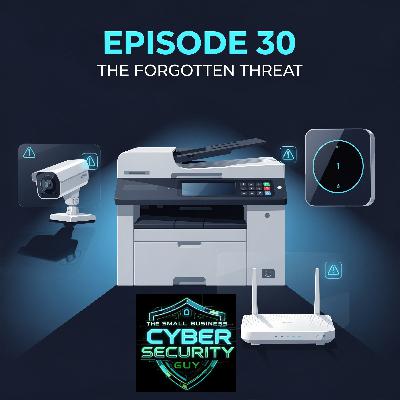
For our 30th episode, we're tackling the cybersecurity blind spot that almost no one discusses but everyone should worry about. You've secured your laptops. You've rolled out multi-factor authentication. Your firewall is properly configured. But what about that office printer quietly storing every contract and payslip you've printed this year on a hard drive nobody ever wipes, with a password an attacker can guess in three tries?
This episode reveals the uncomfortable truth about Internet of Things (IoT) devices in your business. We're talking about printers, CCTV systems, smart thermostats, networked door locks, and every other "smart" device you've stopped thinking about as a computer. These forgotten devices are giving attackers a free pass into networks that are otherwise properly secured.
We share a real case study from our recent emails about a marketing agency that spent £15,000 on security, passed their audit with flying colours, and still got breached through their office printer. This isn't theoretical paranoia. This is happening right now to businesses that think they've got security sorted.
What You'll Learn
Why your office printer is possibly the biggest security risk in your building
How default passwords on "forgotten" devices create easy access points for attackers
The real story of a £15,000 security investment defeated by a £300 printer
What network segmentation actually means and why it matters for small businesses
How to create and maintain an accurate device inventory
Practical steps to secure IoT devices without enterprise budgets
Why your CCTV system might be livestreaming to the internet right now
How smart thermostats become backdoors into your network
Key Topics Covered
The Forgotten Device Problem
Modern offices are full of computers disguised as other things. Every printer, every CCTV camera, every smart thermostat, and every networked door lock is actually a computer connected to your network. Most businesses secure their obvious computers whilst completely forgetting about these devices, creating perfect entry points for attackers who aren't bothering with sophisticated social engineering when they can just log in with "admin/admin".
Real Case Study: The £15,000 Security Investment Defeated by a Printer
A 30-person marketing agency listened to our ransomware and authentication episodes, then invested £15,000 in proper security: new firewalls, endpoint protection, hardware authentication keys for every staff member, and a security audit that came back clean. Two months later, they discovered someone had been accessing their client files for weeks through their HP printer that still used factory default credentials. The printer had full network access and stored copies of everything printed. Nobody had changed the password. Nobody had checked it during the audit. Nobody even thought about it.
Default Credentials: The Epidemic Nobody Discusses
Attackers maintain databases of default passwords for thousands of devices. They don't need to crack complex passwords when they can try "admin/admin" or "admin/password" and gain access to printers, cameras, or thermostats within seconds. These devices often ship with administrative interfaces accessible from the network, and most businesses never change the defaults because they don't think of these devices as security concerns.
Network Segmentation Explained (Without Enterprise Complexity)
Network segmentation sounds enterprise-level complicated, but the basic concept is simple: not everything on your network should be able to access everything else. Your printer doesn't need access to your accounting server. Your CCTV system doesn't need to reach your customer database. Creating separate network zones for different device types means a compromised printer can't become a stepping stone to your sensitive data.
The Device Inventory Challenge
Most small businesses have no accurate list of what's actually connected to their network. They know about the laptops and servers but often forget about the smart coffee machine someone plugged in last year, the wireless access points in the meeting rooms, or the networked thermostat the facilities team installed. Without knowing what's connected, you can't secure it. We discuss practical methods for discovering and documenting every device on your network.
Practical IoT Security Steps
We break down actionable steps that don't require enterprise budgets or dedicated security teams. This includes conducting device audits, changing default passwords, implementing basic network segmentation, regular firmware updates, and creating ownership responsibility for every connected device. The goal is proportionate security that's actually achievable for small businesses.
Key Takeaways
Every connected device is a computer. If it has an IP address, it's a potential security risk that needs management and protection.
Default passwords are attackers' best friends. The first thing to do with any new device is change the administrative password. Never assume factory defaults are acceptable.
Network segmentation isn't optional anymore. IoT devices should be isolated from your main business network, even if that means starting with basic VLAN separation.
Device inventory is fundamental. You can't secure what you don't know exists. Conduct regular network scans to discover forgotten devices.
Ownership matters. Every device needs someone responsible for its security. Don't let devices become "nobody's problem" because that's when they become everyone's problem.
Security audits miss IoT devices. Standard security assessments often focus on servers and workstations whilst completely overlooking printers, cameras, and other IoT equipment.
Firmware updates apply to everything. IoT devices need security patches just like computers. Many businesses forget this entirely.
Your £15,000 security investment can be defeated by a £300 printer. Security is only as strong as your weakest link, and IoT devices are often the weakest links because they're forgotten.
Resources & References
Mentioned in This Episode
Previous Episodes Referenced:
Episode 17: Social Engineering - The Human Firewall Under Siege
Ransomware episodes (multiple)
Authentication episodes featuring Mark Bell
Cyber Essentials episodes
Electoral Commission accountability episode
Hardware Authentication: AuthenTrend hardware keys (mentioned as sponsor)
Case Studies: Marketing agency breach via printer (anonymized client)
Recommended Reading & Tools
NCSC Guidance: National Cyber Security Centre - IoT security guidance
Network Discovery Tools: Fing, Advanced IP Scanner, or similar free network scanning utilities
Device Documentation: Spreadsheet templates for device inventory available on our website
Practical Action Steps
This Week:
Find your printer's admin interface. Log in. If you can't remember the password, that's probably because it's still set to "admin". Change it. Now.
List five connected devices that aren't computers or phones. These are your starting inventory.
Check one device's firmware. Is it up to date? When was it last updated? Who's responsible for keeping it current?
This Month:
Complete device inventory. Use network scanning tools to discover everything connected to your network. Document it all.
Change all default passwords. Every printer, camera, thermostat, and access point needs unique, strong credentials.
Assess your network segmentation. Can your printer access your file server? It shouldn't. Start planning basic network separation.
Assign device ownership. Every device needs someone responsible for its security, updates, and maintenance.
This Quarter:
Implement basic network segmentation. Even simple VLAN separation is better than everything on one network.
Create update schedules. IoT devices need regular firmware updates just like computers.
Review and test. Verify your device inventory is accurate. Check that passwords actually changed. Confirm segmentation works.
Who Should Listen to This Episode?
This episode is particularly relevant for:
Small business owners who've invested in cybersecurity but may have overlooked IoT devices
IT managers and solo IT staff responsible for securing business networks with limited resources
Office managers who purchase and install connected devices without considering security implications
Business owners who think they've "done security" but haven't considered printers, cameras, and similar devices
Anyone who's ever said "it's just a printer" when security concerns were raised
Why This Episode Matters
We've covered passwords, multi-factor authentication, ransomware, supply chain attacks, shadow IT, and social engineering across 30 episodes. We've discussed major breaches at household names and examined what it takes to protect heads of state. But we've deliberately avoided IoT security until now because we knew it would make people uncomfortable, possibly angry, and definitely worried.
The uncomfortable truth is that whilst you've been securing laptops and servers, your office printer has had full network access, stores every document you print, and still uses the password it shipped with. The CCTV system protecting your premises might be livestreaming to the internet because nobody changed the default settings. The smart thermostat saving you money on heating is potentially giving attackers a way into your network.
This isn't theoretical paranoia. We're seeing breaches through IoT devices happen to businesses that have otherwise invested properly in cybersecurity. The marketing agency case study we discuss spent £15,000 on security and still got breached through a printer nobody thought to check during the security audit.
IoT security is the blind spot in small business cybersecurity. This episode gives you the knowledge and practical steps to finally address it without enterprise budgets or dedicated security teams.
Celebrating 30 Episodes
This milestone episode also marks an important achi
What if the best way to protect your business isn't copying what the successful companies do, but avoiding what the failures did wrong? Welcome to reverse benchmarking, the cybersecurity equivalent of learning from other people's face-plants so you don't repeat them.
In this episode, Noel and Mauven flip traditional benchmarking on its head. Instead of asking "what are the best companies doing?", they explore the far more revealing question: "what did the disasters get catastrophically wrong?" From the Target breach via an HVAC vendor to ransomware attacks on UK holiday parks, the hosts dissect spectacular cybersecurity failures to extract practical lessons for small businesses.
You'll discover why copying enterprise best practices often backfires for SMBs, how compliance creates dangerous false security, and practical ways to build your own "disaster library" of lessons learned. Plus, the hosts reveal why some of the worst cybersecurity advice comes from studying successful companies rather than failed ones.
This isn't just negativity packaged as strategy. It's a systematic approach to identifying your business's genuine vulnerabilities by examining where others fell through the cracks. Because in cybersecurity, knowing what not to do is often more valuable than copying what others claim works.
Why This Episode Matters
One in three small businesses were hit by cyberattacks last year. The average cost? A quarter of a million pounds, with some reaching seven million. But here's the crushing statistic: 60% of small businesses close within six months of a cyber incident.
Traditional benchmarking tells you to copy what big enterprises do. Reverse benchmarking shows you what kills businesses like yours, so you can avoid becoming the cautionary tale in someone else's podcast.
Key Takeaways
1. Traditional Benchmarking Often Fails SMBs
Copying FTSE 100 security on a shoestring budget is a losing game
Enterprise solutions don't scale down effectively
By the time you copy last year's "best practice," threats have evolved
Context matters more than copying
2. Compliance ≠ Security
Being compliant doesn't mean you're secure
Compliance is like passing your driving test - it proves you know the rules, not that you'll never crash
Checkbox culture creates dangerous complacency
Attackers don't check your certifications before striking
3. The Statistics Are Sobering
One third of SMBs hit by cyberattacks annually
Average breach cost: £250,000
Some breaches: £7 million
60% of small businesses close within six months post-attack
NCSC estimates 50% of UK SMBs will experience a breach each year
4. Real-World Disasters Teach Practical Lessons
Target breach: Lost $162 million because HVAC vendor credentials weren't properly segmented
Colonial Pipeline: Shutdown of major US fuel infrastructure from weak VPN password
UK holiday park ransomware: Peak season attack forced cash-only operations
Common thread: Basic security fundamentals ignored
5. Third-Party Risks Are Existential
61% of breaches involve third-party access
Small vendors create backdoors into larger networks
Your security is only as strong as your weakest supplier
Segment vendor access ruthlessly
6. Practical Implementation Steps
Build your own "disaster library" of relevant failures
Hold quarterly "what went wrong" review sessions
Map your business to failed case studies
Ask "could this happen to us?" for every breach you read about
Create no-blame culture for reporting near-misses
Detailed Show Notes
Introduction (00:00 - 01:24)
Noel poses a simple question: in the pub, what do people talk about? Their wins, mostly. This episode does the opposite by examining failures instead of successes. The hosts introduce "reverse benchmarking" as the Darwin Awards of cybersecurity, learning from others' digital disasters rather than bragging about fancy firewalls.
Key Quote: "Learn from other people's face-plants so we don't repeat them."
What Is Reverse Benchmarking? (01:24 - 03:46)
Traditional benchmarking means copying what successful companies do. Reverse benchmarking flips this around: study the worst failures in your industry and make certain you don't repeat them.
The Problem with Traditional Benchmarking:
Big enterprises have massive IT teams and unlimited budgets
Trying to copy enterprise security on SMB resources is futile
Benchmarking looks backwards - by the time you implement, hackers have moved on
If everyone in your industry has the same gap, benchmarking won't reveal it
Why It Matters Now:
One third of SMBs were hit by cyberattacks in the past year
Average cost: £250,000, with some reaching £7 million
60% of small businesses close within six months of a cyberattack
Most small business owners still think they're too small to be targeted
UK Context: The National Cyber Security Centre (NCSC) estimates around half of UK SMBs will experience a breach each year. Coin flip odds. If you're sitting in a board meeting saying "hackers won't bother with us," you might as well hang a sign reading "free Wi-Fi, no password."
The Compliance Trap (03:46 - 06:15)
Many businesses believe being compliant means they're secure. This is cybersecurity's biggest misconception.
Compliance vs Security:
Compliance is like passing your driving test - it means you know the rules, not that you'll never crash
Or that you're a good driver
Microsoft's security GM: "Some SMBs believe being compliant means they're safe. It doesn't."
Hackers don't check whether you've got ISO certification before attacking
The Checkbox Culture:
"We did our annual password change. Job done."
Hackers respond: "Challenge accepted."
Following checklists creates false sense of security
Real security requires ongoing vigilance, not annual tick-boxes
The Hidden Risk: If everyone in your industry has the same security gap but meets the same compliance standards, benchmarking against them won't reveal your shared vulnerability. You're all vulnerable together, congratulating each other on your certifications.
Case Study 1: The Target Breach (06:15 - 09:42)
One of retail history's most infamous breaches demonstrates how third-party access becomes a catastrophic liability.
What Happened:
December 2013: Hackers stole 40 million credit card numbers and 70 million customer records
Entry point: HVAC contractor with network access
Attackers used vendor credentials to access Target's corporate network
Then moved laterally to payment systems
The Aftermath:
Direct losses: $162 million
CEO resigned
CIO resigned
Board chairman resigned
Countless hours dealing with breach response, forensics, legal battles
The Lesson: Your security is only as strong as your weakest supplier. That HVAC company, plumber, or IT consultant with network access? They're potential backdoors. Target's enterprise-grade security was bypassed through a small contractor's weak credentials.
For Small Businesses:
61% of breaches involve third-party access
Small businesses often provide services to larger enterprises
Your compromise becomes their breach
Vendor management isn't optional
Practical Actions:
Segment vendor access ruthlessly
No contractor needs access to your entire network
Use separate credentials for third parties
Monitor vendor access continuously
Regular vendor security audits
Case Study 2: Colonial Pipeline (09:42 - 12:28)
In May 2021, a single compromised password shut down a major fuel pipeline supplying 45% of the US East Coast's fuel.
What Happened:
Ransomware attack forced shutdown of 5,500-mile pipeline
Entry point: Weak VPN password
No multi-factor authentication (MFA) on VPN access
Company paid $4.4 million ransom (partially recovered later)
The Impact:
Fuel shortages across southeastern United States
Panic buying, price spikes
Emergency government declarations
Week-long shutdown of critical infrastructure
The Lesson: Credentials are your front door. If you're not protecting them properly, you've left the door unlocked with a welcome mat out for attackers.
For Small Businesses: The Colonial Pipeline didn't fail because of sophisticated zero-day exploits or nation-state malware. They failed because they didn't have MFA enabled on remote access.
Your Action Items:
Enable MFA everywhere, particularly VPN access
Enforce strong password policies
Monitor for credential compromise
Phishing-resistant MFA (hardware tokens or biometrics) for privileged access
Regular access reviews
The Cost-Benefit Reality:
Hardware security keys: £40-70 per user
Potential breach cost: £250,000 average
MFA prevents 99.9% of automated credential attacks
The mathematics are straightforward
Case Study 3: UK Holiday Park Ransomware (12:28 - 15:15)
Closer to home, a UK holiday park discovered that timing matters when ransomware strikes.
What Happened:
Ransomware attack during peak summer season
All booking systems encrypted
Payment processing down
Guest check-ins disrupted
The Business Impact:
Had to operate cash-only during busiest period
Couldn't process new bookings
Lost revenue during most profitable weeks
Guest experience severely compromised
Reputation damage
The Lesson: Attackers choose timing deliberately. They struck during peak season when the business would be most desperate to restore operations quickly and most likely to pay the ransom.
For Small Businesses: Seasonal businesses are particularly vulnerable during peak periods. That's precisely when attackers strike, knowing you can't afford downtime.
Your Defence Strategy:
Offline, air-gapped backups tested regularly
Incident response plan practiced before peak season
Alternative payment processing methods ready
Staff trained on ransomware procedures
Crisis communication templates prepared
The Backup Reality: Having backups isn't enough. You need to test restoration procedures. The middle of a ransomware attack is not the time to discover your backups don't work or take three weeks to restore.
Why Reverse Benchmarking Works Better (15:15 - 17:45)
Traditional approaches f
In this provocative second instalment of the accountability series, hosts Noel Bradford and Mauven MacLeod lay out a detailed proposal for a UK cybersecurity enforcement regime that balances protection for small businesses with personal liability for negligent directors. They compare the current weak regulatory approach to the Health and Safety Executive model, cite international evidence from Singapore, and explore why criminal consequences — up to fines, disqualification and, in extreme cases, prison — might be necessary to change boardroom behaviour.
The episode explains a three-tier framework: Tier 1 (micro and small businesses) protected by Cyber Essentials and criminal liability only for gross negligence; Tier 2 (25–250 employees) required to follow industry-reasonable practice with qualified oversight and documented policies; and Tier 3 (large organisations and public sector) held to the highest standards (ISO/SOC) with lower thresholds for prosecution. The hosts walk through concrete, measurable standards, outcome-based testing, and safe-harbour defences for businesses that engage accredited advisors.
Key technical and organisational measures discussed include Cyber Essentials, MFA, patching and backups, incident response plans, staff training, qualified security oversight (fractional CISOs or accredited MSPs), and government-approved lists of assessors. The episode stresses practical testing — inspectors verifying controls actually work — to prevent compliance theatre and ensure certificates match reality.
Noel and Mauven outline a phased five-year implementation pathway: publication and guidance, data collection and mandatory reporting, staged enforcement beginning with large organisations, then medium businesses, and finally full enforcement — all accompanied by funded support programs, subsidies, and free advisory services to help firms comply.
Costs, benefits and market effects are examined: basic Tier 1 protections are framed as affordable (Cyber Essentials, free MFA), while stronger governance yields lower insurance premiums, preferential procurement, and overall reduced breach costs. The hosts discuss the need to upskill the ICO into a technically capable enforcement agency, political and industry pushback, and international alignment with EU, Singapore and Australia precedents.
The episode closes with a call to action for listeners: implement the basics now (Cyber Essentials, MFA, updates), pressure MPs and industry bodies for proportionate enforcement, and spread the conversation. Expect debates about proportionality, false positives, and safeguarding SMEs, but the central case is clear: a calibrated, evidence-based accountability regime could dramatically reduce breaches and force cybersecurity into the boardroom.

What happens when business negligence causes serious harm to thousands of people? If a faulty ladder injures someone, directors face prison time. If forty million people have their data stolen due to poor security, they receive a strongly worded letter.
In this provocative first episode of our two-part series, Noel and Mauven examine the shocking disparity between health and safety enforcement and cybersecurity regulation in the UK. We compare the HSE's tough approach (prison sentences, director liability, millions in fines) with the ICO's gentle touch (guidance, occasional fines, zero criminal consequences).
With 40 million voter records compromised at the Electoral Commission resulting in just a formal reprimand, whilst construction directors regularly face 18-month prison sentences for single workplace accidents, we ask the uncomfortable question: why is cybersecurity enforcement essentially performative?
This isn't anti-business rhetoric. This is an evidence-based examination of a broken system that fails to protect either businesses or the public, presented through statistics, case studies, and historical precedent, which demonstrates that personal accountability is effective.
What You'll Learn
The Two Regulators: A Tale of Vastly Different Consequences
Why HSE directors face up to 2 years imprisonment, whilst the ICO never imposes criminal penalties
How HSE issued 13,424 enforcement notices and 399 prosecutions in 2023-24
Why the ICO issued just £2.7 million in total UK fines, whilst EU regulators issued over £1 billion
The legal frameworks that create this enforcement gap
The Public-Private Accountability Divide
Electoral Commission breach: 40 million records compromised, 14 months of hostile state access, consequence: formal reprimand
Construction site failures: single injuries lead to prison sentences and director disqualifications
Why do government organisations face minimal consequences for security failures
The message this sends about who matters and who doesn't
Historical Context: How HSE Transformed Workplace Safety
85% reduction in workplace fatalities since the Health and Safety at Work Act 1974
How personal criminal liability changed director behaviour overnight
The construction industry transformation from dangerous to safety-conscious
Evidence that accountability actually works when properly enforced
Arguments Against Director Liability (And Why They Fail)
"Security is too complex for criminal standards" - why doesn't this hold up
"Small businesses can't afford proper security" - HSE already handles proportionate enforcement
"Innovation will suffer" - data showing the opposite effect in the safety sector
"Current system works fine" - statistics proving it demonstrably doesn't
The Current State of Inertia
Why ICO enforcement focuses on "guidance and support" over punishment
Political pressure keeps cybersecurity consequences minimal
Business lobby resistance to accountability measures
The broken incentive structure that rewards negligence
Key Statistics Referenced
HSE Enforcement 2023-24:
13,424 enforcement notices issued
399 prosecutions brought
£73.8 million in fines
Regular prison sentences (average 12-18 months for serious breaches)
ICO Enforcement 2023-24:
£2.7 million total fines across all UK GDPR violations
Zero prison sentences imposed
Zero director disqualifications
Focus on "guidance and support" over punishment
Electoral Commission Breach:
40 million UK voter records compromised
The hostile state actor maintained access for 14 months
Basic security failures: poor patching, weak passwords, inadequate monitoring
Consequence: Formal reprimand only
Impact Statistics:
85% reduction in workplace fatalities since the Health and Safety at Work Act 1974
EU regulators issued over £1 billion in GDPR fines (vs the UK's £2.7 million)
Keymark Construction director: 18 months' prison for fatal fall (2023)
Notable Cases Discussed
Health and Safety Enforcement
Keymark Construction (2023): Director sentenced to 18 months imprisonment following fatal fall due to inadequate safety measures
Corporate Manslaughter Act 2007: Multiple organisations convicted when management failures caused death
Cybersecurity Non-Enforcement
Electoral Commission (2023-24): 40 million voter records compromised by hostile state actor, 14 months of system access, consequence was formal reprimand with no financial penalty or personal liability
British Airways GDPR Fine: Initially £183 million, reduced to £20 million, no director consequences despite preventable security failures
Why This Matters for Small Businesses
This isn't about attacking business owners. It's about exposing a system that fails everyone:
Honest businesses suffer when competitors cut security corners without consequences
Directors lack incentive to invest in security when breaches only result in fines the company pays
Small businesses become collateral damage when larger organisations treat security as optional
The current approach demonstrably doesn't work - breaches increase year on year despite ICO "guidance"
Understanding this enforcement gap helps you see why cybersecurity culture hasn't undergone the same transformation as workplace safety culture. Part 2 will explore what accountability with teeth would actually look like, and how to protect SMEs whilst implementing it.
Resources Mentioned
HSE Annual Report 2023-24: Full enforcement statistics and prosecution details
ICO Enforcement Data: Annual reports showing UK GDPR fine totals
Health and Safety at Work Act 1974: Foundation legislation that transformed UK workplace safety
Corporate Manslaughter and Corporate Homicide Act 2007: Criminal liability framework for organisations
Electoral Commission Breach Report: Technical details of 14-month compromise
EU GDPR Enforcement Tracker: Comparison of UK vs European enforcement approaches
Hosts
Noel Bradford 40+ years in IT/Cybersecurity across enterprise and SMB sectors. Former Intel, Disney, BBC. Current CIO/Head of Technology for boutique security-first MSP. Brings enterprise-level knowledge to small business constraints.
Mauven MacLeod Ex-NCSC Government Cybersecurity Analyst with deep threat intelligence expertise. Glasgow-based security professional who translates complex government-level security concepts into practical SMB advice.
Coming in Part 2
"What If Cyber Had Corporate Manslaughter? The Case for Personal Liability"
We'll explore:
Specific legislative framework for "Corporate Cyber Manslaughter"
SME protection mechanisms (proportionate thresholds)
How other countries successfully implement director liability
Expected cultural transformations
Practical compliance guidance
What "reasonable care" actually means for small businesses
Take Action
Share Your Thoughts: Should directors face criminal liability for gross cybersecurity negligence? Comment on our website or social media.
Prepare for Part 2: Start thinking about what security measures you currently have in place. Could you demonstrate "reasonable care" if asked?
Review Your Security: Whilst we wait for better enforcement, don't wait to improve your security. Free resources available from NCSC.
Subscribe: Make sure you don't miss Part 2, where we build the case for what enforcement with teeth would actually look like.
Forward This Episode: Every business owner needs to understand why the current system fails them.
Episode Details
Runtime: 42 minutes
Release Date: November 17th 2025
Series: Part 1 of 2
Category: Cybersecurity, Business, Technology, Policy
Content Warning: Discussion of regulatory failures, system criticism, and calls for significant policy change. Evidence-based but provocative examination of current enforcement approaches.
Connect With Us
Website: thesmallbusinesscybersecurityguy.co.uk
LinkedIn: [The Small Business Cyber Security Guy]
Email: hello@thesmallbusinesscybersecurityguy.co.uk
Tags
#Cybersecurity #SmallBusiness #UKBusiness #DataProtection #ICO #HSE #RegulatoryEnforcement #DirectorLiability #GDPR #BusinessSecurity #CyberAccountability #SecurityPolicy #UKRegulation #DataBreach #ElectoralCommission #CorporateManslaughter #BusinessCompliance #CyberGovernance #SecurityLeadership #RiskManagement
Transcript
Full episode transcript available on our website at thesmallbusinesscybersecurityguy.co.uk
Support the Show
If this episode opened your eyes to the enforcement gap, please:
Leave a 5-star review on Apple Podcasts
Share with business owners in your network
Follow us on LinkedIn for ongoing discussion
Subscribe to ensure you catch Part 2
Next Episode: Part 2 - What If Cyber Had Corporate Manslaughter?
All Episodes: thesmallbusinesscybersecurityguy.co.uk/podcasts
The Small Business Cybersecurity Guy Podcast offers practical, actionable cybersecurity advice for UK small businesses. We translate enterprise-grade security into affordable, implementable solutions for businesses with 5-50 employees.
Disclaimer: This podcast provides general information and discussion about cybersecurity and business topics. This is not intended as legal, regulatory, or professional advice. Listeners should consult qualified professionals for personalised guidance tailored to their specific circumstances.
© 2025 The Small Business Cyber Security Guy. All rights reserved.
Graham Falkner delivers an authoritative deep dive into November 2025's Patch Tuesday updates, covering the most critical security vulnerabilities affecting businesses of all sizes. This month brings a perfect storm of actively exploited zero-days, critical Exchange Server flaws, and hundreds of patches across Microsoft, Adobe, Oracle, SAP, and third-party vendors. From Windows kernel exploits to e-commerce platform takeovers, November's vulnerability landscape demands immediate attention from IT teams.
Key Topics Covered
Microsoft Security Updates
89 total vulnerabilities patched (12 critical, 4 zero-days)
CVE-2025-0445: Windows Kernel privilege escalation (actively exploited)
CVE-2025-0334: Chrome V8/Edge JavaScript engine RCE (actively exploited)
CVE-2025-0078: Exchange Server unauthenticated RCE (CRITICAL - affects Exchange 2016/2019/2022)
CVE-2025-1789: MSHTML remote code execution via Office documents
CVE-2025-59287: WSUS vulnerability (9.8 CVSS, actively exploited, required re-release)
23 remote code execution vulnerabilities across Windows, Office, and developer tools
Adobe Security Updates
35+ vulnerabilities patched across multiple products
CVE-2025-54236: Adobe Commerce/Magento input validation flaw (9.1 CVSS, actively exploited, Priority 1)
CVE-2025-49553: Adobe Connect XSS vulnerability (9.3 CVSS)
Patches for Illustrator, FrameMaker, Photoshop, InDesign, Animate, Bridge, Substance 3D
Oracle Critical Patch Update (October 2025)
374 new security patches addressing ~260 unique CVEs
CVE-2025-61882: Oracle E-Business Suite zero-day (exploited by ransomware groups)
73 patches for Oracle Communications (47 remotely exploitable without authentication)
20 patches for Fusion Middleware (17 remote unauthenticated)
18 fixes for MySQL
Updates for PeopleSoft, JD Edwards, Siebel, Oracle Commerce, Database Server
SAP Security Updates
18 new security notes plus 1 updated note
CVE-2025-42890: SQL Anywhere Monitor hardcoded credentials (10.0 CVSS - PERFECT SCORE)
CVE-2025-42887: SAP Solution Manager code injection (9.9 CVSS)
CVE-2025-42944: NetWeaver Java insecure deserialisation (updated patch)
CVE-2025-42940: CommonCryptoLib memory corruption
Mozilla Firefox Updates
Firefox 145.0 released November 11th
15 security vulnerabilities fixed (8 high impact)
New anti-fingerprinting measures halving trackable users
Memory safety and sandbox escape prevention
Apple Security Updates
iOS/iPadOS 17.1 and macOS 14.1 released
100+ vulnerabilities patched across iPhones, iPads, Macs
Critical kernel and WebKit bugs fixed
Zero-click exploit prevention
Google Security Updates
Chrome 142 with 5 security bug fixes
Android November 2025 bulletin (patch level 2025-11-01)
CVE-2025-48593 and CVE-2025-48581 affecting Android 13-16
Third-Party Critical Vulnerabilities
WordPress Post SMTP plugin: CVE-2025-11833 (9.8 CVSS, actively exploited, 200,000+ sites affected)
WatchGuard Firebox: CVE-2025-9242 (critical out-of-bounds write, 75,000 devices exposed)
Cisco IOS/XE routers: CVE-2025-20352 (SNMP service, actively exploited for rootkit deployment)
Critical Action Items for Businesses
IMMEDIATE (Deploy Within 24-48 Hours)
Microsoft Exchange Server - Apply CVE-2025-0078 patch or isolate internet-facing servers
Adobe Commerce/Magento - Deploy CVE-2025-54236 hotfix immediately if running Magento
Windows Kernel - Patch CVE-2025-0445 zero-day exploit
Edge/Chrome - Update browsers to address CVE-2025-0334
Oracle E-Business Suite - Verify CVE-2025-61882 patch deployed
WordPress Post SMTP - Update to v3.6.1 or remove plugin
Cisco routers - Apply CVE-2025-20352 patches and check for compromise
HIGH PRIORITY (Deploy Within 1 Week)
SAP systems - Apply critical patches for CVE-2025-42890 and CVE-2025-42887
WSUS servers - Verify CVE-2025-59287 patch installed correctly
Adobe Connect - Update to version 12.10
Firefox, Chrome, Edge - Deploy browser updates organisation-wide
Android devices - Deploy November 2025 security bulletin
WatchGuard Firebox - Apply CVE-2025-9242 patch
STANDARD PRIORITY (Deploy Within 2-4 Weeks)
All other Microsoft patches - Complete Windows and Office updates
Adobe Creative Suite - Update Illustrator, Photoshop, InDesign, etc.
Oracle - Complete October CPU deployment across all Oracle products
SAP - Apply remaining security notes across SAP landscape
CVE Quick Reference
CVE ID
Vendor
Severity
Status
Product
CVE-2025-0445
Microsoft
Critical
Actively Exploited
Windows Kernel
CVE-2025-0334
Microsoft
Critical
Actively Exploited
Edge/Chrome V8
CVE-2025-0078
Microsoft
Critical
Not Exploited Yet
Exchange Server
CVE-2025-1789
Microsoft
Critical
Not Exploited Yet
MSHTML
CVE-2025-59287
Microsoft
Critical (9.8)
Actively Exploited
WSUS
CVE-2025-54236
Adobe
Critical (9.1)
Actively Exploited
Magento/Commerce
CVE-2025-49553
Adobe
Critical (9.3)
Not Exploited Yet
Adobe Connect
CVE-2025-61882
Oracle
Critical
Actively Exploited
E-Business Suite
CVE-2025-42890
SAP
Critical (10.0)
Not Exploited Yet
SQL Anywhere Monitor
CVE-2025-42887
SAP
Critical (9.9)
Not Exploited Yet
Solution Manager
CVE-2025-11833
WordPress
Critical (9.8)
Actively Exploited
Post SMTP Plugin
CVE-2025-20352
Cisco
High
Actively Exploited
IOS/XE SNMP
CVE-2025-9242
WatchGuard
Critical
Not Exploited Yet
Firebox Firewalls
Resources & Links
Vendor Security Bulletins
Microsoft Security Update Guide: https://msrc.microsoft.com/update-guide
Adobe Security Bulletins: https://helpx.adobe.com/security.html
Oracle Critical Patch Updates: https://www.oracle.com/security-alerts/
SAP Security Notes: https://support.sap.com/securitynotes
Mozilla Security Advisories: https://www.mozilla.org/security/advisories/
CISA Known Exploited Vulnerabilities: https://www.cisa.gov/known-exploited-vulnerabilities-catalog
Patch Tuesday Resources
Microsoft Tech Community: https://techcommunity.microsoft.com/
Patch Tuesday Dashboard: https://patchtuesdaydashboard.com/
Security Week Patch Tuesday Coverage: https://www.securityweek.com/
Small Business Cybersecurity Resources
Blog: https://thesmallbusinesscybersecurityguy.co.uk
NCSC Small Business Guide: https://www.ncsc.gov.uk/smallbusiness
Cyber Essentials: https://www.ncsc.gov.uk/cyberessentials
Key Statistics
89 Microsoft vulnerabilities patched
4 actively exploited zero-days (Microsoft)
23 remote code execution flaws (Microsoft)
35+ Adobe vulnerabilities fixed
374 Oracle security patches
18 SAP security notes
200,000+ WordPress sites affected by Post SMTP bug
75,000 WatchGuard devices exposed online
Narrator
Graham Falkner brings his distinctive voice to The Small Business Cyber Security Guy Podcast's research segments. With a background as a former movie trailer narrator and Shakespearean actor, Graham delivers technical security information with gravitas and authority, providing the factual foundation for Noel and Mauven's practical discussions.
About The Small Business Cyber Security Guy Podcast
The Small Business Cyber Security Guy Podcast translates enterprise-grade cybersecurity into practical, affordable solutions for small and medium businesses. Hosted by Noel Bradford (40+ years IT/cybersecurity veteran) and Mauven MacLeod (ex-NCSC government analyst), the show combines deep technical expertise with authentic British humour to make cybersecurity accessible, actionable, and entertaining.
Target Audience: UK small businesses (5-50 employees) who need practical cybersecurity advice within real-world budget and resource constraints.
Connect With Us
Website: https://thesmallbusinesscybersecurityguy.co.uk
Subscribe: Available on Apple Podcasts, Spotify, and all major podcast platforms
Social Media: Follow us on LinkedIn for daily cybersecurity insights
Contact: hello@thesmallbusinesscybersecurityguy.co.uk
Help us spread the word about practical cybersecurity for small businesses:
⭐ Subscribe to never miss an episode
⭐ Leave a review on Apple Podcasts or Spotify
⭐ Share this episode with other business owners who need to hear this
⭐ Comment below with topics you'd like us to cover next
⭐ Visit the blog at thesmallbusinesscybersecurityguy.co.uk for written guides and resources
Disclaimer
This podcast provides educational information about cybersecurity topics. While we strive for accuracy, the threat landscape changes rapidly. Information is current as of November 2025 but may become outdated. Always verify patch information with official vendor sources and test updates in your specific environment before deployment. The hosts are not liable for any actions taken based on this information. Always implement cybersecurity measures appropriate to your business needs and risk profile.
Next Episode
Stay tuned for our next episode where Noel and Mauven discuss practical patch management strategies for small businesses, including how to prioritise updates when you can't deploy everything immediately.
Episode Length: 10-11 minutes
Difficulty Level: Intermediate to Advanced
Best For: IT managers, business owners, MSP clients, anyone responsible for patching
The Small Business Cyber Security Guy Podcast - Making Enterprise Cybersecurity Practical for Small Businesses

The Spy Who Monitored Me - Ofcom's VPN Surveillance Farce
Episode Information
Episode Title: The Spy Who Monitored Me: Ofcom's VPN Surveillance Farce
Episode Number: Hot Take
Release Date: 11 November 2025
Duration: Approximately 18 minute
Hosts: Mauven MacLeod & Graham Falkner
Format: Research segment with heavy sarcasm
Episode Description
Ofcom's monitoring VPNs with a secret AI tool they refuse to name. Because nothing says "liberal democracy" quite like government surveillance of privacy tools.
In this punchy episode, Mauven and Graham dissect TechRadar's exclusive revelation that Ofcom is using an unnamed third-party AI monitoring system to track VPN usage following the Online Safety Act. With 1.5 million daily users allegedly bypassing age verification, the UK's communications regulator has decided the solution is... monitoring everyone.
Spoiler alert: the technology can't distinguish between your accounting manager accessing company systems and someone bypassing age checks. But why let technical limitations get in the way of a good surveillance programme?
We examine the mysterious, unnamed AI tool, the questionable 1.5 million user statistic that appears nowhere in official documents, Section 121's encryption-breaking powers that remain dormant in the Act, and what this means for small businesses using VPNs for legitimate security purposes.
If you've ever wondered what it's like when a supposedly liberal democracy starts copying China's approach to internet regulation, this episode is your depressing guide.
Key Topics Covered
The Surveillance Revelation
Ofcom confirms use of unnamed third-party AI monitoring tool
TechRadar exclusive: "We use a leading third-party provider" with zero transparency
Government surveillance of privacy tools sets a dangerous precedent
Comparison to authoritarian regimes (China, Russia, UAE, Iran)
The Numbers That Don't Add Up
1.5 million daily VPN users claim appears nowhere in official Ofcom documents
No published methodology or verification
VPN detection cannot determine the intent or legitimacy of use
Analytics show VPN use is lower in countries with greater online freedom
What Actually Happened on July 25th
The UK Online Safety Act child safety duties became fully enforceable
Mandatory "highly effective age assurance" replaced simple checkbox verification
Proton VPN: 1,400% surge in UK signups within hours
NordVPN: 1,000% increase in downloads
ProtonVPN beat ChatGPT to become the #1 free app on Apple UK App Store
The Small Business Nightmare
Business VPNs are essential security hygiene for remote work
Ofcom's monitoring cannot distinguish legitimate business use from circumvention
Undisclosed data collection creates unknowable privacy risks
GDPR compliance implications when the government monitors your security tools
Section 121: The Spy Clause
Powers to require client-side scanning of encrypted communications
Government promises not to use "until technically feasible"
Cryptography experts: impossible without destroying encryption
Apple shelved similar plans in 2021
Signal and WhatsApp threatened to leave the UK market
The Authoritarian Playbook in Action
Scope creep within days: blocking parliamentary speeches, news coverage, forums
A cycling forum shut down due to compliance costs
Small platforms are closing rather than face a compliance nightmare
Chilling effect on legitimate content and discussion
International Surveillance Creep
25 US states passed similar age verification laws
EU debating Chat Control (mandatory encrypted message scanning)
Australia is implementing age verification for search engines
Legislative arms race using "protecting children" as a universal justification
What Small Business Owners Must Do
Document all VPN usage for legitimate business purposes
Maintain VPN security protocols despite surveillance theatre
Get legal advice if operating any platform with user-generated content
Fines up to £18 million or 10% of global revenue
Criminal liability for senior managers
The GDPR Compliance Paradox
How do you assess data protection risks from secret surveillance tools?
Opacity makes compliance verification impossible
Government monitoring creates unassessable risks to customer data
Resources & Links Mentioned
Primary Source
TechRadar Exclusive: Ofcom is monitoring VPNs following Online Safety Act
Key Organizations Quoted
Open Rights Group - James Baker's comments on surveillance precedent
Check Point Software - Graeme Stewart's comparison to China, Russia, and Iran
Government Resources
Online Safety Act 2023 - UK Government legislation
Ofcom Online Safety Guidance - Hundreds of pages of vague compliance requirements
Section 121 - Client-side scanning provisions ("spy clause")
VPN Statistics Sources
Proton VPN: 1,400% surge report
NordVPN: 1,000% increase report
Apple UK App Store rankings: July 25-27, 2025
Related Coverage
Petition to Repeal Online Safety Act: 550,000+ signatures
Peter Kyle (UK Technology Secretary) statement on critics
Parliamentary debate triggered by petition threshold
Additional Reading
GDPR compliance implications of government surveillance
Cryptography expert analysis of client-side scanning
Apple's 2021 decision to shelve client-side scanning plans
Signal and WhatsApp statements on Section 121
Key Quotes from Episode
Mauven: "Nothing says 'liberal democracy' quite like government agencies tracking privacy tools. What's next, monitoring who buys curtains?"
Graham: "Train its models. That's AI speak for 'we're hoovering up data and hoping the algorithm figures it out.' As a former actor, I can recognise corporate theatre when I see it."
Mauven: "The 1.5 million number appears exclusively in media reports citing 'Ofcom estimates.' It's like citing your mate Dave as a source on quantum physics."
Graham: "So Ofcom creates a law that makes people deeply uncomfortable about their privacy, people respond by protecting their privacy, and Ofcom's solution is to monitor those privacy tools? It's like putting cameras in the changing rooms to make sure people aren't being indecent."
Mauven: "James Baker from the Open Rights Group nailed it when he told TechRadar that VPN monitoring sets 'a concerning precedent more often associated with repressive governments than liberal democracies.'"
Graham: "Peter Kyle, the UK Technology Secretary, literally said critics of the Online Safety Act are 'on the side of predators.' That's not policy debate. That's emotional blackmail designed to shut down legitimate concerns about civil liberties."
Mauven: "George Orwell is looking at this thinking 'bit on the nose, isn't it?'"
Action Items for Small Business Owners
Immediate Actions
Document VPN Usage
List which employees use VPNs
Document business purposes for encrypted connections
Maintain evidence of legitimate use for potential regulatory action
Maintain Security Protocols
Continue using VPNs for remote work security
Don't let surveillance theatre compromise actual cybersecurity
Protect against real threats (ransomware, phishing, etc.)
Assess Platform Compliance
If you operate any online platform, forum, or user-generated content site
Get legal advice immediately
Understand massive fines (£18m or 10% global revenue) and criminal liability.
Ongoing Monitoring
Stay Informed
Section 121 could be activated at any time
EU Chat Control could affect European operations
US state laws are proliferating rapidly
Monitor regulatory developments actively
Engage Politically
Contact your MP about the surveillance of privacy tools
Reference the 550,000+ signature petition
Make it clear that this is unacceptable in a democracy
Push back before surveillance becomes normalised
GDPR Compliance Review
Assess how government VPN monitoring affects data protection obligations
Document that opacity makes risk assessment impossible
Consult legal counsel on compliance implications
Visual Elements (for YouTube/Video)
Screenshot: TechRadar exclusive article headline
On-screen text: "1.5 million daily VPN users" with question mark
Comparison graphic: VPN use in free vs. authoritarian countries
Timeline graphic: July 25th enforcement → VPN surge → Ofcom monitoring
Text overlay: Section 121 "spy clause" powers
Map graphic: International surveillance legislation spread (UK, US, EU, Australia)
Infographic: Small business action checklist
Key Themes
Government surveillance of privacy tools in supposed liberal democracy
Technical limitations make monitoring ineffective at stated purpose
Scope creep from child protection to political content blocking within days
Small business caught in surveillance net designed for age verification
International trend toward authoritarian internet regulation models
GDPR compliance paradox when government creates unknowable privacy risks
Practical cybersecurity must continue despite surveillance theatre
Political engagement essential before normalization occurs
Tone & Style Notes
Heavy sarcasm throughout - serious WTF tone without profanity
Incredulous questioning of government logic and transparency
Dark humour about dystopian surveillance implications
Technical precision in explaining what monitoring can/cannot do
Practical focus on small business implications
Political urgency without becoming preachy
Professional skepticism balanced with actionable guidance
CTAs (Calls to Action)
Primary CTAs
Subscribe wherever you get your podcasts
Share with other small business owners who need this information
Leave a review if you found this episode useful (or terrifying)
Visit the blog at thesmallbusinesscybersecurityguy.co.uk for full breakdown with sources
Secondary CTAs
Drop a comment with questions about VPN security or regulatory compliance
Contact your MP about surveillance of privacy tools
Sign the petition to repeal the Online Safety Act (if not already done)
Document your VPN usage for legitimate business purposes starting today
Social Media Hashtags
#OnlineSafetyAct
#VPNSurveill
In this episode of the Small Business Cybersecurity Guide, hosts Noel Bradford and Mauven McLeod are joined by Mark Bell from Authentrend (episode sponsor) to explain why the mobile phone, long promoted as a convenient authentication tool, can be one of the weakest links in your business security.
Using real-world examples, including a recent breach of a 15-person firm that relied on SMS one-time passwords, the trio outlines how simple attacks, such as SIM swapping and code interception, make SMS and many authenticator app workflows vulnerable to targeted attackers.
The hosts define multi-factor authentication in plain terms and introduce FIDO2/passkeys and hardware security keys as effective, phishing-resistant alternatives. Mark describes how hardware keys utilise public-key cryptography and local biometric verification (fingerprint on the key), ensuring that private credentials never leave the device, thereby preventing attackers from reusing intercepted codes or tricking users into authenticating to fake sites.
Practical implementation advice is covered in detail: start with a risk assessment, deploy keys in phases (prioritise privileged accounts and executives), run a pilot with high-risk users, and require at least two keys per user for redundancy. They discuss costs (roughly £45 per key, with a 10-year lifespan), the productivity and help-desk savings from passwordless authentication, the effects on cyber insurance and compliance (including Cyber Essentials updates and the gap between compliance and proper protection), and strategies for legacy systems and remote workers.
The episode also highlights human factors, including making authentication easy to use (biometric keys), providing clear training and internal champions, and anticipating user resistance, which can be managed through leadership buy-in and phased rollouts.
Listeners are urged to assess their critical accounts, prioritise hardware keys for high-risk users, and run a small pilot rather than waiting for discounts — because, as the guests stress, hardware keys can stop roughly 80% of credential-based breaches in practice.
Guests and links: Noel Bradford and Mauven MacLeod (hosts), with guest Mark Bell from Authentrend
The show notes include links to Authentrend products,NCSC guidance on passkeys and FIDO2, and step-by-step implementation resources for small businesses.

On October 19th, 2025, four men dressed as construction workers stole €102 million in French crown jewels from the Louvre Museum in just seven minutes. The heist was poorly executed—thieves dropped items and failed to target the most valuable pieces—yet they succeeded spectacularly.
Why? Because the world's most visited museum had been ignoring basic cybersecurity warnings for over a decade.
In this hot take, Noel Bradford examines the shocking details that emerged after the heist: the password to the Louvre's video surveillance system was "LOUVRE." Security software was protected by "THALES" (the vendor's name). Windows 2000 and Server 2003 systems were still in operation years after support ended. And a 2015 security audit with 40 pages of recommendations won't be fully implemented until 2032.
This episode examines the consequences of institutions ignoring expert warnings, the importance of accountability, and what UK small businesses can learn from a €102 million failure. Spoiler: if your security is better than the Louvre's, you're doing something right.
Key Message: Security failures often begin long before the day of the breach. They start years earlier when warnings go unaddressed.
Key Takeaways
The Louvre's password was "LOUVRE." If one of the world's most prestigious institutions used the building's name as its surveillance system password, your organisation probably has similar problems.
Ten years of warnings, zero action - ANSSI identified critical vulnerabilities in 2014. Security upgrades recommended in 2015 won't be completed until 2032. Ignoring expert advice is organisational negligence.
Resources aren't the problem - The Louvre had budget, expertise, and free government audits. They chose to prioritise palace restoration (€60M) over security infrastructure. It's about priorities, not resources.
Hardware authentication solves password problems - FIDO2 security keys can't be guessed, phished, or compromised through weak passwords. At £30-50 per key, they're cheaper than one day of operational disruption.
The accountability gap enables negligence - Government institutions face no consequences for catastrophic security failures, while UK SMBs receive ICO fines and potential closure for less. This double standard undermines security culture.
Your security might be better than that of the Louvre. If you've enabled MFA, run supported operating systems, and have basic password policies, you're already ahead of a museum protecting the Mona Lisa. That's encouraging and concerning.
Security failures often begin years before a breach - The October 2025 heist was made possible by decisions (or non-decisions) that stretched back to 2014. Prevention requires consistent action, not crisis response.
Case Studies Referenced
The Louvre Heist (October 2025)
Incident: €102 million in French crown jewels stolen in 7 minutes
Root causes: Password "LOUVRE" for surveillance, outdated systems (Windows 2000/Server 2003), unmonitored access points
Audit history: 2014 ANSSI audit identified vulnerabilities, 2015 audit provided 40-page recommendations
Accountability: Director retained position, no terminations, Culture Minister initially denied security failure
Timeline: Security upgrades recommended in 2015 won't complete until 2032
KNP Logistics (Referenced)
Industry: East Yorkshire haulage firm
Incident: Ransomware attack, £850,000 ransom demand
Outcome: Couldn't pay, business entered administration, 70 jobs lost
Contrast: Small business faces closure; national institution faces no consequences
Electoral Commission (Referenced)
Incident: Data breach affecting 40 million UK voters
Outcome: No job losses, no significant consequences
Relevance: Government accountability gap vs private sector enforcement
Case Studies Referenced
The Louvre Heist (October 2025)
Incident: €102 million in French crown jewels stolen in 7 minutes
Root causes: Password "LOUVRE" for surveillance, outdated systems (Windows 2000/Server 2003), unmonitored access points
Audit history: 2014 ANSSI audit identified vulnerabilities, 2015 audit provided 40-page recommendations
Accountability: Director retained position, no terminations, Culture Minister initially denied security failure
Timeline: Security upgrades recommended in 2015 won't be completed until 2032
KNP Logistics (Referenced)
Industry: East Yorkshire haulage firm
Incident: Ransomware attack, £850,000 ransom demand
Outcome: Couldn't pay, business entered administration, 70 jobs lost
Contrast: Small business faces closure; national institution faces no consequences
Electoral Commission (Referenced)
Incident: Data breach affecting 40 million UK voters
Outcome: No job losses, no significant consequences
Relevance: Government accountability gap vs private sector enforcement
About The Host
Noel Bradford brings over 40 years of IT and cybersecurity experience across enterprise and SMB sectors, including roles at Intel, Disney, and BBC. Currently serving as CIO and Head of Technology for a boutique security-first MSP, Noel specialises in translating enterprise-grade cybersecurity expertise into practical, affordable solutions for UK small businesses with 5-50 employees.
His philosophy centres on "perfect security is the enemy of any security at all," focusing on real-world constraints and actionable advice over theoretical discussions. Noel's direct, no-nonsense approach has helped "The Small Business Cyber Security Guy Podcast" achieve Top 90 Business Podcast status in the USA and Top 170 in the UK, with a unique cross-Atlantic audience (47% American, 39% British).
Legal & Disclaimer
The information provided in this podcast is for educational and informational purposes only and should not be construed as professional cybersecurity, legal, or financial advice. Listeners should consult qualified professionals for guidance specific to their circumstances.
Product and service mentions, including sponsors, are provided for informational purposes. The host and podcast do not guarantee results from implementing suggested strategies or using mentioned products.
All case studies and incidents discussed are based on publicly available information and reporting. Facts are verified against multiple authoritative sources before publication.
© 2025 The Small Business Cyber Security Guy Podcast. All rights reserved.
Credits
Host: Noel Bradford
Production: The Small Business Cyber Security Guy Productions
Editing: Noel Bradford
Research: Graham Falkner
Show Notes: Graham Falkner
Special Thanks: ANSSI (for their audit work that we wish the Louvre had acted upon), Libération journalist Brice Le Borgne (for his investigative reporting), and UK small businesses everywhere who take security more seriously than world-famous museums apparently do.
Episode Tags
#Cybersecurity #SmallBusiness #UKBusiness #PasswordSecurity #Louvre #DataBreach #HardwareAuthentication #FIDO2 #CyberAccountability #InformationSecurity #RiskManagement #SMBSecurity #CyberNews #HotTake #BusinessPodcast
Next Episode: Coming Soon - Criminal Accountability for Cybersecurity Negligence (Two-Part Series)
Average Episode Downloads: 3,000+ per day at peak
Listener Demographics: 47% USA, 39% UK, 14% Other
Target Audience: UK SMBs with 5-50 employees
In this episode Graham and Mauven break down a major overhaul to Cyber Essentials coming into force from April 2026. The hosts explain the headline change — mandatory multi-factor authentication (MFA) for every cloud service with no loopholes — and how the scheme has tightened scoping so any internet-connected service or system that processes company data is now in scope.
Topics covered include the new emphasis on passwordless authentication (passkeys, FIDO2 hardware keys, and biometrics), why the NCSC is pushing these technologies, and the practical security benefits and limits of passwordless solutions. They also discuss the real-world impact on small businesses: thousands currently relying on weak passwords or shadow IT will face failed assessments, unsupported software will trigger instant fails, and many firms will need to budget for MFA where it’s not free.
Graham and Mauven share concrete, actionable advice for listeners: inventory every cloud service (including forgotten Dropbox or personal Gmail accounts used for work), involve the whole team, enable MFA everywhere possible (and budget for paid options), collect and document evidence (screenshots, logs), map networks and implement segmentation where needed, and plan early to avoid rush and audit pain.
Key takeaways: the bar is being raised to reduce simple attacks, passwordless is being validated as a practical option, expect a drop in pass rates at renewal time, and businesses should start preparing now or face chaotic assessment outcomes. Hosts: Graham Falkner and Mauven MacLeod.
What if I told you there’s a laboratory in Switzerland where scientists are building computers from living human neurons?
Sounds like science fiction, right? But it’s happening right now, and the energy crisis driving this research is about to affect every small business owner’s cloud computing bills.
In this episode, Noel, Graham, and Mauven explore FinalSpark’s revolutionary biocomputing platform. This Swiss company has created the Neuroplatform, a system using approximately 160,000 living human neurons to perform computational tasks. Their goal?
Solving the massive energy consumption problem created by artificial intelligence and modern data centres.
Your brain runs on 20 watts of power. Current AI data centres consume megawatts.
FinalSpark claims their biological processors could use a million times less energy than traditional computing. That’s not incremental improvement – that’s fundamental transformation.
But here’s the catch: this technology is still early, really early. So why should small business owners care about laboratory experiments with brain cells?
Because the energy costs driving this research are already affecting your Azure bills, your SaaS subscriptions, and your cloud hosting fees. And understanding where technology is heading helps you make better decisions about where to invest your limited resources.
What You’ll Learn
Why energy consumption in computing matters to small businesses right now
How FinalSpark’s biocomputing platform actually works (in terms that won’t require a neuroscience degree)
The realistic timeline for when this technology might affect your business
What small businesses should actually do about emerging technologies
The security implications nobody’s talking about yet
The uncomfortable ethical questions around growing human neurons for computation
Key Quotes
Noel Bradford:“Training a single large AI model produces the same carbon emissions as five cars create during their entire lifetime. And that statistic is from 2019. Modern models like GPT-4 produce 50 to 100 times more emissions than that.”
Graham Falkner:“So naturally they thought, you know what, let’s just use actual neurons instead. Because that’s a perfectly reasonable next step when your silicon experiments don’t work.”
Mauven MacLeod:“Bloody hell. Today’s topic just got properly mental.”
Noel Bradford on timeline:“In the next 12 months, nothing. Ignore biocomputing entirely. Focus on the security basics most businesses are probably still getting wrong.”
On security implications:“How do you secure a computer made from living cells? Do you need to understand neuroscience to exploit vulnerabilities in bioprocessors? If someone breaches a living computer system, is it a cyber attack or biological warfare?”
About FinalSpark
Founded by: Dr. Martin Kutter and Dr. Fred Jordan
Location: Vevey, Switzerland
Previous company: Alpvision (anti-counterfeiting specialists)
Current project: The Neuroplatform
Research credentials:
Published peer-reviewed research that reached the top 1% of most-read articles in Frontiers journal
Providing free access to 10 universities worldwide (36 applications received)
Created APIs and documentation for remote access
Built Discord community with 1,200+ members discussing biocomputing
Participating universities:
University of Michigan
Free University of Berlin
University of Exeter
Lancaster University
Leipzig University
University of York
Oxford Brookes University
University of Bath
University of Bristol
Université Côte d’Azur (France)
University of Tokyo
Key Facts from the Episode
Energy consumption statistics:
Data centres consumed 1.5% of global electricity as of 2024
Projected to reach 3% by 2030
AI is accelerating growth exponentially
Meta, Google, and OpenAI are talking about building nuclear power stations
The biocomputing advantage:
Human brain runs on 20 watts
Modern AI data centres use megawatts (millions of watts)
FinalSpark claims million-times efficiency (99.9999% reduction)
Some sources cite up to billion-times more energy efficient
The Neuroplatform specifications:
10,000 living neurons per organoid
16 organoids total
Approximately 160,000 neurons system-wide
Neurons survive up to 100 days in active use
Accessible remotely by researchers worldwide
Why This Matters for Small Businesses
Immediate concerns:
Energy costs always roll downhill to cloud hosting bills and SaaS subscriptions
AI tools your business uses (Microsoft Copilot, ChatGPT, customer service chatbots) all burn energy
Every interaction costs carbon, and those costs eventually reach small businesses
Future implications:
If biocomputing proves viable, benefits arrive through infrastructure improvements
Your cloud providers incorporate biological processors
Your costs decrease, capabilities increase
You won’t buy biocomputers any more than you buy specific processor architectures now
What to watch for (2-5 year timeline):
•Early commercial applications in specialised tasks
•Medical diagnostics applications
•Pattern recognition improvements
•Industry adoption signals
Practical Takeaways for Business Owners
Do these things now:
Secure current systems properly (multi-factor authentication, proper backups)
Train staff on cybersecurity basics
Achieve Cyber Essentials certification
Build adaptable IT infrastructure
Build awareness:
Subscribe to technology news sources
Spend 15 minutes monthly reading about emerging tech
Build mental models of where technology might head
Prepare for paradigm shifts
Watch for these milestones:
Commercial partnerships with major tech companies
Published benchmarks proving practical advantages
Scaling demonstrations (thousands of neurons for months)
Security framework development
Independent energy validation studies
Remember:
Mad ideas sometimes win (iPhone, Netflix, electric cars)
Companies that survive aren’t the ones that predicted the exact future
They’re the ones who built adaptable systems that could pivot
Focus on fundamentals whilst keeping awareness of emerging tech
Resources Mentioned
FinalSpark:
Company website and Neuroplatform information
FinalSpark Butterfly demonstration application (control virtual butterfly using living neurons)
Discord community (1,200+ members)
Academic publications in Frontiers journal
Further reading:
Full blog post with technical details and source verification available at thesmallbusinesscybersecurityguy.co.uk
Research papers on biological computing
Energy consumption studies for AI and data centres
The Uncomfortable Questions We Need to Answer
As Noel, Graham, and Mauven discuss in the episode, biocomputing raises security and ethical questions that nobody has answers for yet:
Security concerns:
How do you secure computers made from living cells?
Can you hack biological neural networks?
Do you need neuroscience expertise to exploit vulnerabilities?
Is a breach a cyber attack or biological warfare?
How do you wipe a neuron’s memory?
Can you verify data deletion?
How do you conduct forensic analysis on biological substrates?
Ethical considerations:
These neurons aren’t conscious or sentient (they’re biological cells performing functions)
But they’re human neurons grown from human stem cells
Where’s the ethical line if we can grow larger collections?
How large before we worry about experiences or consciousness?
How do we measure consciousness in biological systems grown for computation?
Should these conversations happen now, before ubiquity?
The hosts emphasize that awareness isn’t the same as answers, but these discussions need to happen before the technology becomes widespread.
What the Hosts Say You Should Actually Do
After 22 minutes of discussing living neurons, Swiss laboratories, and energy crises, the practical advice is refreshingly straightforward:
Do Nothing different for now at least!
Seriously. Don’t change your technology strategy based on biocomputing research. Instead:
Secure your current systems properly
Implement proper backup strategies
Train your staff on cybersecurity basics
Achieve Cyber Essentials certification
Build IT infrastructure that serves your business objectives
Why? Because the exciting developments in biocomputing don’t change the fact that most UK small businesses still haven’t done the tedious, essential security work that prevents 95% of attacks.
As Noel puts it: “The companies that survive aren’t the ones that predicted the exact future. They’re the ones who built adaptable systems that could pivot when the future arrived unexpectedly.”
Next Steps
Subscribe to the podcast so you don’t miss future episodes exploring where technology is heading and what it means for your business.
Leave a review if you found this episode valuable. Reviews genuinely help other small business owners find the show. Takes 30 seconds, makes a real difference.
Share this episode with business owners who need to understand how energy costs are about to affect their cloud computing bills.
Visit the blog at thesmallbusinesscybersecurityguy.co.uk for the comprehensive write-up with all technical details, source verification, and links to the research.
Comment with your thoughts: Do you think biocomputing is the future or an expensive dead end? Your questions sometimes become future episodes.
About The Small Business Cyber Security Guy Podcast
Practical cybersecurity advice for UK small businesses, delivered with humour and authentic British personality.
Hosted by
Noel Bradford (40+ years in IT, ex-Intel/Disney/BBC, current CIO)
Graham Falkner (Tech Savy small business owner & voice over artist representing the SMB reality)
Mauven MacLeod (ex-government cybersecurity background)
New episodes weekly
Website: thesmallbusinesscybersecurityguy.co.uk
Podcast feed: https://feed.podbean.com/thesmallbusinesscybersecurityguy/feed.xml
Final Thoughts from the Hosts
Noel Bradford:“After 40 years in this industry, I’ve learned that mad
This Halloween special of the Small Business Cyber Security Guy peels back the curtain on the scariest place hackers hide: the tools and toolchains you trust. Hosts Graeme Falkner, Noel Bradford and Mauven MacLeod go ghost hunting inside compilers, build systems and update pipelines to show how supply‑chain attacks can insert backdoors that you’ll never spot by reading source code alone.
The episode revisits Ken Thompson’s classic compiler backdoor thought experiment and explains, in plain language, how a compromised compiler can propagate secrets invisibly. The hosts walk through real incidents — XcodeGhost, SolarWinds, EventStream, and Log4j — to demonstrate how attackers target development tools and upstream suppliers to compromise software at scale.
Expect practical, small-business-focused anecdotes (including a midnight accounting patch that wreaked havoc) and clear explanations of why technical debt, single-developer codebases, and blind trust in update pop-ups are dangerous. The conversation highlights how even open-source software can be compromised if maintainers or dependencies are compromised.
The episode also covers defences and takeaways: demand provenance and supply-chain transparency from vendors, insist on reproducible builds where possible, use two-person reviews and well-maintained dependencies, and protect access with strong authentication. The hosts debate how to distribute trust, verify your verifiers, and reduce single points of failure so one compromised supplier or contractor can’t haunt your whole business.
There’s a sponsor segment from Authentrend about passwordless biometric sign-ins as a way to block credential-based intrusions, along with links to resources and a trial, in the show notes. Throughout, the hosts balance technical history and horror stories with concrete steps small businesses can take now to keep their compilers and supply chains clean.
Listen for clear, actionable advice for small businesses, including how to ask vendors the right questions, when to bring in trusted IT partners, and simple measures to keep the lights on and the doors locked against the ghosts in your code. Sláinte — and may your backups never rise from the grave.

The £18,000 Saving That Cost £200,000 in Revenue
Ever cut a cost that seemed obviously wasteful, only to discover you'd destroyed something far more valuable? Welcome to the Doorman Fallacy —it's probably happening in your business right now.
In this episode, Noel Bradford introduces a concept from marketing expert Rory Sutherland's book "Alchemy" that explains precisely why "sensible" security cost-cutting so often leads to catastrophic consequences. Through five devastating real-world case studies, we explore how businesses optimise themselves into oblivion by defining roles too narrowly and measuring only what's easy to count.
Spoiler alert: The doorman does far more than open doors. And your security measures do far more than their obvious functions.
What You'll Learn
The Core Concept
What the Doorman Fallacy is and why it matters for cybersecurity
The difference between nominal functions (what something obviously does) and actual functions (what it really does)
Why efficiency optimisation without a complete understanding is just expensive destruction
The five-question framework for avoiding Doorman Fallacy mistakes
Five Catastrophic Case Studies
1. The Security Training Fallacy (Chapter 2)
How cutting £12,000 in training led to a £70,000 Business Email Compromise attack
Why training isn't about delivering information—it's about building culture
The invisible value: shared language, verification frameworks, psychological safety
What to measure instead of cost-per-employee-hour
2. The Cyber Insurance Fallacy (Chapter 3)
The software company that saved £18,000 and lost £200,000 in client contracts
Why insurance isn't just financial protection—it's a market signal
Hidden benefits: third-party validation, incident response capability, customer confidence
How cancelling coverage destroyed vendor relationships and sales opportunities
3. The Dave Automation Fallacy (Chapter 4)
Insurance broker spent £100,000+ replacing a £50,000 IT person
The £15,000 server upgrade that Dave would have known was unnecessary
Institutional knowledge you can't document: vendor relationships, crisis judgment, organisational politics
Why ticketing systems can't replace anthropological understanding
4. The MFA Friction Fallacy (Chapter 5)
Fifteen seconds of "friction" versus three weeks of crisis response
The retail client who removed MFA and suffered £65,000 in direct incident costs
Why attackers specifically target businesses without MFA
The reputational damage you can't quantify until it's too late
5. The Vendor Relationship Fallacy (Chapter 6)
Solicitors saved £4,800 annually, lost a £150,000 client
Why "identical services" aren't actually identical
The difference between contractual obligations and genuine partnerships
What happens when you need flexibility and you've burned your bridges
Key Statistics & Case Studies
42% of business applications are unauthorised Shadow IT (relevant context)
£47,000 BEC loss vs £12,000 annual training savings
£200,000 lost revenue vs £18,000 insurance savings
£100,000+ replacement costs vs £50,000 salary
£65,000 incident costs vs marginal productivity gains
£150,000 lost client vs £4,800 vendor savings
Common pattern: Small measurable savings, catastrophic unmeasurable consequences.
The Five-Question Framework
Before cutting any security costs, ask yourself:
What's the nominal function versus the actual function?
What does it obviously do vs what does it really do?
What invisible benefits will disappear?
Be specific: not "provides value" but "provides priority incident response during emergencies"
How would we replace those invisible benefits?
If you can't answer this, you're making a Doorman Fallacy mistake
What's the actual cost-benefit analysis, including invisible factors?
Not just "save £8,000" but "save £8,000, lose security culture, increase incident risk"
What's the cost of being wrong?
In cybersecurity, the cost of being wrong almost always exceeds the cost of maintaining protection
Practical Takeaways
What to Do Tomorrow
Review your most recent efficiency or cost-cutting decision. Ask:
Did we define this function too narrowly?
What invisible value might we have destroyed?
Are we experiencing consequences we haven't connected to that decision?
Better Metrics for Security Investments
Instead of measuring cost-per-hour or savings-per-quarter, measure:
Incident reporting rates (should go UP with good training)
Verification procedure usage frequency
Time-to-report for security concerns
Vendor response times during emergencies
Employee confidence in raising concerns
Making Trade-Offs Honestly
Budget constraints are legitimate. The solution isn't "never cut anything." It's:
Acknowledge what you're sacrificing when you cut
Admit the risks you're accepting
Have plans for replacing invisible functions
Make consequences visible during decision-making
Ensure decision-makers bear some responsibility for outcomes
Quotable Moments
"The doorman's job is opening doors. So we replaced him with an automatic door. Saved £35,000 a year. Lost £200,000 in revenue because the hotel stopped feeling luxurious. That's the Doorman Fallacy." — Noel
"Security training's nominal function is delivering information. Its actual function is building culture. Cut the training, lose the culture, then wonder why nobody reports suspicious emails anymore." — Noel
"We saved £8,000 on training. Spent £70,000 on the Business Email Compromise attack that training would have prevented. The CFO was very proud of the efficiency gains." — Noel
"You can't prove a negative. Can't show the value of the disasters you prevented because they didn't happen. So the training gets cut, the insurance gets cancelled, and everyone acts surprised when the predictable occurs." — Mauven
"The efficiency consultant's dream outcome: Measurable cost eliminated, unmeasurable value destroyed, everyone confused about why things feel worse despite the improvement." — Noel
Chapter Timestamps
00:00 - Pre-Roll: The Most Expensive Cost-Saving Decision
02:15 - Intro: Why Marketing Books Matter for Cybersecurity
05:30 - Chapter 1: The Book, The Fallacy, The Revelation
12:00 - Chapter 2: The Security Training Fallacy
19:30 - Chapter 3: The Cyber Insurance Fallacy
27:00 - Chapter 4: The Dave Automation Fallacy
35:30 - Chapter 5: The MFA Friction Fallacy (+ Authentrend sponsor message)
42:00 - Chapter 6: The Vendor Relationship Fallacy
49:30 - Chapter 7: Hard-Hitting Wrap-Up & Framework
58:00 - Outro: Action Items & CTAs
Total Runtime: Approximately 62 minutes
Sponsored By
Authentrend - Biometric FIDO2 Security Solutions
This episode is brought to you by Authentrend, which provides passwordless authentication solutions that address the friction problem discussed in Chapter 5. Their ATKey products use built-in fingerprint authentication—no passwords, no PIN codes, just five-second authentication that's both convenient AND phishing-resistant. Microsoft-certified, FIDO Alliance-trusted, and designed for small businesses that need enterprise-grade security without enterprise-level complexity.
Learn more: authentrend.com
Resources & Links
Mentioned in This Episode:
Rory Sutherland's "Alchemy: The Dark Art and Curious Science of Creating Magic in Brands, Business, and Life"
Authentrend ATKey Products: authentrend.com
Episode 3: "Dave from IT - When One Person Becomes Your Single Point of Failure" (referenced in Chapter 4)
Useful Tools & Guides:
Download our Doorman Fallacy Decision Framework (PDF)
Template: Articulating Invisible Value in Budget Meetings
Checklist: Five Questions Before Cutting Security Costs
Case Study Library: Real-World Doorman Fallacy Examples
UK-Specific Resources:
ICO Guidance on Security Measures
NCSC Small Business Cyber Security Guide
Cyber Essentials Scheme Information
About Your Hosts
Noel Bradford brings 40+ years of IT and cybersecurity experience from Intel, Disney, and the BBC to small-business cybersecurity. Now serving as CIO/Head of Technology for a boutique security-first MSP, he specialises in translating enterprise-level security to SMB budgets and constraints.
Mauven MacLeod is an ex-government cyber analyst who now works in the private sector helping businesses implement government-level security practices in commercial reality—her background bridges national security threat awareness with practical small business constraints.
Support The Show
New episodes every Monday at Noon UK Time!
Never miss an episode! Subscribe on your favourite podcast platform:
Apple Podcasts
Spotify
Google Podcasts
RSS Feed: https://feed.podbean.com/thesmallbusinesscybersecurityguy/feed.xml
Help us reach more small businesses:
⭐ Leave a review (especially appreciated if you mention which Doorman Fallacy example hit closest to home)
💬 Comment with your own efficiency optimisation horror stories
🔄 Share this episode with CFOs, procurement specialists, and anyone making security budget decisions
📧 Forward to that one colleague who keeps suggesting cost-cutting without understanding the consequences
Connect with us:
Website: thesmallbusinesscybersecurityguy.co.uk
Blog: Visit thesmallbusinesscybersecurityguy.co.uk for full episode transcripts, implementation guides, and decision-making templates
LinkedIn: https://www.linkedin.com/company/the-small-business-cyber-security-guy/
Email: hello@thesmallbusinesscybersecurityguy.co.uk
Episode Tags
#Cybersecurity #SmallBusiness #SMB #InfoSec #CyberInsurance #MFA #SecurityTraining #ITManagement #BusinessSecurity #RiskManagement #DoormanFallacy #BehavioralEconomics #SecurityROI #UKBusiness #CostBenefit #SecurityCulture #IncidentResponse #VendorManagement #Authentrend #FIDO2 #PasswordlessAuthentication
Legal
The Small Business Cyber Security Guy Podcast provides educational information and general guidance on cybersecurity topics. Content should not be considered professional security advice for your specific situation. Always consult qualified cyberse
Hosts Mauven MacLeod and Graham Falkner deliver a fiery rant about the recent AWS US East 1 DNS outage and what it reveals about our dependence on cloud services. In this episode, they unpack the outage's real-world impact — from Snapchat and Venmo outages to Philips Hue bulbs and automated litter boxes going dark — and share colourful personal anecdotes, including a navigation fail on a Loch Lomond walk and a high‑tech mattress that turns into an expensive paperweight when the cloud hiccups.
The pair dig into the technical and cultural roots of the problem: DNS as an ageing single point of failure, the dangers of concentrating critical infrastructure in one region, cost‑cutting that sacrifices resilience, and the worrying effects of automation and staff churn. They discuss how small businesses, banks, gaming platforms, and everyday consumers all found themselves unable to process payments, take bookings, or even turn on a light due to a single regional fault.
Mauven and Graham also examine the human side of outages — exhausted sysadmins, online threads that read like group therapy, and the blurred line between human operators and automated systems shipping production code. They mock the absurdity of smart devices that need the internet to perform basic functions, and contrast that with the resilience of simple, offline tech (their beloved vinyl collections make a cameo).
Finally, the episode offers a clear call to action: rethink resilience. Topics covered include multi‑cloud and hybrid strategies, decentralisation, offline fallback modes or “stupid mode” for essential devices, and the need to prioritise technical debt and redundancy over short‑term savings. Expect sharp humour, practical frustrations, and a promise of tangible fixes and advice in the next episode — plus plenty of memes and sympathy for the folks keeping the lights on.

Vendors love throwing around "InfoSec," "CyberSec," and "IT Security" like they're selling completely different solutions. Half the time it's the same thing with three different price tags. The other half? You're buying protection that doesn't address your actual risks.
With 50% of UK small businesses hit by cyber incidents in 2025 and 60% closing within six months of severe data loss, getting this wrong isn't just expensive—it's potentially fatal to your business.
Noel Bradford (40+ years wrangling enterprise security at Intel, Disney, and BBC) and Mauven MacLeod (ex-Government Cyber analyst who's seen threats at the national security level) cut through the marketing rubbish to explain what each approach actually does, what they really cost, and which one your business needs right now.
No vendor pitch. No corporate speak. Just the brutal truth about what works for UK SMBs.
This Episode is Sponsored by Authentrend
Special Listener Offer: £40 per FIDO2 security key (regular £45) - Valid until December 22nd, 2025
We only accept sponsorships from companies whose products we already recommend to clients. Authentrend's ATKey series provides FIDO Alliance Level 2 certified, phishing-resistant authentication at competitive pricing. Same cryptographic protection as premium brands, without the premium price tag.
Why we're comfortable with this sponsorship: We've been specifying Authentrend keys for UK SMB clients for months because the math works. FIDO2 hardware security keys stop the credential phishing attacks that cause 85% of cyber incidents. At £40-45 per key (two per employee for backup), you're looking at £80-90 per person for protection that actually works.
Learn more: authentrend.com
What You'll Learn
Understanding the Differences
What Information Security actually covers (hint: it's not just digital)
Why Cybersecurity isn't the same as IT Security (despite what vendors claim)
The CIA triad explained without the jargon
Real-world examples showing when each approach matters
UK Business Reality
Current threat landscape: 43% of UK businesses breached in 2025
Why small businesses (10-49 employees) face 50% breach rates
Average incident costs: £3,400 (but the real number is much higher)
UK GDPR, Data Protection Act 2018, and what actually applies to you
What It Actually Costs
Starting from scratch: £5,000-£15,000 annually for 10-20 employees
Phishing-resistant MFA: £80-90 per employee (one-time, includes backup keys)
Cyber Essentials: £300-£500 (your best bang for buck)
Managed security services: £300-£450/month realistic pricing
When £2,000-£3,500/month managed detection makes sense
Free government resources you're probably ignoring
Authentication Security Reality
Why SMS codes and app-based MFA still get phished
How FIDO2 hardware security keys cryptographically prevent credential theft
Real cost comparison: £80-90 per employee one-time vs subscription services costing hundreds annually
Special offer mentioned in episode: Authentrend keys at £40 until December 22nd
Implementation Without the Bullshit
Why IT Security basics beat fancy cybersecurity tools every time
The five controls that address 90% of UK SMB threats
Common mistakes that waste your security budget
How to prioritise when you can't afford everything
Vendor red flags and what to actually look for
Regulatory Requirements Decoded
ICO data protection fees: £40-£60/year (mandatory)
What "appropriate technical and organisational measures" really means
Why recent enforcement shows reprimands over fines for SMBs
Insurance requirements and how to reduce premiums
How phishing-resistant authentication affects cyber insurance premiums
Key Statistics Mentioned
50% of UK small businesses (10-49 employees) experienced cyber incidents in 2025
£3,400 average cost per cyber incident (excluding business impact)
60% of small businesses close within 6 months of serious data loss
85% of cyber incidents involve phishing attacks
43% of all UK businesses experienced breaches in 2025
Only 35,000 of 5.5 million UK businesses hold Cyber Essentials certification
40% of UK businesses use two-factor authentication (meaning 60% rely solely on passwords)
Products & Solutions Discussed
Authentication Security (Featured in Episode)
Authentrend ATKey Series (Episode Sponsor)
ATKey.Pro: USB-A/USB-C with NFC support
ATKey.Card: Contactless card format
Pricing: £45 regular, £40 special offer until December 22nd
FIDO Alliance Level 2 certified
Works with Microsoft 365, Google Workspace, 1000+ FIDO2-enabled services
Deployment cost: £80-90 per employee (2 keys for backup)
Why hardware security keys matter:
Cryptographically bound to specific domains (phishing technically impossible)
Works even when users make mistakes
One-time purchase vs ongoing subscription costs
Significantly reduces cyber insurance premiums
Email Security Options
Microsoft Defender for Office 365 Plan 1: £1.70/user/month
Google Workspace Advanced Protection: £4.60/user/month
Sophos Email Security: £2.50/user/month
Endpoint Protection
Microsoft Defender for Business: £2.50/user/month
Sophos Intercept X: £3.50/user/month
CrowdStrike Falcon Go: £7.00/user/month
Compliance & Frameworks
Cyber Essentials: £300-£500 annually
ISO 27001: £10,000-£15,000 first year (discussed as often unnecessary for SMBs)
Resources Mentioned
Free Government Resources
NCSC Small Business Guidance: ncsc.gov.uk
ICO Free Templates: ico.org.uk
Cyber Essentials Scheme: cyberessentials.ncsc.gov.uk
NCSC FIDO2 Guidance: Phishing-resistant authentication recommendations
Episode Sponsor
Authentrend: authentrend.com
Special offer: £40 per key (regular £45) until December 22nd, 2025
ATKey.Pro and ATKey.Card models
UK distributor support available
Related Blog Posts (From This Week's Series)
Tuesday: "InfoSec vs CyberSec vs IT Security: Stop Paying for the Wrong Protection in 2025"
Wednesday: "Another UK SME Wastes £20k on 'Comprehensive CyberSec': Still Gets Breached"
Thursday: "IT Security First: Your 5-Step Plan to Stop Buying the Wrong Protection"
Friday: "The Leicester SME That Chose IT Security Over InfoSec Theatre: Saved £15k and Actually Got Secure"
Saturday: "Opinion: The Cybersecurity Industry Is Deliberately Confusing UK SMBs"
Recommended First Steps
Immediate Actions (This Week)
Catalogue your information - 1 day exercise to understand what you have and where it lives
Register for ICO data protection fee - £40-£60 annual mandatory requirement
Order hardware security keys - Start with admin accounts (grab Authentrend special offer before Dec 22nd)
First Month
Get Cyber Essentials certified - £300-£500, addresses 90% of common threats
Implement email security - £900-£1,800 annually for proper anti-phishing
Deploy phishing-resistant MFA - £80-90 per employee one-time investment
Configure endpoint protection - £1,200-£2,500 annually for 15-30 users
First Quarter
Test your backups - Don't assume they work, actually restore something
Basic staff training - Use free NCSC materials, focus on phishing recognition
Review and document - Simple policies using ICO templates
Budget Planning
15-20 employee business, first year total: £6,200-£14,500
Email security: £900-£1,800 annually
Hardware security keys: £2,400-£2,700 one-time (with Dec 22nd offer: £2,400)
Endpoint protection: £1,200-£2,500 annually
Backup systems: £600-£1,200 annually
Network security: £600-£1,800 (includes one-time hardware costs)
Training: £0-£1,500 annually
Testing: £500-£2,000 annually
Ongoing costs (Year 2+): £3,800-£11,100 annually
Hosts
Noel Bradford - CIO/Head of Technology, Boutique Security First MSP
40+ years enterprise security (Intel, Disney, BBC)
Direct, budget-conscious, solutions-focused
Enjoys challenging conventional security wisdom
Known for calling out vendor bollocks
Mauven MacLeod - Ex-Government Cyber Analyst
Government cybersecurity background (NCSC)
Glasgow-raised, practical approach
Translates national security threats into business reality
Focuses on what actually works for UK SMBs
Our Sponsorship Disclosure Policy
We only accept sponsorships from security vendors whose products we already recommend to UK SMB clients independently. If we wouldn't deploy it ourselves or specify it for consulting engagements, we won't accept sponsorship money for it.
Why Authentrend: We've been recommending their FIDO2-certified hardware security keys to clients for months because:
They provide the phishing-resistant authentication we consistently advise UK SMBs to implement
Pricing makes proper authentication accessible to small businesses
FIDO Alliance Level 2 certification ensures they meet security standards
They align with our core message: affordable IT security fundamentals over expensive security theatre
Take Action
Don't let perfect be the enemy of good. Start with what you can manage, do it properly, and build from there.
Your Next Steps
Listen to the episode - Understand the differences before spending money
Download the risk assessment template - Available on our blog
Order hardware security keys - Start with admin accounts (special offer ends Dec 22nd)
Get Cyber Essentials certified - £300-£500 addresses most common threats
Implement IT Security fundamentals - £2K-£5K gets you real protection
Review quarterly - Security isn't a one-time project
Subscribe & Connect
Never miss an episode - Hit subscribe wherever you get your podcasts
Leave us a review - It genuinely helps other UK small business owners find these conversations
Visit our blog - Additional resources, templates, and practical guides at [noelbradford.com]
Got specific questions? - Drop us a comment and we might cover it in a future episode
Next Week's Episode
"Government Cyber Initiatives: Why Whitehall's Digital Strategy Keeps Failing UK Businesses"
The NCSC produces world-class guidance. Unfortunately, most of it assumes you have dedicated security teams and enterprise budgets. We'll examine why government cybersecurity initiatives consistently miss
Noel and Mauven unpack Discord’s third-party breach that exposed government-ID checks from age-appeal cases, then weigh it against Westminster’s push for a nationwide digital ID. It’s a frank look at how outsourcing, age-verification mandates and data-hungry processes collide with real-world security on the ground. Expect straight talk and practical fixes for UK SMBs.
What we cover
What actually happened at Discord: a contractor compromise affecting support/Trust & Safety workflows, not Discord’s core systems; notifications issued; vendor relationship severed; law-enforcement engaged.
Why age-verification data is dynamite: passports and licences used for “prove your age” are a high-value, high-liability dataset for any platform or vendor.
The UK digital ID plan, clarified: free digital ID, phased rollout this Parliament, and mandatory for Right to Work checks rather than everyone by default. What that means for employers, suppliers and software choices.
Public sentiment vs promised safety: Britons broadly back “age checks” in principle but expect more data compromise and censorship risk, and doubt effectiveness.
Why it matters to UK SMBs
You can’t outsource accountability. If a payroll, KYC, helpdesk or verification vendor mishandles data, your customers still see your name on the breach notice.
Age and identity checks creep into ordinary business flows. HR onboarding, ticketing, and customer support can accumulate sensitive documents if you let them.
Centralising identity increases the jackpot for attackers. Your job is to minimise what you collect and partition what you must keep.
Key takeaways
Do not collect what you can’t protect. Prefer attribute proofs over document uploads.
Limit blast radius. Separate systems, short retention, hard deletion, and vendor access that is time-boxed and device-checked.
Contract like you mean it. Specify MFA, device compliance, immutable logging, breach SLAs, and verifiable deletion in vendor agreements.
Prepare your Right-to-Work path now. Choose flows that avoid copying and storing underlying documents.
Action checklist for SMB owners
Map every place you’re collecting ID or age proof today. Kill non-essential collection.
Where age is required, adopt attribute-based verification that proves “over 18” without revealing full identity.
Move any remaining uploads behind automatic redaction, strict retention, and encryption with keys you control.
Enforce vendor MFA via your IdP, require compliant devices, and review access logs weekly.
Run DPIAs for onboarding, support and HR flows that touch identity documents.
Rehearse your breach comms. Aim to say: “only an age token was exposed, not source documents.”
Chapter outline
Setting the scene: a breach born in the support queue
Why ID uploads are a liability multiplier
The UK’s digital ID plan, without the spin
Vendor risk is your risk
Practical fixes you can implement before lunch
Q&A and what to do if you uploaded ID to Discord
If you think you’re affected
Treat notices as real; monitor credit; be alert to targeted phishing; don’t re-upload documents to unsolicited “verification” links.
Support the show
Subscribe, rate and review. Share this episode with a business owner who still stores passport scans in their helpdesk.
Send questions or topic requests for future episodes.
Microsoft has released the October 2025 Patch Tuesday update, and the numbers tell a serious story: 172 security flaws patched, six of them zero-day exploits already in the wild. For UK small businesses, this is more than routine maintenance; these updates protect against vulnerabilities that attackers are actively exploiting to break into systems like yours.
Graham Falkner cuts through the technical jargon to explain what these updates actually mean for your business, shares a real-world story of a local bakery that nearly lost everything, and walks through the practical steps you need to take today.
Key Topics Covered
The Scale of the Problem
172 total vulnerabilities patched across Microsoft's ecosystem
Six zero-day flaws (actively exploited or publicly known before patches released)
Eight critical vulnerabilities that could allow unauthorised code execution
Elevation of privilege, remote code execution, and information disclosure threats
Windows 10: End of an Era
15 October 2025 marks the final day of free security updates for Windows 10
Extended Security Updates (ESU) now required for continued protection
Time to seriously plan your Windows 11 migration or budget for ESU costs
Real-World Impact
Linda's Bakery nearly lost a week's worth of turnover after ransomware exploited an unpatched zero-day vulnerability. The attack was fast, the data was locked, and only a quick backup restoration saved her business. Graham uses this story to demonstrate why these updates have tangible consequences for small businesses across the UK.
Windows 11 October 2025 Features
Beyond patching vulnerabilities, the October update brings nine useful new features for Windows 11 versions 25H2 and 24H2:
Improved Phishing Protection
Enhanced defences that make it genuinely harder for dodgy links to trick your staff. Think of it as a digital bouncer for your inbox.
Enhanced Device Control Settings
Brilliant if you operate in an environment where staff might plug in random gadgets. (Yes, coffee shop owners with drawers full of mystery USB sticks, we're looking at you.)
Wi-Fi Security Dashboard
No IT degree required. Plain-language summary of your network's safety status that anyone can understand.
Built-in Password Manager Improvements
Now flags when you've reused weak passwords. No more scribbling your favourite biscuit on a Post-it and hoping for the best.
AI Actions in File Explorer
Smarter file organisation and quick task shortcuts
Notification Centre on Secondary Monitors
Finally works properly where you click it
Moveable System Indicators
Customise where volume and brightness indicators appear
Administrator Protection
Additional security layer for privileged accounts
Passkey Support for Third-Party Providers
More flexibility in authentication methods
Practical Action Steps
Immediate Tasks (This Week)
Schedule Your Updates
Block out an hour when losing a computer for a reboot won't derail your entire operation. Updates can be inconvenient, but getting compromised because you delayed them is far worse.
Verify Installation Success
Don't assume updates installed correctly. Open Windows Update settings and check for failed installations. Graham shares a personal story about his jukebox PC that reinforces this point.
Back Up Before Updating
Protect your important data before applying updates. If something breaks, you'll need that backup to restore operations quickly.
Recovery Planning
Know Your Rollback Options
Windows lets you roll back recent updates through the Advanced Recovery menu. Don't wait until disaster strikes to learn how this works.
Document Your Process
Have a written plan for what to do if an update causes problems. Graham learned this the hard way when his vinyl room jukebox went silent for days.
Long-Term Security Habits
Regular Review Schedule
Treat security reviews like your car's MOT. Schedule them in your diary and actually do them. Ask yourself: "Are my defences still relevant to the threats out there?"
Consider Automation
Intrusion detection tools and vulnerability scanners aren't just for large multinationals anymore. They fit comfortably into small business operations, often catching and patching issues before you even know they exist.
Staff Training
Technology can only protect you so far. The biggest security gaps usually sit between the keyboard and the chair. Regular training on spotting dodgy emails and not clicking every link matters more than you think. All the AI in the world means nothing if someone opens the virtual front door for attackers.
Key Quotes from the Episode
"When you've got bugs that can lead to unauthorised access, stolen data, or a business-crippling ransomware attack, you simply can't afford to fall behind."
"These updates have real-world impact. I'm not talking theoretical."
"Don't leave your business exposed whilst attackers are combing these patch notes, looking for firms running behind."
"Not updating isn't just risky, it's old-fashioned."
"The strongest business is the one that learns just a bit faster than the crooks."
UK Business Context
Why This Matters for Small Businesses
Whether you're a florist in Aberdeen or a solicitor's office in Kent, cybersecurity isn't about ticking an IT box. These updates protect your ability to keep the cash register ringing and maintain customer trust.
Business-crippling ransomware attacks don't just happen to large corporations. Small businesses are increasingly targeted because attackers know you often lack dedicated IT resources and may be running behind on updates.
Regulatory Considerations
Whilst Graham doesn't dive deep into compliance in this Hot Take, remember that unpatched systems can create regulatory headaches:
GDPR obligations require appropriate security measures
ICO enforcement takes security seriously
Professional indemnity insurers increasingly audit cybersecurity practices
Client trust depends on demonstrating you protect their data properly
Technical Details (For the IT-Minded)
Vulnerability Breakdown
80 Elevation of Privilege vulnerabilities
31 Remote Code Execution flaws
28 Information Disclosure issues
11 Security Feature Bypass vulnerabilities
11 Denial of Service flaws
10 Spoofing vulnerabilities
1 Tampering vulnerability
Notable Zero-Days Patched
CVE-2025-24990: Agere Modem driver vulnerability (actively exploited)
CVE-2025-59230: Windows Remote Access Connection Manager (actively exploited)
CVE-2025-24052: Agere Modem driver (publicly disclosed)
CVE-2025-2884: TPM 2.0 implementation flaw
CVE-2025-0033: AMD EPYC processor vulnerability
CVE-2025-47827: IGEL OS Secure Boot bypass
Removed Components
Microsoft removed the Agere Modem driver (ltmdm64.sys) after evidence of abuse for privilege escalation. If you rely on Fax modem hardware using this driver, it will cease functioning after this update.
Resources and Further Reading
Official Microsoft Sources
Microsoft October 2025 Patch Tuesday Security Update Guide
Windows 11 Version 25H2 Known Issues
Windows 10 Extended Security Updates Information
Third-Party Analysis
BleepingComputer: October 2025 Patch Tuesday Coverage
Windows Central: 9 New Features in October Update
Cybersecurity News: Detailed Vulnerability Analysis
UK-Specific Resources
NCSC Small Business Guide
Cyber Essentials Scheme
ICO Data Protection Guidance
Episode Credits
Host: Graham Falkner
Production: The Small Business Cyber Security Guy Podcast
Copyright: 2025 - All Rights Reserved
Call to Action
Help Other Small Businesses Stay Secure
Like this Hot Take if you found it useful
Subscribe to catch every episode as we release them
Share with other UK small business owners who need to hear this
Comment with your own update horror stories or success stories
Your engagement helps us reach more small businesses who desperately need practical cybersecurity guidance. Every share might save another business from becoming next month's ransomware statistic.
Stay Connected
Visit thesmallbusinesscybersecurityguy.co.uk for:
Complete episode archive
Written guides and checklists
Additional resources for UK small businesses
Ways to submit questions for future episodes
Related Episodes
Looking for more context on topics mentioned in this Hot Take? Check out these related episodes:
Episode 17: Social Engineering - The Human Firewall Under Siege
Why staff training matters more than you think, and how attackers exploit human psychology
Episode 10: White House CIO Insights Part 3 - Advanced Threats & AI
AI-powered attacks and how small businesses can defend against sophisticated threats
Enhanced Supply Chain Security
Understanding vendor dependencies and how updates fit into broader security strategy

Ministers have sent an urgent letter to UK business leaders after the NCSC handled 204 nationally significant cyber incidents in the past year, with 18 "highly significant" incidents – a 50% increase for the third consecutive year. Join Mauven MacLeod and Graham Falkner as they unpack the government's wake-up call and translate ministerial warnings into concrete actions every business leader can take today.
What You'll Learn
Why the Chancellor and three Cabinet Ministers personally co-signed an urgent letter to UK business leaders - Ministerial letter on cyber security
The shocking NCSC statistics: nearly half of all incidents were nationally significant, with highly significant incidents up 50%
Real-world impact: empty supermarket shelves, healthcare disruption causing deaths, and £300m+ losses for single organisations
The three specific government requests that will have an immediate impact on your cyber resilience - Ministerial letter on cyber security
Practical first steps you can take this week (most are free)
Key Quotes
"Any leader who fails to prepare for that scenario is jeopardising their business's future... It is time to act." - Richard Horne, CEO of NCSC
"Hostile cyber activity in the UK is growing more intense, frequent and sophisticated. There is a direct and active threat to our economic and national security." - Ministerial Letter, 13 October 2025 - Ministerial letter on cyber security
"While you can plan meticulously, nothing truly prepares you for the moment a real cyber event unfolds. The intensity, urgency and unpredictability of a live attack is unlike anything you can rehearse." - Shirine Khoury-Haq, CEO of The Co-op Group
Resources Mentioned
Ministerial Letter (13 Oct 2025)
NCSC Annual Review 2025
Free Cyber Governance Training for Boards
Early Warning Service (Free) - 13,000+ organisations already signed up
Cyber Essentials - 92% reduction in insurance claims
Cyber Action Toolkit - Free for small businesses
Take Action This Week
Sign up for NCSC Early Warning (free)
Read the ministerial letter
Add cyber security to your next Board agenda
Check if MFA is enabled on critical systems
About the Hosts
Mauven MacLeod - Ex-NCSC cyber security expert with Glasgow roots who translates government-level threat intelligence into practical advice for small businesses.
Graham Falkner - The unmistakable voice from UK cinema trailers, now bringing his theatrical gravitas and storytelling skills to demystify cybersecurity for business leaders.
Connect
Visit our blog: thesmallbusinesscybersecurityguy.co.uk
Like the show? Subscribe, leave a review, and share with colleagues.
Episode Length: ~8 minutes
Bottom line: Nearly half of NCSC incidents are now nationally significant. It's time to act.


Download from Google Play

Download from App Store
 United States
The NVIDIA-Certified Associate AI Infrastructure and Operations (NCA-AIIO) exam, offered by Marks4sure, is a certification designed for IT professionals and AI practitioners who want to validate their expertise in deploying and managing AI infrastructure using NVIDIA technologies. This https://www.marks4sure.com/NCA-AIIO-exam.html assesses candidates' knowledge of AI workloads, GPU-accelerated computing, data center operations, and best practices for optimizing AI performance.