


 Claim Ownership
 The Spiro Circle
The Spiro CircleSubscribed: 0Played: 3
Subscribe

© James Spiro
Description
Join me as I discuss issues relating to Israel, tech, media, and news.
Sometimes with a guest, sometimes solo.
www.thespirocircle.com
Sometimes with a guest, sometimes solo.
www.thespirocircle.com
105 Episodes
Reverse

Three years after October 7, the conversation about antisemitism reaches far beyond the immediate aftermath of the attacks. It touches universities, political movements, foreign funding, and the everyday decisions Jews make about belonging. This week, I spoke with Charles Asher Small about how those all connect, and what he believes institutions and Jewish communities should do next.Small leads the Institute for the Study of Global Antisemitism and Policy (ISGAP). He described its ambition to connect academic research with public policy, and our conversation followed that path: from a broad diagnosis of democratic fragmentation to questions about evidence, university leadership, and Jewish identity.His opening argument was that antisemitism thrives amid wider social and institutional weaknesses. He described the extreme left, extreme right, and radical political Islam as different forces attacking the democratic centre. In his analysis, hostility towards Jews provides a point of convergence between movements that otherwise have little in common.Foreign influence and the institutions shaping opinionThat led us to ‘strategic entryism’, the term his team uses to describe ideological influence entering established institutions. Small focused on the Muslim Brotherhood and Qatar, arguing that funding and networks can advance the movement’s ideas within Western universities and cultural life, something I have covered separately at JNS. He sees universities as especially consequential because they educate future journalists, professors, and political leaders.He argues that the financial pressure faced by universities makes them more receptive to outside money, while the ideas circulating within them eventually reach wider society - a serious allegation about institutional influence.“If you think of what happened at universities on October the 8th, 2023, this to me is a watershed moment where people, I think, were shocked,” he said. “But this has been sort of in the works for decades.”I wanted to understand how his team measures the impact of the funding it identifies, beyond pointing to protests or shifts in rhetoric. He cited ISGAP’s 2023 “Networks of Hate” report, saying universities receiving Qatari funds had “300% more instances of antisemitism” than those that did not, although he acknowledged the difficulty of scientifically proving the broader ideological relationship he described. The exchange raised an essential question: how do we establish what money changes, as well as where it goes?Criticism, antisemitism, and the question of belongingWe also discussed his concerns about propaganda and social media. While the central focus of ISGAP has been the Muslim Brotherhood and Qatar, Small described Iran, Russia, and China as contributing to an environment that fragments Western societies through infiltration and propaganda, including the use of bots.It was here I wanted to challenge him. Universities have long been places of protest, and I believe Israel’s government is as open to criticism as any other. So where does legitimate political opposition end, and antisemitism begin?“We have to define antisemitism in a scientific, comprehensive manner that allows for criticism,” he said, accepting that Israeli policies can be criticized. But institutions must also recognize rhetoric and movements that dehumanize Jews. Later, he spoke about Jewish families questioning whether they could remain in countries where they had lived for generations (something I have written about before), and framed this vulnerability as a warning about the condition of democratic citizenship.The new Hebrew University-European Forum Barometer offers a passing echo of those concerns: Israeli respondents overwhelmingly viewed Israel as safer for Jews than Europe, while Jewish Israelis reported strengthened Israeli identity. Those are perceptions, rather than a test of Small’s explanations, but they show how immediate questions of safety and belonging have become.When I asked what he would do as a university president, Small’s answer began with education. Students should study democratic principles and understand their responsibilities as citizens, he argued.“To live in a democratic society, every generation has a choice.”We discussed greater transparency around foreign university funding and ISGAP’s efforts to turn research into policy through the DETERRENT Act, a congressional bill designed to increase oversight and lower reporting thresholds for foreign gifts and contracts at colleges and universities that receive federal student aid. The House of Representatives passed the bill in March 2025, and it has been referred to the Senate. “Jewish Consciousness” and life after October 7The conversation's final turn came when Small described ISGAP’s Jewish Consciousness framework, which draws parallels from South Africa’s anti-apartheid movement and the influence of Black Consciousness.He argued that we Jews should define ourselves by drawing on our own traditions, knowledge, and history rather than accepting labels imposed onto us by hostile outsiders. I raised what I called “the hijacking of history”: How Israel’s critics exploit language associated traditionally with Jewish persecution, and apply it against Jews themselves. “One of the things that we need to do is define ourselves based on our terms,” he replied.That thought brought the episode’s different strands together. Small’s proposed response combines research, institutional accountability, democratic education, and a deeper understanding of Jewish identity. Our conversation moved between what others say about Jews and what Jews can say about themselves. Three years ago, questions were urgent and immediate: security, safety, who was funding what. This episode suggests those questions remain, but have evolved beyond how institutions should respond to antisemitism, toward who gets to define what being Jewish even means while that fight continues.[Preview: “Strategic Entryism”: How Qatar’s money entered America’s universities] Get full access to The Spiro Circle at www.thespirocircle.com/subscribe

There was a moment in my latest conversation with startup psychologist Yael Daniely that surprised me. She described someone who walked into her clinic and asked to keep his laptop open so that Claude could run live for the entire session.“He came with Claude to the room and asked to keep Claude open because he must be in contact with Claude and give him [updates]… because Claude is working and he must be reactive to him. Otherwise Claude will be stuck.”She said no. “It wasn’t easy for him to close the laptops slowly, slowly.” He couldn’t understand why, in that moment between founder and therapist, the chatbot needed to be left at the door. It’s a funny image, but it speaks to something much larger happening among founders in tech. Yael Daniely has spent years researching the psychology of the individual founder, but also the relationship between co-founders and, interestingly, the relationship between a founder and their family spouse. Over her career, she has helped individuals and pairs work through trauma, anxiety, financial concerns, and (increasingly) the impact that AI has on their roles and identity.She described that moment in her office as a symptom of something bigger than one dependent client. AI isn’t just changing how founders build companies; it’s becoming a relationship for some of them. “Everyone says that their best friend now is ChatGPT... they can share all their dreams, secrets, fears, and emotional burdens and issues with their partner with ChatGPT.”Daniely is not dismissive of AI as a source of support. She said a conversation with a chatbot in the middle of a sleepless night may help someone calm down, and that some tools can complement therapy. Her concerns are placed in founders who put too much emphasis on a responsive machine that can supply everything a person needs from a relationship.“They cannot completely take over the connection and the relationship that’s happening in the room with the therapist,” she said.AI has entered the chat The intense capital around these technologies is mirroring the emotions. Global startup funding hit $506 billion in the first half of 2026, the biggest half-year in venture capital history, with AI startups accounting for around 77% of all that investment. Three companies (OpenAI, Anthropic, and xAI) that build addictive chatbots were behind $237 billion of that total.Against this backdrop, the impact of AI is actually two-fold. Not only are founders forming attachments to their AI tools, but they’re also watching the technology overhaul the entire process of work, causing them to develop existential questions surrounding self-worth and identity. For CTOs, she said, the shift has triggered something closer to professional grief. She shared how some feel they are losing their profession, which they connect to a sense of self. For CEOs, it triggers an anxiety if they see a competitor raise funds quickly, and interpret that news as evidence that they are too slow, too old, or building the wrong thing.Daniely doesn’t think the answer is rejecting the tools; rather, monitoring “how you control AI versus AI controlling you.”But that founder who couldn’t close his laptop is the extreme version of a very ordinary 2026 problem: tools designed to make founders faster are starting to make some of them feel like they’re already behind, all while making it easier to swap human connection for an algorithmic companion.Including, it turns out, inside the therapy room.You can connect with Yael Daniely on LinkedIn and check out more of her work here: https://yaeldaniely.com/[Watch a preview: The Founder, the Therapist... and Claude?] Get full access to The Spiro Circle at www.thespirocircle.com/subscribe

I recorded a conversation yesterday with Alexander Piskunov, a government AI advisor and founding partner at KAAN Ventures, at a strange little intersection of timing. UN Secretary-General António Guterres had just used his address to call for a multilateral AI risk framework. Sam Altman and Dario Amodei were preparing to appear before the Security Council. And President Trump, predictably, was telling the room that the US had no interest in slowing down.Eventually, the Security Council session happened - specifically because it felt AI’s security implications weren’t getting enough attention.Yoshua Bengio, who co-chairs the UN’s scientific panel on AI and is considered a “Godfather of AI”, went first and told council members the dangers posed by advanced AI are “real and imminent.” Amodei warned that AI could become a risk to humanity itself, while Altman pushed for shared global benchmarks to measure AI capabilities and the safeguards companies claim to have in place. I asked Piskunov the obvious question: does America actually have the leverage to just ignore all of this?“It’s still quite important to separate rhetoric from the actual steps that would be made,” he replied. It made much of what is happening at the UN this week sound less like policy and more like theater. Effective theater for some, perhaps, but theater nonetheless.Piskunov is the founding partner of KAAN Ventures, where he's spent the past decade backing deep-tech investments across the US, Europe, and Southeast Asia. More recently, he's shifted into advising governments (Pakistan, South Africa, Kazakhstan, South Korea, among them) on how to build an AI strategy from a position that isn't the US or China.He doesn’t think Trump’s refusal to engage is dangerous or ignorant, as many believe. He thinks his position makes strategic sense, given the shape of the game governments are playing. “The AI race is a game where if you lose your first place, it’s almost impossible to catch up given how rapidly everything is developing,” he explained. If that’s true, then every voluntary slowdown is a gift to whoever doesn’t slow down. And if calls for the US to slow AI development don’t apply to China, is that who we want to win and lead this revolution? As for a potential third place: The EU used to be a contender, but he points out that “the EU is just too over-regulated right now” to remain a key player, and its national champions can’t compete on data or scale anymore.Rather than simply staying out of the conversation around AI regulation this week, President Trump went the other direction completely - as is so often the case. "The United States also totally rejects any attempt to construct a globalist scheme to control for the artificial intelligence being spoken of so much now," Trump said (adding that he thinks AI should be referred to instead as ‘superintelligence’ or ‘SI’).Which brings us to the paradox that started this whole conversation. The same tech executives publicly warning about AI risk and pitching Trump for guardrails are, in Piskunov’s words, making “a very cynical case.” They understand their own limitations more intimately than they let on, and they know that if they can’t out-innovate their competitors, their next best move is to get those competitors regulated. Safety concern and competitive strategy, in other words, aren’t necessarily different things. Piskunov thinks the real value lies in the psychological fight, not the race to regulate. Discussions happening this week “open up the Overton window” for the public and show that governments are taking the risk seriously, even if nothing binding follows just yet. And that may be enough for Guterres or Bengio for now.The week will end with Trump meeting with Xi in Washington - his first visit since 2015. In an act of goodwill, US Treasury Secretary Scott Bessent announced that the two countries will extend their trade truce to January, set to originally expire in November. Perhaps they’re saving this bigger fight for later.America’s current position isn’t just a rejection of multilateral concern about AI. It sees voluntary restraint or an international framework as a move guaranteed to lose against those unwilling to restrain themselves. And so far, no one in New York can argue otherwise. You can connect with Alexander on LinkedIn here: https://www.linkedin.com/in/alexander-piskunov/ The Spiro Circle is a reader-supported publication. To receive new posts and support my work, consider becoming a free or paid subscriber.[Catch a preview: Is Trump Right to Ignore the UN on AI? This Advisor Says Yes] Get full access to The Spiro Circle at www.thespirocircle.com/subscribe

Uzi Krieger has jumped from planes, descended into underwater caves, and skied slopes steep enough to unsettle most people’s stomachs.When I asked what draws him to it, he put it down to a philosophy he lives by. “I think it’s a theme in life of being a little bit of an explorer,” he told me. “I don’t want to say ‘living on the edge’, but trying to see how far you can go, how hard you can push, and do it in a very structured way.”For Krieger, now General Manager of Cloud Security and Exposure Management at CrowdStrike, risk is not about recklessness. “It’s not just about jumping off a cliff or diving hundreds of feet underwater,” he explained. “It’s more about taking on a challenge and trying to see how far you can get… That’s how I’ve approached extreme sports, or work, or almost everything I do in life.”The idea of “structured risk” is interesting to me. I learned it personally at a young age when obtaining my SCUBA license: Plan your dive, dive your plan, I was told. It’s something that also grounds my decisions as I grow my independent media venture after departing from corporate newsrooms last year.Krieger was the right person to speak to about this idea and how he applied it across his career. He started in corporate America’s telecom sector, running a business unit inside a large, publicly traded company, until he left to pursue something else. “Very early on I realized that moving fast and being able to get really good results is something that can only happen in Startup World,” he explained, which is also what attracted him to Israel’s startup ecosystem. He went on to found and run several companies, most notably Reposify, an external attack surface management company which CrowdStrike acquired in 2022. CrowdStrike's leadership asked him to help bring more “founder DNA, startup DNA” into the organization.Krieger credited the mentors of his early startup years with teaching him that line between risk and recklessness. “They had a very unique combination of very strong conviction and an extreme, structured, almost scientific way of how you get to being successful,” he told me. It comes down to preparation, not appetite: “You want to take risk, but it’s not just any risk. Where’s the passion? Are you really all in? What is the plan? Are you actually building a plan, or are you just trying to wing it?”The new speed of risk That same instinct now shapes how CrowdStrike approaches its own market, which has hit $243.3 billion, and a stock price circling within distance of an all-time high. Exposure management, which is the practice of identifying and prioritizing an organization’s most exploitable weaknesses, was largely a background chore before AI adoption pushed it into boardrooms. “It’s no longer a question of ‘why do we need this,’” Krieger said of the shift. “It’s ‘how do we move 10 times faster? How can we be ahead of the curve?’” This mindset gets him safely out of a cave, or back on the ground with both feet, and it’s what separates a security strategy from a scramble. But it requires work. “You really need to build that muscle. It’s not natural. People are risk-averse, but how do you transform risk aversion into something that allows you to take risks, enjoy the journey, and do it in a way that you become successful?” His question stayed with me until long after our meeting.The AI era is asking everyone to take risks. Company pivots, career changes, market shakeups… all of them will require us to make decisions or take actions that will impact our personal and professional lives. “It boils down to basic human nature and being a good person. People want to do good; people want to be successful. It doesn’t matter if it’s in a small company or a big company,” he concluded. “I think [it’s about] not losing the edge that you have with a startup, and taking that into a larger organization, and bringing that impact.”[Watch a preview: Why this CrowdStrike manager skydives, cave dives, and calls it “Structured Risk”] Get full access to The Spiro Circle at www.thespirocircle.com/subscribe
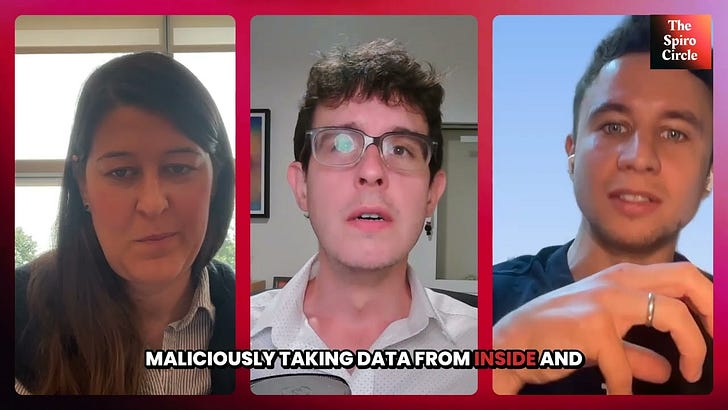
Well, here it is: Episode 100 of The Spiro Circle. When I recorded the first episode 18 months ago, I had a rough idea of what this show could be. I wanted it to be a place where long-form conversations about Israeli tech, geopolitics, or society could get broader attention. Now, with a growing audience across 20 countries and partnerships with international media channels like Forbes, I am proud to see what it is becoming, and that these conversations are getting the attention they deserve. Startup Nation yearned for long-form English conversation, and I am pleased to be helping fill that missing gap. For the 100th, I brought in Nitay Milner, co-founder and CEO of Orion Security, and Emily Fontaine, Global Head of Venture Capital at IBM Ventures, to talk about why every major company should rebuild its data security strategy in this AI era. I find it fitting that our conversation on how a large corporate company saw potential in a scrappy Israeli startup was positioned as the 100th episode. Thanks to all who have joined to share their stories so far, and thank you to all those who keep tuning in.Onwards to 200. - JSThe data loss prevention industry has organized itself around a relatively stable threat model.A disgruntled employee may copy files to a USB drive. Or a phishing attack could expose credentials to an outside attacker. Maybe someone accidentally CCs the wrong person on an email with sensitive information. Solutions focused on perimeter controls or policy rules were imperfect, but understandable when the threats were often caused by humans.But that model is no longer sufficient. According to research by Cyberhaven Labs, whose 2026 AI Adoption and Risk Report analyzed data movements across 222 companies, nearly 40% of all AI interactions now involve sensitive data, with the average employee inputting proprietary information into an AI tool once every three days. Threats don’t disagree insofar as they disaggregate, accelerate, and, in some new cases, remove the human from the equation entirely.Nitay Milner, co-founder and CEO of Orion Security, offered a framework for understanding how the landscape has changed. In a recent episode with Emily Fontaine, Vice President and Global Head of Venture Capital at IBM, which backed ORION’s $32 million Series A in February 2026, he described the three categories of traditional data leakage that the DLP industry was built to address: human error, malicious insider activity, and external attackers. “[Perhaps] I accidentally did ‘Emily@IBC’ and not ‘IBM’,” he said, by way of illustration, “and sent the entire board deck to the wrong person. That happens a lot. I call it keeping honest people honest.” The second category, he noted, involves deliberate exfiltration, what he called the “Snowden” scenario. The third involved external actors penetrating an organization and quietly siphoning data over time.Milner co-founded Orion Security in 2024 with CTO Jonathan Kreiner. It aims to replace traditional DLP (data loss prevention) tools with an automated, context-driven platform. Using LLMs and specialized AI agents, the platform continuously detects and analyzes data loss indicators in real time, capturing context for content sensitivity, data lineage, user identity, behavioral intent, and environmental purpose.New anatomies, new leaks Traditional categories of DLP remain relevant, of course. But Milner identified two new vectors that are reshaping the problem. The first is data extraction into third-party AI: employees uploading sensitive documents like earnings calls, customer records, or source code to unmanaged AI platforms before those materials are cleared for external use. “Taking the earnings call, which is super sensitive data, before the earnings call report was published, and uploading it to like an unmanaged ChatGPT or Claude,” he said. “It’s very, very sensitive, and data is now in the hands of a third party that you don’t have any agreement with.”The second vector is data exfiltration not by humans at all, but by AI agents operating inside the enterprise. “AI agents doing human work inside the organization, having access to super sensitive data,” Milner explained. “Think about an AI agent email assistant that has access to your Google Drive, takes the entire customer list and sends it to the wrong person. That’s data exfiltration by AI.”The scale of this emerging risk is becoming measurable. According to a 2026 Cloud Security Alliance report, 82% of organizations already have AI agents operating in production environments, while only 17% enforce runtime access controls consistently across those deployments. A separate finding from Proofpoint’s 2025 Data Security Landscape report found that 32% of organizations identify unsupervised data access by AI agents as a critical threat.Fontaine framed the underlying problem as one of movement, not just volume. “Data is a huge asset that must be protected, more so than ever before,” she added. “It’s moving across clouds, it’s moving across applications, agents, ecosystems. It’s moving across so much more than it was ever before. And we have to make sure it’s secure, that it is governed correctly.”IBM Ventures, the strategic investment arm of IBM led by Fontaine, operates a $500 million fund focused on AI and quantum technologies — and its bet on Milner and the team reflects IBM’s belief that the arrival of large language models has fundamentally broken the assumptions on which traditional data security was built, creating entirely new leakage paths that legacy DLP tools cannot detect.A new era for DLPThat governance challenge is exactly what today’s DLP industry is no longer built to handle. Policy-based systems depend on known patterns, like a credit card number matching a regex or a file name triggering a rule. They cannot, by design, interpret context or whether a particular data movement constitutes a legitimate business action or an exfiltration event. Milner’s breakdown offers enterprises a useful starting point to identify which of the five categories (legacy or AI-era) represents the highest unaddressed exposure in a given environment, and build from there. “Understand your organization,” he concluded. “Based on this real data, get to decisions, train your employees, and help them understand how to use data safely.”[5-minute preview: Is your AI leaking company secrets? IBM & Orion Security explain] Get full access to The Spiro Circle at www.thespirocircle.com/subscribe

Comments

Download from Google Play

Download from App Store
 United States