


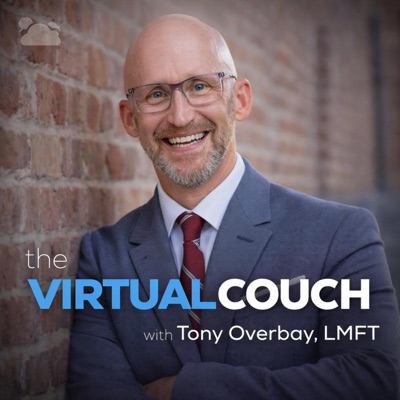
The Virtual Couch
Subscribed: 2,382Played: 79,483
Subscribe


© Copyright 2026 The Virtual Couch
Description
The Virtual Couch is a mental health podcast hosted by Tony Overbay, a licensed marriage and family therapist with more than two decades of experience who works with individuals and couples. Through relatable stories, practical psychology, and evidence-based tools, Tony helps listeners better understand relationships, parenting, addiction, emotional maturity, and personal growth, while also supporting those navigating faith crises and deconstruction from high-demand religions. The podcast offers clear strategies to break unhealthy patterns, improve communication, and build a more grounded sense of self while approaching life’s challenges with insight, clarity, and humor.
492 Episodes
Reverse
Was it narcissistic abuse, or were you the problem? Why does the fog lift after a divorce, and you still can't trust your own judgment?
In this second live therapist Q&A, moderated by Tony's daughter Sydney, almost every question came from someone in the middle of something: a divorce after ten years of marriage, an only child clearing out her late mom's house, a man texting a grieving partner and hearing nothing back, a listener whose therapist of eight years had died. Tony opens with why the brain, a prediction engine that wants certainty now, grabs the nearest story and runs with it. Then he catches himself doing exactly that on air, and leaves it in.
In this episode you'll:
Reframe "am I the narcissist?" into a question that can get you further: what happened to you in the relationship, and who were you becoming inside it
Recognize "making the right mouth sounds," where "You're right, I'm the problem" brings relief for both people, and the effort for change never arrives
Use the four pillars of a connected conversation when every issue you raise gets turned back on you
Notice the pathologically kind pattern of absorbing blame that was never yours to carry
Stay in grief, estrangement, and overthinking without a formula, with a nod to Dr. Joshua Coleman's Rules of Estrangement and a passage from Alex Michaelides' The Fury on the child still waiting inside the adult
Tony Overbay is a licensed marriage and family therapist with more than 20 years of experience helping individuals and couples untangle emotional immaturity, high-conflict dynamics, and the stories the brain tells in the meantime.
If you have a question you didn't get to ask, send it to [email protected] or through tonyoverbay.com, and there's a good chance Tony opens the next live with it. He also mentions scholarship spots for his revamped Magnetic Marriage course for anyone who was on the live.
Please follow Tony on Instagram @virtual.couch on Tiktok @virtualcouch on Facebook https://www.facebook.com/tonyoverbaylmft and on Substack https://thevirtualcouch.substack.com/ You can reach out to Tony through his website tonyoverbay.com or by emailing contact @ tonyoverbay.com
00:00 Welcome and Where to Follow
00:48 Mindfully Sick Storytime
03:25 The Messy Middle Theme
05:48 Brain as Prediction Engine
06:21 Jumping to Conclusions Live
09:03 Emotional Maturity and Safety
11:26 Discomfort and Relationship Dynamics
13:57 Live Q&A Begins
14:37 Divorce and Narcissism Question
19:39 Losing Yourself in Marriage
21:38 Journaling and Memory Doubt
23:47 Grief and Cleaning Out House
30:16 Self-Harm and Finding Help
32:15 Always the Problem Partner
34:16 Four Pillars Conversation Tool
37:11 Threats and Boundaries
39:14 Betrayal and Blame Shifting
41:21 Silent Since July Confusion
44:04 Supporting Grief Withdrawals
45:03 Grief Stages Mythbusting
47:15 Interdependence and Reaching Out
49:41 Boundaries and Respect
50:03 Breaking Things Abuse Cycle
51:18 Overthinking and Rumination
52:30 Accountability Versus Change
54:30 Leaving on Your Timeline
57:04 Estrangement and Parent Ego
01:00:46 Validation and Differentiation
01:07:24 Inner Child and IFS
01:13:47 Therapist Loss and Closure
01:16:10 Final Thanks and Next Live
When someone you love tells you, “Something you did hurt me,” what happens inside of you next? Do you become curious about what it was like to be on the receiving end of you, or does your brain immediately start building the case for why you did what you did, what you meant, what they misunderstood, and what they did first?
That difference may quietly shape almost everything that happens in a relationship.
In what may be one of the most important episodes of The Virtual Couch for anyone who is in a relationship, has been in one, or hopes to be in one someday, Tony explores the difference between self-explanation and self-examination—and why two people can genuinely love each other, both believe they are “working on themselves,” and still have completely different ideas about what that work actually means.
Drawing from more than two decades of couples therapy, Tony looks at what happens when one person is trying to understand while the other person’s nervous system is trying to make discomfort disappear. He explores defensiveness, emotional awareness, overthinking disguised as accountability, internal validation, boundaries, differentiation, people-pleasing, and the uncomfortable reality that sometimes we become so familiar with our story about our partner that we stop being curious about the actual person standing in front of us.
And then the conversation moves into one of the most vulnerable places this dynamic can appear: sex and intimacy. Tony walks through how two well-intentioned people can gradually create patterns of expectation, pressure, duty sex, resentment, withdrawal, and loneliness without either person fully understanding how they got there—and what can happen when both people finally become willing to look at the relationship with new eyes.
This episode isn’t about deciding who is the problem. It’s about learning how to remain yourself in the presence of someone else’s experience. How to hear something you don’t like without immediately defending against it. How to distinguish discomfort from danger. How to stop searching for the perfect explanation that will make everything okay and begin asking a much more useful question:
“What can I learn here?”
Because intimacy requires more than knowing someone’s history. It requires remaining curious enough to keep discovering who they are today.
Catch the moment your brain files its defense brief, usually before the other person has finished their sentence
Tell the difference between self-reflection that finishes and hands you something, and self-reflection that keeps combing the woods for evidence nobody asked you to find
Sit with the honest origin story of duty sex and pity sex in long marriages, and how two people build something painful out of materials neither of them was handed
Walk through the four pillars of a connected conversation, starting with the pre-pillar of separating observation from judgment
Try the week-long assignment: one genuinely curious question before the context, the explanation, or the correction
Twenty years and more than 1,500 couples in, Tony has noticed that the tools get far more useful once somebody can say, "I may not really know what this is that I'm doing."
A heads-up that the middle stretch talks openly about sex, intimacy, and coercion, so you may want to choose your listening company. Notice which person you identify with as you listen — and reach out through the website, and Tony will send you the PDF summary of everything covered here.
Please follow Tony on Instagram @virtual.couch on Tiktok @virtualcouch on Facebook https://www.facebook.com/tonyoverbaylmft and on Substack https://thevirtualcouch.substack.com/ You can reach out to Tony through his website tonyoverbay.com or by emailing contact @ tonyoverbay.com
Anxious-avoidant attachment, emotionally immature in-laws, panic attacks, and what if the unicorn has rabies? Tony tackles his first live Q&A in a year, where you’ll hear answers to these questions and many more.
Recorded live with daughter Sydney moderating, Tony takes real questions from real listeners: what happens when you spot narcissistic traits in your spouse's parent before they do, how to stop reacting and start building the pause, and the complete origin story of the anxious-avoidant loop — the pattern he sees in almost every couple who walks into his office. If you keep pursuing while your partner withdraws, this episode names what's actually happening between those two nervous systems.
EPISODE HIGHLIGHTS:
Understand why handing your spouse the word "narcissist" for their own parent asks them to reinterpret an entire childhood — and what tends to work instead.
Move through the four stages of awakening, from "you don't know what you don't know" to unconscious competence.
Separate observation from judgment ("she hasn't texted back" vs. "she doesn't care about me") using the pre-pillar of Tony's four pillars of a connected conversation.
Meet Jack and Jill: how anxious and avoidant partners find each other, fall into the pursue-withdraw dynamic, and begin to break the loop.
Work with your biology during a panic attack — extended exhales, co-regulation, and why being told to "calm down" triggers psychological reactance.
Tony Overbay is a licensed marriage and family therapist who has spent more than 20 years — and 15 to 20 couples a week — watching these patterns play out in real time.
Want the free Anxious-Avoidant Loop PDF handout Tony reads from in this episode? Email [email protected] and he'll send it your way, along with his related episode list.
Please follow Tony on Instagram @virtual.couch on TikTok @virtualcouch on Facebook https://www.facebook.com/tonyoverbaylmft and on Substack https://thevirtualcouch.substack.com/ You can reach out to Tony through his website tonyoverbay.com or by emailing contact @ tonyoverbay.com
Emotional maturity takes the long way home, and Homer's Odyssey has been quietly saying so for 2,800 years.
Underneath Christopher Nolan's new adaptation sits a poem that Tony thinks is one of the best pieces of therapy literature ever written, and almost nobody reads it that way. The monsters aren't the point — they're the muse. Every obstacle Odysseus meets is asking whether he's willing to become somebody different, and if you've been away too long from your sense of self, from the marriage you thought you'd have, from the body you used to trust, from the faith that used to hand you certainty, or from the person you were sure you'd be by now, this one tends to land.
In this episode:
Meet the Lotus Eaters as experiential avoidance — coping that doesn't start as self-sabotage, it starts because it works, and then it quietly moves the destination
Borrow a rule from Tony's ultra-running days, beware of the chair, and notice how many races end beside a space heater rather than on a cliff
Tie yourself to the mast with a Ulysses contract, the decision your calm Tuesday afternoon self makes on behalf of your 11 p.m. Friday night self
Watch the Cyclops moment show up in a marriage, when "See, I told you so" reaches back and drags a conflict you'd already escaped into your future
Sit with David Schnarch's differentiation, and the difference between other-validated and self-validated intimacy
Tony Overbay is a licensed marriage and family therapist who has spent over twenty years watching people discover they didn't know what they didn't know.
This is part one — part two takes on Schnarch's four points of balance. If the poem stirred something up for you, send it Tony's way and it may end up in the next episode.
Please follow Tony on Instagram @virtual.couch on Tiktok @virtualcouch on Facebook https://www.facebook.com/tonyoverbaylmft and on Substack https://thevirtualcouch.substack.com/ You can reach out to Tony through his website tonyoverbay.com or by emailing contact @ tonyoverbay.com

Content warning: This episode includes discussion of homicide, dismemberment, and domestic violence. Listener discretion advised.
Robert Durst confessed on a hot mic — but the real story is watching a man confabulate in real time, for decades, and nearly get away with it.
In the first-ever Murder on the Couch guest episode, Tony is joined by his friend Kate, a civil attorney and lifelong true crime devotee, to break down the case behind HBO's The Jinx. Kate presents the case — the 1982 disappearance of Kathie Durst, the murder of Susan Berman, the Morris Black acquittal that still defies belief — while Tony reacts in real time with the psychology underneath it all: confabulation, childhood adaptations, and what actually happens when someone is finally confronted with a lie they can't tap-dance out of.
In this episode, you'll discover:
Why memory is "adorable and fallible" — and how the legal system's hierarchy of evidence accounts for exactly that
How Durst's defense team built reasonable doubt around an admitted dismemberment (and why the missing evidence mattered more than the conceded facts)
The difference between psychopathy and sociopathy — nature vs. nurture, charm vs. rage, and why nonviolent sociopaths walk among us
What a masterful cross-examination and an eight-hour couples intensive have in common: staying with someone's discomfort until the adaptation collapses
Why breakthroughs so often have a "shelf life" — and what it takes for real change to stick
Tony Overbay is a licensed marriage and family therapist who has spent decades watching people confabulate, deflect, and defend in real time — just usually not on the witness stand.
If you've ever watched someone rewrite reality right in front of you and wondered how they believe their own story, this episode is for you.
Please follow Tony on Instagram @virtual.couch on Tiktok @virtualcouch on Facebook https://www.facebook.com/tonyoverbaylmft and on Substack https://thevirtualcouch.substack.com/ You can reach out to Tony through his website tonyoverbay.com or by emailing contact @ tonyoverbay.com
Content warning: This episode includes discussion of homicide, dismemberment, and domestic violence. Listener discretion advised.
Robert Durst confessed on a hot mic — but the real story is watching a man confabulate in real time, for decades, and nearly get away with it.
In the first-ever Murder on the Couch guest episode, Tony is joined by his friend Kate, a civil attorney and lifelong true crime devotee, to break down the case behind HBO's The Jinx. Kate presents the case — the 1982 disappearance of Kathie Durst, the murder of Susan Berman, the Morris Black acquittal that still defies belief — while Tony reacts in real time with the psychology underneath it all: confabulation, childhood adaptations, and what actually happens when someone is finally confronted with a lie they can't tap-dance out of.
In this episode, you'll discover:
Why memory is "adorable and fallible" — and how the legal system's hierarchy of evidence accounts for exactly that
How Durst's defense team built reasonable doubt around an admitted dismemberment (and why the missing evidence mattered more than the conceded facts)
The difference between psychopathy and sociopathy — nature vs. nurture, charm vs. rage, and why nonviolent sociopaths walk among us
What a masterful cross-examination and an eight-hour couples intensive have in common: staying with someone's discomfort until the adaptation collapses
Why breakthroughs so often have a "shelf life" — and what it takes for real change to stick
Tony Overbay is a licensed marriage and family therapist who has spent decades watching people confabulate, deflect, and defend in real time — just usually not on the witness stand.
If you've ever watched someone rewrite reality right in front of you and wondered how they believe their own story, this episode is for you.
Please follow Tony on Instagram @virtual.couch on Tiktok @virtualcouch on Facebook https://www.facebook.com/tonyoverbaylmft and on Substack https://thevirtualcouch.substack.com/ You can reach out to Tony through his website tonyoverbay.com or by emailing contact @ tonyoverbay.com

Comments

Download from Google Play

Download from App Store
 United States