


 Claim Ownership
This Time Tomorrow
Subscribed: 2Played: 18
Subscribe

© This Time Tomorrow Podcast
Description
This Time Tomorrow is a podcast that takes on the global rise of autocracy. We bring you insightful interviews with thought-leaders from civil society, we explain complex events from a variety of perspectives, and we also try to make you feel… well, a little less alone in the fight against anti-democrats. It’s not just in your head—our democracies and our freedoms are at stake—and we’re here to keep you company as well as updated.
Hosted by Omri Preiss, Benjamin Zeeb and Daniela Vancic. Produced by Ted Verver-Greijer.
thistimetomorrowpod.substack.com
Hosted by Omri Preiss, Benjamin Zeeb and Daniela Vancic. Produced by Ted Verver-Greijer.
thistimetomorrowpod.substack.com
82 Episodes
Reverse
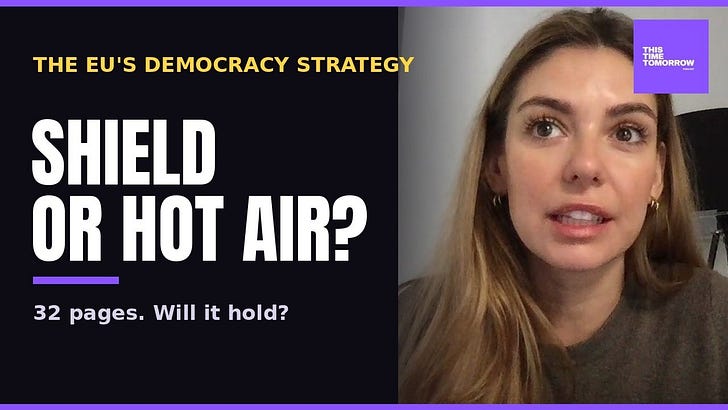
Omri and Daniela take apart the European Commission’s flagship democracy strategy.The Democracy Shield is a 30-page communication, which is Brussels for a long document setting out what the Commission intends to do. Omri calls it an IKEA catalogue of things the EU has done, is doing, or would like to do better: enforcing the Digital Services Act against the platforms, enforcing the AI Act, a new Centre for Democratic Resilience, media literacy, citizen participation. The question running underneath the whole episode is whether any of it gets the funding and the enforcement to happen, or whether it stays on paper.The Centre for Democratic Resilience is the big new piece. The idea is something like an intelligence clearing house. Alerts come in, agreed protocols decide what happens to them, and they go out to the people who can actually act, the sanctions process, the regulators, national agencies, rather than landing in an inbox as a newsletter item nobody does anything with.Then there is the hole in it. The system depends on member states raising the alarm about interference in their own countries. Daniela’s point is that the governments most exposed to Kremlin-aligned operations are the ones least likely to report them.The last third is the citizen participation pillar, which Daniela argues is the weakest of the three. The European Citizens’ Panel on Democratic Resilience puts 150 randomly selected people from all 27 member states in a room together, and it hands its recommendations to the Commission at its closing session in Brussels from 20 to 22 November.Chapters00:00 Intro01:53 What the Democracy Shield actually is04:28 The IKEA catalogue: DSA, AI Act, resilience centre08:59 Where it stands, and what Parliament wants11:02 Romania, Sweden and an ongoing attack14:34 The Centre for Democratic Resilience20:40 Who raises the flag when the government is the problem25:34 The third pillar, and the weakest26:23 Inside the citizens’ panel29:16 Democracy offence, not just defence31:19 An on-demand society with a 19th century democracy35:37 What lands in November41:29 Why people are right to be angry43:23 What you can actually doRecorded on 2 October 2026, between the panel’s first and second sessions. This is a public episode. If you would like to discuss this with other subscribers or get access to bonus episodes, visit thistimetomorrowpod.substack.com

Three elections in three weeks and three very different lessons. Omri, Benni and Daniela go through Brazil, Serbia and Israel and ask what actually worked.In Brazil, Lula went into the runoff behind and written off, then won it on the back of a digital campaign that grew a WhatsApp channel from 60,000 to 11 million subscribers in a month. Fan clubs, influencers and a lot of people donating their platform to the cause.In Serbia, the students’ list took an absolute majority, 140 of 250 seats, against two years of state capture, a captured broadcaster and a sound cannon. Daniela was there as an election observer. The part that is not getting enough attention is how they built the list, through student plenums and local citizens’ assemblies out in the villages.In Israel, Netanyahu lost his majority and then pulled every lever at once. A phone call with the chief of police the night before the vote. Arab party activists arrested on election morning. A security chief who called the election perfect, then announced a foreign funding plot and asked for the result to be cancelled. Pressure on the army to bomb Iran. Omri flew in to vote and out again the same afternoon.Too big to rig has been the theme of the year. Israel was small enough.Chapters00:00 Intro02:40 Brazil: how Lula came back07:14 The WhatsApp masterclass, 60,000 to 11 million17:56 Serbia: from the streets to the ballot sheets25:01 Can you still win on Meta’s platforms?28:55 What happens next in Serbia33:29 Student plenums and village assemblies36:41 Israel: into the dark swamp42:05 Netanyahu’s 24 hours52:43 Why Israel was small enough to rig56:46 Autocrats’ days are numbered61:05 Wrap This is a public episode. If you would like to discuss this with other subscribers or get access to bonus episodes, visit thistimetomorrowpod.substack.com
Fresh off the midterms, we zoom out with historian Sergey Radchenko. Did Trump’s drubbing change anything for Putin? Does Putin even believe Europe exists? And why does Sergey say Russia is a disease of the skin while China is a disease of the heart?Sergey argues the Russians missed the boat: their best window for a settlement on their terms was a Trump desperate for a win before the midterms. That window is gone, and Europe and Ukraine have agency that Moscow keeps discounting. We get into Putin’s real war aims (nobody knows except Putin), what the Soviet collapse and Afghanistan do and don’t teach us, Orban and Vucic losing, the AfD as Putin’s last hope in Europe, and what Europe has done right and wrong since 2022.After the break: China. Deindustrialisation, the terms and conditions of the Belt and Road, the Tajik parliament with Chinese characters on the front, whether Xi’s system is stable, demographics, climate, and why Sergey is still moderately optimistic.Sergey Radchenko is a professor at the Johns Hopkins School of Advanced International Studies and the author of To Run the World: The Kremlin’s Cold War Bid for Global Power. He joined us from Bologna.Hosts: Benjamin Zeeb, Omri Preiss and Daniela Vancic.Chapters00:11 Intro02:13 Did the midterms change anything for Putin?06:07 What does Putin actually want?12:03 Putin’s friends are losing elections17:56 Lessons from Soviet retreats, and what Europe can do26:32 Middle powers, democracies and autocracies34:17 China: a disease of the heart42:30 When does investment become influence?46:21 Is there a benign end state for China?53:48 Demographics and decline57:31 What should democracies do? This is a public episode. If you would like to discuss this with other subscribers or get access to bonus episodes, visit thistimetomorrowpod.substack.com
All three of us, the afternoon after the US midterms, on very little sleep. Daniela stayed up till 8am for Michigan and calls it a bloodbath: a Trump endorsement is now the kiss of death, Texas has a Democratic governor and senator, Kansas and South Carolina went blue, Mississippi is still being counted. Benny says the bank robbery has turned into a hostage situation, and the next two years are about one man trying not to go to prison. Omri worries Europe will do what it always does and crawl back into hibernation. Also: what the Democrats got right on message, why ICE lost Trump the Latino vote, whether Europe should shut up or say its piece, the coup question, and why “too big to rig” is the lesson for everyone.Listen, like, subscribe, follow! Share with your friends! And if you are not a member of a political party yet, go and join one. This is a public episode. If you would like to discuss this with other subscribers or get access to bonus episodes, visit thistimetomorrowpod.substack.com
Benny’s off dealing with children and Daniela is on some kind of democratic safari in Botswana, so Omri flies solo with a very special guest: Alberto Alemanno, professor at HEC Paris, founder of The Good Lobby, co-founder of Alliance4Europe and one of the sharpest commentators on EU affairs around. Where does Europe’s politics stand, which dependencies leave the continent exposed, what does the EU keep getting wrong when it regulates, can growth and sustainability be reconciled, and how do you actually mobilise European citizens and leaders before it is too late?Listen, like, subscribe, follow! Share with your friends! This is a public episode. If you would like to discuss this with other subscribers or get access to bonus episodes, visit thistimetomorrowpod.substack.com

Comments

Download from Google Play

Download from App Store
 United States