


 Claim Ownership
Thoughtlines
Subscribed: 21Played: 95
Subscribe

© All rights reserved
Description
Thoughtlines brings you the best academic thinking outside the box from CRASSH at the University of Cambridge. The podcast is presented by Catherine Galloway and produced by Carl Homer at Cambridge TV.
A well as Thoughtlines episodes you can enjoy podcast episodes produced by some or our Research Networks and Research Labs.
The Centre for Research in the Arts, Social Sciences and Humanities (CRASSH) is an interdisciplinary research centre at the University of Cambridge.
Founded in 2001, CRASSH came into being as a way to create interdisciplinary dialogue across the University’s many faculties and departments in the arts, social sciences and humanities, as well as to build bridges with scientific subjects. It has now grown into one of the largest humanities institutes in the world and is a major presence in academic life in the UK. It serves at once to draw together disciplinary perspectives in Cambridge and to disseminate new ideas to audiences across Europe and beyond.
A well as Thoughtlines episodes you can enjoy podcast episodes produced by some or our Research Networks and Research Labs.
The Centre for Research in the Arts, Social Sciences and Humanities (CRASSH) is an interdisciplinary research centre at the University of Cambridge.
Founded in 2001, CRASSH came into being as a way to create interdisciplinary dialogue across the University’s many faculties and departments in the arts, social sciences and humanities, as well as to build bridges with scientific subjects. It has now grown into one of the largest humanities institutes in the world and is a major presence in academic life in the UK. It serves at once to draw together disciplinary perspectives in Cambridge and to disseminate new ideas to audiences across Europe and beyond.
26 Episodes
Reverse

Akeelah Bertram: soul technologies and prophetic dreams
The second episode of LEAP Lab’s 'Un/knowing' podcast was recorded last October at the end of guest Akeelah Bertram’s tenure as the Cavendish Art Science Fellow 2024-25. We had a meandering conversation walking around Girton College, touching on consciousness, water, dreams, and visions… continuing our earlier discussions on the Cambridge Physics department podcast (Ep 38 — link below) into the realm of the unknown and unexplained.
Akeelah is an interdisciplinary artist whose practice sits at the intersection of immersive installation, sound, technology, and spiritual inquiry. Through works like the forthcoming 1000 MOONS, she creates experiences that investigate what she terms as ‘Sacred Architecture’—spaces shaped by emotional and spiritual resonance rather than physical structure alone.
Central to her practice is Sonic Ceremony, a methodology drawing from congregational vocal traditions that explores how collective sound-making creates containers for witness, transformation, and communal knowing.
During her time as the Cavendish Art Science Fellow, Akeelah’s research examined the relationship between digital technologies and ancestral practices of gathering, resonance, and the technologies of the soul—inquiries that continue to inform her writing and installations.
Her reflections on these themes can be found at Just a Feeling on Substack, where she explores Sacred Architecture and ways of knowing that resist easy categorisation.
Akeelah's links:
• Substack: Just a Feeling - https://open.substack.com/pub/akeelahbertram
• YouTube: https://youtube.com/@studioakeelahbertram
• Website: www.akeelahbertram.com
People Doing Physics podcast, Ep 38 “Creativity in science: a conversation with Akeelah Bertram and Kevin Lim”: https://people-doing-physics.captivate.fm/episode/creativity-in-science-a-conversation-with-akeelah-bertram-and-kevin-lim
Cavendish Arts Science Fellowship: https://www.cavendish-artscience.org.uk/
CRASSH (Centre for Research in the Arts, Social Sciences and Humanities): https://www.crassh.cam.ac.uk/about/
LEAP (Living Experiments in Arts-Science Practice to Re-imagine Sustainability) Lab: https://www.crassh.cam.ac.uk/research/research-labs/leap-lab/
Podcast produced, hosted, recorded, and edited by Kevin Lim (@KevinTPLim): https://kevintplim.com
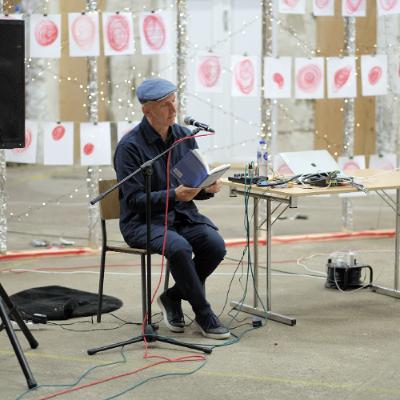
In this final episode of the podcast we present 'Unscripted: Notes Toward Freedom in Music' a selection of short reflections by Brandon LaBelle. This episode isn’t an interview, and it isn’t a lecture. It’s a free-flow response to everything we’ve been thinking and feeling together in this series. Think of it as a spoken score: fragments of theory, memory, and rhythm gathered into one last listening space. Let it wash over you. Take what you need; leave what you don’t.
If you enjoyed this episode, please subscribe and share Sounding Freedom and Liberation with your community.
Biography
Brandon LaBelle is an artist, writer, theorist, and artistic director of The Listening Biennial and Listening Academy. His work focuses on questions of agency, community, pirate culture, and poetics, which results in a range of artistic presentations and extra-institutional initiatives, including Communities in Movement (2019-23), Oficina de Autonomia (2017-), The Living School (with South London Gallery, 2014-16), The Imaginary Republic (2014-19), Dirty Ear Forum (2013-22), Surface Tension (2003-2008), and Beyond Music Sound Festival (1998-2002). In 1995 he founded Errant Bodies Press, an independent publishing project supporting work in sound art and studies, performance and poetics, artistic research and contemporary political thought. His publications include Poetics of Listening (2025), Dreamtime X (2022), Acoustic Justice (2021), The Other Citizen (2020), Sonic Agency (2018), Lexicon of the Mouth (2014), Diary of an Imaginary Egyptian (2012), Acoustic Territories (2010), and Background Noise (2006).
Podcast hosts
Dr Férdia Stone-Davis: www.ferdiastonedavis.com
Dr Charissa Granger: https://sta.uwi.edu/fhe/dlcc/dr-charissa-granger
Podcast acknowledgements
The Sounding Freedom and Liberation music was composed by Samuel J. Wilson. Website: https://www.samueljwilson.com/profile
The Sounding Freedom and Liberation logo was designed by Pavlína Kašparová. Website: https://www.creativenun.com/bio
The Podcast was recorded at the Media Lab, the West Hub, Cambridge, and was edited by Mike Chivers
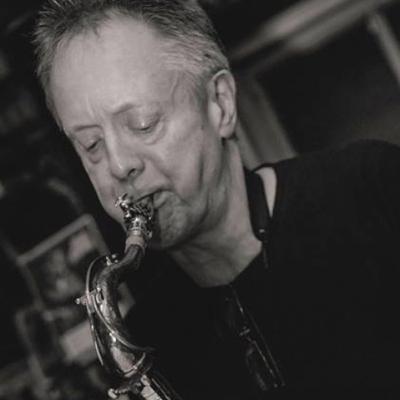
In this episode we speak to Professor Andrew Bowie, who discusses his work at the intersection of philosophy and music, suggesting that both practices “make sense” of things, and that aesthetic experience opens up new ways of relating that extend beyond the simply cognitive. It is within this context that ideas of freedom arise. While resisting a definition of freedom, Andrew is clear that music is not just a metaphor for freedom but is itself a liberatory practice, responding to constraints and working to transcend these.
If you enjoyed this episode, please subscribe and share Sounding Freedom and Liberation with your community.
Biography
Andrew Bowie is Professor Emeritus of Philosophy and German, Royal Holloway, University of London, and a jazz saxophonist. He has written extensively about the relationship between music and philosophy, showing how they are entangled with each other historically, and how each illuminates the other. Works in this area include Music, Philosophy, and Modernity (Cambridge University Press, 2007), Aesthetic Dimensions of Modern Philosophy (Oxford University Press, 2022), alongside numerous articles and chapters, as well as two introductions to German philosophy.
Links to accompany the episode
This is from the same tour as when I heard alto saxophonist Johnny Hodges live with the Ellington band, which sparked a lifelong obsession with the expressive possibilities of saxophone tone. https://youtu.be/ASdihZyUIy0?si=aoEzyEJ4JO5vPH6D
The coda to Bruckner’s 8th Symphony, which I never tire of, since hearing it live with Herbert von Karajan and the Berlin Philharmonic in 1976. This excerpted version of the coda gets a clarity many recordings lack. However one thinks about it, this seems to me to show what is meant by musical transcendence. https://youtu.be/uXS-LvrJgdU?si=xmzRgyTYYqLXIThG
This is my favourite example of how Louis Armstrong really invented jazz: there is nothing like this in music before Louis started playing in this way. The rather staid accompaniment only serves to highlight how startling his playing was. https://youtu.be/KF7-xh8Ai1c?si=WHZ2_dEamZS_NuZR
Beethoven’s Missa Solemnis in an outstanding live performance. It’s works like this that make me resist trying to reduce the great tradition of Western music to issues like colonialism. https://youtu.be/pKPVAyDaFY4?si=vc7eOivnVC9LCV3s
This not very well recorded version of Thelonious Monk’s Round Midnight by Charlie Parker, with a completely exceptional piano solo by Bud Powell, was on about the 3rdjazz LP I ever bought, aged 16 in 1968. https://youtu.be/ECLoE-bw3Kw?si=RzMce_K9XMbul9JP
Beethoven’s Grosse Fuge. Like the Missa Solemnis, this resists reduction to any of the ways it might be thought about. He said of it that it was ‘“tantôt libre, tantôt recherchée”: the freedom it embodies is expressed so powerfully because it is manifest in relation to music governed by many complex rules. https://youtu.be/EqGKHDjMTiM?si=
The conclusion of Mahler’s 2nd Symphony in a remarkable performance under Klaus Tennstedt. At a time when the world is descending into chaos such music offers a form of temporary liberation whose value cannot be underestimated. https://youtu.be/cUccRm0SYaY?si=jVSnbU1Y2KLAB60s
Andrew recommends …
“The best books to show why so much modern philosophy fails to make real sense of the world”: https://shepherd.com/best-books/why-so-much-modern-philosophy-fails-to-make-real-s
Podcast hosts
Dr Férdia Stone-Davis: www.ferdiastonedavis.com
Dr Charissa Granger: https://sta.uwi.edu/fhe/dlcc/dr-charissa-granger
Podcast acknowledgements
The Sounding Freedom and Liberation music was composed by Samuel J. Wilson. Website: https://www.samueljwilson.com/profile
The Sounding Freedom and Liberation logo was designed by Pavlína Kašparová. Website: https://www.creativenun.com/bio
The Podcast was recorded at the Media Lab, the West Hub, Cambridge, and was edited by Mike Chivers
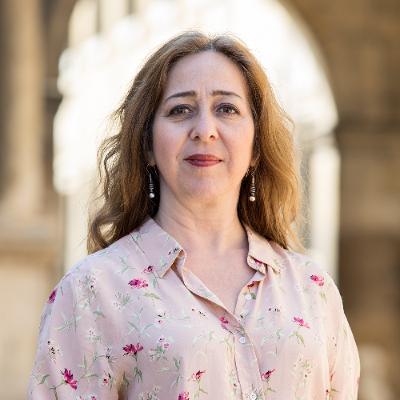
In this episode of Sounding Freedom and Liberation join us for a conversation with Dr Vanessa Paloma Elbaz as we hear about her work in the Sephardi music tradition of the mediterranean diaspora. With a particular focus on women, and women’s role in mediating and subverting traditions, we hear how pockets of freedom are created amidst unfreedom as songs are modified and used to resist constrictions of gender and tradition. Hear also about the complexities of archiving within this space, but also of its significance as it foregrounds voices that are considered unimportant, creating ruptures in larger narratives, and unravelling hierarchies of knowledge.
Biography
Dr Vanessa Paloma Elbaz is a Senior Research Associate at Peterhouse, the University of Cambridge, and Research Associate on the ERC-funded project Ottoman Auralities and the Eastern Mediterranean: Sound, Media & Power, 1789-1922. In 2012, she founded KHOYA: Jewish Morocco Sound Archive to collect, digitize, classify, and analyse contemporary and historical sound recordings of Moroccan Jews. She has more than twenty academic books, chapters, and journal articles on Jewish music in Morocco, Spain, and the Mediterranean.
Links to accompany the episode
El PAIPERO (Fray Pedro) https://www.youtube.com/watch?v=hInE3lxruxE
En Kelohenou https://www.youtube.com/watch?v=TA7jxGdTOX0
Khoya https://yalalla.org.uk/
Ottoman Auralities https://ottomanauralities.com
Vanessa’s writing
Jewish music in northern Morocco and the building of sonic identity boundaries. The Journal of North African Studies, 2021 27(5), 1027–1059. https://www.tandfonline.com/doi/full/10.1080/13629387.2021.1884855
Imagining a sonic Al-Andalus through sound, bones, and blood: the case of Jewish music in Morocco and Spain. Jewish Culture and History, 2021 22(4), 336–357. https://www.tandfonline.com/doi/full/10.1080/1462169X.2021.1993541?src=recsys#abstract
Sephardi Orature and the Myth of Judeo-Spanish Hispanidad, in Oral Literary Worlds: Location, Transmission and Circulation, edited Sara Marzagora and Francesca Orsini, pp. 233–260. Open Book Publishers, 2025. https://www.openbookpublishers.com/books/10.11647/obp.0405/chapters/10.11647/obp.0405.08
Vanessa recommends … Gherasim Luca Lettrism/kabbalah https://www.youtube.com/watch?v=16ltchO5Vpw
Victoria Hanna alef beth/Kabbalah https://www.youtube.com/watch?v=Bl1epz3tSSA
Temsamani orchestra https://www.youtube.com/watch?v=d32FrfReF6M
Bellida Bellida Lala Tamar https://www.youtube.com/watch?v=lrRBccAR1nU&list=RDlrRBccAR1nU&start_radio=1
Podcast hosts
Dr Férdia Stone-Davis: www.ferdiastonedavis.com
Dr Charissa Granger: https://sta.uwi.edu/fhe/dlcc/dr-charissa-granger
Podcast acknowledgements
The Sounding Freedom and Liberation music was composed by Samuel J. Wilson. Website: https://www.samueljwilson.com/profile
The Sounding Freedom and Liberation logo was designed by Pavlína Kašparová. Website: https://www.creativenun.com/bio
The Podcast was recorded at the Media Lab, the West Hub, Cambridge, and was edited by Mike Chivers
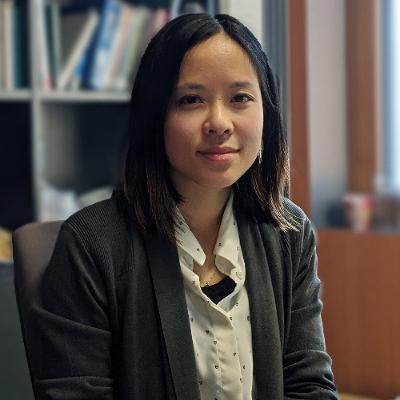
In this episode of Sounding Freedom and Liberation we speak to Dr Beryl Pong and learn about her work, which spans from the inter-war period between the first and second world wars to contemporary warfare and the use of drones. Discover how music and sound are involved in world-making, how atmosphere politics influences the ability to think, act, and be, how everyday soundscapes are transformed by sirens and drones, and how individual and collective freedom is dynamically negotiated under such constraints.
If you enjoyed this episode, please subscribe and share Sounding Freedom and Liberation with your community.
Biography
Dr Beryl Pong is an academic and researcher with interdisciplinary interests in modern and contemporary war; aesthetics; philosophies of space and time; and literary, sound, and visual cultures. She is a UKRI Future Leaders Fellow hosted by the Centre for the Future of Intelligence and the Institute for Technology and Humanity at the University of Cambridge, where she leads the Centre for Drones and Culture.
Beryl’s writing
“‘The Zoom of a Hornet’: Virginia Woolf, Aural Biopolitics, and the Phenomenology of an Air Raid”, in Modern Fiction, Disability, and the Hearing Sciences, 95–113, ed. Edward Allen. London: Routledge, 2024.
Links to accompany the episode
The Blue Skies exhibition at the Imperial War Museum: https://www.iwm.org.uk/events/beware-blue-skies-the-psychology-of-drone-warfare
A longer write-up for Beware Blue Skies: https://www.centrefordronesandculture.com/beware-blue-skies
Beryl recommends …
“Living Under Drones: Death, Injury, and Trauma to Civilians from US Drone Practices in Pakistan”. International Human Rights and Conflict Resolution Clinic at Stanford Law School and Global Justice Clinic at NYU School of Law. 2012: https://law.stanford.edu/wp-content/uploads/2015/07/Stanford-NYU-LIVING-UNDER-DRONES.pdf
Rancière, Jacques. The Politics of Aesthetics: The Distribution of the Sensible. London and New York: Continuum, 2004.
Podcast hosts
Dr Férdia Stone-Davis: www.ferdiastonedavis.com
Dr Charissa Granger: https://sta.uwi.edu/fhe/dlcc/dr-charissa-granger
Podcast acknowledgements
The Sounding Freedom and Liberation music was composed by Samuel J. Wilson. Website: https://www.samueljwilson.com/profile
The Sounding Freedom and Liberation logo was designed by Pavlína Kašparová. Website: https://www.creativenun.com/bio
The Podcast was recorded at the Media Lab, the West Hub, Cambridge, and was edited by Mike Chivers
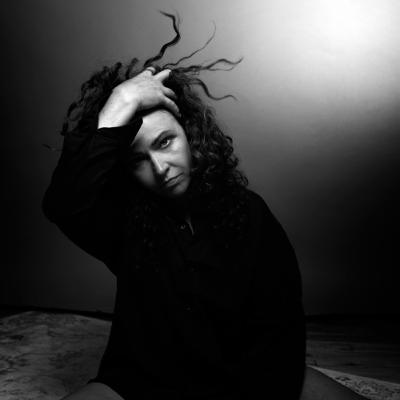
Join us for a conversation with Dr Polly Paulusma to hear how her experience as a singer led her to uncover Angela Carter’s deep love of and connection with folk song, one that infuses Carter’s writing. Discover also how this influences Polly’s own creative practice, which moves freely between word and song, and embodies Carter’s “magpie” approach. Listen as Polly tells us how folk song engages with freedom, allowing individuals to take on the personas and experiences of others by adapting stories and lyrics, making them their own, and offering ways of imagining different ways of being and acting.
If you enjoyed this episode, please subscribe and share Sounding Freedom and Liberation with your community.
Biography
Polly is both a musician and a scholar. She has been a signed recording artist since 2003. Her albums have achieved international critical acclaim and she has toured the USA, the UK and Europe supporting Bob Dylan, Jamie Cullum, Coldplay and Marianne Faithfull. She continues to record and release records with One Little Independent. Her latest album is called Wildfires. Alongside her music, Polly completed a doctorate at the University of East Anglia and her book, Angela Carter and Folk Music: ‘Invisible Music’, Prose and the Art of Canorography, was published in 2023 by Bloomsbury. Between writing, recording and touring Paulusma teaches songwriting and poetry for Cambridge University and songwriting for the Institute of Contemporary Music Performance, where she is Associate Professor of Song and Literature. She is a Bye-Fellow of Murray Edwards College.
Links to accompany the episode
Polly’s music
Invisible Music (an album which includes music that inspired Angela Carter): https://pollypaulusma.lnk.to/invisiblemusic
Wildfires https://pollypaulusma.lnk.to/wildfires
Polly’s writing
Angela Carter and Folk Music https://www.bloomsbury.com/uk/angela-carter-and-folk-music-9781350296299/
Polly recommends …
Emily Portman, Hatchling https://emilyportman.bandcamp.com/album/hatchling
Emily Portman, The Glamoury https://emilyportman.bandcamp.com/album/the-glamoury
Eliza Delf, Into the Wilderness https://elizadelf.com/track/3051798/into-the-wilderness
Get Angela Carter community http://getangelacarter.co.uk/
Podcast hosts
Dr Férdia Stone-Davis: www.ferdiastonedavis.com
Dr Charissa Granger: https://sta.uwi.edu/fhe/dlcc/dr-charissa-granger
Podcast acknowledgements
The Sounding Freedom and Liberation music was composed by Samuel J. Wilson. Website: https://www.samueljwilson.com/profile
The Sounding Freedom and Liberation logo was designed by Pavlína Kašparová. Website: https://www.creativenun.com/bio
The Podcast was recorded at the Media Lab, the West Hub, Cambridge, and was edited by Mike Chivers
In this episode of Sounding Freedom and Liberation we speak to Dr Berta Joncus and learn about Berta’s own personal experience of freedom and liberation through discovery of her own voice as a performer, and how this led to her research career. Berta tells us about eighteenth-century performer-celebrity Kitty Clive, who worked against cultural constraints to exercise musical and social freedom, and recovered her career by turning the “trash-talk” used against her to her own benefit. Learn also about the unknown repertoire of abolition song, a form of activism circulating in polite society of the eighteenth century—particularly among women—that appropriated the narratives of enslaved people and set them musically so as to engage sympathy and ultimately work towards the end of the slave trade.
If you enjoyed this episode, please subscribe and share Sounding Freedom and Liberation with your community.
Biography
Dr Berta Joncus is a musicologist, and Research Project Lead at the Guildhall School of Music and Drama in London. Her research focuses in large part on Early Music repertories, including 18-century European opera and vocal music. Berta is an impassioned advocate for lost and marginalised voices, and most recently has been awarded a 24-month Arts and Humanities Research Council Curiosity Grant to lead an interdisciplinary network looking at abolition song and its legacies in Britain between 1787 and 1830. The network works in partnership with the Guildhall School of Music and Drama, the British Library, and the Handel Hendrix House.
Berta’s writing
Kitty Clive, or The Fair Songster, Berta Joncus (Suffolk: Boydell & Brewer 2019): https://boydellandbrewer.com/book/kitty-clive-or-the-fair-songster-9781783273461/
Links to accompany the episode
Abolition Song and its Legacies (ASail): https://www.gsmd.ac.uk/abolition-songs-and-its-legacies-asail
Project concerts at Handel Hendrix House, London
Concert 1, 9th January 2025: Video: https://www.youtube.com/watch?v=UDKCLSZZPYE
Full programme: https://pure.gsmd.ac.uk/ws/portalfiles/portal/51740035/9.1.25_concert_prog_corrected.pdf
Concert 2, 19th May 2025: Video: https://www.youtube.com/watch?v=r9y0T3uTL3E
Full programme: https://pure.gsmd.ac.uk/ws/portalfiles/portal/52014526/19.5.2025_ASaiL_Programme.pdf
Concert 3, 8th September 2025: https://youtu.be/9-rqoYJOyhA
Full Programme: https://pure.gsmd.ac.uk/ws/portalfiles/portal/52014527/ASaiL_8_Sept_2025_Prog.pdf
Podcast hosts
Dr Férdia Stone-Davis: www.ferdiastonedavis.com
Dr Charissa Granger: https://sta.uwi.edu/fhe/dlcc/dr-charissa-granger
Podcast acknowledgements
The Sounding Freedom and Liberation music was composed by Samuel J. Wilson. Website: https://www.samueljwilson.com/profile
The Sounding Freedom and Liberation logo was designed by Pavlína Kašparová. Website: https://www.creativenun.com/bio
The Podcast was recorded at the Media Lab, the West Hub, Cambridge, and was edited by Mike Chivers
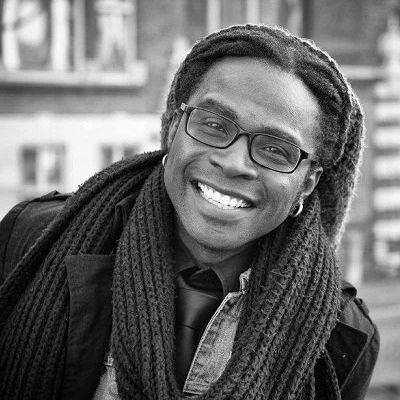
Join us for a conversation with Professor Francio Guadeloupe as he elaborates freedom as a practice that places us in relation to different spheres, including the political and religious, and to all forms of life (not just “those who human”).
Drawing on the radical relationality of the Rastafari notion of the “I-and-I”, and reflecting in particular on music in the Caribbean, Francio draws out how music enables a relational and participatory aesthetic that creates moments of freedom and denaturalises categories of race, identity and gender.
If you enjoyed this episode, please subscribe and share Sounding Freedom and Liberation with your community.
Biography
Francio Guadeloupe is Professor by special appointment of Public Anthropology of Kingdom Relations at the Faculty of Social and Behavioural Sciences. His research focus is on the Dutch Caribbean and the Netherlands Antilles, and in particular he is concerned with themes including identity, post-colonialism and social dynamics within kingdom relations. Guadeloupe ’s principal areas of research have been on the manner in which popular understandings of national belonging, cultural diversity, religious identity, and mass media constructions of truth, continue to be impacted by colonial racisms and global capital.
Links to accompany the episode
Music
Bunny Wailer (and the Rastafari notion of the I-and-I)
Armagideon: https://www.youtube.com/watch?v=6qWRdMr3Oos
Respeck Band – Freedom: https://www.youtube.com/watch?v=7A7cSGhjoz8
On the idea of mi hendenan in the Dutch Caribbean:
Rincon Boysz and Jéon: https://www.youtube.com/watch?v=lDyfJ3_OGDU
On the Haitian “nèg”, which is a radical resignification leading the term to mean simply “human” (and tied to it in modern form the “kita nago” movement emulating the movement of the cross for peace):
Carimi – Kita Nago: https://www.youtube.com/watch?v=Q0j6LP_5Ieg
Midnite, Rastafari Now (and music based on the heart beat): https://www.youtube.com/watch?v=1wyPwbAnTRc
Francio’s writing
Chanting Down the New Jerusalem: Calypso, Christianity, and Capitalism
in the Caribbean (University of California Press, 2009): https://www.ucpress.edu/books/chanting-down-the-new-jerusalem/paper
Link to Black man in the Netherlands: An Afro-Antillean Anthropology University press of Mississippi, 2002): https://www.upress.state.ms.us/Books/B/Black-Man-in-the-Netherlands
Francio recommends …
Patrick Chamoiseau, The Old Slave and the Mastiff, trans. Linda Coverdale. Dialogue Books, 2018.
Podcast hosts
Dr Férdia Stone-Davis: www.ferdiastonedavis.com
Dr Charissa Granger: https://sta.uwi.edu/fhe/dlcc/dr-charissa-granger
Podcast acknowledgements
The Sounding Freedom and Liberation music was composed by Samuel J. Wilson. Website: https://www.samueljwilson.com/profile
The Sounding Freedom and Liberation logo was designed by Pavlína Kašparová. Website: https://www.creativenun.com/bio
The Podcast was recorded at the Media Lab, the West Hub, Cambridge, and was edited by Mike Chivers

Professor Joanna Page: different ways of knowing (Un/knowing podcast Episode 1)
Welcome to the first ever 'Un/knowing' podcast by LEAP Lab, hosted by founding member Kevin Lim. One of our three themes, Un/knowing is where we explore the fuzzy boundary between what we know and what we don't.
In this episode we were honoured to have as our guest Professor Joanna Page, Director of CRASSH at the University of Cambridge. Sitting on her picnic mat in a woody spot near Lammas Land, we talked about different ways of knowing the world and how she became a Latin Americanist.
Joanna Page is Professor of Latin American Studies at the University of Cambridge, where she directs CRASSH, the Centre for Research in the Arts, Social Sciences and Humanities. Her research explores the relationship between science and culture, and she also has a keen interest in cetaceans and marine conservation.
Further reading (open access): Decolonizing Science in Latin American Art (UCL Press, 2021) by Joanna Page, where she engages with Isabelle Stengers’s work on ‘slow science’. https://uclpress.co.uk/book/decolonizing-science-in-latin-american-art/
Joanna Page: https://www.latin-american.cam.ac.uk/staff/academic/joanna-page
CRASSH (Centre for Research in the Arts, Social Sciences and Humanities): https://www.crassh.cam.ac.uk/about/
LEAP (Living Experiments in Arts-Science Practice to Re-imagine Sustainability) Lab: https://www.crassh.cam.ac.uk/research/research-labs/leap-lab/
Podcast produced, hosted, recorded, and edited by Kevin Lim (@KevinTPLim ): https://kevintplim.com
Learn more:
- Read or download Decolonial Ecologies: The Reinvention of Natural History in Latin American Art (2023), which is published on open access by Open Book Publishers (https://www.openbookpublishers.com/books/10.11647/obp.0339), or read a blog about the book (https://blogs.openbookpublishers.com/the-reinvention-of-natural-history-in-latin-american-art/)
- Read or download Decolonizing Science in Latin American Art (2021) (https://uclpress.co.uk/book/decolonizing-science-in-latin-american-art/), which is published on open access by UCL Press, or watch a video essay (https://www.youtube.com/watch?v=vIgQHyKsLLo) that introduces some of the art-science projects discussed in the book, or watch a video of the book launch (https://www.youtube.com/watch?v=YKBf065AZQc&t=1575s)
- Find a list of major publications by Joanna Page here: https://www.latin-american.cam.ac.uk/staff/academic/joanna-page
- Watch a lecture by Joanna Page on Open Research and the Coloniality of Knowledge (2023)
- Listen to Kuai Shen’s recordings of ant stridulations: https://kuaishen.tv/stridulation-amplified.html
- Find out more about the marine conservation charity ORCA: https://orca.org.uk/
- Listen to a recording by Fairhaven Singers (the choir Joanna sings in): https://open.spotify.com/track/6vV6DzjEgpR6rsjkXL9Q2i
When did we forget how to talk to each other properly? And how to think difficult things through, together? Or has this always been controversial, fraught, and sometimes even deadly?
The importance of honest, frank, respectful dialogue among citizens was a belief that Socrates lived and died for back in Ancient Greece. And for Dr Frisbee Sheffield – Associate Professor of Classics at Cambridge and Fellow of Downing College – it is a belief that needs to be re-examined and promoted today.
Her recent fellowship at CRASSH saw her bring Socrates and Plato alongside 20th century philosopher Hannah Arendt to ask ‘what’s so good about conversation?’
At a moment when the University itself was debating freedom of speech, and social media appears an increasingly toxic space, how can we restore the benefits of thoughtful disagreement and face to face discussion? And what might change if we did?
Learn More:
- Frisbee's page on the Faculty website: https://www.classics.cam.ac.uk/directory/dr-frisbee-c-c-sheffield
- Read more of Frisbee Sheffield's work on the ethics of conversation here: https://antigonejournal.com/2021/04/socrates-ethics-conversation/
- Listen to Frisbee Sheffield discussing Plato's dialogues and the death of Socrates with Melvyn Bragg on BBC Radio 4's In Our Time: https://www.bbc.co.uk/programmes/m0011rzy
- Discover the work of Frisbee Sheffield's CRASSH colleague, Kübra Gümüşay, on conversation, language and freedom of speech in a contemporary context, which is mentioned in this episode: https://www.waterstones.com/book/speaking-and-being/kubra-gumusay/gesche-ipsen/9781788168496
Read more on the Hannah Arendt / Adolf Eichmann controversy here:
https://www.dissentmagazine.org/wp-content/files_mf/1390334198d9Ezra.pdf
And more on Arendt and Socrates here:
https://www.jstor.org/stable/23955554
In this episode we talk tech, power, and the endless hell of phone storage with sociologist Professor Gina Neff.
As the Executive Director of the Minderoo Centre for Technology and Democracy at Cambridge, and the Professor of Technology and Society at Oxford, she briskly rejects the mythology of a ‘lone genius’ in Silicon Valley coding every aspect of our daily lives. Instead, she champions those she calls the ‘unsung heroes’ of innovation – essentially everyone struggling to make a “better, faster, new way of working” actually … work.
Her academic research spans industries as diverse as fashion, construction, and healthcare, and she’s equally at home online, winning a coveted Webby award for her beginner’s guide ‘The A to Z of AI’.
Her love of a good data story well told is anything but dry, and her pandemic project is still flourishing. But her main goal is to empower us all to answer two key questions: what kind of future do we want? And what choices must we make today to make that happen?
Learn More:
Follow Gina Neff on Twitter (for those daily flower photos and more!)
https://twitter.com/ginasue
Gina Neff is the Executive Director of The Minderoo Centre for Technology and Democracy at CRASSH - all projects discussed in this episode can be found here:
The Minderoo Centre for Technology and Democracy
https://www.mctd.ac.uk/
Watch Gina Neff give the CRASSH annual lecture, on 'The Cost of Data - making sense in digital society'
https://www.youtube.com/watch?v=P94q42MzKvI
Her recently published book, Human-Centered Data Science, discussed in this episode can be found here:
Human-Centered Data Science
https://mitpress.mit.edu/9780262543217/human-centered-data-science/
Gina Neff's 'A to Z of AI' project, discussed in this episode, and which won a Webby Award for Best Educational Website in 2021, can be found here:
https://winners.webbyawards.com/2021/websites-and-mobile-sites/general-websites-and-mobile-sites/education/174204/the-az-of-ai
Other examples of Gina Neff's work can be found here:
On why AI must not make working women's lives worse
AI must not make women’s working lives worse - OECD.AI
https://oecd.ai/en/wonk/ai-womens-working-lives
A paper relating to her ongoing work on technology in commercial construction, 'Innovation through practice: the messy work of making technology useful for architecture, engineering and construction teams'
https://ora.ox.ac.uk/objects/uuid:8354369c-816b-4bc9-a74d-4f276fe4cc41
Her work on data, and on work: Who does the work of data?
http://interactions.acm.org/archive/view/may-june-2020/who-does-the-work-of-data
and Venture Labor
https://mitpress.mit.edu/9780262527422/venture-labor/
In this first episode of our second season of Thoughtlines we talk about how culture fights back with historian Professor Kenneth Marcus.
As a visiting fellow at CRASSH he’s been exploring what happens when music ‘goes there’ and tackles the horror and heartbreak of war. The ongoing conflict in Ukraine and its musical resistance, rapidly going viral on social media, is effectively his project in real time. But his focus on the epic pacifist works of Arnold Schoenberg, Hanns Eisler, and Benjamin Britten reminds us that music was shaping the global human rights imagination well before now.
Not only that, it’s also a very effective way to wake up the classroom.
Learn more:
Many thanks to Larry Schoenberg for permission to use an excerpt from Arnold Schoenberg’s A Survivor from Warsaw, Op. 42: http://www.schoenberg.at/index.php/en/joomla-license-sp-1943310036/a-survivor-from-warsaw-op-46-1947
The piano track featured after the introduction is "Waves", written and performed by Kenneth Marcus.
Kenneth talks about his book, Schoenberg and Hollywood Modernism, in the Author Hub series at Cambridge University Press: https://www.youtube.com/watch?v=B_u0-3dLsCw&ab_channel=CambridgeUniversityPress-Academic
He performs his rap on World War I, titled The War: https://www.youtube.com/watch?v=z_D_K6oWdyI&ab_channel=KennethMarcus
One of the only live-performance videos of Hanns Eisler’s Germany Symphony (Deutsche Sinfonie, Op. 50) is with the Rundfunk-Sinfonie-Orchester Berlin and Rundfunkchor Berlin, conducted by Max Pommer (1987): https://www.youtube.com/watch?v=LvB_XNCaJKo
Examples of using the arts as resistance in the war in Ukraine:
Ukraine's music is an effective weapon of resistance
- https://theplanet.substack.com/p/ukraines-music-is-an-effective-weapon
"I wanted to fight. The army told me to sing"
- https://www.bbc.co.uk/news/av/world-europe-62137767
Ukrainian graduates dance in front of destroyed school in Kharkiv
- https://www.youtube.com/watch?v=o2YTdnJX960
Kyiv Chamber Orchestra, on using music for peace and resistance
- https://www.youtube.com/watch?v=hieu5GSA2EM
Kenneth Marcus, Cambridge playlist:
Handel, Trumpet Concerto in D Major, HWV 335a (Crispin Steele-Perkins, trumpet, Cambridge Music Festival, St. Catherine’s College, 1990)
Dvorak, Cello Concerto in B Minor, Op. 104 (Steven Isserlis, cello, West Road Concert Hall, 1989)
Gershwin, ’S Wonderful (performed at Forbes Mellon Library, Clare College, 1987)
Gershwin, I Got Rhythm (performed at College Chapel, Clare College, 1987)
Marcus, Long, Hungry World (composed at Thirkill Court, Clare College, 1987)
Marcus, Talkin’ Love (composed at 30 Hardwick Street, Newnham, 1991)
Marcus, Waves (composed at Cambridge, 1991)
Quincy Jones with Ice-T, Kool Moe Dee, Big Daddy Kane, and Melle Mel, Back on the Block (played as DJ for Cambridge University Radio, 1990)
Strauss, The Blue Danube (Clare May Ball, 1990)
Tosh, I Am That I Am (Clare May Ball, 1990)
Javanese Gamelan (percussionist in Cambridge Gamelan Society, West Road Concert Hall and Hyde Park, London, 1990)
William Byrd, Short Evening Service (King’s College Evensong, 1989)
In this final episode of the CRASSH 20th anniversary year, we ask the centre’s Director, and Grace 2 Professor of English at Cambridge, Steven Connor, whether what we do for a living can ever, or should ever, be anything other than drudgery?
Thousands of column inches in the past year have been devoted to ‘The Great Resignation’, or ‘The Big Quit’ – a mass rebellion by millions of disgruntled employees worldwide who decided their current work just isn’t working for them any longer. Employment, then, is yet another thing to be re-worked by the COVID-19 pandemic, but less examined is why we even do it in the first place.
Connor’s latest research project, the culmination of a 40-year academic career, aims to unpack our deeply, and sometimes unconsciously, held beliefs about what we ‘do’.
He himself is never less than fully and happily occupied, but also shares his thoughts on what could, and should, constitute ‘serious’ academic work in the Humanities. And it starts by allowing ourselves to admit that, despite our very best efforts to conceal it, we are having an awful lot of fun.
Find out more:
The CRASSH website includes Q&As on Steven’s two recent books; one with Imke van Heerden in June 2019 (https://www.crassh.cam.ac.uk/blog/the-madness-of-knowledge-5-questions-to-steven-connor/), on the strangeness of ‘the species that styles itself sapiens’, as discussed in his book The Madness of Knowledge (http://www.reaktionbooks.co.uk/display.asp?ISB=9781789140729), and the other, with Judith Weik in October 2019 (https://www.crassh.cam.ac.uk/blog/giving-way-5-questions-to-steven-connor/) on the nastiness of the idea of agency and the associated ‘lexicon of the illimitable’ in Giving Way: Thoughts on Unappreciated Dispositions (https://www.sup.org/books/title/?id=31510).
He discusses his writing and especially his more recent work, in the podcast Critical Attitudes, a conversation with Nathan Waddell in March 2021: https://anchor.fm/criticalattitudes/episodes/8--Steven-Connor-e17be4r.
Thaumodynamics: Making a Living in Great Expectations, the Hilda Hulme Lecture given for the Institute of English Studies, London, in June 2021: http://stevenconnor.com/thaumodynamics.html
Ceremonics (https://stevenconnor.com/ceremonics.html) is a brief prospectus for the sequence of books he has been writing since 2019 on social performativities. The sequence includes Giving Way: Thoughts on Unappreciated Dispositions (2019); A History of Asking (2022) and Seriously, Though (2022). Essays on crisis-behaviour, desperation styles, anger-management, wishing-rituals and faith-operations form part of this ongoing enquiry.
http://stevenconnor.com/emergency.html
http://stevenconnor.com/desperate-remedies.html
http://stevenconnor.com/modernist-anger-management.html
http://stevenconnor.com/best-wishes.html
http://stevenconnor.com/religion-beyond-belief.html
More of Steven Connor’s essays, broadcasts and works-in-progress can be read, heard or watched on his website stevenconnor.com.
In this episode we answer a $100,000 question.
Writer and journalist Trish Lorenz won the global essay competition, The Nine Dots Prize, by turning anxiety about the world’s ageing population on its head and celebrating the game-changing power of Africa’s ‘youthquake’.
Part of the prize is the chance to spend a term at CRASSH, and turn that initial 3,000 word entry into a book published by Cambridge University Press. But Trish took the long way round from her home in Berlin – arriving in Cambridge via Lagos and Abuja where she found and interviewed the young Africans who best represent the energy, the ingenuity, and the infectious generosity that she wanted to highlight.
The ‘Soro Soke’ generation in Nigeria, and beyond, are outspoken, urban, tech savvy, globally connected, and unlike any demographic that has come before. So what happens when we start tuning in to what they have to say?
Follow Trish Lorenz on Twitter here: @mstrishlorenz and on Instagram here: @mstrishlorenz
Further examples of her journalism can be found here: https://www.clippings.me/users/trishlorenz
When Trish misses Lagos, and the energy of the Soro Soke generation, she listens to this track by Wizkid (the most steamed Nigerian artist of all time): https://www.youtube.com/watch?v=Q7QiLceJSLQ
Two albums that represent the sounds of contemporary Nigeria, both released in 2020, are WizKid's 'Made in Lagos' (https://www.youtube.com/watch?v=5OJ_5aS-PdM) and Burna Boy's 'Twice as Tall' (https://open.spotify.com/album/218CJKDCszsQQj7Amk7vIu).
More information on The Nine Dots Prize, including the publication announcement for Trish's book on the Soro Soke generation in Africa, appearing in May 2022, can be found here: https://ninedotsprize.org
A recent UNICEF study on what it feels like to be young in today's world can be found here: https://changingchildhood.unicef.org
And Africa's 'youthquake' is discussed here: https://blackwells.co.uk/bookshop/product/9781800241589?gC=5a105e8b&gclid=EAIaIQobChMI-v6zgof49AIVdIFQBh2_fwCdEAQYAyABEgKJB_D_BwE
The story of how Jesus College, Cambridge, returned a Benin bronze to Nigeria, discussed in this episode, is here:
https://www.jesus.cam.ac.uk/articles/jesus-college-returns-benin-bronze-world-first
In this episode we discover how words move us. Literally.
Dr Charlotte Lee is a Senior Lecturer in German at the Faculty of Modern and Medieval Languages at the University of Cambridge, but just lately she’s stepped beyond her academic boundaries to ask everyone from neuroscientists, to dancers, to tiny children, more about the transporting power of poetry.
Working in three languages, and across disciplines, her current research tries to discover how writers make us physically feel things that we only read about, and how our brain dances along to textual rhythms even when our bodies remain sitting still in a library chair.
From the Ancient Greeks to nursery rhymes to hip hop, literature is always moving to the beat. But we’re only just discovering where it could take us.
Learn more:
Find out more about the New Hall Art Collection, the location for this episode, here https://www.murrayedwards.cam.ac.uk/about/new-hall-art-collection
The 'Watching Dance' project (http://www.watchingdance.org/) is an excellent resource for understanding principles such as kinesis and kinaesthetic empathy as discussed in this episode.
'Dance of the Muses' (http://www.danceofthemuses.org/) offers danced reconstructions of Ancient Greek choral poetry.
At Cambridge, the Baby Rhythm Project of the Centre for Neuroscience in Education (https://www.cnebabylab.psychol.cam.ac.uk/) is elucidating the central role of rhythm in language acquisition in babies.
Charlotte Lee's 2017 article on Klopstock and Goethe explores the relationship between poetry and movement (MOVEMENT AND EMBODIMENT IN KLOPSTOCK AND GOETHE - https://onlinelibrary.wiley.com/doi/10.1111/glal.12172)
Her first book, also discussed in this episode, is a study of Goethe's last works and can be found here: (www.mhra.org.uk/publications/gl-5).
In this episode we ask an expert on expertise what she knows for sure.
Dr Anna Alexandrova is a Reader in the Philosophy of Science at the University of Cambridge, and the principal investigator for the ‘Expertise Under Pressure’ group at CRASSH.
Her latest research is co-authored with people currently in severe financial hardship, and combines their insights and lived experiences with conventional academic approaches to articulate a more authentic, democratic understanding of what it means to truly ‘flourish’ – work which could have significant impact on the government’s current wellbeing agenda.
At a moment when expertise, globally, is under extreme pressure how can we make space for different ways of knowing? Is it reasonable to expect cast-iron certainty from our public experts? And what did Dr Alexandrova learn as a teenager that has shaped her whole career?
Follow Anna Alexandrova and the Expertise Under Pressure team on Twitter via @ExpertiseUnder
Anna’s writings can be found on her PhilPeople profile (https://philpeople.org/profiles/anna-alexandrova) and her webpage (https://sites.google.com/site/aaalexandrova/). Her 2017 book A Philosophy for the Science of Well-being is now available in paperback: https://global.oup.com/academic/product/a-philosophy-for-the-science-of-well-being-9780197598894
You can find out about her ongoing work on responsible science of wellbeing (https://twitter.com/BennettInst/status/1409434292430770176) by following the Bennett Institute for Public Policy @BennettInst.
Some recent articles include “Wellbeing and Pluralism”(https://link.springer.com/article/10.1007/s10902-020-00323-8), “Happiness Economics as Technocracy” (https://www.cambridge.org/core/journals/behavioural-public-policy/article/abs/happiness-economics-as-technocracy/ED0C177E734BCAF9458CF4755775B603), “Mental Health Without Wellbeing” (https://philarchive.org/archive/WREMHWv1).
And read more about national poverty charity Turn2Us and the co-production research work mentioned in this episode here:
https://www.turn2us.org.uk/Working-With-Us/Co-production-and-involvement-at-Turn2Us
In this episode we take a long look at what the New York Times believes might be “the dominant emotion of 2021.” But what is languishing? And did we really just invent it?
Dr Emma Claussen, a British Academy Postdoctoral Fellow in French at the University of Cambridge and research associate at Peterhouse College, thinks we certainly did not, and that writers and thinkers have been battling with how to ‘beat the blah’ (or at least learn to live with it) for centuries.
So, what can voices from the Early Modern period tell us about living a ‘good’ life in uncertain times? How do the acts of reading and writing help us deal with loss, distance and disappointment? And what do you do when your meticulously documented research term suddenly becomes a media buzzword?
Learn more:
- Follow Emma Claussen on Twitter @eclaussen
- Emma Claussen's new book, discussed in this episode, is available here and from all good bookshops: Politics and ‘Politiques' in Sixteenth-Century France(https://www.cambridge.org/core/books/politics-and-politiques-in-sixteenthcentury-france/1C233A43CF8B287AAB5AB12A2079DDB9)
In this episode we talk inequality, life chances, and the daily struggle to balance household budgets with Dr Niamh Mulcahy, economic sociologist at CRASSH and Alice Tong Sze Fellow at Lucy Cavendish College, Cambridge.
The financial crash of 2008, followed by the UK government's decade of austerity, and the Covid-19 pandemic has left millions of people in Britain facing a very uncertain future and holding increasingly unmanageable levels of personal debt.
What set us on such a precarious path? How can we return to what Dr Mulcahy terms "steadiness"? And how is her college addressing these challenges in its own backyard?
Learn More:
Niamh Mulcahy's book, 'Class and Inequality in the Time of Finance', discussed in this episode is available for pre-order:
https://www.routledge.com/Class-and-Inequality-in-the-Time-of-Finance-Subject-to-Terms-and-Conditions/Mulcahy/p/book/9780367530990#
In this episode we join the dots on the global story of abolition with Dr Bronwen Everill, 1973 lecturer in History at Gonville and Caius College, Cambridge, and Fellow of the Royal Historical Society.
Why was the Cambridge connection so central to those campaigning to end the slave trade in Britain? What did these abolitionists have in common with those in West Africa and in the United States? What was the product that both drove slavery and helped early ethical consumers do their bit for the abolitionist cause? And how do we acknowledge the different types of ‘labour’ that make an academic life possible today?
Learn more:
Bronwen Everill's book 'Not Made By Slaves: Ethical Capitalism in the Age of Abolition' is available here and in all good bookshops: https://www.hup.harvard.edu/catalog.php?isbn=9780674240988
Hear Bronwen Everill talking further about the Zong massacre on BBC Radio 4.
BBC Radio 4 - In Our Time, The Zong Massacre: https://www.bbc.co.uk/programmes/m000pqbz
Read Bronwen Everill's blog article about buying ethically, and its limitations "Shopping for Racial Justice" (https://harvardpress.typepad.com/hup_publicity/2020/06/shopping-for-racial-justice.html) and her research during her CRASSH fellowship here:
- a journal article in History of Science (https://doi.org/10.1177/0073275320945117) on Freetown, Sierra Leone, as a ship-building and repair hub in the nineteenth century
- and an African Economic History working paper on measuring the standard of living in nineteenth century Freetown (https://www.aehnetwork.org/working-papers/on-the-freetown-waterfront-household-income-and-informal-wage-labour-in-a-nineteenth-century-port-city/)
The plaque to Anna Maria Vassa, discussed at the beginning of this episode, can be found at St Andrew's Church, Chesterton, Cambridge: https://www.standrews-chesterton.org/
St Andrew's Church, Chesterton's Wikipedia entry which discusses the plaqu: https://en.wikipedia.org/wiki/St_Andrew%27s_Church,_Chesterton

Comments

Download from Google Play

Download from App Store
 United States