


 Claim Ownership
Two Buddhas
Subscribed: 7Played: 110
Subscribe

© MarkWhiteLotus
Description
Two Buddhas is a fresh take on Nichiren Buddhism for the 21st century—warm, curious, and free of dogma. Hosted by author and teacher Mark Herrick, this podcast explores Ren Buddhism, a contemporary path rooted in the chanting of Namu Myoho Renge Kyo, the wisdom of the Lotus Sutra, and the power of personal awakening. Two Buddhas blends deep Buddhist insight with everyday relevance, spiritual questioning, and the courage to let go of rigid systems. Real stories, real practice, real life—this is the Lotus without the walls
84 Episodes
Reverse
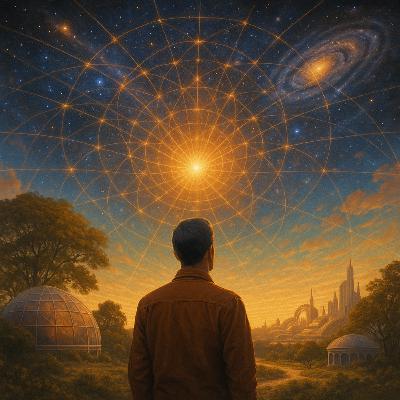
This episode of Deep Dive explores the Buddhist Threefold Truth, a foundational concept stating that all phenomena are simultaneously empty of fixed essence, possess provisional existence through interdependence, and embody the Middle Way where these two aspects interpenetrate. The author contrasts this perspective with Robert Saltzman's "feedback loop" model of the self, which, while acknowledging the self as a process, is critiqued for potentially leading to a reductive and nihilistic viewthat overlooks wonder and meaning. The text argues that Buddhism avoids this extreme by embracing the "non-exclusive" Middle Way, recognizing that the self, though without fixed essence, is not nothing, but rather a dynamic, interconnected arising. This understanding is achieved through Shikan meditation, where practitioners observe thoughts and the self through the lens of the Threefold Truth, leading to a realization of interconnectedness and the inherent wonder in all existence.

Meditation has adverse effects, and the research is finally saying so. What almost nobody says is what to do when it happens to the person in front of you.Fourteen centuries ago Zhiyi, the Chinese master who wrote the manual on silent sitting, named this exact situation. Extreme weariness, illness, drowsiness that will not lift, obstacles that displace concentrated mindfulness so the practitioner cannot dispel them. For these he prescribed chanting, and he explained why it works in anatomical rather than devotional terms.In this talk: what Zhiyi actually wrote, why a vocal practice works differently than a silent one, why almost nobody has studied chanting, and what I've learned about recognizing when my own practice has gone out of balance.Full essay at https://www.twobuddhas.org/post/adverse-effects-in-meditationSource: Zhiyi, Clear Serenity, Quiet Insight, trans. Paul L. Swanson (University of Hawaii Press, 2018), 249.

In 1278 a woman named Myoho-ama wrote to Nichiren with a question. Her husband was dying. She wanted to know whether chanting was enough — whether what she was doing at his bedside was reaching anything. He died within weeks of the reply.Nobody has ever come to me asking about receptivity and response. They come asking what she asked. And the sole question turns out to be the soul question — which is the trouble, because soul is the one word Buddhism will not give them.This episode looks at four images the tradition uses for how the Dharma responds: sympathetic resonance between two instruments, the moon held in still water, natural law, and Nichiren's caged bird whose song draws the free birds down. They are usually presented as four ways of saying one thing. They aren't. Each fails in a different direction, each reaches a different kind of sufferer, and the tradition's refusal to choose between them is its most sophisticated move rather than its sloppiest.Also: why the strongest assurance text in the Nichiren corpus is the most dangerous one to hand a scrupulous practitioner; why feeling nothing is not failure; why the Gohonzon is permitted to be either the Buddha or the Dharma; and an honest report on what returns at four in the morning after the argument has been won.Full essay with citations: https://www.twobuddhas.org/post/the-word-that-keeps-coming-back

Is chanting really enough? Shouldn't I understand more of this first?Everyone asks it sooner or later. The answer is yes, and that is not the whole answer.This talk sits with a saying that will not resolve: one daimoku is enough, and a million is not enough. One is enough because nothing is missing from it, and nothing is being held back from us. A million is not enough because a life takes a lifetime, and knowing we are on the path is not the same as being done with it. The Buddha kept sitting, kept walking, kept teaching, right up to the last night under the trees.Along the way: why understanding comes through practice rather than before it, how something small enough to fit in our mouth can hold the whole of a teaching, why counting is fine but is not what we are doing, and why nothing is outside this.From Reflections in the Pond, the podcast of Myokan-ji Temple and the Two Buddhas Meditation Community in Oakland, California. Written version at: https://www.twobuddhas.org/post/one-daimoku-is-enough-and-a-million-is-not-enough

"Don't think about your breath, just let it come naturally." All right — and how exactly does one do that? It is like being told not to think about a pink elephant. Nothing complex is ever learned whole. I spent years training search and rescue dogs, and the road to a dog who could work a scent for hours began with one small thing: engagement. Look at me. Everything else was built on top of it. Breath meditation works the same way. Zhiyi, the Tiantai master, set out the sequence most of us have met — count the breaths one through ten and begin again; when counting steadies, drop it and follow; then let following go and simply sit. Fifteen centuries later it has not needed improving. And the third step is the entire point of the first two. You count in order to arrive somewhere counting is no longer needed. A person who has never counted a breath in his life is also not counting. He is not, on that account, meditating. That leads to the line most people know from Donovan and almost nobody knows from its source, the Ch'an master Qingyuan Weixin: mountains are mountains, then mountains are not mountains, then mountains are mountains once again. Qingyuan ends the passage with a challenge that usually gets left out — are these three views the same or different? Can you tell the black from the white? He is asking whether you can distinguish his first mountain from his third, because from the outside they are indistinguishable. This episode takes up two consequences of that. First, that the middle stage is a passage and not an address: emptiness is an intoxicating place to live, a position that cannot lose an argument, and holding it permanently is its own attachment. Second, that the third stage has an imitator — the practitioner who hears that the destination is ordinary and arrives at plainness by never having left it. You cannot tell the two apart by listening. The difference shows when the ground moves. The last section applies this to chanting Namu Myoho Renge Kyo across nearly fifty years: the same seven syllables met three times, the third looking exactly like the first from across the room, with nothing added and a great deal removed. And a caution offered mostly to myself — the third mountain is not tenure. Some dry morning you may find yourself back at the base of the first one, counting breaths, one through ten, beginning again at one. Which is not failure. It is the road. Read the essay: https://www.twobuddhas.org/post/to-forget-the-breath Mark Herrick (Nichiryu) is an independent Nichiren Buddhist dharma teacher and cofounder of Myokan-ji Temple and the Two Buddhas Meditation Community in Oakland, California. Essays, podcast episodes and talks at twobuddhas.org. Namu Myoho Renge Kyo

Comments

Download from Google Play

Download from App Store
 United States