DiscoverWonder Cabinet
Wonder Cabinet
Claim Ownership

Wonder Cabinet

Author: Wonder Cabinet Productions

Subscribed: 5,562Played: 155,558
Share

Description


Wonder Cabinet is an independent podcast from Anne Strainchamps and Steve Paulson, Peabody Award-winning creators of public radio's To The Best Of Our Knowledge. For 35 years, that show brought long-form conversations to 200+ stations nationwide; its interviews are now archived in the Library of Congress.


Episodes feature intimate, long-form conversations with scientists, philosophers, writers, and artists who are re-imagining our relationship with the planet. Some study black holes or quantum entanglement; others map mycelial networks or count ancient tree rings. And some explore dream worlds, myths, and fairy tales to revive ways of knowing that challenge what we think we understand about the nature of reality.


The name references Enlightenment-era cabinets of curiosities—private collections of shells, fossils, astronomical instruments, and saints' relics that existed at a moment when the scientific revolution was still in conversation with older ways of knowing the world. Today, another shift is taking place, as mechanistic models give way to more holistic, relational understandings of life on a sentient planet. Wonder Cabinet lives at that threshold.


About the hosts

Anne Strainchamps and Steve Paulson co-founded To The Best Of Our Knowledge. Steve hosts Luminous, a podcast about the science and philosophy of psychedelics, and is the author of Atoms and Eden.


Learn more at wondercabinetproductions.com.

737 Episodes
Reverse
Can Science Be Sacred?

Can Science Be Sacred?

2026-11-2139:37

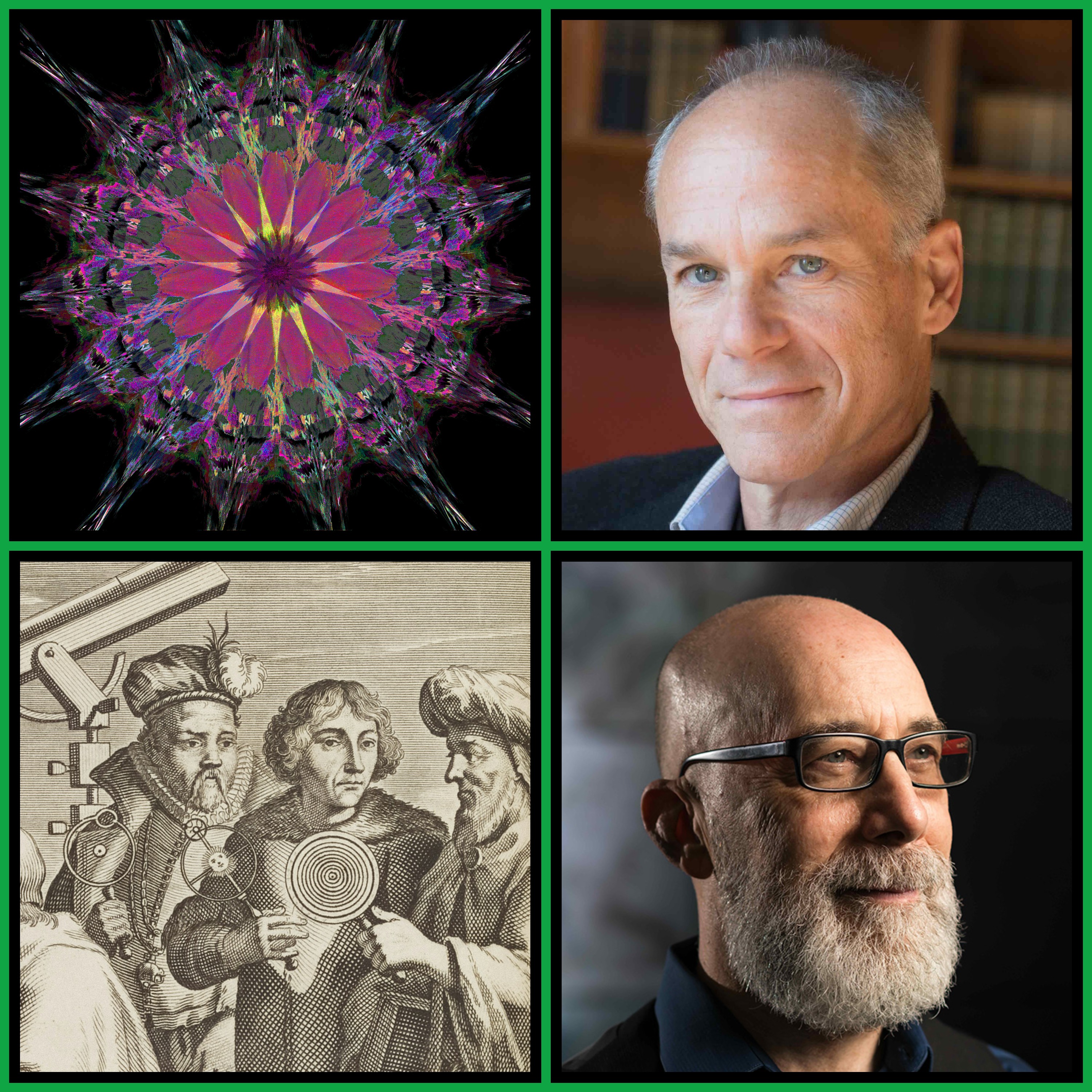
In the hills near Siena, at a small think tank called the Island of Knowledge, Anne Strainchamps sits down with two physicists who believe modern science needs to remember its roots. Marcelo Gleiser, theoretical physicist at Dartmouth and winner of the 2019 Templeton Prize, and Adam Frank, astrophysicist at the University of Rochester, argue that Kepler, Newton and Einstein saw their equations as something close to prayer. Somewhere along the way, science came to treat nature as dead matter to be poked, extracted and burned. Marcelo and Adam call the remedy “resacralizing” the world.Their conversation moves from Galileo’s beautifully crafted instruments to Frankenstein and transhumanism, from the mystic physicists who invented quantum mechanics to the postwar American push to “just calculate.” They talk about hierophany, the moment when the sacred breaks into ordinary life, and how it can arrive in the middle of a calculation. Marcelo recalls the thrill of discovering the oscillon, a bubble of energy that doesn’t want to die. Adam describes Zen kensho and the poetry hiding inside mathematics.They also speak about the losses they carried from childhood, and how the stars and the big questions of physics offered direction and perspective. Finally, they look beyond the Western canon, to Brazil’s indigenous traditions and to philosophers like Nagarjuna, for the ideas that could help build a new kind of science.– More from the "Island of Knowledge" series Book: "The Blind Spot: Why Science Cannot Ignore Human Experience" Book: "Frankenstein" Book: "The Constant Fire: Beyond the Science and Religion Debate" Book: "The Dancing Universe: From Creation Myths to the Big Bang" The Island of Knowledge –00:00:00 Introduction00:03:05 Galileo and the Dead Universe00:16:48 Awe at the Blackboard00:29:05 Grief and Other Ways of Knowing Wonder Cabinet is hosted by Anne Strainchamps and Steve Paulson. Find out more about the show at https://wondercabinetproductions.com, where you can subscribe to the podcast and our newsletter.
Where do you turn when your life falls apart? When you’re stuck in shame and despair? Essayist Meghan O’Gieblyn worked through her own crisis with the help of an unusual guide: the French philosopher and mystic Simone Weil.In her searing memoir "Will and Attention," O’Gieblyn tells the story of her "double midlife crisis" — a relapse into drinking after 11 years of sobriety and a failed attempt to become Catholic. Raised Evangelical, she left the church long ago, and her life since has been a kind of spiritual quest for deeper answers than religion gave her. In this conversation, O’Gieblyn recounts her struggle with a nearly fatal addiction, her recovery, and a gnawing spiritual angst. Her honesty is bracing, at times almost uncomfortably so, as she describes the allure of drinking and the secret life she hid from family and friends. “I knew that it was bad and that it made me unhappy,” she says. “But I did it anyway.”To sort through it all, O’Gieblyn turns to philosophy. She wrestles with Nietzsche, William James, and Iris Murdoch, along with Weil, who helped her understand why her willpower kept failing her and how “attention,” as Weil described it, offered a path forward. The book blends personal, almost confessional writing with rigorous inquiry, the qualities that drew readers to her previous books, "Interior States" and "God, Human, Animal, Machine."Along the way O’Gieblyn confronts big existential questions. How do we find meaning in our lives? Why should we be good? How can we reckon with a divided self “who both wants and wants not to want”? And how can beauty be a guide for living?—00:00:00 Introduction00:02:10 Simone Weil and Failed Willpower00:09:04 Evangelical Roots, Divided Self00:23:16 Relapse and the Pull of Mass00:33:26 Beauty, Wonder, and Testimony— Personal website Book: "Will and Attention" New Yorker: “Is Will Power Overrated?”  New York Review of Books: “Wishing It So”  New Yorker: James Wood’s review of “Will and Attention” — Wonder Cabinet is hosted by Anne Strainchamps and Steve Paulson. Find out more about the show at https://wondercabinetproductions.com, where you can subscribe to the podcast and our newsletter.
Budbreak. Witch’s broom. Wind throw. These are some of the evocative words gathered in "A Forest Language: Words that Illuminate the Astonishing World of Trees," a new book of micro-essays from poet, essayist and Storey Publishing editor Hannah Fries. This week, she joins us to talk about the power of naming and how words can open a window onto the secret lives of trees.Hannah’s writing lives at the intersection of science, poetry and wonder. So imagine a field guide written by a poet – a compendium of tree terminology, illustrated with line drawings of leaves, bark, and seed pods. Each word introduces a kernel of new knowledge while simultaneously drawing us deeper into mystery and what Hannah calls “the wild ecology of wonder.” We sat down with her on a gorgeous October morning, at peak leaf season, to talk about the magic of naming, what we lose when we forget the names of the trees and birds around us, and poetry as a practice of paying attention. We also hear how non-poets can borrow a poet’s tools to see the natural world more closely.—00:00:00 Woods and Words00:03:55 From Tree Climbing to Tree Words00:20:45 Poetry as Paying Attention00:26:40 Life, Death, and Refugium— Website Book: "A Forest Language: Words that Illuminate the Astonishing World of Trees" Video of stoma (“plant mouth”) opening and closing Performance: “Night Migrations,” lyrics by Hannah Fries. Composer: Oliver Caplan. Performed by New Hampshire Master Chorale, Juventus New Music Ensemble. — Wonder Cabinet is hosted by Anne Strainchamps and Steve Paulson. Find out more about the show at https://wondercabinetproductions.com, where you can subscribe to the podcast and our newsletter.
Joan Halifax loves Wordsworth’s summons to “see into the life of things.” For the Buddhist abbot of Upaya Zen Center, this kind of deep seeing has been a lifelong pursuit, and it has led to her care for the dying.Now in her 80s, Halifax has had a remarkable life, from medical anthropology to psychedelic research to Zen practice. For more than fifty years, she has sat with dying people and trained the hospice workers, nurses, and doctors who care for them. Upaya is known for its socially engaged Buddhism, with decades of experience in end-of-life care, along with its work in prisons and with the homeless.In this conversation, Halifax talks about the freedom and deepening that can arise in old age, and her own experience of nearly dying. She describes sitting with a dying person as an experience of wonder, perhaps even an encounter with the ultimate mystery of our lives.—00:00:00 Introduction00:03:00 Wonder at the Deathbed00:14:35 Open-Heart Surgery and Luminosity00:22:35 Calm, Joy, and Growing Old— Personal site Upaya Zen Center Book: "Standing at the Edge" Book: "Being with Dying" Video: "Talk at Google: Standing at the Edge"  — Wonder Cabinet is hosted by Anne Strainchamps and Steve Paulson. Find out more about the show at https://wondercabinetproductions.com, where you can subscribe to the podcast and our newsletter.
Twenty years ago, Maria Popova was newly arrived in the US and working four jobs to pay for college. Lonely and disoriented, she started keeping a record of her search for meaning. Today, what began as an email to seven friends has millions of followers and is preserved in the Library of Congress permanent web archive. The Marginalian (formerly Brain Pickings) is still a one-woman labor of love, a free and ad-free cultural blog exploring science and philosophy, art and literature, poetry and children’s books. In this conversation, Maria Popova looks back on twenty years of reading and writing “through the lens of wonder.” How do we make sense of life in a random and chaotic universe? How do we sustain a sense of wonder in the face of disappointment or despair? Popova shares some of her own inspirations – from reading Mary Shelley’s diaries and J.R.R. Tolkien’s letters, to witnessing Bulgaria’s popular democratic uprising as a child.  We discuss science as a portal to wonder, and her fascination with mapping the invisible connections that link people and ideas across time and place.  In addition to The Marginalian, Popova has written multiple books: "Figuring" (2019), an LA Times Book Prize-winning “biographical mosaic” weaving together the lives of historical figures such as astronomer Johannes Kepler, sculptor Harriet Hosmer, and marine biologist Rachel Carson; "Traversal" (2026), connecting the lives and legacies of visionaries like Mary Shelley, Walt Whitman, Frederick Douglass, and Dorothy Crowfoot Hodgkin; "The Universe in Verse" (2024), an anthology of science and poetry; "The Snail with the Right Heart" (2021), a true, illustrated children's story about genetic mutation, chance, and biological uniqueness; and "An Almanac of Birds: 100 Divinations for Uncertain Days" – an oracle deck. —00:00:00 Meet Maria Popova00:05:00 Wonder Beyond the Listicle00:11:30 Growing Up in Bulgaria00:24:08 Mary Shelley, Lichen and Chance—The Marginalian— Wonder Cabinet is hosted by Anne Strainchamps and Steve Paulson. Find out more about the show at https://wondercabinetproductions.com, where you can subscribe to the podcast and our newsletter.
loading
Comments