


 Claim Ownership
One Thing with Dr. Adam Rinde
Subscribed: 24Played: 833
Subscribe

© Dr. Adam Rinde
Description
The most engaging conversation between health professionals happens in chance meetings in the hallways. During these moments so much is learned .*One Thing* brings together thought leaders in conversation and we share it with health enthusiasts , practitioners, and learners. Our conversations primarily focus on one significant thing in the arenas of gut health, brain health, immune system, metabolism, performance, and aging . This for clinicians and patients alike who are insightful and motivated.
find us on Listen Notes
find us on Listen Notes
147 Episodes
Reverse
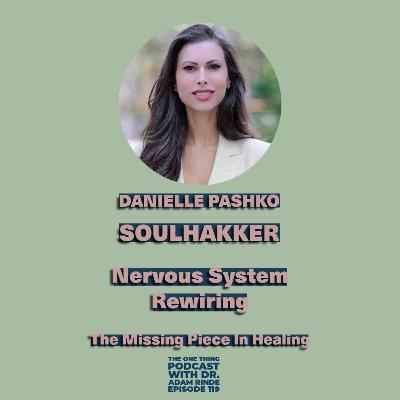
What happens when all your supplements, clean eating, and protocols stop working—and you just keep getting sicker?Danielle Pashko had built her career in functional medicine, doing everything “right.” But after thyroid cancer, Lyme disease, and long COVID wrecked her health, she hit a wall. Nothing worked—until she stopped chasing fixes and started going inward.In this episode, Danielle shares how she finally started healing by rewiring her nervous system, using Qigong, martial arts, and visualization. She breaks down why most chronic illness approaches miss the mark, why emotions and stress regulation matter more than you think, and how she created a daily routine that actually stuck.If you’re stuck in a healing rut, frustrated with endless protocols, or just want to feel like yourself again—this one’s for you.Timestamps:00:00:00 – Intro + Sponsor00:01:05 – Meet Danielle & her health crash00:03:22 – From teenage loss to holistic health00:05:14 – Cancer at 30 despite doing it all right00:06:57 – Why functional medicine didn’t cut it00:08:42 – The role of nervous system dysregulation00:10:47 – Visualization + martial arts: weird but it worked00:13:15 – Lessons from her mother’s spiritual approach00:17:45 – Pleading with the universe—and finding help00:22:32 – When the body shifts before the mind00:26:15 – Wing Chun, Qigong, and brain rewiring00:29:34 – The daily stuff that actually made a difference00:33:42 – Carnivore diet, CGMs, and getting real about food00:38:16 – How nature helped heal when nothing else did00:42:50 – Making healing sustainable (not another to-do list)00:46:41 – What “Soul Hacker” really means00:49:28 – The soul work behind real healing00:50:09 – Connect with DanielleAttention listeners: Since 2019, we have been providing free content that is life-changing and valuable. The expense of producing a high-level podcast depends on your generosity; please support us through our affiliate sponsors.You can support the podcast through affiliate sponsors like Healthgevity (use code ONETHING for 10% off)

Panic disorder isn't a flaw in your character—it's your body's alarm system misfiring. In this episode, Dr. Adam Rinde sits down with Dr. Nicole Cain, author of Panic Proof (published by Penguin Random House), to unpack the neurobiology of panic and reveal why the traditional medical model often misses what's really driving it. Dr. Cain breaks down the critical difference between fear, anxiety, and panic—and introduces her "stoplight strategy" (green, yellow, red) to help you recognize where you are in your activation cycle. The key insight: panic isn't the problem; what your panic is trying to communicate is. Drawing on trauma-informed principles and her own journey through panic disorder, Dr. Cain explains how your gut microbiome, hormone systems, and skeletal alignment all contribute to anxiety—and why treating only one system never works. You'll learn how to access her free Panic Proof audiobook through your library, explore her Root Cause Anxiety Method course, and discover why having an "ace in your pocket" (an emergency tool) actually empowers healing rather than enabling avoidance.---About Dr. Nicole Cain, ND, MADr. Nicole Cain, ND, MA is a leading voice in integrative approaches to mental and emotional wellness. She holds a degree in psychology from Luther College, a Master of Arts in clinical psychology from the Chicago School of Professional Psychology, and a Doctorate in Naturopathic Medicine from Sonoran University of Health Sciences. An Arizona-licensed Naturopathic Physician and EMDR-trained psychotherapist, she specializes in anxiety, panic disorder, and trauma through a whole-person approach that is at once medical, psychological, and holistic.She is the author of Panic Proof: The New Holistic Solution to End Your Anxiety Forever (Rodale, 2024) and the founder of the Holistic Wellness Collective, a membership program that guides self-healers through the practical application of the Panic Proof method. Her insights have been featured in Psychology Today, Health Magazine, HuffPost, Katie Couric Media, Salon, and Spirituality & Health.Resources & LinksConnect with Dr. Nicole CainWebsite — drnicolecain.comPanic Proof (book site) — panicproof.comInstagram — @drnicolecainYouTube — Dr. Nicole Cain, ND, MALinkedIn — dr-nicole-cainThe Holistic Wellness Collective — her 3-month signature program applying the Panic Proof method — drnicolecain.com/holistic-wellness-collectiveThe Anxiety Breakthrough Program — drnicolecain.com/the-anxiety-breakthrough-programThe Vagus Nerve Reset Program — drnicolecain.com/the-vagus-nerve-reset-programAll courses — drnicolecain.com/coursesSonoran University of Health Sciences (formerly Southwest College of Naturopathic Medicine) — sonoran.eduAANP — American Association of Naturopathic Physicians — naturopathic.orgPESI — continuing education for clinicians — pesi.com/topics/anxietyEMDR training — EMDR Humanitarian Assistance ProgramsPolyvagal theory — Stephen Porges' model of the vagal nervous system — background · foundational paperConcepts discussedWindow of tolerance — the zone of arousal where you can process experience without overwhelmThe therapeutic order — the naturopathic principle of treating from least-force interventions upwardThe stoplight strategy — green (calm) / yellow (activated) / red (crisis), Dr. Cain's self-assessment modelThe six F's — running, fighting, flopping, fawning, freezing, fracturingThe nine types of anxiety — covered in depth in Panic ProofGo Deeper — From The One Thing PodcastEpisode 127: Richmond Heath on TRE and Somatic Trauma Release — trauma release, vagal states, and the panic cycle from a body-first anglePsychobiotics and the Gut-Brain Axis with Scott Anderson — the gut side of the anxiety picture Dr. Cain describesPolyvagal theory and IBS — Dr. Rinde's own lecture — mindsethealth.comSafe and Sound Protocol — vagal regulation in clinical practice — soundintegrative.com/ssp

If you live with hypermobility, EDS, POTS, or MCAS, you've likely been told to stay "safe," stay small, and never push — advice that can leave you feeling like a jellyfish with no sense of where your body is in space. Heidi Pasch offers a different path. A trainer, author, and artist who went from competitive athlete to disabled after seven surgeries, she rebuilt her body by ignoring the templates and learning to read the body in front of her.In this conversation, Heidi and Dr. Adam Rinde unpack why flexibility without control is the real danger, what "earned range of motion" means, and how strength — not restriction — protects a hypermobile joint. They dig into why the scale misses everything that matters, how a body can show up completely different day to day (mast cell reactions, POTS flares, hormonal shifts), and why recovery is where the real rebuilding happens. Heidi also shares her book, Beyond Weight: Body and Context, and her art exploring the lived experience of connective tissue. It's an empowering listen for anyone told their body's limits are fixed.------------------------------------ABOUT HEIDI:Heidi Pasch is a trainer, author, and artist who specializes in movement for hypermobile bodies. After a series of orthopedic surgeries took her from competitive athlete to disabled, she rebuilt her body by developing her own approach — grounded in control, strength, and reading "the body in front of you." Living with Ehlers-Danlos Syndrome, POTS, and MCAS, she trains hypermobile clients around the world, works across ballroom and circus-arts movement traditions, and is the author of Beyond Weight: Body InContext, which explores the disconnect between movement, measurement, and medicine.--------------------social links:Hypermobility and joint-stability training:https://www.heidipasch.com/training-for-hypermobility-and-joint-stabilityBeyond Weight: Body in Context:https://www.heidipasch.com/shop/p/beyond-weight-body-in-context(also available on Amazon)Instagram:https://www.instagram.com/heidi.pasch/about the One Thing Podcast with Dr. Rinde(Featured this episode: Three Square's BackPack for Kids — if we reach 300 listens in the first 30 days, we'll make our donation there. n Heidi's honor, Three Square Food Bank — BackPack for Kids (Las Vegas): sends backpacks of food home with kids who may lack weekend food security — because food should be an equal-opportunity foundation for lifelong health. https://www.threesquare.orgDiscussion: Discussion question: If you're hypermobile, what's one piece of standard fitness advice that never worked for your body — and what did you find instead?#hEDS, #EDS, #POTS, #HympermoblityAbout The One Thing Podcast with Dr. Adam RindeHost Dr. Adam Rinde, ND brings together leaders in functional and naturopathic medicine for actionable conversations on gut health, brain health, metabolism, and longevity. Subscribe and share at https://onethingpod.com.

When conventional medicine says 'there's nothing else we can do,' Dr. Marty Ross knows you're just getting started. This episode explores the overlooked co-infections, mold toxicity, and system dysfunctions behind chronic fatigue and fibromyalgia—and the terrain-based healing approach .Dr. Ross walks through a patient case: a young missionary bedridden from what appeared to be Lyme disease received eighteen months of IV antibiotics with minimal improvement. The course changed when he recognized mold toxicity as the missing link—cholestyramine alone brought 90% recovery in weeks.He reveals why treating the system—not just killing the germ—matters. He discusses testing recommendations (IgeneX for Borrelia and co-infections; Vibrant Lab or Mosaic for mold biotoxins), then three no-cost starting points: sleep hygiene (7-9 hours nightly), feeding your microbiome with polyphenols and plant-forward foods, and addressing limbic system dysfunction via tools like the Gupta Program or Primal Trust.For those suffering with Lyme diagnosis or suspect chronic illness which has terrain-based roots, this conversation offers both immediate steps and the framework to reframe your healing—plus Dr. Ross's resources for personalized guidance.about Dr. RossDr. Marty Ross is a functional medicine physician based in Seattle and one of the leading clinical voices in chronic Lyme disease, tick-borne infections, and complex chronic illness in the United States. Over 25 years, he has helped thousands of patients across the US and internationally recover from conditions that mainstream medicine often dismisses, including Lyme, mold toxicity, fibromyalgia, and long COVID.He is the founder of Treat Lyme, one of the largest chronic illness education platforms online, and is the author of Hacking Lyme Disease: An Action Guide to Wellness. He also runs a monthly live Q&A webinar and a curated supplement line in partnership with Femologist. Before opening the practice in Seattle, Marty shaped US public health legislation from the Senate. Today, he is the doctor who shows up for patients when everyone else has stopped looking.https://www.linkedin.com/in/marty-ross-md/https://www.instagram.com/martyrossmd/----In the even the podcast exceeds 300 views in the first week, The One Thing Podcast will donate at least $100 in your honor of Plus One Foundation (https://plusonefoundation.networkforgood.com/projects/194639-everyday-donation-page)

After 22 years on antidepressants—escalating from a quarter dose to maximum doses of multiple medications—Dr. Noushin Hart hit a wall: her psychiatrist said he had nothing else to offer. Instead of accepting that as an ending, she embarked on a journey revealing the real root of her depression: 30 years of untreated childhood trauma and a nervous system locked in survival mode. This episode explores why the serotonin hypothesis misses the full picture, why repeating trauma stories in talk therapy can re-traumatize you, and how somatic approaches process trauma in the body without requiring you to relive it—leading to genuine healing without medication dependency. You'll learn the neuroscience behind why your HPA axis and nervous system dysregulation matter more than serotonin levels, hear about alternatives like transcranial magnetic stimulation and plant medicine, and discover how saffron offers natural mood support. Whether you're stuck on antidepressants, skeptical of talk therapy alone, or searching for integrative solutions, Dr. Hart's story and practical insights offer both hope and a clear path forward.Dr. Noushin Hart shares her 22-year journey from antidepressant dependency to somatic healing, revealing why conventional psychiatry missed the trauma-informed approach her body needed. This conversation examines the limitations of the serotonin model, the re-traumatization trap of repetitive talk therapy, and the nervous-system science behind why body-based modalities create lasting transformation.Key takeaways:• Antidepressants work for acute depression but long-term chronic use leads to tolerance, escalating doses, and side effects that mirror original symptoms—making it impossible to distinguish depression from medication effects.• Depression frequently roots in unprocessed childhood trauma and nervous system dysregulation (HPA axis), not serotonin deficiency alone; the body keeps score for decades.• Repetitive talk therapy—retelling trauma stories over and over—can re-traumatize the nervous system; somatic approaches that process trauma at the body level without re-narration create safer, faster healing.• The sympathetic nervous system (fight-or-flight) can remain dominantly activated for 30+ years due to childhood trauma; somatic work restores parasympathetic balance and safety.• Dependency on practitioners or modalities signals unhealthy treatment; true healing empowers you with self-directed tools so you become your own healer.• Natural alternatives like saffron show strong evidence for mood support, insomnia, and concentration—offering a gentler starting point or complement to other interventions.• Being told 'there's nothing else to offer you' reflects a practitioner's limitation, not your capacity to heal; seek modalities and practitioners that fit your nervous system's needs.Resources mentioned:• MAP (somatic trauma processing modality)• Plant medicine protocols for trauma and depression• Transcranial Magnetic Stimulation (TMS)• Saffron (clinical evidence for mood, insomnia, and concentration)• Dr. Gabor Maté (trauma framework and nervous system science)• HPA axis regulation and polyvagal theory• Somatic and energy-based healing approachesLinks mentioned:• Heart to Heart Cancer Consultants —https://h2hcc.com/• Healing by Hart — https://healingbyhart.com/

Comments

Download from Google Play

Download from App Store
 United States