


 Claim Ownership
PBE Podcast
Subscribed: 15Played: 213
Subscribe

Description
Energy innovation is born in the Permian Basin, we’re on the front lines of it! Let’s build a community for the next generation of energy needs.
252 Episodes
Reverse
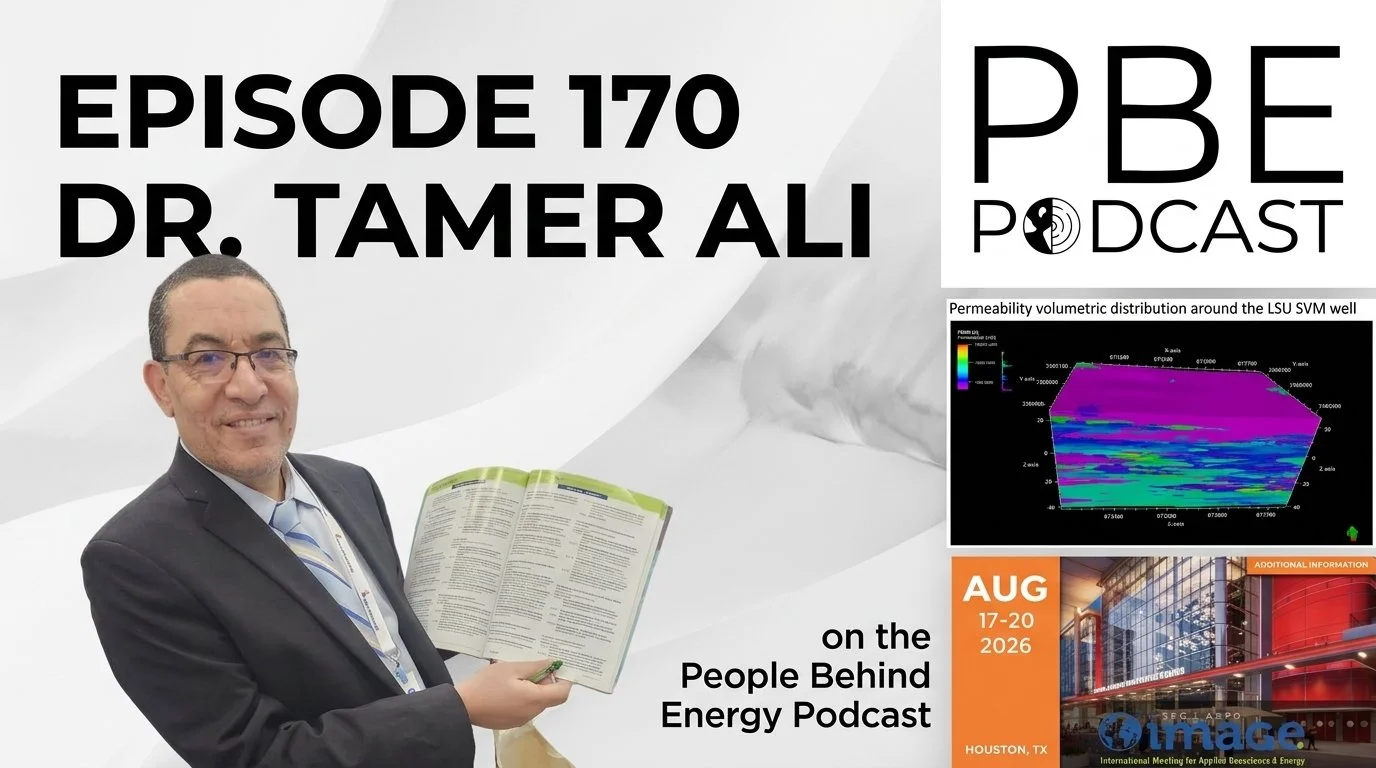
In this episode of the PBE podcast, host Troy Tittlemier sits down with Tamer Ali at IMAGE 2026 to explore the cutting edge of geology, geophysics, and AI integration. Tamer shares his incredible journey from growing up on a farm in the Nile Delta to processing seismic data across six countries, and eventually earning degrees from the Colorado School of Mines and LSU. The conversation dives into Tamer's groundbreaking PhD dissertation, which uses a novel AI hybrid model—combining generalized additive models (GAM) and k-means clustering—to quantitatively integrate geophysical and geological data. By predicting grain size and permeability in shallow, unconsolidated sediments, Tamer's work precisely locates dangerous water seepage beneath structures like the LSU Veterinary School of Medicine. This localized, quantitative approach could save tens of millions of dollars annually in levee restoration and prevent catastrophic infrastructure failures across the Lower Mississippi Valley.
Episode Highlights:
The Elevator Pitch: An introduction to Tamer's extensive academic background and his focus on quantitative data integration using AI.
Roots in the Nile Delta: Tamer discusses his Egyptian heritage, farming background, and how a geologist uncle sparked his early love for earth sciences.
The Industry Grind: Balancing a full-time 3D seismic processing career at WesternGeco with a grueling daily commute to earn a master's degree at Colorado School of Mines.
Quantitative vs. Qualitative: The shift from subjective visual inspections to writing robust Python and R code to build a new hybrid AI model.
The LSU Vet School Project: Securing an AAPG grant and Army Corps permits to investigate uneven stress and water seepage beneath the university building.
K-Means Clustering for Civil Engineering: Applying five distinct data properties to accurately classify subsurface facies from zero to 90 feet.
Saving Millions & Preventing Disasters: How Tamer's precise seepage detection can prevent future tragedies like Hurricane Katrina and save an estimated $50 million a year.
The Future of Petrophysics: Tamer's next chapter pursuing the only specialized petrophysics master's degree in the United States at Texas A&M-Kingsville.

In this episode, we sit down with Dalma Cerro Arrieta, a petroleum engineer and PhD candidate at UT Austin, to discuss her journey through the geosciences. Dalma shares her path from studying at a public school in northern Colombia to learning Portuguese in three months for a Master's degree in Brazil, and eventually transitioning to a PhD program in Texas. The conversation dives into the technical details of geomechanics, her time working for Petrobras in the Brazilian pre-salt layers, and her current research using NMR and resistivity logs to estimate permeability in complex carbonates.
Episode Highlights:
00:00:00 - Origins & Education: Dalma discusses growing up in Colombia and her early interest in organic chemistry before shifting her focus to petroleum engineering at the National University in Medellín.
00:04:17 - A Life-Changing Encounter: Dalma explains how volunteering at a university geomechanics conference led to a meeting with a Brazilian professor, resulting in a master's degree offer in Brazil.
00:05:51 - Geomechanics Simplified: A breakdown of earth mechanics, wellbore stability, and how mud weight is used to prevent well fractures and keep fluids inside the rocks.
00:09:35 - Rock Frackability: An exploration of the rock properties used in frack modeling, including Poisson's ratio and Young's modulus.
00:11:17 - Innovative Fracking Concepts: A discussion on a patented, non-traditional "kinetic frac" method that utilizes expanding CO2 bubbles to shatter rock.
00:16:48 - Industry Experience at Petrobras: Dalma shares her experience working on wellbore stability in Brazil, specifically focusing on the challenges of drilling through salt seals to reach presalt carbonate reservoirs.
00:18:28 - The Journey to UT Austin: The story of how Dalma relocated to Austin to learn English, eventually passing her GRE and TOEFL exams to begin her PhD in formation evaluation.
00:21:15 - Permeability in Complex Carbonates: Insights into Dalma's current research on combining Nuclear Magnetic Resonance (NMR) and electrical resistivity logs to navigate the challenges of micropores and heterogeneous rock.
00:22:22 - Protecting NMR Data: Practical advice on using ditch magnets in mud tank possum bellies to clear out iron and prevent electrical field disturbances during NMR logging.
00:24:26 - Leadership in SPWLA: Dalma highlights the importance of the UT Austin SPWLA student chapter for building networking skills, forcing student engagement, and connecting academia with industry professionals.
00:31:21 - Demystifying Wettability: A concise explanation of wettability and how rock mineralogy determines its affinity for holding oil versus water.
In this episode of the People Behind Energy (PBE) podcast, host Troy Tittlemier travels to UT Austin to sit down with PhD students Axel Jeconiah and Christian Dominguez from Dr. Carlos Verdin's formation evaluation program. The conversation dives deep into the future of the energy industry, focusing heavily on new-generation geothermal technologies, the integration of machine learning, and advanced fracture detection methods. Axel and Christian share their unique journeys into the energy sector—from growing up in Qatar and Houston to pursuing cutting-edge DOE-funded research. The episode explores how modern physics and engineering are being applied to create more efficient and sustainable energy solutions, including the economic challenges of mapping geothermal fractures and the vision for distributed geothermal micro-wells.
Episode Highlights
00:00:00 - Introduction at UT Austin and meeting the PhD students in the formation evaluation program.
00:01:46 - Axel and Christian share their backgrounds, from Houston and Qatar, and what inspired them to pursue petroleum engineering.
00:04:33 - Breaking down the basics of geothermal energy and how water heat is converted to turbine power.
00:06:11 - Exploring "new generation" geothermal technology and the process of hydraulically fracturing hot dry rock.
00:09:41 - The experimental research surrounding the extraction of lithium from underground geothermal brines.
00:11:03 - Discussing Texas geothermal anomalies and the impact of tight gas on thermal conductivity in the McAllen area.
00:13:17 - Defining the difference between Machine Learning and AI, and their growing necessity in the energy sector.
00:15:41 - Axel details his DOE-funded PhD research on using electromagnetics and conductive proppant to map fractures through casing.
00:23:48 - Vision for the future: Why distributed networks of 20-megawatt micro-wells are more effective than giant, single-source geothermal wells.
Episode Sponsors
Mandrill Energy Solutions: Providing tailored staffing, solids control solutions, and equipment solutions to keep energy operations running safely and efficiently.
Resonate H2O: A premium hydration mix featuring electrolytes and essential amino acids to support everyday focus and performance.
The Evolution of UTAPWeLS & Well-Log Modeling
In this episode of the PBE Podcast, host Troy Tittlemier sits down with Dave Kennedy to explore the history of the UT Austin Formation Evaluation research consortium and the development of the UTAPWeLS software. Dave shares his expansive career journey, spanning from his early days at Georgia Tech and military service during the Vietnam War, to his extensive work with industry giants like Schlumberger, Mobil, ExxonMobil, and Baker Hughes. The discussion dives deep into the evolution of well-log modeling, detailing the industry's shift from the standard 30-year use of the 6FF40 induction instrument to proprietary array induction tools. Dave also highlights how consortium leader Carlos successfully united competing service companies to build a comprehensive petrophysical simulator that continues to push the technological envelope today.
Episode Highlights
Introduction to Dave Kennedy, his long-standing association with Carlos since 1986 at Berkeley, and the start of the UT Austin consortium in 2000.
Dave’s early life: Attending Georgia Tech, his family's military background, and his decision to join the army as airborne infantry during the Vietnam War.
Entering the oil patch: Landing a job at Schlumberger in 1972 after sending out a hundred letters through a vendor catalog.
Transitioning to research: Moving to Mobil in 1988, solving Maxwell's equations to understand the 6FF40 induction tool's response function, and adding 100 million barrels to the Statfjord field reserves using forward modeling.
The industry shift to array induction tools and the service companies' initial reluctance to share their proprietary hardware specifications and modeling data.
The birth of UTAPWeLS (University of Texas at Austin Petrophysical and Well-Log Simulator): How Carlos successfully negotiated with competing service companies to incorporate their models into a unified simulator for the industry.
Forward modeling vs. inversion: A breakdown of how UTAPWeLS helps determine hydrocarbon saturation by overlaying guessed formation layer conductivities onto observed tool responses.
Dispelling the myth of a "mature industry": How technological advancements like fiber optics, miniaturization, and rare earth magnets for nuclear magnetic resonance keep the oil and gas sector on the cutting edge.
Concluding thoughts on the 26-year-old consortium's ongoing evolution, Carlos's leadership, and the modern integration of AI into their research.
In this episode of the People Behind Energy podcast, Dr. Carlos Torres-Verdín (Professor at the University of Texas at Austin) and Mark Kittridge (Principal and Manager of the Quantitative Interpretation Team at Occidental Petroleum) explore the 26-year history and future of the UT Austin Formation Evaluation Consortium. The conversation details Dr. Torres-Verdín’s journey in establishing an independent academic program for formation evaluation, Mark Kittridge’s perspectives as a long-time industry sponsor, and the core physics behind subsurface reservoir measurements. They also examine how multiphysics modeling, novel sensors, and artificial intelligence are advancing petrophysics, driving reservoir recovery factors, and enabling energy transition applications such as CO2 sequestration.
Key Highlights & Timestamps
- Celebrating 26 Years of Innovation: The conversation opens with reflections on the 26-year uninterrupted legacy of the UT Austin Formation Evaluation Consortium and its pivotal role in advancing petrophysics.
- Mark Kittridge’s Longhorn Legacy: Mark shares his journey coming to UT Austin in August 1986 for his Master's in Petroleum Engineering under Dr. Larry Lake, discussing how his graduate work laid the foundation for his industry career.
- Dr. Carlos Torres-Verdín’s Career Path: Carlos outlines his academic and industry path, from earning his PhD at UC Berkeley to conducting research at Schlumberger (SLB) and working in operations at YPF in Argentina before joining UT Austin in July 1999.
- Pitching the Consortium Vision in 2000: Carlos recalls pitching his vision for an academic unit dedicated to formation evaluation, pushing back against the perception that petrophysical technology had reached its limit.
- Early Consortium Impact: Mark discusses the immediate value the consortium brought to operators by tying tool physics directly to multiphysics, multiscale data, quantitative interpretation, and downhole formation testing.
- The Power of Academic Neutrality: The guests discuss how UT Austin provided a neutral, independent research environment to maximize measurement value without commercial tool bias.
- The Future of Subsurface Physics: Carlos highlights future research frontiers, focusing on complex heterogeneous rocks, new in situ sensors, fast computing, and combining physical laws with artificial intelligence to boost reservoir recovery factors.
- Demystifying Formation Evaluation: Mark and Carlos break down how petrophysicists translate indirect wellbore measurements (density, acoustic, electromagnetic) into key reservoir properties like porosity, fluid saturation, and permeability.
- Evolution of the University JIP Model: The group analyzes how university-led Joint Industry Projects (JIPs) must evolve amid changing academic landscapes and shifting industry funding priorities.
- Subsurface Engineering in the Energy Transition: Mark details his work in CO2 sequestration, explaining how traditional petroleum engineering methodologies are being repurposed for carbon capture, groundwater management, and global energy solutions.

Comments

Download from Google Play

Download from App Store
 United States