


 Claim Ownership
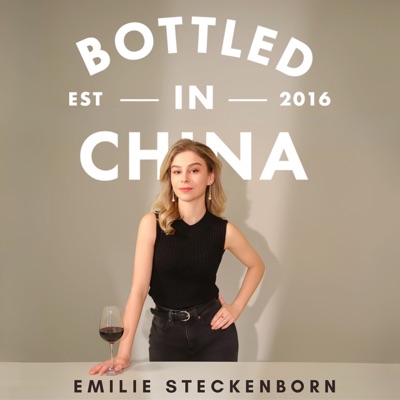
Bottled in China: A Wine & Food Podcast
Subscribed: 205Played: 1,561
Subscribe

© 2016 Bottled in China
Description
Since 2016, Bottled in China brings you into the world of wine, drink and food through insightful conversations with thought leaders who are at the forefront of the global wine and food scene.
Hosted by Emilie Steckenborn, the show is your one spot for all things wine, food, beer and spirits from across the world.
203 Episodes
Reverse

What if a clue to understanding Chinese culture lies not in politics or economics, but in the crops people have grown for centuries?On this episode of Bottled in China, we speak with cultural psychologist Thomas Talhelm about how rice and wheat farming may have shaped the way people think, build relationships and do business.Thomas Talhelm is an Associate Professor and holds the Robert Cialdini Endowed Professorship at Arizona State University. His interest in China began in 2007, when he taught in Guangzhou through Princeton in Asia, and deepened over four years living in the country, including as a Fulbright scholar. A former freelance journalist in Beijing, he also founded Smart Air, a social enterprise dedicated to making clean air more affordable and accessible.I first encountered Talhelm’s work at a talk about an unlikely research setting: Starbucks. By observing how customers navigated chairs placed in their path, he explored whether everyday behaviour might reflect cultural patterns rooted in agriculture. The idea stayed with me and inspired this conversation.Historically, rice cultivation required roughly twice as much labour as wheat farming, along with close coordination among neighbours. Talhelm’s research suggests that these demands helped foster greater interdependence in rice-growing regions of southern China, compared with the more individualistic tendencies observed in wheat-growing regions of the north.The conversation also challenges a common assumption about collectivism: that it necessarily means greater friendliness or cooperation with everyone. Instead, Talhelm explains how it can centre on obligations to family and close-knit social circles—a distinction with implications for everyday interactions and business relationships.In this episode:- What rice and wheat farming can reveal about cultural differences within China.- How a study involving chairs in Starbucks tested patterns of independence and interdependence.- Why collectivism is not the same as being friendly to strangers.- What these findings tell us about relationships and doing business in China.Further reading:Explore Thomas Talhelm’s research through the links below.Starbucks study: Chair moving: https://www.science.org/doi/10.1126/sciadv.aap8469 Moving: Young people moving across China are still picking up rice-wheat differences in thought style : https://bpspsychub.onlinelibrary.wiley.com/doi/abs/10.1111/bjop.70033Seed theory: Some evidence that cultural differences are getting larger in China and around the world: https://academic.oup.com/pnasnexus/article/5/3/pgag021/8510565Responsibilism: A study on how people misunderstand collectivism: https://doi.org/10.1038/s41562-026-02525-1 Follow Thomas on Twitter and Bluesky for his latest work and news.Twitter: https://x.com/ThomasTalhelm Bluesky: https://bsky.app/profile/thomastalhelm.bsky.social
Since 2016, Bottled in China brings you into the food and drink scene through conversations with the some of the most happening personalities. Hosted by Emilie Steckenborn, the show is your one spot for all things wine, food and beverages from across the world. Connect with us on LinkedIn or Instagram @bottled.in.chinaPodcast available on iTunes, Spotify , online or wherever you listen to your episodes! Subscribe to Bottled in China to follow the journey!Check out our new website & find out more at https://www.thebottledshow.com

Everyone agrees Burgundy is having a moment in China. But beneath the enthusiasm lies a harder question—one that Bordeaux answered badly a decade ago: can it last, or is Burgundy quietly repeating history's most expensive mistake?In this episode we gather three voices who see the market from very different vantage points. Matthieu Luneau, Export Sales Director at Domaine Faiveley, speaks for one of Burgundy's most historic estates—an institution that first bet on China back in 2007. Maxime Gibrat, Director of Operations at Bund Fine Wines in Shanghai, tracks the market's daily realities, from cash-flow crises to counterfeit DRC. PM Hall-Jones, owner of Domaine Thomson, bridges Old World Burgundy and New World Pinot Noir from New Zealand.Together they unpack a paradox. Burgundy grew by double digits as French still wine overall collapsed by more than a quarter. However, it remains under 2% of China's imported still wine. So how does a tiny category dominate the headlines?The conversation moves from the data to the ground. The guests explore why Burgundy never "exploded" like Bordeaux, how its dizzying complexity became a weakness turned strength for curious Chinese drinkers, and why consumption is shifting from gifting and banquets toward genuine enjoyment and learning. They confront the uncomfortable truths too: surging prices, a punishing exchange rate, tightening anti-corruption rules, and a persistent counterfeit trade.
Since 2016, Bottled in China brings you into the food and drink scene through conversations with the some of the most happening personalities. Hosted by Emilie Steckenborn, the show is your one spot for all things wine, food and beverages from across the world. Connect with us on LinkedIn or Instagram @bottled.in.chinaPodcast available on iTunes, Spotify , online or wherever you listen to your episodes! Subscribe to Bottled in China to follow the journey!Check out our new website & find out more at https://www.thebottledshow.com

Richard Geoffroy was the eccentric driving force behind the world’s most famous Champagne, Dom Pérignon. But then, everything changed at 64.In this episode, Richard Geoffroy, the legendary former Cellar Master at Dom Pérignon, where he shaped the house’s style for 15 years, turns his craft to an unexpected frontier: IWA sake. Bringing Champagne rooted mastery to the art of blending, precision, and reinvention, Geoffroy begins rewriting the rules without losing what makes Japan feel unmistakably present.Crafted outside a traditional sake region in Toyama Prefecture, IWA gives Geoffroy room to innovate while staying deeply rooted in Japan. His flagship IWA 5 delivers a distinct expression each year, and his latest release, Assemblage 7, offers a new expression of his vision. It uses five different yeast strains, including experimental ones, with a rice polishing rate of just 35 percent, and it incorporates reserve sakes to add depth.We also explore a career that did not follow a straight line from one passion to the next. Geoffroy traces his path from medicine to Champagne and finally to Japan, where IWA comes to life. Along the way, he discusses what carries over across industries and how his drive for innovation travels across borders.Finally, we dig into a deeper question: innovation vs tradition. Both Champagne and sake are rooted in deep history, rituals, terroir, and craftsmanship, and ask which world truly leaves room for modern experimentation. The answer might be more surprising than you think.Find out more: Assemblage 7 — IWA Sake of JapanVisit their Instagram: IWA Sake of Japan (@iwa.sake) • Instagram photos and videos
Since 2016, Bottled in China brings you into the food and drink scene through conversations with the some of the most happening personalities. Hosted by Emilie Steckenborn, the show is your one spot for all things wine, food and beverages from across the world. Connect with us on LinkedIn or Instagram @bottled.in.chinaPodcast available on iTunes, Spotify , online or wherever you listen to your episodes! Subscribe to Bottled in China to follow the journey!Check out our new website & find out more at https://www.thebottledshow.com

India consumes more whiskey than Scotland produces. It is a nation of 1.4 billion people, of spirits and celebration, where wine accounts for barely one percent of the alcohol market. And yet, something is shifting. A growing middle class, an expanding cohort of women entering the workforce, and a wave of new free trade agreements with the European Union, the United Kingdom, and Australia have placed India at the threshold of becoming one of the world's most consequential wine markets.
In this episode, we speak with Sonal C Holland, India's first and only Master of Wine, about the decade-long journey that took her from a Fortune 500 corporate career to the highest credential in the global wine trade. We explore India's wine scene, the structural barriers of duties and state-by-state distribution, and the quiet revolution underway among a new generation of consumers.
Connect with Sonal C Holland, Master of Wine, on Instagram and discover more about her remarkable journey in her new book, One In a Billion: Becoming India’s First Master of Wine.
Special thanks to Rachel Mamane for putting this piece together and to Jeff for the audio editing.
Since 2016, Bottled in China brings you into the food and drink scene through conversations with the some of the most happening personalities. Hosted by Emilie Steckenborn, the show is your one spot for all things wine, food and beverages from across the world. Connect with us on LinkedIn or Instagram @bottled.in.chinaPodcast available on iTunes, Spotify , online or wherever you listen to your episodes! Subscribe to Bottled in China to follow the journey!Check out our new website & find out more at https://www.thebottledshow.com

What does it take to bridge two wine worlds?
Lenz Moser has made 75 trips to China over 21 years, transforming from curious visitor to pioneering winemaker at Chateau Changyu Moser XV in Ningxia.
As the fifth generation of Austria's legendary Lenz Moser wine family, whose grandfather invented the revolutionary trellising system used across Europe. In this episode, we discuss how Lenz brought his vision and winemaking wisdom to China's emerging wine frontier. After managing Austria's pre-eminent winery and serving as General Manager for Robert Mondavi in Europe, he turned his attention east in 2005.
In this episode, Lenz shares his journey from that first overwhelming moment in Beijing Airport to becoming the winemaker Chateau Changyu Moser XV in Ningxia. We discuss how he spent 10 years building trust before Changyu appointed him head winemaker, and why understanding China's contradictions: patience versus speed, became essential to his success. He reveals the secret behind Ningxia's world-class wines: the smallest Cabernet Sauvignon berries on earth, grown in a desert terroir that went from unknown to World Atlas of Wine recognition in just over a decade.
Since 2016, Bottled in China brings you into the food and drink scene through conversations with the some of the most happening personalities. Hosted by Emilie Steckenborn, the show is your one spot for all things wine, food and beverages from across the world. Connect with us on LinkedIn or Instagram @bottled.in.chinaPodcast available on iTunes, Spotify , online or wherever you listen to your episodes! Subscribe to Bottled in China to follow the journey!Check out our new website & find out more at https://www.thebottledshow.com

Comments

Download from Google Play

Download from App Store
 United States