


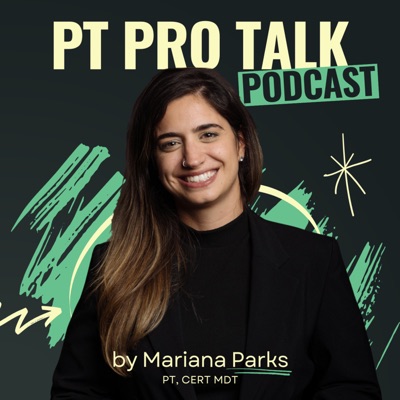
PT Pro Talk
Subscribed: 35Played: 1,314
Subscribe

© 841801
Description
Join Mariana Parks, PT, Cert. MDT, as she interviews world-leading experts in physical therapy, rehabilitation, and sports medicine. Each episode delivers evidence-based insights, proven techniques, and clinical strategies to help physical therapists expand their knowledge, improve patient outcomes, and stay ahead in the ever-evolving PT field.
👉 https://www.ptprotalk.com/
🔗 https://linktr.ee/Ptprotalk
📲Follow us :
Instagram - @ptprotalk
Facebook - @ptprotalkpodcast
LinkedIn: https://www.linkedin.com/company/pt-pro-talk/
YouTube: https://www.youtube.com/@PTProTalk
X: x.com/MariHannaParks
👉 https://www.ptprotalk.com/
🔗 https://linktr.ee/Ptprotalk
📲Follow us :
Instagram - @ptprotalk
Facebook - @ptprotalkpodcast
LinkedIn: https://www.linkedin.com/company/pt-pro-talk/
YouTube: https://www.youtube.com/@PTProTalk
X: x.com/MariHannaParks
217 Episodes
Reverse

💡 In this episode of PT Pro Talk, host Mariana Parks speaks with Audrey Long, a seasoned clinician and 30-year McKenzie Institute instructor. This interview breaks down the clinical application of Mechanical Diagnosis and Therapy (MDT) through three real-world cases where initial diagnoses and imaging completely missed the mark - ranging from misattributed lumbar stenosis to a refractory tennis elbow hiding a joint restriction. From overcoming confirmation bias and spotting history clues that "don't fit" to applying end-range passive overpressure and testing joints above and below the site of pain, Audrey shares actionable insights on how to systematically screen mechanical derangements, avoid jumping too quickly into tendon load management, and refine patient communication in everyday practice. Download our Free Tendinopathy Clinical Cheat Sheet! 1-page quick-reference guide summarizing diagnostic tests, differential diagnosis, and exercise suggestions for your daily practice. Get your copy here. 💭 "Even if you think you have a firm diagnosis, your history and physical exam should always be looking at what doesn't fit." - Audrey Long👉🏻 Audrey Long has 40 years of clinical experience ranging from work in hospitals, chronic workers' comp multidisciplinary programs, and private practice. For the last 2 decades, she has enjoyed working in a private practice owned by MDT-credentialled therapists. She completed her MDT Diploma Program in New Zealand in 1993 and was promoted to Teaching Faculty in 1997. She went on to publish 4 peer-reviewed papers, qualified to order diagnostic imaging, and completed the Canadian Orthopedic Clinical Specialist (MSK) program.Audrey is now enjoying semi-retirement mode: no current research, 3 short clinic days per week, teaching half the number of courses, serving on a few Committees, and keeping up with her 2 Labrador Retrievers. She enjoys her work most when she encounters patients who are not simple extension responders.📚In this episode, you'll learn:How to spot symptoms and information that doesn’t match a patient’s referral diagnosis, and what to do next.The specific subjective and objective findings Audrey used to arrive at the real diagnosis in each of the three cases.A model for clinical reasoning that prioritizes assessment findings over the diagnosis already written on the chart.How 30+ years of MDT training and practice shape the way an experienced clinician approaches an ambiguous or misleading case.📲 Audrey's contact information:LinkedinAudrey's Website 🚨Try Hanna Health free for 30 days - a customizable HEP platform where you can use your own videos, edit quickly, and track patient access. Start your trial here: https://bit.ly/4pSkYjP 🎥Link to interview on Youtube 👉 Share Your Feedback🎙Join our email list to receive podcast updates📸Instagram 📱Facebook💻LinkedIn🐦Twitter📩Email: [email protected]PT Pro Talk Podcast is only possible with the support of forward-looking and innovative companies like Hanna Health.

💡 In this episode of PT Pro Talk, host Mariana Parks speaks with Professor Tasha Stanton, a clinical pain neuroscientist and physiotherapist who leads the Persistent Pain Research Group. This interview breaks down the clinical application of pain neuroscience for knee osteoarthritis, from debunking the harmful "bone on bone" narrative to addressing systemic, low-level inflammation. From utilizing the Protectometer to identify danger and safety cues in a patient's life to enhancing exercise adherence with novel technologies like virtual reality, Tasha shares actionable insights on how to properly deliver pain education, reframe the aging process through bioplasticity, and optimize non-pharmacological treatments for chronic joint pain.Download our Free Tendinopathy Clinical Cheat Sheet! 1-page quick-reference guide summarizing diagnostic tests, differential diagnosis, and exercise suggestions for your daily practice. Get your copy here. 💭 "How much we hurt is dependent on the available level of credible evidence of safety versus the available credible evidence of danger." - Prof. Tasha Stanton👉🏻Professor Tasha Stanton is a clinical pain neuroscientist who leads the Persistent Pain Research Group at SAHMRI and co-directs IIMPACT in Health at Adelaide University. Originally trained as a physiotherapist, her award-winning research focuses on chronic pain, osteoarthritis, and the use of novel technologies like virtual reality to enhance treatment. Working closely with patients and clinicians, she has secured over $17.4m in funding, published more than 150 peer-reviewed articles, and delivered over 130 keynote presentations globally. 📚In this episode, you'll learn:Why the "bone-on-bone" story most patients believe about knee osteoarthritis is outdated, and what the current evidence says insteadHow a peer-mentorship program is using patients' own lived experience to deliver pain science education that actually sticksA personalized approach to matching patients with the right pain education resources, instead of a one-size-fits-all handoutHow virtual reality is being used to solve the single biggest barrier in knee OA management - getting patients to actually stick with exercise🔎Tasha's Resource of Information:https://www.noigroup.com/ 📲 Tasha's contact information:LinkedinIG FacebookXE-mail: [email protected] 🚨Try Hanna Health free for 30 days - a customizable HEP platform where you can use your own videos, edit quickly, and track patient access. Start your trial here: https://bit.ly/4pSkYjP 🎥Link to interview on Youtube 👉 Share Your Feedback🎙Join our email list to receive podcast updates📸Instagram 📱Facebook💻LinkedIn🐦Twitter📩Email: [email protected]PT Pro Talk Podcast is only possible with the support of forward-looking and innovative companies like Hanna Health.

💭 "I think the biggest mistake is ignoring an irritable knee." - Jill Monson💡 In this episode of PT Pro Talk, host Mariana Parks speaks with Jill Monson, a physical therapist with over 20 years of experience specializing in complex knee injuries at Twin Cities Orthopedics. This interview breaks down the clinical decision-making behind meniscus tear management, from navigating degenerative changes to handling complex root and radial tears.From avoiding the "downhill cellular spiral" of an irritable joint to setting strict objective criteria for returning to sport, Jill shares actionable insights on how to properly interpret mechanical symptoms, respect surgical timelines, and optimize both non-operative and post-op meniscus rehab.👉🏻 Jill Monson, PT, OCS is a Board Certified Orthopaedic Clinical Specialist highly focused on treating lower extremity injuries and complex knee conditions. She currently serves as the lead physical therapist for the Complex Knee Injury Clinic at Twin Cities Orthopedics, where she directs clinical care and research initiatives in collaboration with orthopedic surgeon Dr. Robert LaPrade.Beyond her clinical practice, Jill is a prominent figure in international medical education. She is a frequent conference speaker, a prolific author of scientific articles, and an active committee member for the AASPT. Her ultimate professional goal is to help patients overcome challenging orthopedic problems and return to their peak performance in both life and sport.📚In this episode, you'll learn:What actually makes someone a good candidate for conservative management, versus needing a surgical referralHow long conservative treatment should really be given before reconsidering the surgical optionHow to structure post-op rehab from the first few weeks after repair through return-to-sport criteriaThe biggest mistakes PTs make when rehabbing a meniscus repair🔎Jill's Resource of Information:Monson JK, Tollefson LV, et.al. Current Rehabilitation Principles Following Meniscus Repairs. Curr Rev Musculoskelet Med. 2025 Sep. PMID: 40343689 Prill R, Ma CB, et. al. The formal EU-US Meniscus Rehabilitation 2024 Consensus: An ESSKA-AOSSM-AASPT initiative. PMID: 40501314Pujol N, Giordano AO, et. al. The formal EU-US Meniscus Rehabilitation 2024 Consensus: An ESSKA-AOSSM-AASPT initiative. PMID: 40353298Dr. LaPrade Website Dr. Chala Website📲 Jill's contact information:IG: https://www.instagram.com/jillmonsonpt/Linkedin: https://www.linkedin.com/in/jillmonsonptocs/🚨Try Hanna Health free for 30 days - a customizable HEP platform where you can use your own videos, edit quickly, and track patient access. Start your trial here: https://bit.ly/4pSkYjP 🎥Link to interview on Youtube 👉 Share Your Feedback🎙Join our email list to receive podcast updates📸Instagram 📱Facebook💻LinkedIn🐦Twitter📩Email: [email protected]PT Pro Talk Podcast is only possible with the support of forward-looking and innovative companies like Hanna Health.

💡 In this episode of PT Pro Talk, host Mariana Parks sits down with Dr. Philomena Commons (Specialist Musculoskeletal Physiotherapist, McKenzie Tutor, and PhD) to explore what it really takes to practice physical therapy in some of the most restricted, dangerous, and under-resourced environments in the world. From treating endemic leprosy in Bangladesh to teaching the McKenzie Method (MDT) under government surveillance in North Korea and evaluating back pain in Afghan prisons, Dr. Commons shares extraordinary insights on clinical intuition, cross-cultural adaptation, and patient empowerment. Learn how shifting from a purely mechanistic approach to addressing the social determinants of health (like poverty, education, and social stigma) can completely transform patient care and long-term outcomes.💭 "I didn't really appreciate what the value of freedom until I left North Korea." - Dr. Philomena Commons👉🏻 Dr. Philomena Commons PhD MSc Dip MDT Grad Dip Phys MCSP is a highly experienced Musculoskeletal Physiotherapist and McKenzie Tutor specializing in evidence-based treatments for complex, recurrent pain. She has held senior clinical roles in the UK's NHS and served as a Senior Lecturer at Leeds Beckett University. Beyond her clinical and academic work, she integrates her CrossFit and Life Coaching backgrounds to run functional exercise classes for Parkinson's patients. Deeply committed to global and social impact, Dr. Commons has advanced physiotherapy education in developing countries and currently volunteers to provide care for homeless individuals in the UK.📚In this episode, you'll learn:Adapting hands-on treatment when cultural norms limit what you can see, touch, or demonstrate.Why treating the individual patient isn't always enough - and how one encounter with a paralyzed young man changed her thinking on disability.What it's like to teach under constant government surveillance in North Korea.Trusting clinical intuition and staying safe in unpredictable settings abroad.🔎Philomena's Resource of Information:McKenzie UK Website 📲 Philomena's contact information:Philomena's LinkedInE-mail: [email protected] McKenzie's FacebookMcKenzie's IG 🚨Try Hanna Health free for 30 days - a customizable HEP platform where you can use your own videos, edit quickly, and track patient access. Start your trial here: https://bit.ly/4pSkYjP 🎥Link to interview on Youtube 👉 Share Your Feedback🎙Join our email list to receive podcast updates📸Instagram 📱Facebook💻LinkedIn🐦Twitter📩Email: [email protected]PT Pro Talk Podcast is only possible with the support of forward-looking and innovative companies like Hanna Health and SaraHealth.

💡 In this episode of PT Pro Talk, host Mariana Parks speaks with Gregg Johnson, a physical therapist with over 50 years of clinical experience and co-developer of the Functional Manual Therapy (FMT) system. This interview breaks down how shifting your focus from treating local symptoms to evaluating the entire human system can completely transform your daily practice. From curing the "migrating miseries" in chronic pain patients to understanding the feed-forward mechanism of the core, Gregg shares actionable insights to help you look beyond the joint, integrate PNF, and properly assess mechanical capacity and motor control to unlock life-changing patient outcomes. 💭 "Shift your focus away from symptoms to function. To me, every time I chase symptoms, I chase the migrating miseries in my chronic pain patients..." - Gregg Johnson👉🏻 Gregory S. Johnson is a world-renowned physical therapist who co-founded the Institute of Physical Art (IPA) and the Functional Manual Therapy® System. A 1971 USC graduate, he revolutionized the field by integrating the fascial system into manual therapy and developing the first Soft Tissue Mobilization course for PTs in 1980. He has trained over 50,000 therapists globally. Today, he continues to treat patients, conduct research, and lead Fellowship programs as the President of IPA and founding partner of Johnson and Johnson Physical Therapy.📚In this episode, you'll learn:What Functional Manual Therapy is and how the MNM model (mechanical capacity, neuromuscular function, and motor control) guides clinical reasoningWhy fascial dysfunction is often overlooked and how to identify and treat it as part of a whole-system approachHow to use PNF to assess and facilitate core muscles that have become inhibited by pain, including the multifidusWhy passive stretching often fails and how active, resistance-based approaches produce more lasting results🔎Gregg's Resource of Information:WebsiteCollins CK, Gilden B. A NON-OPERATIVE APPROACH TO THE MANAGEMENT OF CHRONIC EXERTIONAL COMPARTMENT SYNDROME IN A TRIATHLETE: A CASE REPORT📲 Gregg's contact information:InstagramFacebookLinkedInYouTube 🎥Link to interview on Youtube 🚨Try Hanna Health free for 30 days - a customizable HEP platform where you can use your own videos, edit quickly, and track patient access. Start your trial here. 👉 Share Your Feedback🎙Join our email list to receive podcast updates📸Instagram 📱Facebook💻LinkedIn🐦Twitter📩Email: [email protected]PT Pro Talk Podcast is only possible with the support of forward-looking and innovative companies like Hanna Health and SaraHealth.

Comments

Download from Google Play

Download from App Store
 United States