


 Claim Ownership
Off the Chart: A Business of Medicine Podcast
Subscribed: 25Played: 408
Subscribe

© MJH Life Sciences
Description
Off the Chart: A Business of Medicine Podcast features lively and informative conversations with health care experts, opinion leaders and practicing physicians about the challenges facing doctors and medical practices. New episodes release every Monday and Thursday morning. Brought to you by Medical Economics and Physicians Practice.
Off the Chart: A Business of Medicine Podcast Staff
Hosts: Keith Reynolds, Austin Littrell
Contributors: Chris Mazzolini, Todd Shryock, Richard Payerchin, Keith Reynolds, Austin Littrell
Inquiries: Please email Hosts Keith Reynolds ([email protected]) or Austin Littrell ([email protected]) with feedback, questions, guest suggestions and more.
244 Episodes
Reverse

The final 2027 Medicare Physician Fee Schedule, released Nov. 4, cuts the conversion factor 1.83% for clinicians in qualifying advanced alternative payment models (APMs) and 2.31% for everyone else. Both cuts are deeper than the Centers for Medicare & Medicaid Services (CMS) proposed in July. For physicians in accountable care organizations (ACOs), the rule also adds guardrails on benchmark growth and a larger complexity payment for ACO clinicians. Starting April 1, 2027, it lets ACOs reduce or eliminate patient cost sharing for Part B services.Medical Economics Senior Editor Richard Payerchin sat down with Aisha Pittman, M.P.H., senior vice president of government affairs at the National Association of ACOs (NAACOS), to walk through what the rule means for physicians in value-based care. Pittman explains why ACOs that have cut costs for years have watched their own benchmarks work against them. She lays out why NAACOS is asking Congress to reverse the 2027 cut and extend advanced APM incentive payments for another year, and why she wants CMS to bring primary care capitation into the Medicare Shared Savings Program. The conversation also covers changes to beneficiary notifications and quality reporting, the sunset of the Merit-based Incentive Payment System (MIPS), the delayed remote patient monitoring policy and what the midterm elections could mean for long-term physician payment reform.Register for the Medical Economics Practice Academy: Beneath the Surface: Efficiency, Revenue and Burnout, a free virtual event on Thursday, Nov. 19, from 1 to 4 p.m. ET.Music Credits: Paper Cranes by Buurd - stock.adobe.com A Textbook Example by Skip Peck - stock.adobe.comEditor’s note: Episode timestamps and transcript produced using AI tools.0:00 – 0:38 | Cold open. Pittman on why physicians need adequate payment before they can take on downside risk in an ACO.0:38 – 1:45 | Introduction. Austin Littrell introduces the episode, the guest and the Nov. 19 Medical Economics Practice Academy.1:45 – 2:35 | Meet NAACOS. Pittman describes the association and its members, who take part in the Medicare Shared Savings Program, CMS Innovation Center ACO models and risk-based contracts with other payers.2:35 – 5:09 | Guardrails on ACO benchmarks. Pittman says the provision that matters most to NAACOS members is a new limit on the accountable care prospective trend. In its first two years, she says, the trend lowered benchmarks instead of raising them. The final rule keeps it within 1% below to 1.5% above health care inflation.5:09 – 6:18 | The long-term benchmark problem. With the Shared Savings Program nearing 15 years, Pittman says repeated benchmark resets have lowered targets for ACOs that have cut costs since the start, and a permanent fix is still needed.6:18 – 11:28 | Payment cuts and APM incentives. Pittman says physicians need adequate payment before they can take on risk. NAACOS is asking Congress to reverse the 2027 cut, build an inflation update into physician pay and extend advanced APM incentive payments for another year.11:28 – 14:27 | Why accountable care takes three to five years. Pittman explains why practices usually need three to five years to see results and how upfront payments could shorten that timeline.14:27 – 15:52 | Fixing cash flow with capitation. Pittman wants CMS to bring primary care capitation or hybrid payment into the permanent Shared Savings Program. Both approaches have been tested in ACO REACH and are planned for the LEAD model.15:52 – 16:44 | P2 Management Minute. Keith Reynolds invites listeners to share their own practice management tips.16:44 – 21:56 | Cutting administrative burden. Pittman says changes to beneficiary notification requirements will save ACOs staff time. She says keeping the current quality reporting options also matters, because ACOs struggle to pull electronic quality data from hundreds of practices on different electronic health record systems ahead of CMS’ 2030 goal for digital quality measures.21:56 – 23:14 | Modifiers B1 and B2. Pittman says CMS’ decision to keep a higher complexity payment for clinicians in ACOs adds an incentive Congress never required.23:14 – 25:56 | Waiving Part B cost sharing. Starting in April 2027, ACOs can cover patients’ cost sharing for services such as chronic care management and transitional care management. Pittman notes that Medicare still pays its full share and the ACO absorbs the patient’s portion.25:56 – 27:44 | The end of MIPS. Pittman says the change matters less for most ACO clinicians. She adds that MIPS Value Pathways still don’t fully fix quality measurement for physicians outside APMs.27:44 – 29:46 | The midterms and physician payment. Pittman says accountable care has had bipartisan support. She points to the Patients First Act as a first bipartisan step toward long-term payment reform.29:46 – 31:51 | Remote patient monitoring delay. CMS had proposed requiring clinicians to deliver remote patient monitoring themselves. Pittman says the agency listened to concerns and delayed that policy until 2029.31:51 – End | Outro. Littrell wraps the episode and reminds listeners about the Practice Academy.
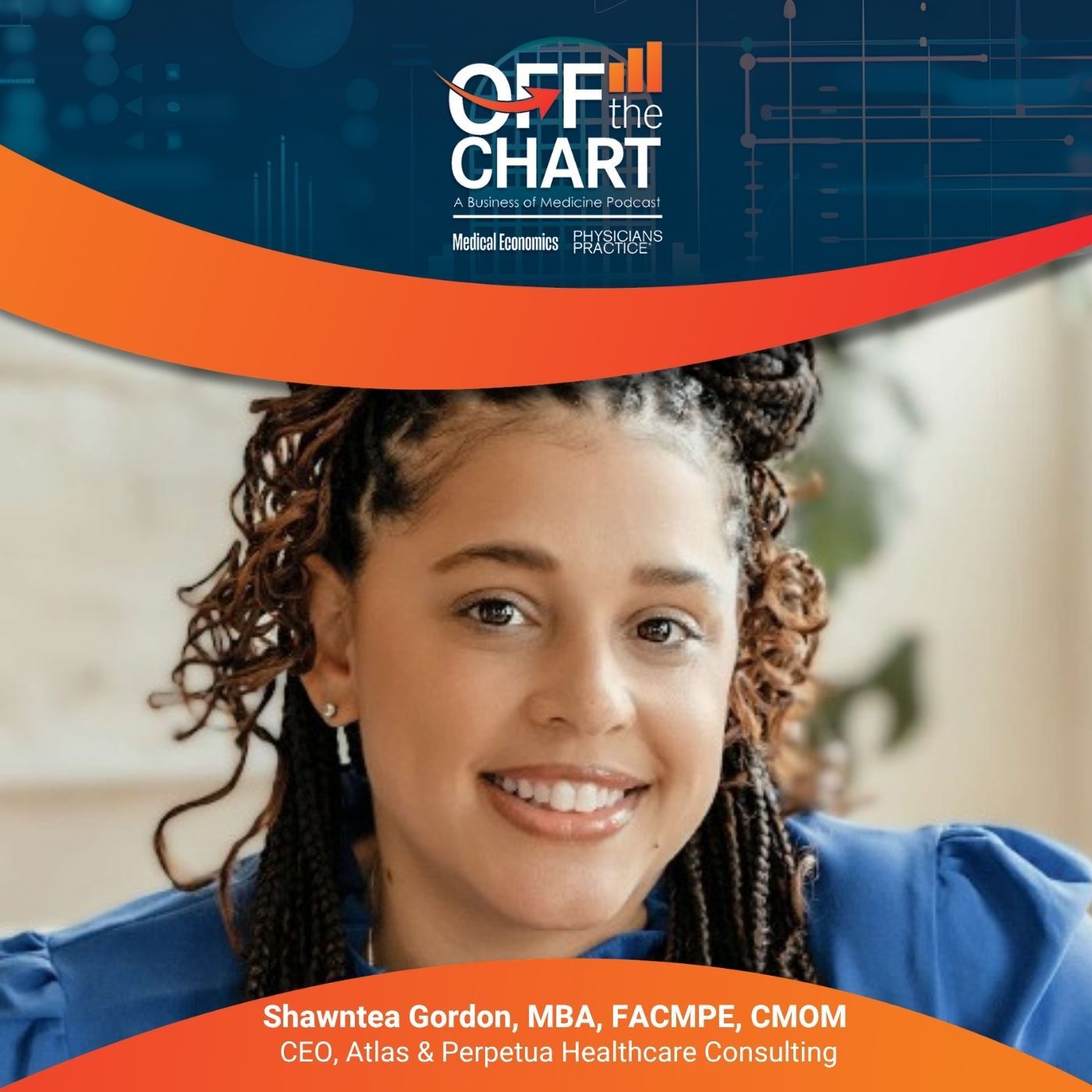
Medicare’s final 2027 physician fee schedule, released Nov. 4, cuts the conversion factor 2.31% for most clinicians starting Jan. 1, a deeper cut than CMS proposed in July. When an office visit billed with modifier -25 falls on the same day as a 0-day global procedure, Medicare will pay the lower-paid service at 80%, not the 50% CMS had proposed.Physicians Practice Managing Editor Keith Reynolds sat down with Shawntea “Taya” Gordon, MBA, FACMPE, CEO of Atlas & Perpetua Healthcare Consulting, the morning after the final rule came out to get her first read.Gordon says the scaled-back modifier -25 policy shows CMS heard commenters, but she won’t count it as a win while practices still have to work through so many steps to figure out what they’ll be paid. She compares the yearly conversion factor cuts to the sustainable growth rate (SGR) formula, saying “it almost feels like the SGR all over again.” She explains why billing teams need to know when the same-day reduction applies so they can appeal as other payers follow CMS. She also covers how replacing add-on code G2211 with modifier B1, a 16% increase in place of a flat amount, can throw off 2027 budgets practices have already finished, and which table in the rule she reads first.Gordon leads the 2 p.m. ET session at the Medical Economics Practice Academy: Beneath the Surface: Efficiency, Revenue and Burnout, a free virtual event on Thursday, Nov. 19, from 1 to 4 p.m. ET.More on the final rule: who’s cheering and who’s worried and what it changes for practices from Medical Economics, and reaction on billing, same-day visits and new codes and the same-day and G2211 changes from Physicians Practice.Music Credits: Cup of Coffee by Ionics - stock.adobe.comEditor’s note: Episode timestamps and transcript produced using artificial intelligence (AI) tools.0:00 – 0:25 | Cold open. Gordon on why the 2027 cut feels like the SGR all over again.0:25 – 1:32 | Introduction. Keith Reynolds introduces the special report, the final rule and Gordon.1:32 – 2:24 | First read. Gordon starts by looking at what CMS did and didn’t finalize, and says the modifier -25 changes show the agency listened to comments.2:24 – 3:40 | Is the modifier -25 change a win? A 50% cut would have devastated most groups, Gordon says, but a payment policy this complicated can’t count as a win.3:40 – 5:05 | Another conversion factor cut. Most of the 2.31% decline comes from the end of the one-year 2.5% increase for 2026. Gordon doubts Congress will step in during the lame-duck session.5:05 – 6:17 | Getting billing teams ready for modifier -25. Educate staff on when the reduction applies, set up alerts to catch incorrect payments and watch payer bulletins as other payers follow CMS.6:17 – 8:22 | G2211 becomes modifier B1. Why Gordon doesn’t mind the change, and how a percentage in place of a flat rate complicates 2027 budgets.8:22 – 11:40 | The first thing to do this week. Hold a team meeting, plan for each path the rule could take and start with the rule’s impact analysis table.11:40 – 12:20 | Closing thoughts. Gordon says practices are still early in digesting the rule and points to upcoming summaries from industry organizations.12:20 – [END] | Outro. Reynolds thanks Gordon and previews her Nov. 19 Practice Academy session.

Starting Jan. 1, most adults who got Medicaid through expansion will have to prove they’re working, in school, in job training or doing community service to keep their coverage under the 2025 reconciliation law known as H.R. 1. A recent survey found 44% of Medicaid members unprepared. Colby Takeda, M.P.H., MBA, co-founder and CEO of Pear Suite, says states and health plans are turning to community health workers to reach them.Medical Economics Associate Editor Austin Littrell sat down with Takeda, whose company helps community health workers contract with health plans and get paid. Takeda explains what those workers can and can’t do, where their nonclinical role ends on the medically frail exemption and whether Medicaid pays for redetermination outreach. He says that varies by state.He also covers how a small practice can hire community health workers, contract with them or reach them through community care hubs, and what physicians should ask their state and health plans before January. According to Takeda, one health plan reported that members who worked with a community health worker were three times more likely to see their primary care physician within six months.Register for the Medical Economics Practice Academy: Beneath the Surface: Efficiency, Revenue and Burnout, a free virtual event on Thursday, Nov. 19, from 1 to 4 p.m. ET: https://registration.medicaleconomics.com/November2026Don’t miss our recent episodes on heart health habits, Medicare’s 2027 fee schedule, the Medical Group Management Association’s 100th annual conference and maternity care gaps.Music Credits: Ocean Calm by Cephas - stock.adobe.com A Textbook Example by Skip Peck - stock.adobe.comEditor’s note: Episode timestamps and transcript produced using AI tools.0:00 – 0:25 | Cold open. Takeda on why community health workers shouldn’t be expected to keep doing this work for free.0:25 – 1:50 | Introduction. Austin Littrell introduces the episode and the guest and previews the Medical Economics Practice Academy on Nov. 19.1:50 – 3:50 | Inside Pear Suite. Takeda on building the documentation, contracting and billing setup that community-based organizations need to get paid by health plans.3:50 – 6:36 | Who community health workers are. From his start in senior care to the care coordinators, advocates and promotores who have done this work for decades without much connection to physicians.6:36 – 8:45 | What early states are seeing. Takeda on confusion in states like Nebraska and the first questions to ask about who leads the outreach.8:45 – 10:47 | Where coverage breaks down. Language barriers, tech literacy and fear of sharing personal information, and why trusted messengers matter.10:47 – 12:24 | Does Medicaid pay for the outreach? Reimbursement varies by state, and Takeda says assuming community health workers will do it for free is misguided.12:24 – 13:16 | P2 Management Minute. Keith Reynolds shares practice management tips and invites listeners to submit their own workflow ideas.13:16 – 15:37 | The medically frail exemption. Community health workers can’t diagnose or prescribe, and Takeda says one of their biggest jobs is connecting patients with a primary care physician.15:37 – 18:31 | How a practice can work with them. Hiring in house, contracting, partnering with community organizations or working through a community care hub.18:31 – 21:09 | The outcome data. Takeda on about 78% member engagement and one health plan’s finding that members were three times more likely to see their primary care physician within six months.21:09 – 22:23 | What to do before January. Learn your state’s and health plans’ strategies, and find the local organizations that can help patients with forms and work requirements.22:23 – 23:20 | Final thoughts. Takeda urges physicians to look for the community health workers already working in their area.23:20 – End | Outro. Littrell wraps the episode and reminds listeners about the Practice Academy.

Francisco Lopez-Jimenez, M.D., M.S., MBA, and Kyla M. Lara-Breitinger, M.D., M.S., are preventive cardiologists at Mayo Clinic and co-authors, with the late Amir Lerman, M.D., of the “Mayo Clinic Guide to a Healthy, Happy Heart.” More than 30 Mayo Clinic clinicians who see patients regularly contributed to the book.Earlier this year, Medical Economics Senior Editor Richard Payerchin sat down with Lopez-Jimenez and Lara-Breitinger. They explain how primary care physicians can steer patients who want one quick fix toward small changes that last. They also explain why the most useful goals are behaviors a patient controls, like eating less salt, instead of a blood pressure number.They also discuss normal weight obesity and the limits of body mass index (BMI), advanced lipid markers, how to bring patients’ home blood pressure readings into care and what primary care physicians should weigh before prescribing glucagon-like peptide-1 (GLP-1) drugs without a specialist on hand. Proceeds from book sales support the Mayo Clinic Cardiovascular Research Department.Don’t miss our recent episodes on Medicare’s 2027 fee schedule, MGMA’s 100th annual conference, maternity care gaps and interoperability.Music Credits:Ambient Jazz by AurbanniAudio - stock.adobe.comA Textbook Example by Skip Peck - stock.adobe.comEditor’s note: Episode timestamps and transcript produced using AI tools.0:00 – 0:48 | Cold open. Lopez-Jimenez on the question he asks patients who don’t own a blood pressure monitor: how many TVs they have.0:48 – 2:03 | Introduction. Austin Littrell introduces the episode and the guests.2:03 – 3:10 | Remembering Amir Lerman, M.D. Lopez-Jimenez describes his late co-author’s pioneering work on how the inner lining of the arteries functions.3:10 – 4:48 | Behind the book. Lara-Breitinger on the more than 30 contributors across Mayo Clinic campuses, and Lopez-Jimenez on why every one of them sees patients.4:48 – 7:50 | Beyond the quick fix. Lopez-Jimenez says the biggest benefit comes from going from doing nothing to doing something, and Lara-Breitinger explains why delayed gratification makes heart health a hard sell.7:50 – 12:25 | Goals patients can control. Simple goals that are easy to track, asking patients about their biggest source of stress and why eating less salt is a better patient goal than a blood pressure number.12:25 – 16:52 | Advanced markers and body fat. Lara-Breitinger on adding high-sensitivity C-reactive protein, lipoprotein(a) and apolipoprotein B to a lipid panel, and Lopez-Jimenez on making risk testing easier for patients to get.16:52 – 17:45 | P2 Management Minute. Keith Reynolds shares practice management tips and invites listeners to submit their own workflow ideas.17:45 – 22:18 | Talking about weight. Normal weight obesity, raising weight with tact and sensitivity, metabolically healthy patients with a higher BMI and why measuring waist circumference is hard in a 15- to 30-minute visit.22:18 – 28:25 | Home blood pressure data. Lopez-Jimenez on getting home readings into the electronic health record without burying physicians, why some devices aren’t reliable and why diagnosis should happen at home. Lara-Breitinger on why patients need to hear that blood pressure is a big deal.28:25 – 31:35 | GLP-1s without a specialist. Lara-Breitinger on the patients who clearly qualify, the harder cases at a BMI of 25 or 26 and the cost barrier for patients paying full price.31:35 – 35:57 | One thing to change. Lopez-Jimenez’s four tenets of prevention, and Lara-Breitinger on asking patients what brings them joy and lowering low-density lipoprotein cholesterol.35:57 – End | Outro. Payerchin thanks the guests and Littrell wraps the episode.

If the proposed 2027 Medicare physician fee schedule is finalized, real Medicare payment rates will be 35% below 2016 levels, according to Jonathan Ketcham, Ph.D., Earl and Gladys Davis Distinguished Research Professor in Business and professor of economics at Arizona State University. Ahead of the final rule, guest interviewer Cameron J. Sabet, M.S., MBA, M.A., a medical student at Georgetown University, sat down separately with Ketcham; Michael Chernew, Ph.D., Leonard D. Schaeffer Professor of Health Care Policy at Harvard Medical School and former chair of the Medicare Payment Advisory Commission (MedPAC); Miranda Yaver, Ph.D., assistant professor at the University of Pittsburgh; and David O. Meltzer, M.D., Ph.D., Fanny L. Pritzker Professor of Medicine and chief of the Section of Hospital Medicine at the University of Chicago. Medical Economics Senior Editor Richard Payerchin connects the interviews.Chernew explains why he doesn’t call the 2027 conversion factor drop a cut and why MedPAC still recommended paying above current law. Yaver says a proposed pay cut for evaluation and management visits on the same day as a procedure could mean more trips, copays and parking fees for older patients. Meltzer makes the case for hybrid payment models, and Ketcham says he would sunset the fee schedule altogether.Register for the Physicians Practice Practice Academy Series: Protecting Your Practice’s Revenue, a virtual event on Thursday, Oct. 29, from 12 to 4 p.m. ET: https://registration.physicianspractice.com/990031Music Credits: Distant Memories by Buurd - stock.adobe.com A Textbook Example by Skip Peck - stock.adobe.comEditor’s note: Episode timestamps and transcript produced using AI tools.0:00 – 0:57 | Cold open. Ketcham, Chernew, Yaver and Meltzer on payment rates, fairness, rationing and hybrid payment models.0:57 – 2:22 | Introduction. Austin Littrell introduces the episode and the experts and previews the Physicians Practice Practice Academy on Oct. 29.2:22 – 3:26 | Is it really a cut? Chernew says the 2027 conversion factor drop is the same as it would have been under current law once a temporary increase expired.3:26 – 5:18 | 35% below 2016. Ketcham says real Medicare rates have fallen sharply since 2016, commercial rates have tracked along and the result has pushed physicians toward consolidation.5:18 – 7:36 | When pay cuts become an access problem. Yaver notes 98% of non-pediatric physicians accept traditional Medicare, and Chernew explains why MedPAC found access adequate but still recommended paying more.7:36 – 9:00 | The same-day visit cut. Yaver says a proposed cut to visits billed on the same day as a procedure could spread care across more appointments for older patients.9:00 – 12:06 | Is Medicare paying for the wrong things? Meltzer on risk selection, the limits of pay for performance and how advanced primary care management fees helped his program’s primary care break even.12:06 – 12:58 | P2 Management Minute. Keith Reynolds shares practice management tips and invites listeners to submit their own workflow ideas.12:58 – 14:39 | Fairness vs. economics. Chernew argues physician pay comes down to what it costs to get the services we want, not what feels fair.14:39 – 15:57 | Does the fee schedule favor bigger practices? Ketcham says administrative and legal barriers, not medicine itself, push practices to grow, and the 2027 changes continue that momentum.15:57 – 17:31 | Paying for prior authorization work. Yaver on the Wasteful and Inappropriate Service Reduction (WISeR) Model pilot, nearly 53 million Medicare Advantage prior authorization requests in 2024 and one practice’s five-person prior authorization staff.17:31 – 18:23 | Sunset the fee schedule. Ketcham, back in academia after working in the White House, says he would get the government out of setting physician prices.18:23 – 19:42 | Do alternative payment models work? Chernew says they only have to be better than fee-for-service and urges small practices to look at conveners.19:42 – 20:56 | A fixed payment per patient? Meltzer warns flat per-patient payments invite avoiding sicker patients and says hybrid models matter.20:56 – 22:37 | The most important change. Yaver warns that well-intentioned policies, like prior authorization, can backfire and make care costlier.22:37 – End | Outro. Littrell thanks the experts and wraps the episode.

Comments

Download from Google Play

Download from App Store
 United States