


 Claim Ownership
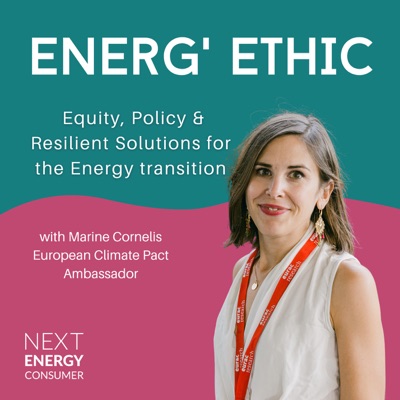
Energ’Ethic - Climate Justice and Energy Transition
Subscribed: 7Played: 116
Subscribe

© Marine Cornelis
Description
Energ'Ethic asks the question most energy debates skip: who the transition is for. Hosted by Marine Cornelis, founder of Next Energy Consumer, each episode moves between frontline reality and the rooms where European energy policy is decided. The conversations follow one thread through energy, housing, digitalisation, and finance: whether the systems being built earn people's trust and improve their lives. For listeners, it offers a grounded guide to a transition too often told only in megawatts and money. For anyone weighing a collaboration, it shows how Next Energy Consumer reads the field.
For organisations and sponsors: Energ'Ethic offers partnership opportunities for organisations seeking to reach a senior, policy-literate audience. Partnerships are selective and editorially independent. Contact: [email protected] (mailto:[email protected])
Hosted on Ausha. See ausha.co/privacy-policy for more information.
107 Episodes
Reverse

Citizens stop attending participation meetings dominated by the loudest voice in the village. Tenants stop lodging complaints when they no longer believe anyone is listening. The energy transition assumes a dialogue that, in many places, has already broken down. The institutions able to repair it, the mediator who steps in before conflict escalates and the ombudsman who steps in after the damage is done, remain treated as peripheral services.Urszula Papajak is a newly certified mediator for infrastructure and energy transition projects, with years of work on citizen energy and decentralised energy systems. She works on conflict at three layers: boards, teams, and whole villages facing a wind or PV project. In this episode, Ula also turns the questions back on me, on my years with the energy ombudsman and on the research behind our book on access to justice for vulnerable consumers.We discuss:Why democracy depends on people believing they can disagree without destroying each otherHow meeting structures that reward interruption push thoughtful, constructive voices out of the roomWho calls in a mediator, and why acknowledging conflict still carries a stigmaWhy people facing energy poverty rarely seek the redress they are entitled toLegal versus fair, nice versus empatheticWhy conflict competence grows only through human interaction, and why AI carries no accountabilityA conversation about trust as infrastructure, built through agency, empathy, accountability and belonging.Reference: Access to Justice for Vulnerable and Energy-Poor Consumers: Just Energy? (2021)Listen also to the episode with Dr Naomi Creutzfeldt and Dr Chris Gill. Marine Cornelis is the founder of Next Energy Consumer, a policy consultancy working on energy poverty, consumer rights, and housing at EU level. If you are working on a related mandate or research question, you can reach her at [email protected]' Ethic goes out every other week.Keep up to date with new episodes straight from your inboxReach out to Marine Cornelis via BlueSky or LinkedInMusic: I Need You Here - KamariusEdition: Podcast Media Factory Support Energ'Ethic on Patreon© Next Energy Consumer, 2026Hosted on Ausha. See ausha.co/privacy-policy for more information.

Markets do not correct themselves simply because a problem becomes visible. Correction usually needs an actor with a legal mandate, the evidence to support a claim, and enough independence to make companies and regulators respond. In Great Britain, that actor has held authority in energy and postal services for years, and now argues for extending the model into housing, telecoms, water, and financial services.Tom Lowe leads the energy networks and systems team at Citizens Advice, the statutory consumer advocate for domestic, small business, and heat network consumers in Great Britain. Sixteen years across energy suppliers, trade associations, regulators, and consumer advocacy inform his argument that a legal mandate, rather than goodwill, is what makes a market answerable to the people it serves.In this conversation:Why a statutory mandate changes how companies and regulators respond to a consumer body, compared with a voluntary or campaigning oneThe fifteen year path from identifying a problem with energy brokers to direct regulation by OfgemThe case made in Building Better Markets for extending the model into housing, telecoms, water, and financial servicesHow the advocate function is funded through an industry levy, and what protects that funding from becoming a dependency on the sector it holds accountableWhat an EU member state would need in place to replicate the model beyond the United KingdomThe conversation returns to a question that outlives any single sector: what a market owes the people who cannot easily walk away from it, and who holds the mandate to make sure it delivers.Energ'Ethic, with Marine Cornelis of Next Energy Consumer: the energy transition examined through the people it touches and the systems that govern it. If you are working on a related mandate or research question, you can reach her at [email protected]' Ethic goes out every other week.Keep up to date with new episodes straight from your inboxReach out to Marine Cornelis via BlueSky or LinkedInMusic: I Need You Here - KamariusEdition: Podcast Media Factory Support Energ'Ethic on Patreon© Next Energy Consumer, 2026Hosted on Ausha. See ausha.co/privacy-policy for more information.
Some of the most consequential facts about an energy system never appear on a policy dashboard: whether an 85-year-old can read her own bill, whether she knows help exists, whether she trusts the voice on the phone enough to answer it.Nina Campbell, Global Energy Lead at Consumers International, led the Blueprint for Inclusive Energy Services, the report examining a liberalised, choice-based energy market from the perspective of Italians aged 75 and over. Marine co-authored the Blueprint and brings that collaboration into this conversation on trust, exclusion, and who a market is actually built for.In this episode:– Why Consumers International moved away from "vulnerable consumer" toward "energy hardship," and what that shift changes about people's willingness to ask for help– The loyalty premium: why discovering you paid more for staying put damages trust more deeply than a plainly bad deal– The invisible labour of carers, 16% of Italians in a caregiving role around energy, mostly women over 45, absorbing costs the system doesn't recognise– How the Blueprint's ten solutions took shape through direct collaboration with suppliers– What it would take to replicate this method for other consumer groups and other marketsReference: Blueprint for Inclusive Energy Services, Consumers International. (2026)Energ'Ethic, with Marine Cornelis of Next Energy Consumer: the energy transition examined through the people it touches and the systems that govern it. If you are working on a related mandate or research question, you can reach her at [email protected]' Ethic goes out every other week.Keep up to date with new episodes straight from your inboxReach out to Marine Cornelis via BlueSky or LinkedInMusic: I Need You Here - KamariusEdition: Podcast Media Factory Support Energ'Ethic on Patreon© Next Energy Consumer, 2026Hosted on Ausha. See ausha.co/privacy-policy for more information.
EUSEW turns 20. To mark it, Marine Cornelis sits down at the European Sustainable Energy Week with three people who have spent two decades inside EU energy policy: Thomas Nowak (heat pumps and buildings), Dušan Jakovljević (industrial energy efficiency) and Heike Winkler (offshore wind and the North Sea).The conversation treats EUSEW as a mirror. What it foregrounds, and what it sidelines, tracks whatever the Commission has in vogue, from hydrogen to carbon capture, often at the expense of people, consumers and energy poverty.What we get into:Why a convening that reflects priorities struggles to set them, and how limited slots turn the agenda into a zero-sum gameElectrification as the efficient core of the system, and the "primary energy fallacy" still used against itRe-industrialisation, green hydrogen and jobs, and where a top-down European approach might have moved fasterThe single market's unfinished business, and the real cost of member-state deviationsWhy EUSEW keeps talking to the already-convinced, and how to bring member states and silos into the same roomParallel agendas, from the New European Bauhaus to energy poverty and citizen advisory hubs, and the risk of fragmentationA stocktake of what changed, what was harder than it should have been, and what a fair, socially accepted transition still demands.Energ'Ethic, with Marine Cornelis of Next Energy Consumer: the energy transition examined through the people it touches and the systems that govern it. If you are working on a related mandate or research question, you can reach her at [email protected]' Ethic goes out every other week.Keep up to date with new episodes straight from your inboxReach out to Marine Cornelis via BlueSky or LinkedInMusic: I Need You Here - KamariusEdition: Podcast Media Factory Support Energ'Ethic on Patreon© Next Energy Consumer, 2026Hosted on Ausha. See ausha.co/privacy-policy for more information.
You have more energy rights than you think, and the EU's Unlock Your Power campaign wants you to start using them.Most of us never think about our energy rights until a bill stops adding up or a supplier gets something wrong. That is the day those rights are tested in real life, and the day you find out whether they mean anything at all.Recorded live on launch day at EU Sustainable Energy Week, Marine speaks with Katarzyna Wolos of European Commission's DG Energy about Unlock Your Power, the European Commission's first awareness campaign on consumer energy rights. Built around ordinary life stages rather than legislation, it rests on one idea: the power to understand, choose and act is already yours.In this conversation:Why awareness is the weak link when only a third of Europeans say they fully understand their billHow the Citizens Energy Package becomes real: protection from disconnection, transparent billing, the right to join an energy communityOne message across three realities: cooling in Greece, heating in Czechia, shared solar in SpainRedress as the invisible right, and why knowing a door exists changes how people actTrust as a confident relationship with the unknown, and what that asks of institutionsA companion to Ep "The Public Square" with Ewelina Hartstein, the episode sits where consumer rights, vulnerability and the credibility of EU energy policy meet.Campaign: Unlock Your Power: https://energy.ec.europa.eu/topics/markets-and-consumers/energy-consumers-and-prosumers/unlock-your-power_enMarine Cornelis is the founder of Next Energy Consumer, a policy consultancy working on energy poverty, consumer rights, and housing at EU level. If you are working on a related mandate or research question, you can reach her at [email protected]' Ethic goes out every other week.Keep up to date with new episodes straight from your inboxReach out to Marine Cornelis via BlueSky or LinkedInMusic: I Need You Here - KamariusEdition: Podcast Media Factory Support Energ'Ethic on Patreon© Next Energy Consumer, 2026Hosted on Ausha. See ausha.co/privacy-policy for more information.

Comments

Download from Google Play

Download from App Store
 United States