


 Claim Ownership
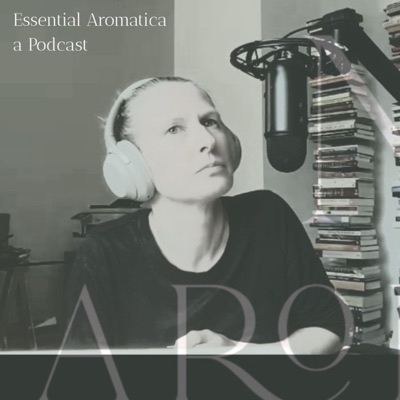
Essential Aromatica
Subscribed: 16Played: 204
Subscribe

© Amy Anthony
Description
Aromatherapy is more than essential oils—it's an invitation to connect with nature and the chemistry of the botanical world.
On Essential Aromatica, certified aromatherapist, herbalist, distiller, gardener, and educator Amy Anthony explores the intricate relationship between plants, their aromatic compounds, and their profound effects on us. Essential oils are not mere fragrances; they are chemical messages influencing our emotions, physiology, and state of mind. The Latin word sentir—meaning both "to smell" and "to feel"—reminds us that aromatic molecules are deeply entwined with experience.
On Essential Aromatica, certified aromatherapist, herbalist, distiller, gardener, and educator Amy Anthony explores the intricate relationship between plants, their aromatic compounds, and their profound effects on us. Essential oils are not mere fragrances; they are chemical messages influencing our emotions, physiology, and state of mind. The Latin word sentir—meaning both "to smell" and "to feel"—reminds us that aromatic molecules are deeply entwined with experience.
82 Episodes
Reverse

This episode explores aromatherapy, myth, seasonality, and ritual through the lens of Demeter, the archaic goddess of grain, humus, nourishment, and the threshold between life and death. Essential Aromatica blends the art and science of aromatherapy, olfaction, and plant‑based wisdom for listeners seeking an expanded aromatic education.Before Demeter was framed primarily as Persephone’s mother, she was a sovereign, earth‑bound goddess whose realm encompassed agriculture, ripening, decay, humus, and the cyclical return that defines human life. In this episode, I explore her earlier identity, the meaning of Thesmophoros, the rites of the Thesmophoria, and the Eleusinian Mysteries — experiential rituals of fasting, procession, darkness, illumination, and symbolic rebirth. These rites reveal Demeter’s function: life becomes nourishment, becomes death, becomes life again.This episode is personal. I reflect on the importance of ritual and how modern life lacks meaningful initiatory rites that shape character and psyche. I share how Demeter’s teachings — descent, dissolution, humus, and return — offer a framework for working with the ego, the shadow, and transformation. I also introduce an essential‑oil synergy for early autumn featuring carrot seed, cardamom, and other wonderful aromatic allies aligned with Demeter’s season of nourishment, grounding, and descent. The episode closes with an original poem, The Rotting Return, composed to honor Demeter’s chthonic wisdom.Keywords: aromatherapy, essential oils, Demeter, Eleusinian Mysteries, Thesmophoria, ritual, archetypes, mythology, autumn, psyche, transformation.Sources of note: Vinciane Pirenne-Delforge. Demeter as Thesmophoros: What Does She Bring Forth?. Alaya Palamidis; Corine Bonnet. What’s in a Divine Name?, De Gruyter, pp.185-204, 2024, 978-3-11-132651-1. ⟨10.1515/9783111326511-011⟩. ⟨hal-04799047⟩Investigating the psychedelic hypothesis of kykeon, the sacred elixir of the Eleusinian Mysteries; https://doi.org/10.1038/s41598-026-39568-3

This episode explores aromatherapy, myth, and aromatic extracts through the lens of Medusa: the ancient Gorgoneion, a boundary keeping feminine force that guarded thresholds and petrified danger. Essential Aromatica blends the art and science of aromatherapy, olfaction, and plant-based wisdom for listeners seeking an expanded aromatic education.Before Medusa was recast as a monster and beheaded by Perseus, she was a Gorgoneion: a fierce symbol placed at sacred thresholds, food stores, ovens, and ritual spaces to stop wrongdoing and turn harmful forces away. In this episode, I trace how the Gorgoneion became the Gorgon and then Medusa, and why reclaiming the original function matters psychologically today. This episode is personal. I’ve been holding Medusa’s aegis metaphorically at my heart while working with psychosocial-energetic boundaries. I share an original poem, titled “Destructive Distillation: Creation of an Aromatic Aegis” and introduce fire born aromatic extracts, including Choya Luban, and Alligator Juniper struck by lightning as aromatic allies to support boundary keeping.Keywords: aromatherapy, essential oils, medusa, gorgon, archetypes, plant medicine, boundary keeping, feminist mythology, feminism.Sources of note: The cover art contains Franz von Stuck’s Medusa II.Finlayson C, Gutierrez Lopez JM, Reinoso delRio MC, Saez Romero AM, Giles Guzman F, et al. (2021) Wheremyth and archaeology meet: Discovering the Gorgon Medusa’s Lair. PLOS ONE16(4): 0249606. https://doi.org/10.1371/journal.pone.0249606Feldman, Thalia. “Gorgo and the Origins of Fear.” Arion:A Journal of Humanities and the Classics, vol. 4, no. 3, 1965, pp. 484–94. JSTOR, http://www.jstor.org/stable/20162978.Accessed 24 Aug. 2026.Lazarou, Anna. “Prehistoric Gorgoneia: a CriticalReassessment.” Studia Antiqua Et Archaeologica, vol. 25, no. 2, 2019, pp.353–385.

This episode continues season five’s exploration of aromatherapy, essential oils, archetypes, and seasonality, with Episode 8 featuring Carrot Seed (Daucus carota) essential oil and the Hera goddess archetype. Essential Aromatica blends the art and science of aromatherapy, seasonal and lunar themes, and plant-based wisdom for listeners seeking an expanded aromatic education.In this episode, I explore Hera’s original civic sovereignty—governance, continuity, and civility—in real-world moments when social order falters. We are in mid-summer, when heat amplifies Zeus and Ares, and the need for Hera’s stabilizing container becomes apparent, but only when she removes herself and things fall apart.I then turn to Carrot Seed essential oil as a mature, mid-to-late summer aromatic ally: dry, earthy, unadorned, and structurally supportive. This plant and its essential oil are utterly Hera. I share its grounding and continuity-focused qualities, share my poem written for Queen Anne’s Lace, and offer essential oil guidance and safety notes. [1, 2, 3]Find the full plant profile here: https://nycaromatica.com/carrot-seed-essential-oil/Find the poem here: https://nycaromatica.com/a-poem-for-queen-annes-lace/Keywords: aromatherapy, essential oils, plant medicine, olfaction, herbalism, archetypes, goddess Hera, carrot seed essential oil, civics, Greek gods, Greek goddesses, botanical intelligence, seasonal wellness, depth psychology

Aphrodite, Zeus, Eros, Myrtle, and Laurel come together in this early summer audio essay exploring archetypes, seasonality, and the embodied intelligence of aromatic plants and aromatherapy.Season 5, Episode 7 traces Aphrodite’s primordial origins, her solar yin brilliance, and her dark, warrior lineage long overshadowed by patriarchal retellings. We look at how Aphrodite embodies Eros — the spark of creation, aliveness, and valuation — and why she requires a Healthy Zeus: the steady sky container capable of holding her transformative force without collapsing into domination.Through mythology, seasonality, and embodied aromatherapy, we explore:• Aphrodite as solar yin — radiance, relationality, alchemy, and the Sublime• Zeus as mature yang — structure that serves life, not ego• Eros as the primordial lifeforce that demands presence and awakens the soul• Myrtle (Myrtus communis) as Aphrodite’s refined, relational yin• Laurel (Laurus nobilis) as Zeus’s bold clarity and soul igniting fireTogether, these archetypes and plants illuminate the polarity of early summer: aliveness needing a container, and structure needing soul.Aromatherapy, mythology, and seasonal intelligence converge here — an invitation to meet the world with presence, courage, and the spark of Eros.Cover Art Artwork by Marco Luccio, from the series "Reverse Archaeology: Metamorphosis of Aphrodite". Used with permission. Explore the full series: marcoluccio.com.auPlant Allies Full articles + garden plant talk videos for Myrtle and Laurel at nycaromatica.comReferenced in this Episode This Jungian Life podcast episode APHRODITE’S SHADOW: Drowning in Beauty

This episode explores Apollo, the Muses, Memory, and Helichrysum—where mythology, culture, and aromatherapy meet.As the season turns from Artemis to Apollo, I look at what happens when the young yang aspects of the psyche mature into clarity, direction, and mastery — and what collapses when that masculine principle forgets its lineage. We explore the Muses as channels of collective memory, Mnemosyne as the river that keeps hubris in check, and Apollo Musagetes as the conductor who can only function when he’s in right relationship with them.I talk about the Duchamp exhibit at MoMA and the cultural drift into “look culture,” drawing on Sophie Gilbert’s Girl on Girl and the long shadow of the AIDS crisis — how desire moved into the visual realm and left us with a disembodied gaze. We trace how this shift severed Apollo from the Muses, leaving us with spectacle instead of depth, performance instead of relationship.And then we return to the body — to aromatherapy as an embodied antidote. To the intelligence of aromatic molecules and their direct line to memory, emotion, and meaning. This leads us to Helichrysum — Immortelle — a plant of memory and deep healing. A plant that cools swollen yang, steadies drifting yin, and reminds us that creation is never ours alone.If you’re drawn to myth, memory, culture, and the living intelligence of aromatic plants, this episode will meet you where you are.Access the companion article here.

Comments

Download from Google Play

Download from App Store
 United States