


 Claim Ownership
The Better Architecture Project
Subscribed: 9Played: 47
Subscribe

© Shubhayan M
Description
BetterArch.org is a spatial research agency that situates the architectural praxis within the larger political economy, mapping the causalities that shape how the built environment is conceived, produced, and lived while provoking designers into rigorous self-reflection through critical conversations.
Housed in India, BetterArch aims to bring you raw, unadulterated discourses right from the hearts of the ones bearing the brunt of the architect life!
38 Episodes
Reverse

Season 2: Architecture X Media StudiesEp. 31: The Salone 'Look'Manju Sara Rajan discusses how architecture/interiors media in India shifted from print-first to digital-first, with social media shrinking print runs and forcing constant content output, creating an undeclared hierarchy between print and digital. Rajan argues print isn’t dead but must offer longevity and value beyond digital, while magazines must rethink frequency and differentiation. She describes competing now with individual creators, the absence of design criticism because people have low tolerance for opinion, and the need for writing that adds meaning beyond imagery and buzzwords. At Beautiful Homes (under Asian Paints), she prioritizes homeowner-led, lived-in spaces amid homogenized aesthetics. She contrasts biennales as democratic, non-transactional idea platforms versus commercial design fairs. She advises young writers to read widely and develop voice, flags ChatGPT’s sterile copy, emphasizes individual responsibility over more roundtables, and urges designers to integrate client personality, memory, and contextual craft, with stronger architecture–interiors education overlap.Guest: Manju Sara RajanDesignation: Editor-in-Chief, Beautiful Homes India.Bio: Manju Sara Rajan is an author, editor, and arts manager, and is presently the Editor-in-Chief of beautifulhomes.com, India’s largest design and décor content platform, by Asian Paints, where she also serves as a Senior Advisor on special projects. Since 2023, MSR has run a series of design-related events called The Makers’ Trail in Bangalore, where she was also part of the founding team of KAASH, an arts space in the city. She is the former CEO of the Kochi Biennale Foundation, where she oversaw the management of Kochi-Muziris Biennale 2016. She was the founding editor of the Indian edition of Architectural Digest and a Contributing Editor for Vogue. MSR began her career in 2002 as a Reporter in Time magazine’s Asia bureau in Hong Kong, before moving to India and media publications like Indian Express, Mint Lounge, and Open. She has been a columnist for Mint Lounge and is the co-author of the book My Life As A Comrade, the memoir of Kerala’s former Health Minister KK Shailaja. LinkedIn | Instagram | Facebook- - - - - - - - - - - - - - - - - - - - - - - - - - - - - -Website: www.betterarch.orgLinkedIn: https://www.linkedin.com/company/betterarch/Instagram: https://www.instagram.com/betterarch_org/Twitter: https://www.x.com/betterarch_org/Facebook: https://www.facebook.com/betterarch.org/Copyright 2026 @ The Better Architecture Project.

Season 2: Architecture X Media StudiesEp. 30: A Publisher's PathAriadna argues that books remain vital amid short-form digital media because they are curated, researched, and irreversible once printed. She describes an organic shift from architectural practice, writing, and urban criticism in Barcelona to publishing a book on her late father and then building a catalog-led program focused on architectural travel guides, Indian architecture and cities, monographs, and new mini-books planned years in advance. She outlines the bookmaking workflow: manuscript and material collection, peer review, design/layout, copyediting, drawing and image preparation, print-proofing, and production, followed by the harder work of sales via distributors, bookshops, launches, word of mouth, and social media. She stresses balancing text with drawings/images, calls for stronger writing and reading cultivation in architecture education, sees AI as a useful tool for editing/summarizing but not for generating ideas, and identifies independent publishing’s main constraints as economics, distribution dominance, and weak institutional support, advocating more open forums around architectural media and publishing.Guest: Ariadna A. GarretaDesignation: Architect & Director, Altrim PublishersBio: Ariadna A. Garreta is an architect, editor, and adviser. She has completed her Master’s degree from the Barcelona Technical School of Architecture (ETSAB, Spain). She has been a member of the College of Architects of Catalonia (COAC) assembly, where she has developed various positions for the COAC Barcelona delegation. She has been advising the Barcelona City Council and has been a member of the Barcelona Fundació Mies van der Rohe Board of Trustees. In India, she has been Director at CEPT University Press.She has been practising architecture with her father, Dr. Miquel Alvarez Trincado, at Altrim Studio since 1999, and she has been the Director since 2008. She has taught at the School of Architecture (EsArq) at the International University of Catalonia (UIC). She used to write for several Catalan and Spanish newspapers and Design and Architecture magazines. In 2010, she founded the Barcelona-based publishing company Altrim Publishers to provide a new platform for the promotion of architecture and city planning focused on India and Southeast Asia. In 2012, she settled in Chandigarh (India), where she is developing a series of book guides under the title of Southeast Asia & Indian Architectural Travel Guides. She has been the Director of CEPT University Press (Ahmedabad) and Coordinator at The Aditya Prakash Foundation (Chandigarh). She is currently a member of the Advisory Board of Poornima University (Jaipur, India), School of Planning & Architecture, Research & Consultancy Cell.Website | LinkedIn | Instagram | LinkedIn (P) | Instagram (P)- - - - - - - - - - - - - - - - - - - - - - - - - - - - - -Website: www.betterarch.orgLinkedIn: https://www.linkedin.com/company/betterarch/Instagram: https://www.instagram.com/betterarch_org/Twitter: https://www.x.com/betterarch_org/Facebook: https://www.facebook.com/betterarch.org/Copyright 2026 @ The Better Architecture Project.

Season 2: Architecture X Media StudiesEp. 29: The Listening Frame, Soumya DasguptaPart two of the continuing conversation shifts from architectural media’s narratives to how criticality is (and isn’t) cultivated through academia, especially in India. The episode argues that professional architectural education prioritizes technical and problem-solving skills while sidelining critical thinking. Critique is inherently marginal, political, and often mistaken for complaining. Critical thinkers need critical listeners, and professional architectural education must provide the pedagogical infrastructure to support this. Soumya contends this is a global issue, but more intense in India because institutions and the profession are structured to keep architecture technocratic, apolitical, and aligned with capital and state power, making the “visionary architect” largely a marketing myth and most graduates “architectural workers”. The episode also discusses building critical listening through sustained conversation and exposure to humanities beyond architecture, discussing how access barriers may be overcome by multilingualism and translation, and cautioning that formal organizations for discourse can quickly become bureaucratic and uncritical.Guest: Soumya DasguptaDesignation: Architectural ScholarBio: Soumya is a Ph.D. Candidate in Architecture (History and Theory) at the University of Illinois Urbana-Champaign, USA. He is a recipient of the Humanities Research Institute Graduate Fellowship and the Illinois Distinguished Fellowship. He holds a certificate from the School of Criticism and Theory, Cornell University. He holds a Master's in Urban Design from SPA Delhi and a B.Arch. from IIEST Shibpur (Erstwhile BESU Shibpur). His scholarly interests include neoliberal developmentalism, digital technocracy, the Global South, and South Asia, and his Ph.D. dissertation broadly explores the contested systems of architectural production in the rapidly transforming context of 21st-century urban India.Website | LinkedIn | Instagram | Facebook- - - - - - - - - - - - - - - - - - - - - - - - - - - - - -Website: www.betterarch.orgLinkedIn: https://www.linkedin.com/company/betterarch/Instagram: https://www.instagram.com/betterarch_org/Twitter: https://www.x.com/betterarch_org/Facebook: https://www.facebook.com/betterarch.org/Copyright 2026 @ The Better Architecture Project.
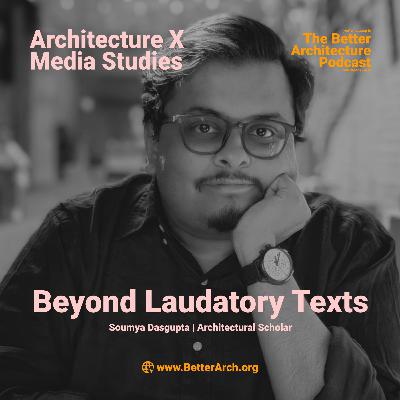
Season 2: Architecture X Media StudiesEp. 28: Beyond Laudatory Texts, Soumya DasguptaThis episode features a candid, critical conversation with Soumya Dasgupta on the intersection of architecture, media, and political economy in India and the West. The episode exposes the dominance of architects’ narratives, the absence of criticality, and the systemic inequalities within the profession. Soumya challenges the status quo, urging for uncomfortable but necessary dialogues about power, capital, and the future of architectural practice.Guest: Soumya DasguptaDesignation: Architectural ScholarBio: Soumya is a Ph.D. Candidate in Architecture (History and Theory) at the University of Illinois Urbana-Champaign, USA. He is a recipient of the Humanities Research Institute Graduate Fellowship and the Illinois Distinguished Fellowship. He holds a certificate from the School of Criticism and Theory, Cornell University. He holds a Master's in Urban Design from SPA Delhi and a B.Arch. from IIEST Shibpur (Erstwhile BESU Shibpur). His scholarly interests include neoliberal developmentalism, digital technocracy, the Global South, and South Asia, and his Ph.D. dissertation broadly explores the contested systems of architectural production in the rapidly transforming context of 21st-century urban India.Website | LinkedIn | Instagram | Facebook- - - - - - - - - - - - - - - - - - - - - - - - - - - - - -Website: www.betterarch.orgLinkedIn: https://www.linkedin.com/company/betterarch/Instagram: https://www.instagram.com/betterarch_org/Twitter: https://www.x.com/betterarch_org/Facebook: https://www.facebook.com/betterarch.org/Copyright 2025 @ The Better Architecture Project.
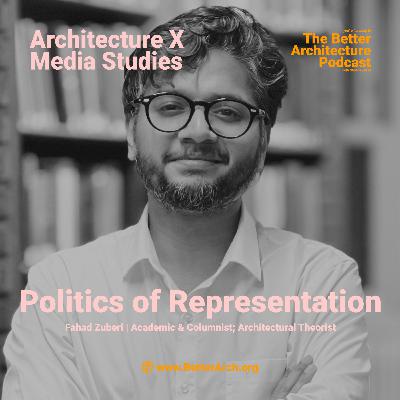
Season 2: Architecture X Media StudiesEp. 27: Politics of Representation, Fahad ZuberiFahad Zuberi delivers a sharp, historically grounded critique of how architecture is represented in India, tracing its journey from the ancient glorification of rulers to the colonial manipulation of meaning and the current dominance of PR-driven narratives. He argues that all representation is inherently political, shaped by the values and goals of those in power, and warns against the dilution of meaning when criticality is replaced by commercialism. Fahad distinguishes genuine critique—rooted in hope, ethical responsibility, and the aspiration for a better future—from cynicism and empty praise, emphasizing the need for rigorous theory, public engagement, and investment in the humanities. He calls for a clear separation between PR and criticism, urges architectural media to reclaim meaning and judgment, and insists that building a thoughtful, critical discourse is essential for shaping the worlds we want to inhabit.Guest: Fahad ZuberiDesignation: Academic & Columnist, Doctoral Scholar (Architectural History, Theory & Criticism)—Massachusetts Institute of Technology, USABio: Fahad is an academic and columnist, currently pursuing a PhD at MIT's Department of Architecture HTC. His work focuses on the intersection of architecture and violence, particularly in South Asian contexts. Fahad studied B. Arch at Aligarh Muslim University, an M. Arch HTC at CEPT University, Ahmedabad, and then pursued an MSc in Modern South Asian Studies at the University of Oxford as the Indira Gandhi Radhakrishnan Scholar with the Oxford India Centre for Sustainable Development, where he was awarded the Archibald Jackson Prize 2024 and Scholars Development Award 2024 for his work on Domicide.Fahad has taught Architecture and Design Philosophy at CEPT University and at the National Institute of Design in Ahmedabad as visiting faculty and is a columnist and political commentator with several Indian platforms, such as The Indian Express, The Hindu, The Wire, and The Hindustan Times. Fahad has also worked as a comics journalist and in electoral politics, and seldom composes music. He is the Producer of Mutant: The Democracy Podcast—conceived as a contemporary dictionary of politics—with the Institute of New Global Politics, Cal Poly Pomona, and his first feature-length film as a Music Director - Kayo Kayo Colour?—premiered at IFF, Rotterdam 2023.LinkedIn | Facebook | X/Twitter | MIT Portal- - - - - - - - - - - - - - - - - - - - - - - - - - - - - -Website: www.betterarch.orgLinkedIn: https://www.linkedin.com/company/betterarch/Instagram: https://www.instagram.com/betterarch_org/Twitter: https://www.x.com/betterarch_org/Facebook: https://www.facebook.com/betterarch.org/Copyright 2025 @ The Better Architecture Project.

Comments

Download from Google Play

Download from App Store
 United States