


 Claim Ownership
IFPRI Podcast
Subscribed: 54Played: 1,334
Subscribe

© All rights reserved
Description
The International Food Policy Research Institute (IFPRI) provides research-based policy solutions to sustainably reduce poverty and end hunger and malnutrition in developing countries. Established in 1975, IFPRI currently has more than 600 employees working in over 50 countries. It is a research center of CGIAR, a worldwide partnership engaged in agricultural research for development.
563 Episodes
Reverse

Policy Seminar | IFPRI Policy Seminar
Double exposure: How El Niño and the Iran crisis could reshape food security
October 8, 2026
Both El Niño and the ongoing crisis in Iran threaten to disrupt the global food system and affect food prices through impacts on agricultural production, energy and fertilizer markets, and trade. National governments and international partners face pressure to respond to effects on global markets and prices, as well as the more immediate shocks to production and input costs at the country level. These shocks can have broad implications for countries, as reduced crop and livestock production and higher fuel and fertilizer costs can negatively affect economic growth, poverty, and food security.
Join us for this IFPRI policy seminar examining the implications of overlapping climate and geopolitical shocks for food security. The seminar will feature complementary perspectives on risks at the global level and new IFPRI modeling of direct impacts in Malawi, Kenya, Ethiopia, India, and Guatemala. These presentations will emphasize the range of possible outcomes across countries and scenarios rather than offering a single forecast. A policy-focused panel will then discuss responses to these risks, where important gaps remain, how efforts can be tailored to different country contexts, and what constrained public finances and reduced foreign assistance mean for preparedness and response.
Opening Remarks
Johan Swinnen, Director General, IFPRI
Potential Impacts of El Niño and Iran
Joseph Glauber, Research Fellow Emeritus, IFPRI
Emerta Aragie, Research Fellow, IFPRI
Panel Discussion: Response Priorities Amidst Fiscal Constraints
Richard Choularton, Director, Climate and Resilience Service, World Food Programme (WFP)
Natasha Mbengo, Chief Disaster Preparedness Officer, Department of Disaster Management Affairs (DoDMA), Government of Malawi
Ashley Pople, Economist, The World Bank
Closing Remarks
Ruth Hill, Director, Markets, Trade, and Institutions, IFPRI
Moderator
Chris Hillbruner, Program Head, Global Food Security Program, IFPRI
More about this Event: https://www.ifpri.org/event/double-exposure-how-el-nino-and-the-iran-crisis-could-reshape-food-security/
Subscribe IFPRI Insights newsletter and event announcements at www.ifpri.org/content/newsletter-subscription
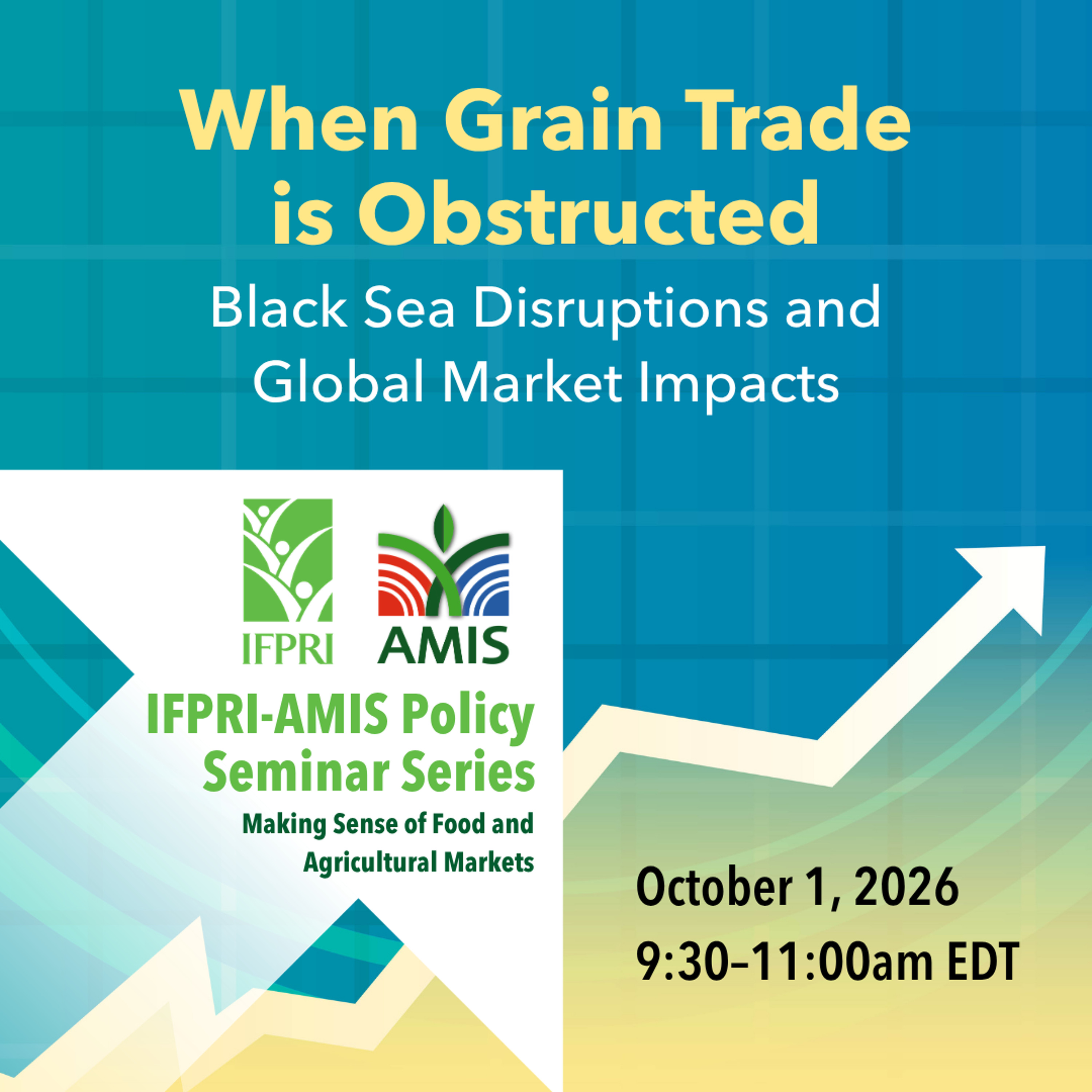
Policy Seminar | IFPRI Policy Seminar
When Grain Trade Is Obstructed: Black Sea Disruptions and Global Market Impacts
Co-organized by IFPRI and Agricultural Market Information System (AMIS)
October 1, 2026
The Black Sea region plays a critical role in global agricultural trade, supplying a significant share of internationally traded wheat, maize, and oilseeds. Yet ongoing disruptions to transport and export logistics—including damage to port infrastructure, shifting trade routes, rising freight and insurance costs, and heightened operational uncertainty—are affecting exports of agricultural commodities from the region. While global grain supplies remain generally adequate, constraints to moving grain efficiently can alter trade patterns, increase costs, and contribute to greater market uncertainty.
This seminar will examine how continued logistical disruptions in the Black Sea region are reshaping agricultural markets and affecting global food security. Bringing together market analysts and industry practitioners, the discussion will explore the implications for grain exporters, import-dependent countries, traders, and shipping service providers. Particular attention will be given to evolving export routes, transportation and insurance costs, market competitiveness, and the resilience of global grain supply chains in an increasingly uncertain environment.
Welcome Remarks and Framing
Monika Tothova, Senior Economist, Food and Agriculture Organization of the United Nations (FAO); Agricultural Market Information System (AMIS) Secretary
Global Wheat Markets: Navigating Renewed Black Sea Uncertainty
Alexander Karavaytsev, Senior Economist, International Grains Council (IGC)
Trading Through Disruption: The View from Ukraine
Nikolay Gorbachov, President, Ukrainian Grain Association (UGA)
Beyond Ukraine: Shifting Flows from Russia and Other Origins
Indrek Aigro, Head of Business Development, Copenhagen Merchants
Panel Discussion
Session 1: How Disrupted Is Grain Trade Really?
Nikolay Gorbachov, President, Ukrainian Grain Association (UGA)
Indrek Aigro, Head of Business Development, Copenhagen Merchants
Brian Arnold, President, The DeLong Co., Inc., Grain and Feed Trade Association (GAFTA)
Alexander Karavaytsev, Senior Economist, International Grains Council (IGC)
Session 2: Costs, Competitiveness and Changing Trade Patterns
Malak Al Akiely, CEO, Golden Wheat for Grain Trading
Brian Arnold, President, The DeLong Co., Inc., Grain and Feed Trade Association (GAFTA)
Indrek Aigro, Head of Business Development, Copenhagen Merchants
Nikolay Gorbachov, President, Ukrainian Grain Association (UGA)
Session 3: Food Security and Policy Implications
David Laborde, Director, Agrifood Economics and Policy Division, Food and Agriculture Organization of the United Nations (FAO)
Malak Al Akiely, CEO, Golden Wheat for Grain Trading
Moderators
Monika Tothova, Senior Economist, Food and Agriculture Organization of the United Nations (FAO); Agricultural Market Information System (AMIS) Secretary
Joseph Glauber, Research Fellow Emeritus, IFPRI
More about this Event: https://www.ifpri.org/event/when-grain-trade-is-obstructed-black-sea-disruptions-and-global-market-impacts/
Subscribe IFPRI Insights newsletter and event announcements at www.ifpri.org/content/newsletter-subscription

Policy Seminar | IFPRI Policy Seminar
AI Policy Considerations for Food, Land, and Water Systems
Co-organized by IFPRI and the CGIAR Program/Accelerator Digital Transformation
September 15, 2026
Amid rapid advances in artificial intelligence (AI), there is growing interest in using AI as a tool to advance food systems transformation. AI has significant potential to transform policy research in food, land, and water systems (FLWS) by enhancing accessibility, efficiency, and responsiveness in policy analysis, but only if tools are rigorously tested, made transparent, and appropriately integrated into research and decision-making processes.
This seminar brings together researchers, practitioners, and policymakers to examine how AI is being developed, financed, deployed, and governed across FLWS in low- and middle-income countries (LMICs), and the resulting implications for food policy research. Speakers will discuss current applications of AI, emerging trends, and political and economic forces shaping its use. Attendees will gain perspectives on governance, inclusion, and design, including how to ensure AI systems respond to real-world constraints and contribute to public value rather than reinforcing existing inequalities.
Attendees will come away with three key insights:
An understanding of the broad and growing landscape of AI innovation in FLWS
Insights into how AI can most effectively strengthen policy research
Practical reflections from leading experts on responsible and equitable AI in FLWS
Welcome Remarks
Jawoo Koo, Senior Research Fellow, IFPRI
Landscape of AI Innovation in Food, Land, and Water Systems
Speakers will present a landscape analysis of AI innovation across food, land, and water systems, looking at current applications, emerging trends, and key gaps, with a focus on how AI is being developed and deployed in low- and middle-income countries.
Monisha Lakshminarayanan, Principal Consultant, Athena Infonomics
Zeba Siddiqui, Senior Consultant, Athena Infonomics
Shaping the Enabling Environment: Policy and Political Economy of AI
This session examines how public and private investment, regulatory frameworks, and data governance are shaping the development and adoption of AI in FLWS. Speakers will also reflect on the evolving AI policy landscape in low- and middle-income countries and its implications for innovation.
Judy Chambers, Director – Program for Biosafety Systems, IFPRI
Testing Solutions (RIAPA Demo)
This live demonstration showcases an example of how AI can be used to support policy research. It will illustrate how AI tools can make complex models more accessible and responsive, while highlighting considerations for their effective use in research and in informing policy and investment decisions.
Askar Mukashov, Research Fellow, IFPRI
Panel Discussion: AI for Policy and Practice in Food, Land, and Water Systems
The seminar features a panel discussion bringing together leading experts from academia, industry, and international research to reflect on the opportunities and risks of AI in FLWS.
Moderated by Eliot Jones-Garcia, Senior Research Analyst, IFPRI
Joyce Nabende Nakatumba, Senior Lecturer, Makerere University
Benjamin Cattermoul, Partnership Manager – FCDO & the Gates Foundation; Food and Agriculture Adviser, Foreign, Commonwealth & Development Office (FCDO)
Tavonga Siyavora, Product Lead, Google Research Africa
Rajesh Veeraraghavan, Associate Professor, Georgetown University
Moderator
Charlotte Hebebrand, Director of Communications and Public Affairs, IFPRI
More about this Event: https://www.ifpri.org/event/ai-policy-considerations-for-food-land-and-water-systems/
Subscribe IFPRI Insights newsletter and event announcements at www.ifpri.org/content/newsletter-subscription

Policy Seminar | IFPRI Policy Seminar
Global Agrifood Systems Outlook to 2050: Informing Decisions for an Uncertain Future
Organized by IFPRI in collaboration with the CGIAR Science Program on Policy Innovations
September 10, 2026
Around the world, agrifood systems are changing rapidly as populations grow, incomes rise, technological innovations emerge, and the climate shifts. But how will these systems continue to evolve over the next 25 years? Anticipating and preparing for change requires us to learn from the past and anticipate future dynamics. While near-term forecasts and medium-term outlooks on agrifood systems are readily available, information on longer-term challenges is limited. Helping decision-makers in low- and middle-income countries strategically plan for future agrifood system challenges requires a comprehensive longer-term outlook.
Join us for this virtual event to launch the Global Agrifood Systems Outlook to 2050, a new IFPRI report that explores plausible futures for diets, agricultural production, trade, food security, and natural resource use under various scenarios. Prepared as part of the CGIAR Science Program on Policy Innovations, this report aims to help inform the decisions needed to ensure healthy and sustainable agrifood systems in the decades ahead.
The event will feature key findings from the report, thematic highlights on productivity and resources, and a regional focus on Africa and trade. A panel discussion with leading experts will examine the report’s implications for the future of agrifood systems, including perspectives from development, policy, research, and practice, before concluding with a Q&A session and discussion of the report’s relevance for CGIAR and the broader policy research agenda.
Welcome & Setting the Scene
Moderator Welcome: Evgeniya Anisimova, Media and Digital Engagement Manager, IFPRI
Why Look Ahead? The Importance of Looking Ahead to the Future of Agrifood Systems:Clemens Breisinger, Director, CGIAR Policy Innovations Program
Introducing the Global Outlook Report
Overview: Keith Wiebe, Senior Research Fellow, IFPRI
Thematic Highlight: Productivity & Resources: Abhijeet Mishra, Research Fellow, IFPRI
Regional Highlight: Africa & Trade: Faaiqa Hartley, Scientist, IFPRI
Panel Discussion: What Does the Outlook Mean for Agrifood Systems?
A discussion with leading experts on the implications of the report’s findings for the future of agrifood systems, including perspectives from development, policy, research, and practice.
Rob Bertram, Chief Scientist, Food Security Leadership Council
Valeria Piñeiro, Director Technical Cooperation, Inter-American Institute for Cooperation on Agriculture (IICA)
Elisabetta Gotor, Director, Land Resource Economics Unit, Alliance of Bioversity and CIAT
From Outlook to Action
Connecting the Findings to the CGIAR and Policy Research Agenda: James Thurlow, Director, Foresight and Policy Modeling Unit, IFPRI
More about this Event: https://www.ifpri.org/event/global-agrifood-systems-outlook-to-2050-informing-decisions-under-uncertain-future/
Subscribe IFPRI Insights newsletter and event announcements at www.ifpri.org/content/newsletter-subscription
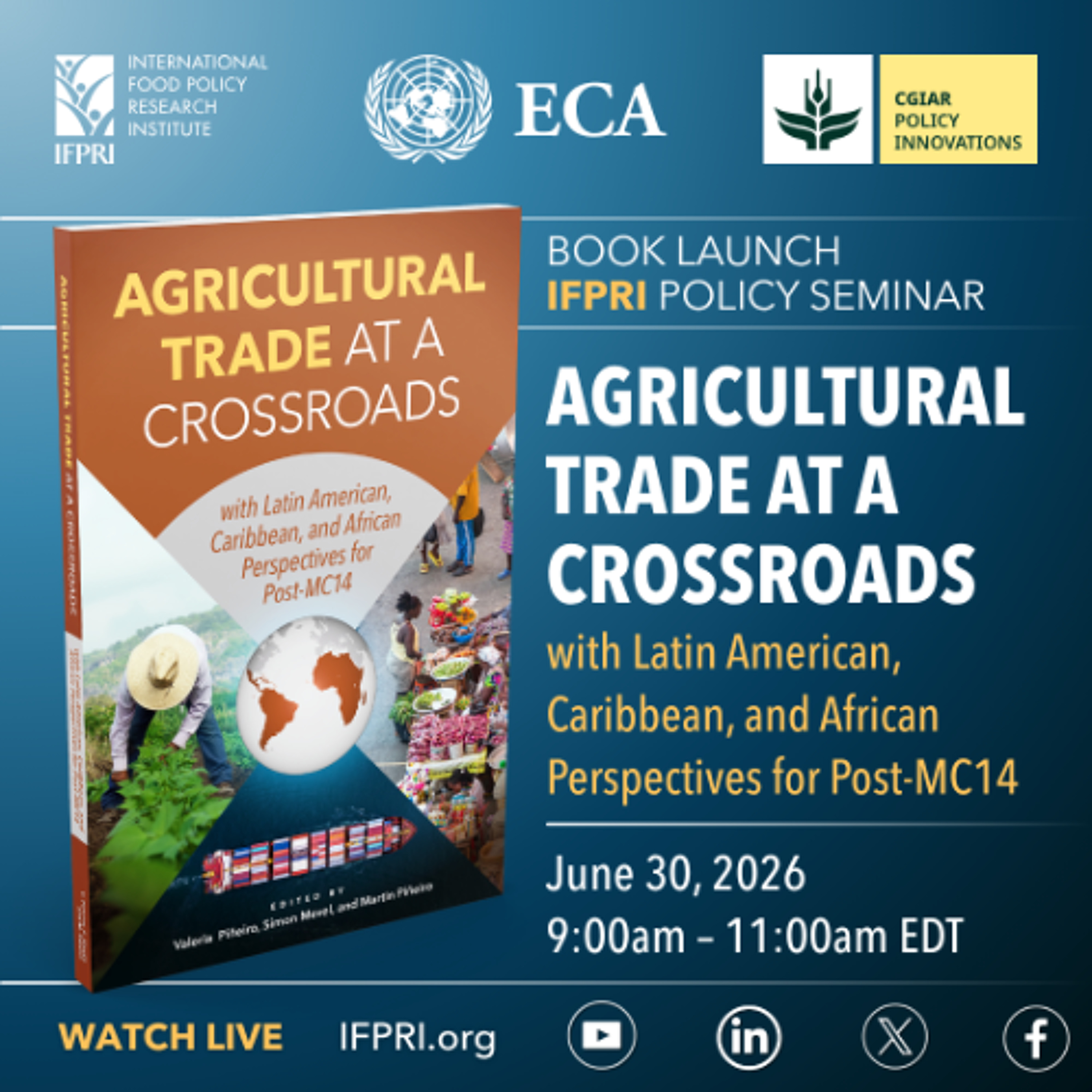
Policy Seminar | IFPRI Policy Seminar
Agricultural Trade at a Crossroads with Latin American, Caribbean, and African Perspectives for Post-MC14
Organized by IFPRI, United Nations Economic Commission for Africa (ECA), and the CGIAR Science Program on Policy Innovations
June 30, 2026
Agricultural trade is facing an increasingly complex environment shaped by geopolitical tensions, climate pressures, and growing trade disruptions. These developments are reshaping trade flows, affecting food security, and challenging the ability of existing institutions and policy frameworks to respond effectively. These pressures are also creating new opportunities for developing regions to strengthen their competitiveness, resilience, and participation in global markets. Understanding these changes is essential for identifying practical pathways toward a more inclusive, sustainable, and predictable agricultural trading system.
Join us for the launch of Agricultural Trade at a Crossroads—with Latin American, Caribbean, and African Perspectives for Post-MC14 (https://hdl.handle.net/10568/183392). This seminar will bring together the book’s authors, policymakers, representatives from international organizations, development partners, and other stakeholders to discuss the future of agricultural trade and trade governance, including key findings of the book and priorities for a constructive agenda following the 14th Ministerial Conference of the WTO. Four thematic panels will cover global developments, Latin America and the Caribbean, Africa, and opportunities for cooperation. Discussions will highlight implications for food security, sustainability, competitiveness, regional integration, and the future of the WTO, as well as opportunities for strengthening dialogue and collaboration between Latin America, the Caribbean, and Africa.
Opening Remarks
Ruth Hill, Director, Markets, Trade, and Institutions, IFPRI
H.E. Girma Amente, African Union High Representative to the World Trade Organization
More about this Event: https://www.ifpri.org/event/agricultural-trade-at-a-crossroads-with-latin-american-caribbean-and-african-perspectives-for-post-mc14/
Subscribe IFPRI Insights newsletter and event announcements at www.ifpri.org/content/newsletter-subscription

Comments

Download from Google Play

Download from App Store
 United States