DiscoverWhat the Fundraising
What the Fundraising
Claim Ownership

What the Fundraising

Author: Mallory Erickson

Subscribed: 75Played: 1,755
Share

Description

What the Fundraising is the podcast for impact leaders and change-makers who are tired of doing things the old school way and are looking for best practices to raise money, run their organization, and think about the nonprofit sector in a whole new way. 

Every Tuesday for 40-60 min, your host, Mallory Erickson, will be having real and raw conversations with some of the best personal and professional development experts, many of whom are outside the nonprofit sector. These are bestselling authors, world-renowned researchers, and TEDx experts, most of whom have never spoken to a non-profit audience before. They have come ready to share expertise, lessons, and stories that will fundamentally change the way you show up as a leader and fundraiser.

There are so many valuable lessons nonprofit leaders are missing because they are outside of their typical orbit, but no more. Mallory is bringing them in and helping to apply her guest's expertise to disrupt the nonprofit sector once and for all.

So if you are ready to learn how to upgrade your fundraising strategy, leadership skills, energy, habits, and mindset to bring in more funding and actually have some fun doing it, then this is the right podcast for you.

If you’re wanting to implement ideas you heard, visit MalloryErickson.com/Podcast for the top tips and tools, full transcripts, quotes, videos, and additional resources from each episode.

344 Episodes
Reverse
When pressure and noise pile up on nonprofit leaders, we start making decisions to survive this year’s goals, even when those decisions weaken the foundation we’ll need two years from now. In this in-person episode recorded in the What the Fundraising studio, Justin McCord of RKD Group joins Mallory to talk about what that pressure does to our choices, and why story and presence are still the most powerful tools we have. Justin brings 15 years in nonprofit marketing and a decade before that in minor league baseball and Major League Soccer, where he first fell in love with direct response. He and Mallory talk about a Jenga tower that’s quietly getting top-heavy, why the smallest possible story cuts through the most noise, and how a founder recording an unpolished video from their car can do more than a polished campaign. They also get into using donor data to spark curiosity instead of assumptions, why fear crowds out curiosity, and what’s missing when content feels AI-generated even without the obvious tells. Key takeaways from this episode. Pressure and noise change our behavior. Under pressure, leaders lean toward decisions that hit this year’s number no matter what happens downstream, and under noise they tell the broadest story possible instead of the most personal one. Watch out for the Jenga problem. Pulling easy blocks from the bottom to stack on top solves today’s pressure but weakens your base. Justin’s team pushes for decisions that look 18 to 24 months ahead instead of 12. Make the story smaller. One person helped, one life changed, one table provided for. There’s a reason this works: in Darley and Latané’s classic 1968 bystander study, people who believed they were the only one hearing an emergency were far more likely to help than people who thought others were listening too. One-to-one makes it personal. Presence is what makes it land. A handwritten note, a voice memo, a founder’s unpolished iPhone video all ask the reader to show up fully, and they show up because you did. Let data create wonder, not certainty. For one hospital, every consecutive-year donor they lost took 10 new first-year donors to replace. Data should tell you where to focus and make you more curious about the people in it, not more sure you already know them. Fear drowns out curiosity. Real curiosity means sitting with uncertainty, which is hard when you’re under pressure. But walking in with the answer already decided leaves no room for the donor, or for creativity. Support for this show is brought to you by Practivated. Practivated delivers AI-powered donor conversation simulations that let fundraisers practice in a private, judgment‑free space—building confidence, refining messaging, and improving outcomes before the real conversation even begins. Developed by fundraising experts with real‑time coaching at its core, it’s the smart way to walk into every donor interaction calm, prepared, and ready to connect. Learn more at practivated.com. Connect with me:  Instagram: https://www.instagram.com/_malloryerickson/ Facebook: https://www.facebook.com/whatthefundraising YouTube: https://www.youtube.com/@malloryerickson7946 LinkedIn: https://www.linkedin.com/mallory-erickson-bressler/ Website: malloryerickson.com/podcast Loved this episode? Leave us a review and rating here: https://podcasts.apple.com/us/podcast/what-the-fundraising/id1575421652 If you haven’t already, please visit our new What the Fundraising community forum. Check it out and join the conversation at this link. If you’re looking to raise more from the right funders, then you’ll want to check out my Power Partners Formula, a step-by-step approach to identifying the optimal partners for your organization. This free masterclass offers a great starting point.
Shaun Floerke spent 16 years as a district court judge. He built drug courts, DWI courts and domestic violence courts because he could see that what brings someone into a courtroom is a whole ecosystem of factors. Telling people to “get better” wasn’t going to fix that. So he went upstream. Today he’s President and CEO of Boreal Waters Community Foundation, and he’s pushing philanthropy to take root causes more seriously. In this conversation, Shaun and Mallory talk about how to keep urgency in your mind without letting it take over your body. Shaun shares the Three Sisters story, which shows why we need people pulling babies out of the river, people teaching others to swim, and people running upstream to find out who’s putting them in the water. They talk about the hero mentality, why his team gets better when he’s off the grid in Mongolia, and the “everything’s a no until it’s a full yes” practice. They also cover why connection is the antidote to overwork and why Shaun asks his team “How did you fail?” in performance reviews. If you’re carrying big goals in a world that feels like it’s on fire, this one’s for you. Key takeaways from this episode. We need all three sisters. Direct service, capacity building and systems change all matter. If we only work on the symptoms, the symptoms keep coming back. Macro urgency, micro calm. You can act urgently without feeling panicked. A hijacked nervous system makes worse decisions. In Shaun’s son’s Marine unit, they say calm is contagious. Watch the hero mentality. Saying yes to everything feeds your ego and starves your team. When the leader steps back, other people step up. Default to no. A request has to line up with mind, body and spirit before it becomes a yes. Rank your 25 life goals and ruthlessly refuse the bottom 20, because they’ll drain energy from your top five. Regulation doesn’t always mean slowing down. Joy, laughter and connection calm your system too, which helps when slowing down feels impossible. Normalize failure. If you’re trying to solve problems nobody has solved before, failing at some things means you’re taking enough risks. Connect with me:  Instagram: https://www.instagram.com/_malloryerickson/ Facebook: https://www.facebook.com/whatthefundraising YouTube: https://www.youtube.com/@malloryerickson7946 LinkedIn: https://www.linkedin.com/mallory-erickson-bressler/ Website: malloryerickson.com/podcast Loved this episode? Leave us a review and rating here: https://podcasts.apple.com/us/podcast/what-the-fundraising/id1575421652 If you haven’t already, please visit our new What the Fundraising community forum. Check it out and join the conversation at this link. If you’re looking to raise more from the right funders, then you’ll want to check out my Power Partners Formula, a step-by-step approach to identifying the optimal partners for your organization. This free masterclass offers a great starting point.
What if the reason your new process, tool or campaign plan isn’t taking off has less to do with the plan and more to do with the people you’re asking to carry it? In this episode, Mallory sits down with Joanna Sutton, Assistant Vice Chancellor of Donor Engagement at UCLA. Joanna has spent nearly 25 years building the systems behind one of the country’s biggest advancement shops. She’s a self-described process person with a background in psychology, and that mix shapes everything she does. She designs for adoption from the start, because, as a consultant once told her, you can have the best steakhouse in town, but if no one eats there, it shuts down. Mallory and Joanna talk about why stressed teams resist change, and how giving people a real choice early gives them a stake in the result. They get into breaking overwhelming work into “conquerable chunks,” pulling back like a toy car to build momentum instead of spinning your wheels, and how she reframes a project that feels like “two steps forward, ten steps back.” Then Joanna realizes, mid-conversation, that the thing that most changed her leadership had nothing to do with work. In this episode, you will be able to:  Build adoption into a new process from day one by framing it around what helps your team, not what helps you. Get real buy-in before a big change by talking with a few very different users and letting them help choose the final direction. Respond to pushback under deadline pressure by naming the anxiety underneath it, making room for it, and then moving forward together. Break an overwhelming project into “conquerable chunks” so you and your team always know the next step. Protect yourself from burnout by focusing your energy on what you can control and setting aside what you can’t. Turn an “I need this now” request into a partnership ask that respects people’s expertise and gets things done faster. Support for this show is brought to you by Bay Business Group. Our friends at Bay Business Group really understand nonprofit accounting and financial management on so many levels. Focus on your mission while gaining complete clarity and confidence over your organization's finances. Partner with an employee-owned team built solely to support you, handling everything from bookkeeping and payroll to budgeting and fractional CFO guidance. Learn more at bay-biz.com/mallory. Connect with me:  Instagram: https://www.instagram.com/_malloryerickson/ Facebook: https://www.facebook.com/whatthefundraising YouTube: https://www.youtube.com/@malloryerickson7946 LinkedIn: https://www.linkedin.com/mallory-erickson-bressler/ Website: malloryerickson.com/podcast Loved this episode? Leave us a review and rating here: https://podcasts.apple.com/us/podcast/what-the-fundraising/id1575421652 If you haven’t already, please visit our new What the Fundraising community forum. Check it out and join the conversation at this link. If you’re looking to raise more from the right funders, then you’ll want to check out my Power Partners Formula, a step-by-step approach to identifying the optimal partners for your organization. This free masterclass offers a great starting point
What would happen if a nonprofit stopped asking for an entire year? No GivingTuesday, no year-end push, no urgent emails. Dr. Sanjay Bindra, MD, a cardiac electrophysiologist and the co-founder and president of GOSUMEC Foundation USA, actually ran that experiment. In this episode, Sanjay shares what he learned from the GIVE Study, a year-long, real-time look at whether a small, volunteer-run nonprofit with no paid staff could build sustainable recurring giving through relationships. He walks through his GIVE framework (Gratitude, Impact, Voice and Engagement), why he sees the first gift as the entry point to a relationship rather than the win, and why he believes recurring giving is an identity shift, not a payment plan. Mallory and Sanjay also talk about the difference between the quick spark of a giver's high and the slower work of belonging, why small nonprofits have a built-in advantage when it comes to relationships, and what it means to work on the conditions around a donor instead of working on the donor. If you lead a small shop, or you're tired of starting over at zero every January, this conversation offers a different way to think about retention, and a lot more permission to build slowly. In this episode, you will learn how to:  — See why fewer than 1 in 5 first-time donors give again, and treat the first gift as an open door instead of the finish line. — Think of recurring giving as an identity shift, not a payment plan, so your monthly giving invitations build belonging instead of pressure. — Use the GIVE framework to plan what you give your donors before you ask them for anything. — Make your small size an advantage, because you’re close enough to your community that donors can see the impact for themselves. — Build a strong identity around your cause, the way faith communities do, so the right people see themselves in your mission. — Replace year-end intensity with year-round consistency, so you aren’t starting over at zero every January. — Shape the conditions around your donors instead of pushing on the donors themselves.   Support for this show is brought to you by Bay Business Group. Our friends at Bay Business Group really understand nonprofit accounting and financial management on so many levels. Focus on your mission while gaining complete clarity and confidence over your organization's finances. Partner with an employee-owned team built solely to support you, handling everything from bookkeeping and payroll to budgeting and fractional CFO guidance. Learn more at bay-biz.com/mallory. Connect with me:  Instagram: https://www.instagram.com/_malloryerickson/ Facebook: https://www.facebook.com/whatthefundraising YouTube: https://www.youtube.com/@malloryerickson7946 LinkedIn: https://www.linkedin.com/mallory-erickson-bressler/ Website: malloryerickson.com/podcast Loved this episode? Leave us a review and rating here: https://podcasts.apple.com/us/podcast/what-the-fundraising/id1575421652 If you haven’t already, please visit our new What the Fundraising community forum. Check it out and join the conversation at this link. If you’re looking to raise more from the right funders, then you’ll want to check out my Power Partners Formula, a step-by-step approach to identifying the optimal partners for your organization. This free masterclass offers a great starting point.
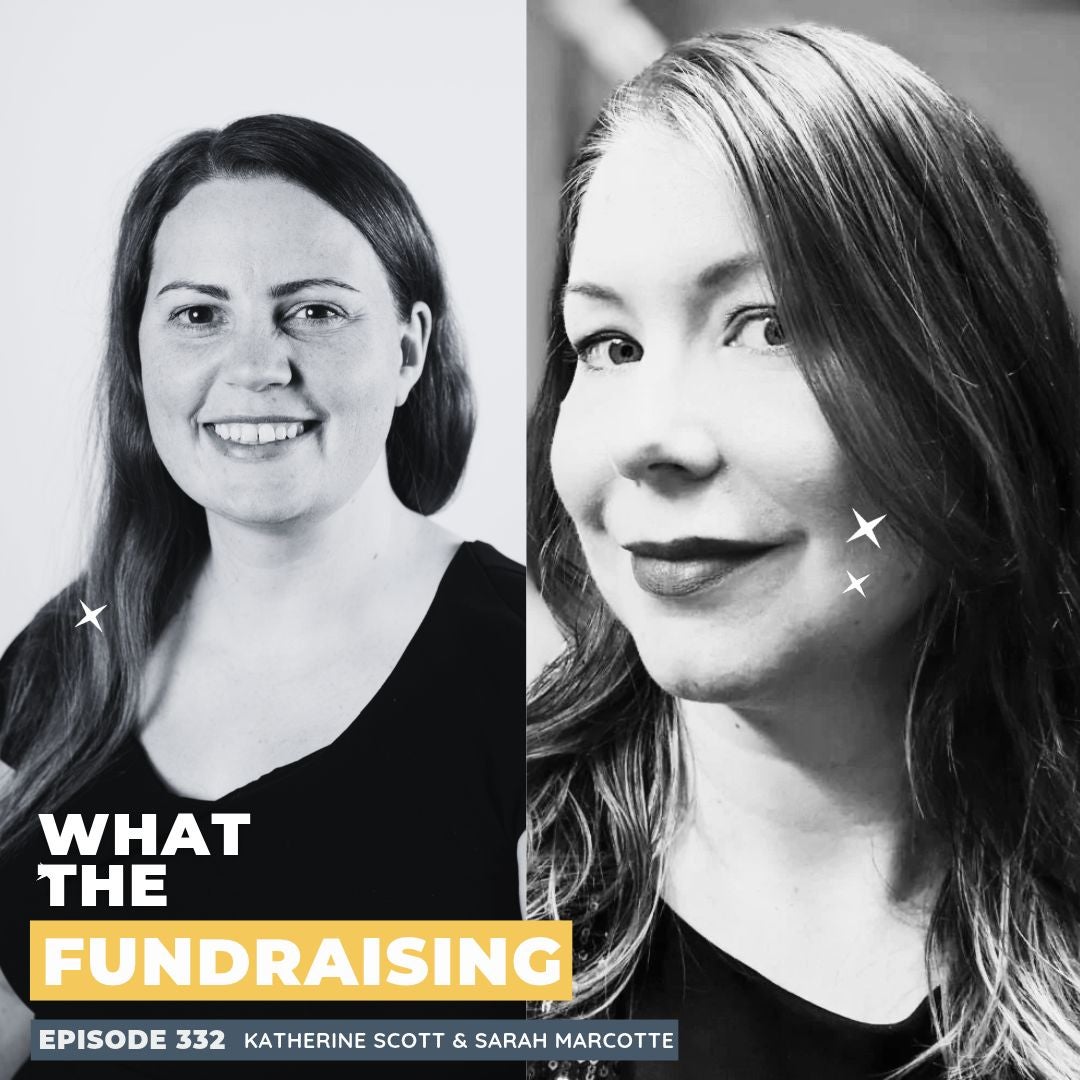
Behind every transformational charitable gift lies a trail of data waiting to become a meaningful human connection. Also, in a world where numbers often overpower stories, strategic prospect research serves as the quiet engine driving modern fundraising success. Let's meet Katherine Scott and Sarah Marcotte, co-authors of From the Ground Up: Prospect Research for Nonprofits. Both bring nearly two decades of industry expertise, and their shared experience led them to write the foundational guide they wished they'd had when starting their careers. Today's conversation explores how researchers act as backstage stage managers, translating wealth screening and raw metrics into actionable conversation starters. Katherine and Sarah tackle the tension between quantitative data and frontline fundraisers' lived experiences, cautioning against over-relying on static snapshots or biased AI tools. Ultimately, they champion a balanced approach that pairs data-driven strategy with genuine human relationships to maximize impact. In this episode, you will be able to:  Understand the true role of prospect research Discover how to pair quantitative wealth metrics with frontline fundraisers' qualitative, real-world observations. Learn to use donor data to uncover personal connections, not just evaluate financial capacity. Identify the limitations of wealth screening tools and AI, avoiding over-reliance on static snapshots or single metrics. Understand how researchers and frontline fundraisers can bridge communication gaps and move past rigid "right vs. wrong" debates. Learn why delivering targeted, high-quality insights is far more effective than cluttering reports with excessive data. Get all the resources from today’s episode here.  Support for this show is brought to you by Bay Business Group. Our friends at Bay Business Group really understand nonprofit accounting and financial management on so many levels. Focus on your mission while gaining complete clarity and confidence over your organization's finances. Partner with an employee-owned team built solely to support you, handling everything from bookkeeping and payroll to budgeting and fractional CFO guidance. Learn more at bay-biz.com/mallory. Connect with me:  Instagram: https://www.instagram.com/_malloryerickson/ Facebook: https://www.facebook.com/whatthefundraising YouTube: https://www.youtube.com/@malloryerickson7946 LinkedIn: https://www.linkedin.com/mallory-erickson-bressler/ Website: malloryerickson.com/podcast Loved this episode? Leave us a review and rating here: https://podcasts.apple.com/us/podcast/what-the-fundraising/id1575421652 If you haven’t already, please visit our new What the Fundraising community forum. Check it out and join the conversation at this link. If you’re looking to raise more from the right funders, then you’ll want to check out my Power Partners Formula, a step-by-step approach to identifying the optimal partners for your organization. This free masterclass offers a great starting point.
loading
Comments