


Access 2 Perspectives – Conversations. All about Open Science Communication
Subscribed: 7Played: 30
Subscribe

© Dr. Jo Havemann
Description
Bridging Academic landscapes.
At Access 2 Perspectives, we provide novel insights into the communication and management of Research. Our goal is to equip researchers with the skills and enthusiasm they need to pursue a successful and joyful career.
This podcast brings to you insights and conversations around the topics of Scholarly Reading, Writing and Publishing, Career Development inside and outside Academia, Research Project Management, Research Integrity, and Open Science.
Learn more about our work at https://access2perspectives.org
At Access 2 Perspectives, we provide novel insights into the communication and management of Research. Our goal is to equip researchers with the skills and enthusiasm they need to pursue a successful and joyful career.
This podcast brings to you insights and conversations around the topics of Scholarly Reading, Writing and Publishing, Career Development inside and outside Academia, Research Project Management, Research Integrity, and Open Science.
Learn more about our work at https://access2perspectives.org
142 Episodes
Reverse

In a world where scientific progress holds the key to solving humanity’s most pressing challenges, Henri Max Deda, co-founder of scienceOS.ai, shares his journey from molecular biologist to science communicator and entrepreneur. Speaking with Jo Havemann, Henri reflects on how his diverse background and a pivotal lecture on the “Network Effect” inspired him to co-create a platform that empowers researchers to collaborate and innovate more effectively. The realization that vast amounts of unpublished research data lead to redundant R&D spending became a driving force behind scienceOS, a tool initially designed for life science researchers but now serving a broader scientific community.Read more about this episode at https://access2perspectives.org/2025/07/a-conversation-with-henri-max-deda/ Find more podcast episodes here: https://access2perspectives.org/conversations/Host: Dr Jo Havemann, ORCID iD 0000-0002-6157-1494 Editing: Ebuka EzeikeMusic: Alex Lustig, produced by Kitty Kat License: Attribution 4.0 International (CC BY 4.0) At Access 2 Perspectives, we guide you in your complete research workflow toward state-of-the-art research practices and in full compliance with funding and publishing requirements. Leverage your research projects to higher efficiency and increased collaboration opportunities while fostering your explorative spirit and joy.Website: https://access2perspectives.org
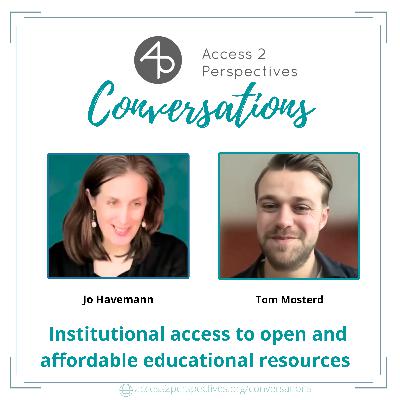
In this episode, Tom Mosterd - co-founder of Sylla, talks about his journey in the open-access movement and the vision behind Sylla’s innovative approach to scholarly publishing. The team at Sylla works with educators and university librarians to adopt open and affordable scholarly resources.LinkedIn: /in/tom-mosterd-667497a4With experience at Knowledge Unlatched and the OAPEN Foundation, Tom joins Jo to share key insights that have shaped his perspective on making academic books and journals more accessible. They discuss the challenges and opportunities in expanding open access, the financial sustainability of Open Educational Resources (OER), and how initiatives like Sylla can support universities and educators. They also dive into global equity in higher education, particularly in regions with limited resources, and the future of open-access publishing.Find more podcast episodes here: https://access2perspectives.org/conversations/Host: Dr Jo Havemann, ORCID iD 0000-0002-6157-1494 Editing: Ebuka EzeikeMusic: Alex Lustig, produced by Kitty Kat License: Attribution 4.0 International (CC BY 4.0) At Access 2 Perspectives, we guide you in your complete research workflow toward state-of-the-art research practices and in full compliance with funding and publishing requirements. Leverage your research projects to higher efficiency and increased collaboration opportunities while fostering your explorative spirit and joy.Website: https://access2perspectives.org

Beth Bayley is the Open Science Manager at Karger Publishers, a health sciences publisher based in Switzerland. She co-leads Karger’s Open Science Task Force as well as the Karger Ambassadors Program. Specializing in Open Access since 2010, Beth is engaged with strategy, policy, and communications to support Karger's “open for Open“ drive toward a sustainable transition to Open Access that will serve all stakeholders, from libraries to authors to research funders and the broader public.In this episode, Beth shares her journey into scholarly publishing and her role in promoting Open Science. She started with a background in journalism before joining Karger. Beth discusses how Karger embraced Open Access publishing early, launching its first Open Access journal in 2017. Over time, her role expanded to Open Science, which includes supporting researchers with best practices beyond Open Access, such as open data, FAIR data principles, and open peer review. Jo and Beth further highlight the importance of making research data more accessible while considering ethical concerns, especially in medical and clinical research. The conversation also touches on open methodology—ensuring that research methods, tools, and software are transparently shared to enhance reproducibility. Find more podcast episodes here: https://access2perspectives.org/conversations/Host: Dr Jo Havemann, ORCID iD 0000-0002-6157-1494 Editing: Ebuka EzeikeMusic: Alex Lustig, produced by Kitty Kat License: Attribution 4.0 International (CC BY 4.0) At Access 2 Perspectives, we guide you in your complete research workflow toward state-of-the-art research practices and in full compliance with funding and publishing requirements. Leverage your research projects to higher efficiency and increased collaboration opportunities while fostering your explorative spirit and joy.Website: https://access2perspectives.org

Dr Friederike Rohde is a sustainability researcher with a background in science and technology studies. She is committed to the sustainable shaping of digital change and the responsible use of technology. She is particularly interested in the interactions between digitalisation, AI, and sustainability and further societal debates surrounding new technologies. She holds a PhD in Science and Technology Studies.In this episode, Dr. Friederike, who works with the Berlin Ethics Lab, talks with Jo about the environmental impact of artificial intelligence (AI). She explains how she became interested in AI and sustainability, starting from her work on smart cities and digital technology in energy systems. She discusses how AI requires a lot of energy and resources, including electricity, water, and rare materials for hardware. They also talk about efforts to make AI more sustainable, including new rules in the European Union. Friederike highlights that while AI can be useful, it is important to think about its hidden costs to the environment.Find more podcast episodes here: https://access2perspectives.org/conversations/Host: Dr Jo Havemann, ORCID iD 0000-0002-6157-1494 Editing: Ebuka EzeikeMusic: Alex Lustig, produced by Kitty Kat License: Attribution 4.0 International (CC BY 4.0) At Access 2 Perspectives, we guide you in your complete research workflow toward state-of-the-art research practices and in full compliance with funding and publishing requirements. Leverage your research projects to higher efficiency and increased collaboration opportunities while fostering your explorative spirit and joy.Website: https://access2perspectives.org

A couple of days ago, Matthieu Boisgontier shared a post on Linkedin, mentioning that he had just published his 100th paper. While this seems to be quite the achievement for many scholars these days, he questioned if that was even something that should be celebrated. You can read the original post in French (or a translation into your preferred language) at https://www.linkedin.com/feed/update/urn:li:activity:7275957469862891520/.Matthieu Boisgontier is an Associate Professor at the University of Ottawa in the Faculty of Health Sciences, a physiotherapist, a kinesiologist, and a certified medical imaging technologist. He completed his Ph.D. in France in 2012 at the Université Grenoble Alpes. His research program combines neuroscience, gerontology, and health to contribute to understanding and solving the pandemic of physical inactivity. In this episode, Jo and Matthieu discuss Matthieu's career transition from physiotherapy to research and teaching, as well as the importance of open access publishing in academic research. They explored the benefits of diamond open access journals, the progress of open science initiatives globally, and the significance of multilingualism in research communication.Podcast summaryCareer Transition and Research ImportanceMatthieu and Jo discussed Matthieu's career transition from physiotherapy to research and teaching. Matthieu expressed his initial skepticism towards research, but now appreciates its niche nature. They also discussed the significance of publishing papers, with Matthieu questioning the importance of the number of articles published. He emphasized the value of the time and effort invested in each paper, and his realization that he had been publishing in industries that didn't prioritize good science. Matthieu also mentioned his preference for diamond open access journals.Open Access Journal Models DiscussedJo and Matthieu discussed the pros and cons of different open access journal models. Matthieu expressed his preference for diamond open access journals, where readers and authors don't pay, as he believes it helps keep money within the academic system. He also suggested choosing university press journals, as most of the money would stay within the academic system. Jo agreed with Matthieu's points, highlighting the questionable profit margins of commercial publishing houses and the need for a more equitable distribution of costs and benefits within the academic community.Advancing Open Science InitiativesJo and Matthieu discussed the progress of open science initiatives in Europe, Canada, and the US. Matthieu noted that Europe is leading the way, but progress is slow, especially in North America. He emphasized the importance of individual contributions, such as preprinting one paper or publishing in a diamond open access journal, to support the open science movement. Jo agreed, suggesting that small steps can make a significant difference. Matthieu concluded by encouraging others to contribute in any way they can, even if it's just once a day or once a month.Advantages of Diamond Open AccessIn the discussion, Jo and Matthieu explore the purpose and benefits of publishing academic research through open access journals. Matthieu highlights that diamond open access journals promote inclusivity and diversity, as they eliminate financial barriers for researchers from less privileged institutions. Jo emphasizes that in the digital era, open access journals can assign persistent identifiers and be indexed in scholarly databases, ensuring wide dissemination of research across linguistic and geographic boundaries. Both agree that now is an opportune time to embrace diamond open access publishing, preprints, and open practices that prioritize equity and accessibility over commercial interests.Multilingualism in Research and CommunicationJo and Matthieu discussed the importance of multilingualism in research and communication. Matthieu shared his experiences of conducting interviews and presentations in French, despite most of his research being in English. Both agreed on the need for more inclusive research practices, with a focus on equity, diversity, and inclusion. They also discussed the potential for automatic translations in journals, which could enable researchers to publish in their native languages without disadvantage.Find more podcast episodes here: https://access2perspectives.org/conversations/ Host: Dr Jo Havemann, ORCID iD 0000-0002-6157-1494 Editing: Ebuka EzeikeMusic: Alex Lustig, produced by Kitty Kat License: Attribution 4.0 International (CC BY 4.0) At Access 2 Perspectives, we guide you in your complete research workflow toward state-of-the-art research practices and in full compliance with funding and publishing requirements. Leverage your research projects to higher efficiency and increased collaboration opportunities while fostering your explorative spirit and joy.Website: https://access2perspectives.org

Dr. Mark Young, the founder ofRational Games, is an independent author, trainer and consultant with many years´ practical and academic experience in the area of negotiation, mediation and conflict management skills. His theoretical work is tempered by practical lessons learned as a negotiator in government (US Department of Commerce) and in the field of corporate finance and mergers and acquisitions in the US and Europe. Mark divides his time between Cambridge, Mass, Washington, DC and Berlin, Germany.In this episode, Mark Young and Jo explored the importance of negotiation in various settings, including academia and politics, and the need to balance personal interests with communal goals.We will hear from Mark why it is important to enter any negotiation setting well-prepared, also – and especially – in the research arena.Find more podcast episodes here:https://access2perspectives.org/conversations/Host: Dr Jo Havemann, ORCID iD0000-0002-6157-1494 Editing:Ebuka EzeikeMusic: Alex Lustig, produced by Kitty Kat License: Attribution 4.0 International (CC BY 4.0) At Access 2 Perspectives, we guide you in your complete research workflow toward state-of-the-art research practices and in full compliance with funding and publishing requirements. Leverage your research projects to higher efficiency and increased collaboration opportunities while fostering your explorative spirit and joy.Website:https://access2perspectives.org
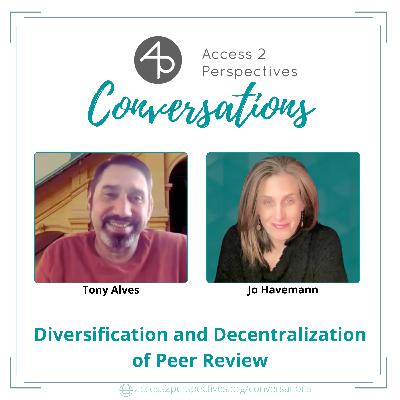
Tony Alves is the Senior Vice President of Product Management at HighWire Press, Inc. With 30 years of experience in scholarly publishing, Tony has developed expertise in areas such as product development, software design, content acquisition, and international client management.
He has a deep understanding of the publishing process, especially for scientific journals, scholarly communications, professional textbooks, and educational programming. Tony is also skilled in bibliographic database design, workflow systems development, and social media.
Over his career, Tony has successfully created and launched innovative products and services, built strong client relationships, and led high-performing teams. He is recognized as a leader in the scholarly publishing industry, known for fostering collaborations between publishers, professional societies, and universities, and for promoting standards that benefit scholarly communication globally.
Tony is passionate about editorial and production workflows, software design, multimedia development, medical and science publishing, and continuing medical education. He also has a keen interest in marketing and sales strategies that drive product success.
Tony joins Jo on this podcast episode to discuss his extensive background in scholarly publishing and peer review. He shares how he started in the industry in 1990, initially working with textbooks and later transitioning to journal publishing, where he helped develop peer review tracking systems.
They explore the evolution of peer review, particularly the shift from manual to digital systems, and Tony's work in developing efficient processes to improve peer review.
Tony also talks about his current role at HighWire Press, where he focuses on developing platforms to support various aspects of scholarly publishing, including peer review and content management.
Find more podcast episodes here: https://access2perspectives.pubpub.org/podcast
Host: Dr Jo Havemann, ORCID iD 0000-0002-6157-1494
Editing: Ebuka Ezeike
Music: Alex Lustig, produced by Kitty Kat
License: Attribution 4.0 International (CC BY 4.0)
At Access 2 Perspectives, we guide you in your complete research workflow toward state-of-the-art research practices and in full compliance with funding and publishing requirements. Leverage your research projects to higher efficiency and increased collaboration opportunities while fostering your explorative spirit and joy.
Website: https://access2perspectives.org

Monica Gonzalez-Marquez is passionate about improving how scientific information is documented and understood. She works closely with researchers and experts to make scientific documents clearer, more accurate, and easier to access by following the best practices.
She also uses creative methods to simplify complex scientific ideas, designing user-friendly tools and organizing information in a way that makes it easier for others to understand.
As an advocate for better reading and understanding of scientific materials, Monica applies ideas from cognitive science to help people grasp complicated information. She encourages different community of learners to engage with science more effectively.
Monica promotes a new approach called the Heliocentric Model of Open Science Documentation, which goes beyond traditional research papers. It focuses on recording and sharing the most important information in a way that improves communication and preserves knowledge for the future.
Her mission is to change how scientists share and use knowledge, making open science more effective and accessible for everyone.
On this podcast episode, Monica and Jo discussed their shared advocacy for open science and their experiences in the field since its earlier days.
Monica shared insights about her role as an Open Science Manager at Julich Forschungszentrum in Germany, touching on its diverse scientific disciplines and unique infrastructure challenges. She detailed her academic journey, including her work in linguistics, cognitive science, and developing methodologies to improve comprehension of scientific literature by framing it as narrative problem-solving.
Jo and Monica also reflected on the broader importance of storytelling in science to contextualize research and inspire meaningful societal impact while distinguishing between authentic narrative-driven science and questionable practices like hypothesizing after results are known.
Find more podcast episodes here:
https://access2perspectives.org/conversations/
Host: Dr Jo Havemann, ORCID iD 0000-0002-6157-1494
Editing: Ebuka Ezeike
Music: Alex Lustig, produced by Kitty Kat
License: Attribution 4.0 International (CC BY 4.0)
At Access 2 Perspectives, we guide you in your complete research workflow toward state-of-the-art research practices and in full compliance with funding and publishing requirements. Leverage your research projects to higher efficiency and increased collaboration opportunities while fostering your explorative spirit and joy.
Website: https://access2perspectives.org

Dr Haseeb Md. Irfanullah is a biologist-turned-development facilitator, who often introduces himself as a research enthusiast.
Over the past 25 years, Haseeb has been working for different international environment/ development organizations, academic/ research institutions, funders, and government agencies in different capacities.
Currently a Council Member of European Association of Science Editors (EASE), an associate editor of Learned Publishing, an associate at INASP, and a Chef of The Scholarly Kitchen, Haseeb advocates for sustainability, climate action, and resilience of the scholarly publishing ecosystem.
Haseeb has a PhD in aquatic ecology from the University of Liverpool, UK.
Dr. Haseeb joins Jo in this podcast episode to discuss the concept of resilience and its application to scholarly publishing, highlighting the need for both individuals and publishing systems to not only survive disruptions but also adapt and transform in response to future challenges.
Find more podcast episodes here: https://access2perspectives.pubpub.org/podcast
Host: Dr Jo Havemann, ORCID iD 0000-0002-6157-1494
Editing: Ebuka Ezeike
Music: Alex Lustig, produced by Kitty Kat
License: Attribution 4.0 International (CC BY 4.0)
At Access 2 Perspectives, we guide you in your complete research workflow toward state-of-the-art research practices and in full compliance with funding and publishing requirements. Leverage your research projects to higher efficiency and increased collaboration opportunities while fostering your explorative spirit and joy.
Website: https://access2perspectives.org

Anja Harrison, PhD Dipl.-Psych is a Lecturer and Applied Neuroscience Programme lead at King's College London, Fellow of the Higher Education Academy and CEO at The Collaborative Library - an online platform dedicated to bringing scientific knowledge to the masses by providing a space for people to share plain language summaries of research articles.
Anja’s background and research training are at the interface of psychology and biology. For the past 10 years Anja has mentored and supervised students ranging from BSc to MSc and PhD level, working closely with student disability services. In her view, keys to success in this context are partnership, equity, accountability and ownership.
Her main career interest is to utilize her passion for interdisciplinary research, teaching and mentoring to attract, excite and train the next generation of scientists and professionals as well as contribute to knowledge equity.
Anja joins Jo on this episode to talk about her project, The Collaborative Library and how it addresses access barriers to scientific information and encourages interdisciplinary collaboration. She also highlights the initiative’s goal of providing tools for both students and professionals to engage with and summarize research for broader public understanding.
Find more podcast episodes here: https://access2perspectives.org/conversations/
Host: Dr Jo Havemann, ORCID iD 0000-0002-6157-1494
Editing: Ebuka Ezeike
Music: Alex Lustig, produced by Kitty Kat
License: Attribution 4.0 International (CC BY 4.0)
At Access 2 Perspectives, we guide you in your complete research workflow toward state-of-the-art research practices and in full compliance with funding and publishing requirements. Leverage your research projects to higher efficiency and increased collaboration opportunities while fostering your explorative spirit and joy.
Website: https://access2perspectives.org/conversations/

Laetitia Bracco is a curator in the Research Support Mission of the Université de Lorraine libraries. She is in charge of the "ADOC Lorraine" data workshop, the support service for research data, as well as the Bibliometrics unit. At the national level, she leads the research data working group of the Couperin consortium.
She is also the project leader for the French Open Science Monitor on research data and software codes. At the international level, she is a member of the SPARC Europe board and one of the coordinators of the Open Science Monitoring Initiative (OSMI).
Laetitia joins Jo on this episode to discuss the developments and challenges of Open Science monitoring. In their conversation, they emphasized the need for context-sensitive indicators to support researchers rather than penalize them.
They also touched on global efforts like the Open Science Monitoring Initiative (OSMI) to improve open science practices.
Find more podcast episodes here: https://access2perspectives.pubpub.org/podcast
Host: Dr Jo Havemann, ORCID iD 0000-0002-6157-1494
Editing: Ebuka Ezeike
Music: Alex Lustig, produced by Kitty Kat
License: Attribution 4.0 International (CC BY 4.0)
At Access 2 Perspectives, we guide you in your complete research workflow toward state-of-the-art research practices and in full compliance with funding and publishing requirements. Leverage your research projects to higher efficiency and increased collaboration opportunities while fostering your explorative spirit and joy.
Website: https://access2perspectives.pubpub.org

Maha Said is a post-doctoral researcher on the ERC-funded NanoBubbles project which asks the questions how, when, and why does science fail to correct itself. Originally trained in molecular and cellular biology and working close to science and technology studies especially science integrity, she is currently working in 2 sub-projects, the first being post publication peer review in which articles on the topic of interest are critically analyzed and publicly commented on Pubpeer, and second is the reproducibility project in which research articles that describe the use of nanoparticles for intracellular sensing are examined.
On this podcast episode, Jo and Maha engage in a conversation focused on research integrity within the field of nanoparticles. Maha shares her journey into this area, driven by experiences of encountering integrity issues during her PhD research, particularly with antibodies. They discuss the challenges of peer review, replicability, and reproducibility, highlighting Maha's current work on post-publication peer review and replicability initiatives within nanoparticle research, specifically intracellular sensing. They also touch on the complexity of defining and implementing registered reports as a tool for ensuring transparency and accountability in research. Throughout their discussion, they emphasize the importance of critical analysis, collaboration across disciplines, and adaptation to changes in scientific processes.
Find more podcast episodes here: https://access2perspectives.pubpub.org/podcast
Host: Dr Jo Havemann, ORCID iD 0000-0002-6157-1494
Editing: Ebuka Ezeike
Music: Alex Lustig, produced by Kitty Kat
License: Attribution 4.0 International (CC BY 4.0)
At Access 2 Perspectives, we guide you in your complete research workflow toward state-of-the-art research practices and in full compliance with funding and publishing requirements. Leverage your research projects to higher efficiency and increased collaboration opportunities while fostering your explorative spirit and joy.
Website: https://access2perspectives.pubpub.org

Cooper Smout is on a mission to revolutionize scientific conduct and communication through the principles of Open Science. Unhappy with the costly, inefficient, and biased nature of scholarly publishing, Cooper saw the need for change. Thus, he founded Project Free Our Knowledge, an initiative dedicated to empowering researchers globally.
With Free Our Knowledge, Cooper seeks to harness the collective power of researchers worldwide to challenge the dominance of profit-driven publishers. His vision is to redirect the invaluable contributions of researchers from commercial publishers to community-owned Open Access journals. This shift not only democratizes access to knowledge but also minimizes risks for vulnerable individuals, such as Early Career Researchers.
Cooper joins Jo on this podcast episode to discuss the evolution of open science, personal experiences with academia and mental health, challenges in transitioning to open access publishing, and his project, Free Our Knowledge. They discuss the resistance within academia, the need for cultural shifts, and the slow progress towards disrupting the current academic publishing model. Cooper shares his journey with Free Our Knowledge and its transition to a new campaign focusing on simple, low-bar pledges for open access publishing.
Find more podcast episodes here: https://access2perspectives.pubpub.org/podcast
Host: Dr Jo Havemann, ORCID iD 0000-0002-6157-1494
Editing: Ebuka Ezeike
Music: Alex Lustig, produced by Kitty Kat
License: Attribution 4.0 International (CC BY 4.0)
At Access 2 Perspectives, we guide you in your complete research workflow toward state-of-the-art research practices and in full compliance with funding and publishing requirements. Leverage your research projects to higher efficiency and increased collaboration opportunities while fostering your explorative spirit and joy.
Website: https://access2perspectives.pubpub.org

Dr. Wendy Patterson is a member of the board of management of the Beilstein-Institut where she serves as scientific director. She received various degrees in the field of physics, culminating in a doctorate degree in optics and then continued post-doctoral research in the areas of nanotechnology and materials for energy conversion and storage in the US and Germany. Concerned with the direction that scholarly publishing had taken and its impact on scholars, she joined the Beilstein-Institut, a charitable foundation, in 2014 to contribute to their diamond open access journals. She is also a board member of Crossref and the Free Journal Network, both non-profit entities providing services for the scholarly community.
Wendy joins Jo on this episode to discuss her journey
from academia to her current position at the Beilstein-Institut,
where she now focuses on improving the scholarly publishing system, promoting
open science principles, including supporting open access, open data, and open
infrastructure in chemistry. They talked about the challenges with academia's
focus on publishing metrics and the pressure to publish, which led Wendy to
seek alternative career paths.
They also touched on challenges in scholarly publishing, such as
the dominance of commercial publishers and the misuse of metrics like journal
impact factors.
Wendy further emphasized the importance of transparent and
sustainable publishing models, like diamond open access, to ensure equitable
access to research.
Find more podcast episodes here: https://access2perspectives.pubpub.org/podcast
Host: Dr Jo Havemann, ORCID iD 0000-0002-6157-1494
Editing: Ebuka Ezeike
Music: Alex Lustig, produced by Kitty Kat
License: Attribution 4.0 International (CC BY 4.0)
At Access 2 Perspectives, we guide you in your complete research workflow toward state-of-the-art research practices and in full compliance with funding and publishing requirements. Leverage your research projects to higher efficiency and increased collaboration opportunities while fostering your explorative spirit and joy.
Website: https://access2perspectives.pubpub.org

Formerly a medical doctor, clinical researcher and medical journal editor, Jigisha Patel is an independent research integrity specialist and founder of Jigisha Patel Research Integrity Limited.
She has extensive experience of a wide range of research integrity issues in publishing, including the investigation and management of complex cases such as peer review manipulation and paper mills.
Jigisha joins Jo on this podcast episode to discuss the importance of research integrity, including honesty, transparency, and accountability in scholarly publishing. They explored common integrity issues like plagiarism and authorship disputes, emphasizing the responsibility and accountability of authors. They also pointed out that editors have the authority to reject papers based on moral concerns, but transparent journal policies are essential to uphold ethical standards.
Find more podcast episodes here: https://access2perspectives.pubpub.org/podcast
Host: Dr Jo Havemann, ORCID iD 0000-0002-6157-1494
Editing: Ebuka Ezeike
Music: Alex Lustig, produced by Kitty Kat
License: Attribution 4.0 International (CC BY 4.0)
At Access 2 Perspectives, we guide you in your complete research workflow toward state-of-the-art research practices and in full compliance with funding and publishing requirements. Leverage your research projects to higher efficiency and increased collaboration opportunities while fostering your explorative spirit and joy.
Website: https://access2perspectives.pubpub.org

Rosemarie Bernabe is a Professor of research ethics and research integrity at the University of Oslo; and an adjunct professor of medical research ethics at the University of South-Eastern Norway. With her expertise and leadership, she is dedicated to advancing research ethics and integrity in various contexts and serves as the project coordinator of several initiatives, including:
Responsible Open Science in Europe project (ROSiE)
Beyond Bad Apples: Towards a Behavioural and Evidence-Based Approach to Promote Research Ethics and Research Integrity in Europe (BEYOND)
The Equitable, Inclusive, and Human-Centered XR Project (XR4Human)
Improving Post-Trial Access in Africa (AccessAfrica)
Strengthening Clinical Trial Regulatory and Ethical Review Oversight in East Africa (AccessAfrica2; https://cordis.europa.eu/project/id/101103296)
Developing national and global agendas for the ethics of post-trial arrangements in LMICs during pandemics/epidemics (Pandemic Ethics)
Ethics in Research and Clinical Practice (ETHIMED)
Rosemarie is our guest on this podcast episode and she joins Jo to discuss her involvement in the ROSiE project, her background in research ethics and integrity, the complexities of open science, and the importance of citizen science.
They emphasized the broad applicability of citizen science while recognizing the need for careful consideration and equitable inclusion of diverse stakeholders in research projects.
Find more podcast episodes here: https://access2perspectives.pubpub.org/podcast
Host: Dr Jo Havemann, ORCID iD 0000-0002-6157-1494
Editing: Ebuka Ezeike
Music: Alex Lustig, produced by Kitty Kat
License: Attribution 4.0 International (CC BY 4.0)
At Access 2 Perspectives, we guide you in your complete research workflow toward state-of-the-art research practices and in full compliance with funding and publishing requirements. Leverage your research projects to higher efficiency and increased collaboration opportunities while fostering your explorative spirit and joy.
Website: https://access2perspectives.pubpub.org

Damita Snow (ORCID 0000-0001-8757-6464), CAE, ENV SP, is the Director of Accessibility & Diversity, Equity, and Inclusion Strategy, Publication, and Standards at the American Society of Civil Engineers (ASCE). She was the founder and immediate past chair of ASCE’s Staff Diversity and Inclusion (D&I) Council. In addition, she served as a co-chair for the Diversity, Equity, Inclusion, and Accessibility Committee at the Society for Scholarly Publishing (SSP), where she is also a board member.
Snow has held leadership roles in the Community Engagement Committee and the Diversity, Equity & Inclusion (DEI) Committee, and has judged the EXCEL awards for the Association, Media, & Publishing (AM&P) Network Associations Council. She has co-chaired the Publications Special Interest Group for the Council of Engineering and Scientific Society Executives (CESSE) and was a member of their Annual Meeting Committee. Currently, she serves on the board of Black Associations Executives and was a former member of the Research Committee at the American Society of Association Executives Foundation.
Damita Snow joins Jo on this podcast episode to discuss her experience in Diversity, Equity, and Inclusion (DEI) within various organizations, notably in the scholarly publishing field.
She further highlighted the importance of building supportive communities, mentorship, and recognizing the contributions of those who paved the way for current opportunities in DEI work.
Find more podcast episodes here: https://access2perspectives.pubpub.org/podcast
Host: Dr Jo Havemann, ORCID iD 0000-0002-6157-1494
Editing: Ebuka Ezeike
Music: Alex Lustig, produced by Kitty Kat
License: Attribution 4.0 International (CC BY 4.0)
At Access 2 Perspectives, we guide you in your complete research workflow toward state-of-the-art research practices and in full compliance with funding and publishing requirements. Leverage your research projects to higher efficiency and increased collaboration opportunities while fostering your explorative spirit and joy.
Website: https://access2perspectives.pubpub.org

Julie Wren is an experienced wellness consultant, nutritionist and self-care expert who offers transformative wellbeing solutions to individuals and organizations, so they can lead their best healthiest and happiest lives.
With over 20 years of experience in the health and wellness industry, she uses her expertise to design healthy routines to meet the uniqueness of her clients.
Julie joins Jo on her return to this podcast to discuss the importance of self-care and brain health. She emphasized the need to engage in some techniques such as deep breathing and body scans.
They also stressed on the significance of body movement and balanced nutrition in maintaining optimal brain function, especially for researchers.
Find more podcast episodes here: https://access2perspectives.pubpub.org/podcast
Host: Dr Jo Havemann, ORCID iD 0000-0002-6157-1494
Editing: Ebuka Ezeike
Music: Alex Lustig, produced by Kitty Kat
License: Attribution 4.0 International (CC BY 4.0)
At Access 2 Perspectives, we guide you in your complete research workflow toward state-of-the-art research practices and in full compliance with funding and publishing requirements. Leverage your research projects to higher efficiency and increased collaboration opportunities while fostering your explorative spirit and joy.
Website: https://access2perspectives.pubpub.org

Rania Baleela has been a dedicated Open Science and Open Access trainer since 2012. Rania is the Founder of the first Sudanese institutional repository (OASCIR), a platform for openly sharing research.
As the EIFL Open Access Country Coordinator, she has played a key role in advancing open access in Sudan and has trained librarians in this area. Rania is also the Founding Director of the Toxic Organisms Research Centre at the University of Khartoum.
Her Ph.D. is in Infectious Diseases and Tropical Medicine. Rania is deeply committed to promoting transparency and collaboration in research, and her work has had a significant impact on the research community.
She joins Jo on this podcast episode to discuss how she is using her expertise as a biologist to save the people in Sudan from dying from snake bites and scorpions stings. They also talked about the effects of the war in Sudan on the Sudanese people.
Find more podcast episodes here: https://access2perspectives.pubpub.org/podcast
Host: Dr Jo Havemann, ORCID iD 0000-0002-6157-1494
Editing: Ebuka Ezeike
Music: Alex Lustig, produced by Kitty Kat
License: Attribution 4.0 International (CC BY 4.0)
At Access 2 Perspectives, we guide you in your complete research workflow toward state-of-the-art research practices and in full compliance with funding and publishing requirements. Leverage your research projects to higher efficiency and increased collaboration opportunities while fostering your explorative spirit and joy.
Website: https://access2perspectives.pubpub.org

Dr. Jia Ng, MD MSCE is a Board-certified Nephrologist and Assistant Professor at the Zucker School of Medicine at Hofstra/ Northwell, New York. She is also the founder of PublishedMD, where she coaches clinicians on how to publish research papers, build authority, and achieve their academic goals without the overwhelm.
Since 2020, she has been giving Academic Writing Workshops and Seminars to Medical Departments that want to increase the scholarly productivity of their students and faculty members. She has been invited to speak at institutions around the US and internationally at King’s College London, UK and Sheikh Shakhbout Medical City - Mayo Clinic, Abu Dhabi.
She received her Nephrology Fellowship training and Masters of Science in Clinical Epidemiology from University of Pennsylvania, US. Currently, she is an active clinical researcher, and has received more than $1 Million Dollars of grant funding from the National Institutes of Health and Foundational Grants.
Dr. Jia joins Jo on this podcast to discuss about her journey from clinical research student to helping researchers to avoid overwhelm.
Find more podcast episodes here: https://access2perspectives.pubpub.org/podcast
Host: Dr Jo Havemann, ORCID iD 0000-0002-6157-1494
Editing: Ebuka Ezeike
Music: Alex Lustig, produced by Kitty Kat
License: Attribution 4.0 International (CC BY 4.0)
At Access 2 Perspectives, we guide you in your complete research workflow toward state-of-the-art research practices and in full compliance with funding and publishing requirements. Leverage your research projects to higher efficiency and increased collaboration opportunities while fostering your explorative spirit and joy.
Website: https://access2perspectives.pubpub.org


Download from Google Play

Download from App Store
 United States
Mastering essay writing is crucial for students, and this guide offers valuable information. For more support and professionally written essays, I recommend visiting https://allessay.org/essay-on-internet-boon-or-bane/. Their professional writing services guarantee high-quality papers that meet academic standards.
Writing a paper can be quite challenging, especially when you're pressed for time. It's great to know there are services like this https://allessay.org/maintaining-the-counselor/ that offer professional help at discounted rates. They can assist you in crafting high-quality papers, ensuring you meet your deadlines and academic standards. This can be a lifesaver when you're juggling multiple assignments and responsibilities.
In my first year of college, I came across https://allessay.org/essay-on-population-explosion/ while searching for affordable essay writing services. Their custom essays were not only budget friendly but also high quality. I recommend their services to students looking for cost-effective yet reliable essay writing help.
Explore the synergy between different academic fields with our insightful content on bridging academic landscapes. For specialized assistance, trust the expert Nursing essay writers from https://allessaywriter.com/nursing-essay-help.html.
I love to listen to podcast episodes as it highlights the significance of editorial processes in maintaining integrity in medical research. If you're involved in medical research and in need of assistance with writing high-quality research papers, https://studyclerk.com/medical-research-paper can provide valuable support. With it, the production of well-written and scientifically rigorous research papers would be much easier.
A well-designed marketing strategy leads to success. But not all specialists specialize in narrow-profile areas. Therefore, I decided to visit https://limeup.io/blog/healthcare-marketing-agencies/ this link to find out about marketing agencies that work with the healthcare sector. Our company is engaged in medicine and it is very important for us to cooperate with experts who have experience in this field.