


 Claim Ownership
Dishing with Stephanie's Dish
Subscribed: 158Played: 5,838
Subscribe

© Stephanie Hansen
Description
Host of Emmy award-winning TV show “Taste Buds with Stephanie,” Author of "True North Cabin Cookbook," blogger at stephaniesdish.com, radio host of "The Weekly Dish", podcaster at "Dishing with Stephanies Dish" and contributor on Fox 9’s The Jason Show.
503 Episodes
Reverse
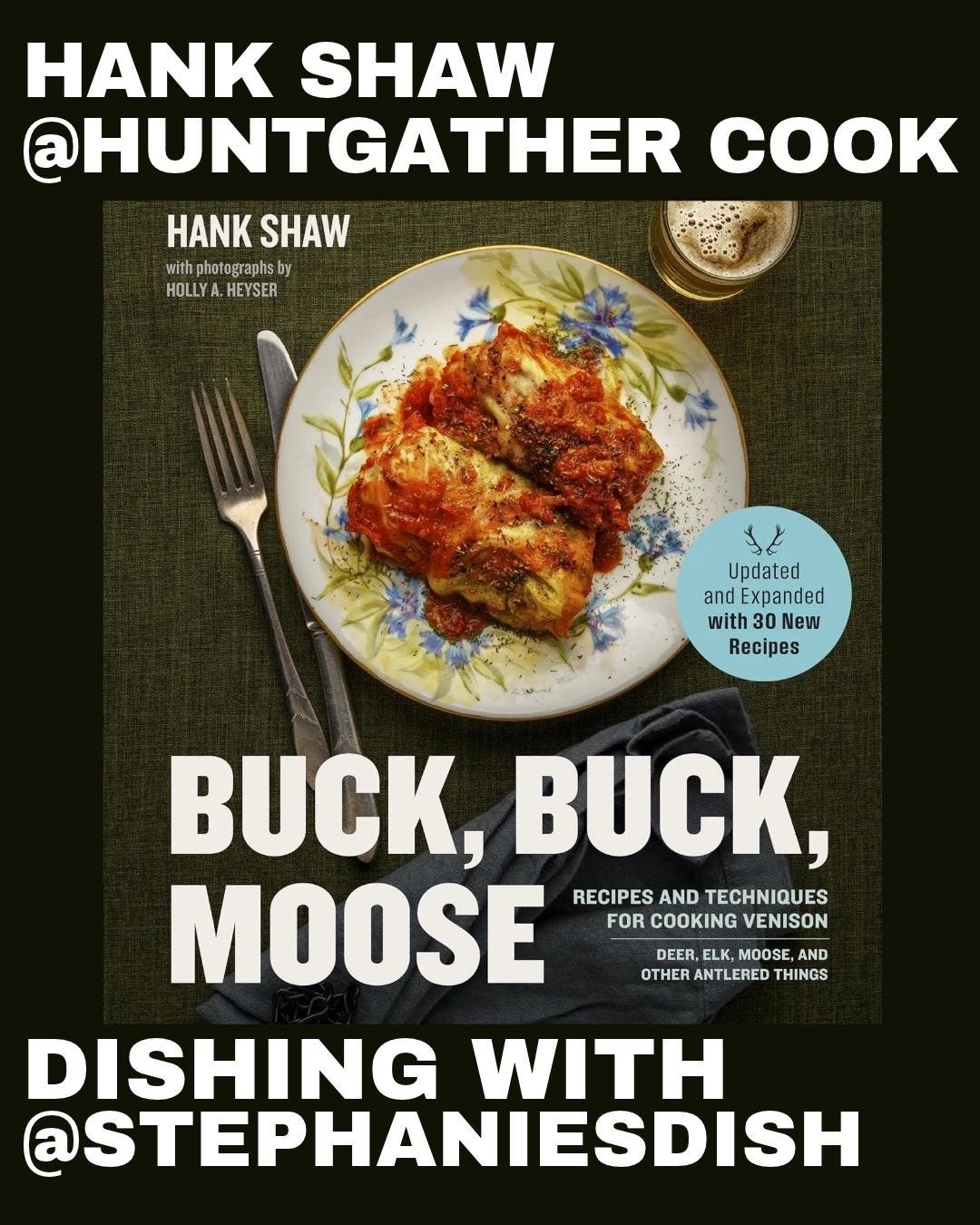
It’s deer season here in Minnesota. That means a lot of freezers are filling up with venison, and a lot of cooks are asking the same question: now what do I make with it?My guest today has the answer. Hank Shaw is a James Beard Award winner and the voice behind Hunter Angler Gardener Cook. He’s a chef, a forager, a hunter and the author of five cookbooks. Today we’re talking about one I think every hunting family should own: Buck, Buck, Moose.It’s Hank’s complete guide to venison of every kind: deer, elk, moose, antelope and more. He takes you all the way from the field to the table: how to break down and age the meat, and how to cook every part, from backstrap to shanks to the bits most people throw away.If you’ve ever had venison that came out tough or gamey, this conversation is going to change your mind.Stephanie Hansen (00:01)Hello, everybody, and welcome to Dishing with Stephanie’s Dish, the podcast where we talk to people that are obsessed with food. And today it’s pretty exciting because we are on the cusp. Actually, we’re in the deer season for Minnesota. The archery has started, and I think Hank Shaw is my guest. Does the guns start this weekend? Okay.Hank (00:21)It’s sort of last weekend, so we’re in gun season.Stephanie Hansen (00:25)And people are hopefully getting deer, and then of course, theDifficulty is what do you do with them when you either take them to the processor? Do you process them yourselves? Do you try and hang them in your own garage? And we have a guest today that has done all of this. Hank Shaw is the author of Buck Buck Moose, and it is a 10th anniversary edition that has been relaunched that has 30 new recipes, 200 color photos. It’s glorious.It is everything you would want if you’re a venison hunter. And while I am not a venison hunter, I have a bunch of people in my life that are and I’ve given them this book and they just are it’s like the encyclopedia of what to do if you’re a deer hunter.Hank (01:10)Well, that was the goal. it it’s funny you should say that because I did an event in Madison, Wisconsin a week ago and I you know, it was over a hundred people were there. And I said, Okay, so how many people are hunters? And you know, about maybe forty percent of hands went up. And then I said, Well, okay, well, how many people here have access to venison?whenever you want and let every single person raise their hand.It was it is a it is definitely a thing that happens up here in the upper midwest that is you know, people hunt deer and and venison is just kind of, you know, the coin of the realm when it comes to fall and winter and and it’s pretty easy to get your hands on some.Stephanie Hansen (01:46)Yeah, and it’s also, you know, if we didn’t hunt deer, because I’ve spent a lot of time thinking about this, it they we we’d probably be overrun with them because there are a lot. I live in Golden Valley and the last three days in a row a buck has literally walked through my yard. So I feel like there’s quite a few. What is it about buck hunting in particular or deer hunting that you think appeals to so many Midwesterners?Hank (02:12)I think the you know, the the idea of deer hunt deer hunting is way beyond the Midwest. I mean, we’ve been hunting something like a deer since we were something like a human. So there’s a very, very deep, very ancestral millennia, tens,hundreds of millennia, we’ve been chasing something like a deer, all the way back to pre, you know, early hominids.So even if you don’t hunt deer, or even if you don’t like hunting deer, you recognize that it’s a thing. Like this is a thing that humans do. so i you know, in the Midwest I think what’s interesting is A, like we just said, there are a lot of deer. So you the the opportunity to be successful is very high. Um the other piece to it is thatthe deer season, especially the gun seasons, which that brings out the pumpkin army, So you have to be a little bit more dedicated and a little bit more skilled to hunt with a muzzle loader or with a bow. you know, but the rifle season is is basically for everybody. And the deal of it is in most states, this being one of them, your gun season’s very short. So it’s sometimes it’s only a two weekends in a week. And but in other cases it’stwo weeks, but it’s rarely more than three weeks long in the Midwest. So there’s this kind of buildup of excitement that goes on where this is happening. It’s gonna happen. Where in the West, for example, I used to live in Northern California and a particular any given gun season there is six weeks long. So the the the there’s no urgency as much, you know. Mm-hmm.Stephanie Hansen (03:37)Yeah, the fever is a little less.Hank (03:40)And there it there’s also a Thanksgiving aspect to it as well, becausevirtually every Midwestern state links their main deer season to Thanksgiving. It’s either right before or during or right after. And so the the family aspect of Midwestern deer hunting is very, very strong. Much stronger than in the West Coast.Stephanie Hansen (03:58)Okay. So you started writing about food in earnest in two thousand seven. I feel like you have you’ve written about pheasants, you’ve written about venison, you’ve written about all the wild things, fish, angling, foraging now. You are someone that has been really connected with the wild your whole life. Where did that come from and how do you sustain that living in a city?Hank (04:23)Well, it’s actually kinda easy living in a city, because there’s more around than you might think. now you there’s no hunting in a city. although I’m contemplating putting out traps for those stupid rabbits who are always eating my gardenStephanie Hansen (04:33)Yes. why don’t we eat more rabbits, really?Hank (04:37)well there’s a there’s a sort of a mechanistic answer for that because at one point rabbits and and chickens were kind of neck and neck in terms of America’s white meat. This would be like in the thirties or forties. but until they developed what’s called the Cornish Cross, the double breasted chicken, that we’re known that we all eat now, that didn’t happen until the fifties.SoStephanie Hansen (04:57)Wow.Hank (04:57)immediately when that happens, you you the ability to get more meat off of a carcass of the same size, really, really it dramatically shifted everything in the chicken’s favor. And plus chickens grow faster and their their feed to meat ratio is better. SoThat’s basically how the the chicken won. It’s like they’re easier to cut up, they are they’re faster to grow and they’re cheaper to grow. So and they’re not as cute. So there is absolutely like if you don’t think a rabbit is cute, there’s some something dead inside you, but they are also super tasty, soStephanie Hansen (05:31)Yes, and I just feel like there’s so many. No one’s gonna miss a few.Hank (05:34)Especially in especially I live in St. Paul. There’s buckets of them. Like I I guarantee you in the course of this podcast, one will hop by my front window.Stephanie Hansen (05:42)Yeah, and as a gardener, it’s the scourge of your life, like the rabbits.Hank (05:45)Yeah.Stephanie Hansen (05:47)Food blogging has changed a lot since you started in 2007.Hank (05:50)yes.Stephanie Hansen (05:52)And I first met you, I think four years ago. Is that how long you’vebeen in the Twin Cities?Hank (05:57)Since twenty twenty three.Stephanie Hansen (05:58)Okay. And now we’re seeing a real shift in this industry that is probably dramatic and permanent in that many of the people who write blogs and maintain food blogs for a living, their traffic has been cut in half, therefore revenue has been cut in half. And we’re seeing new models of how to get readers, but it’s really the wild west and we’re in early stages of figuring outhow this is all gonna land. And while it maybe seems like what you’re doing, publishing cookbooks or reissuing older books with new content might be the way to go at $35 a book, you know, wholesale or no cost. Your cost is probably, I don’t know, 20 bucks. It’s gonna be… This is a public episode. If you'd like to discuss this with other subscribers or get access to bonus episodes, visit stephaniehansen.substack.com/subscribe
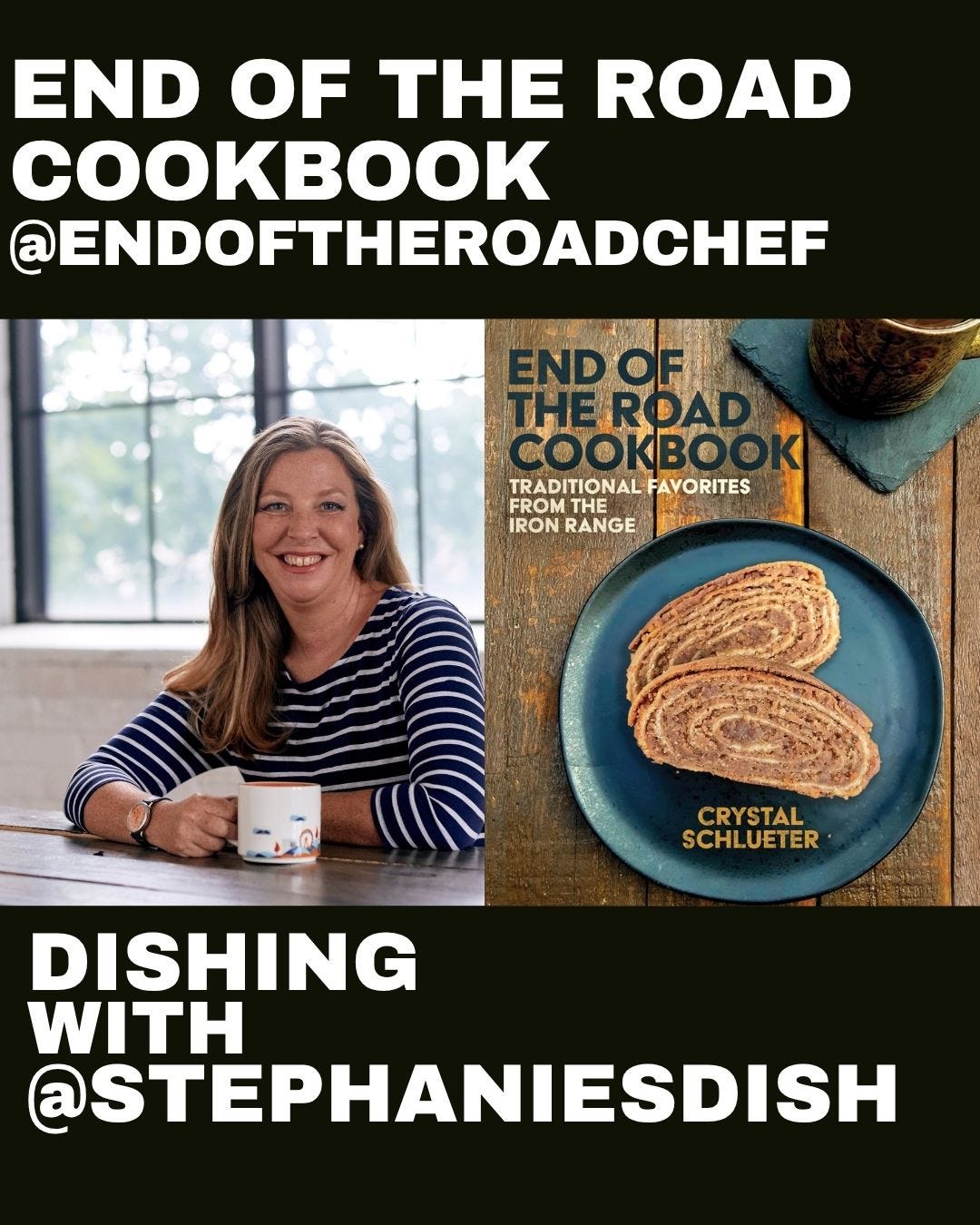
Get Tickets to the Book Launch Sunday, November 15, 20262:00 PM - 3:30 PMMinnesota History CenterJoin us for a delicious celebration of Minnesota’s Northland with Iron Range native Crystal Schlueter as she shares the stories, traditions, and recipes behind End of the Road Cookbook. with Stephanie Hansen, Ticket price includes the program, a selection of sweet treats from End of the Road Cookbook, coffee/tea, and a book signing. This is a public episode. If you'd like to discuss this with other subscribers or get access to bonus episodes, visit stephaniehansen.substack.com/subscribe

We made sheet pan chicken tonight with Brussels sprouts, potatoes, and fig jam. I am going to make this one of my exclusive Substack recipes, as it was really tasty. Subscribers get access to my archive of 70 exclusive recipes.We started with chicken thighs and oiled, salted, and peppered them. Then we cut red potatoes and Brussels sprouts in half and tossed them with a fig jam, Dijon mustard, Balsamic vinegar, Thyme, Rosemary and olive oil. We reserved 1/4 cup of marinade and put our sheet pan in the oven at 400 for 30 minutes. After 30 minutes, we turned the heat up to 450. We tossed the veggies, glazed the chicken with the reserved marinade, and cooked for 15 more minutes until the chicken was cooked and the veggies were crisp and roasted. Here is an official recipe:Fig Jam-Glazed Sheet Pan Chicken Thighs with Brussels Sprouts and PotatoesCrispy chicken thighs glazed with fig jam, Dijon, and balsamic, roasted on one pan with caramelized Brussels sprouts and red potatoes.INGREDIENTSFor the Chicken• 1 pounds bone-in, skin-on chicken thighs (4 thighs)• 2 teaspoons olive oil, for the chicken• 1 teaspoon kosher salt, for the chicken• 1/2 teaspoon black pepper, for the chickenFor the Vegetables• 1 pound small red potatoes, halved• 1 pounds Brussels sprouts, trimmed and halvedFor the marinade• 2/3 cups fig jam• 2 Tbsp Dijon mustard• 1 Tbsp balsamic vinegar• 1/4 cup olive oil, for the marinade• 1 Tbsp fresh thyme leaves• 1 Tbsp fresh rosemary, finely chopped• 1 teaspoon kosher salt, for the vegetables• 1 teaspoon black pepper, for the vegetablesInstructions1. Preheat: Heat the oven to 400°F. Line a large rimmed sheet pan with a Silpat silicone mat, foil, or parchment for easier cleanup.2. Season the chicken: Pat 1-1.5 pounds bone-in, skin-on chicken thighs (4 thighs) dry with paper towels. Rub with 2 teaspoons olive oil, for the chicken and season all over with 1 teaspoon kosher salt, and 1/2 teaspoons black pepper, for the chicken.3. Make the fig marinade: Whisk 2/3 cups fig jam, 2 Tbsp Dijon mustard, 1 Tbsp balsamic vinegar, 1/4 cup olive oil, for the marinade, 1 Tbsp fresh thyme leaves, 1 Tbsp fresh rosemary, finely chopped, 1 teaspoon kosher salt, for the vegetables, and 1 teaspoon black pepper, for the vegetables in a large bowl. Set aside 1/4 cup of the marinade in a small bowl for glazing the chicken later.4. Toss the vegetables: Toss the Brussels sprouts and potatoes, trimmed and halved, in a large bowl with the remaining marinade and toss to coat.5. Arrange the pan: Spread the vegetables on the sheet pan, placing the potatoes and Brussels sprouts amongst the chicken thighs skin side up.6. Roast at 400°F for 30 minutes.7. Increase the oven to 450°F. Toss the vegetables on the pan, then brush the chicken with the reserved 1/4 cup marinade.8. Finish roasting: Roast 15 minutes more, until the chicken reaches 175°F inside and the vegetables are crisp and caramelized.9. Rest and serve: Let rest 5 minutes. Spoon any pan juices over the chicken and vegetables, and garnish with extra thyme if you like.Substitutions:* Apricot or cherry jam works in place of fig. * Scatter with chopped parsley and finish with crumbled goat cheese or toasted walnuts for a dinner-party version.Thank you to everyone who tuned into my live video to cook dinner tonight! Join me for my next live video in the app on 11/13 6pm CST.Also, I'll see you at the Becker Library 11/9!Stephanie Hansen's @StephaniesDish Newsletter is a reader-supported publication. To receive new posts and support my work, consider becoming a free or paid subscriber. This is a public episode. If you'd like to discuss this with other subscribers or get access to bonus episodes, visit stephaniehansen.substack.com/subscribe

Thank you to everyone who tuned into my live video! Join me for my next live video in the app.Get the marinated goat cheese and other recipes at stephaniesdish.com This is a public episode. If you'd like to discuss this with other subscribers or get access to bonus episodes, visit stephaniehansen.substack.com/subscribe

Get Reservations at Charlie’s RestaurantGet more information about The Minneapolis ClubOpen Seatings to the Public* Dinner Tuesday - Friday, 5 pm - 7:15 pm* Charlie’s Bar Open until 9 pmNon-members can join for cocktails at the iconic Charlie’s Bar until 9 pm or for full dinner service with seatings available Tuesday through Friday from 5 pm to 7:15 pmMake a Non-Member ReservationTo make a same-day reservation, please call us at 612-332-2292.ORIGINAL EDITED TRANSCRIPTStephanie Hansen (00:00.664)Hi, welcome to Dishing with Stephanie’s Dish, the podcast where we talk to people in the food space. And today I’m actually recording from the Minneapolis Club. I had a little internet trouble at home, so I’m a member here and, coincidentally, I'm recording today with Michael Lopata, Executive Chef and Director of the Culinary Program at the Minneapolis Club. Welcome to the podcast, Michael.Michael Lopata (00:21.117)Thank you so much. Good to have you here, literally and figuratively.Stephanie Hansen (00:25.352)Yes, thank you. I am glad to be here too. I hosted a really powerful event last week, I thought, about women in food. Fellow member Beth Dooley , who is a cookbook writer. She’s written so many great books. She was there. Joy summers , a food critic for the Star Tribune, and my radio partner, Stephanie March , the founder of the Salt Cure Recovery Fund for Restaurant Recovery. It was really just such a great panel. And we had a lot of opportunity to talk about food from the intersection of chefs, farmers, product producers, people that write about, and home cooking. And that day you made something so delicious. You made one of my favorite things. Did you know I love a beef short rib?Michael Lopata (01:16.955)No, but I wouldn’t trust you if you said you didn’t. So it was nice to kind of live in the center lane of the highway there, but also be able to put something out there. I’ve said for years, as long as I’ve been doing this, there are those corporate Monday-through-Friday lunches with chicken, mashed potatoes, and asparagus, and that fits the bill. But I wanted to do something a little bit more fun. I definitely want to touch on something that you said about the intersection of food and chefs, butit’s always easier when we’re cooking people’s favorite food. It makes my job and my team’s job so much easier. So I’m glad we I’m glad we hit that mark.Stephanie Hansen (01:50.763)it was so delicious. And I had mine packed up to go because obviously when I was speaking I couldn’t eat, and I was sitting down in a little side room kind of off of Charlie’s restaurant here, which is open to the public Thursday through Sunday. So, Thursday through Saturday, did I get the hours right?Michael Lopata (02:11.843)Tuesday through Saturday for dinner. Yep. Yep.Stephanie Hansen (02:14.732)People don’t realize they can come to the Minneapolis Club and eat this delicious food at Charlie’s. You also have a beautiful patio. It’s getting to be fall now, but the patio is lovely during patio season. yeah, I had a lot of great comments about the food that day, so well done.Michael Lopata (02:35.762)Thank you so much. I caught the very end of you and Beth and Joy and Stephanie andyou know, as soon as that food was out, we actually had an event on the second floor, but we’re rushing through it because I love listening to people talk about their passion. Whether I’m getting my oil changed and it’s somebody who just graduated from auto tech school and he’s excited about the next 20 years of his life, and I’m driving away thinking, I’m glad that guy loves cars more than I do. But it’s always nice to listen and exciting for me, especially because this is my passion. And this is what I’ve dedicated the last twenty-five years of my life to: listening to four just exponentially great voices in this in the Minneapolis food scene and beyond. Two quick things. I moved here from Seattle in January 2022. And then when you work at a place like the Minneapolis Club that has that rich history and that tradition, the expectation is, you knowThe ins and outs of Midwest food, you know the history of the club. And a lot of times I’m teaching Tuesday morning what I learned Monday night. So if I have to listen to you, talk to Beth, and have those experiences, it’s a win-win for me because I get to talk to somebody who’s passionate, and I also get to learn. And that’s that’s the best part about this job. So as I was listening to you all talk, I kept hearing, over and over again, everybody referencing what I say at all my interviews and all my wine dinners.The food tastes better when it has a story. And y’all were just telling the story of food for an hour. And I I didn’t want the day to end. I love hearing that. Every time you have a story for food, it always tastes better. And if you can relate it to those those certain aspects of of what people are eating and why they’re eating it, it’s always gonna make the food better. So really, really fun event, as you said, and it was just amazing to hear four people so passionate about what we do here. Bring some light to some things that maybe a lot of people don’t see and don’t know about the restaurant business.Stephanie Hansen (04:32.104)When you're putting menus together here, you guys have a pretty robust lunch business because you have a built-in clientele; obviously, a lot of events and people are here. The club is very active during the day. But how would you describe evening service, and what kind of food do you think is appealing for the evening guest? That’s a little bit different.Michael Lopata (04:56.786)Yeah, it’s it’s different. It’s a challenge, and that’s kind of what makes it fun. There are challenges and obstacles in this world, in this business, and in life. And I think challenges are what you overcome, and I think obstacles are the excuses you make to keep you from doing something. So when you’re when you’re at a private club, a lot of times you are able to do those fun events for the members. We could turn Charlie’s into a barbecue restaurant every Tuesday night in the winter. But if you have a family of four, like last weekend,It looked like a daycare in here because there was a child, like a kid focused event at at Orchestra Hall and we were slinging chicken tenders and mac and cheese and pepperoni pizzas. but you have to lean into that and say we are open to the public. There are a lot of places that you are not able to bring your kids into, we’re not able to bring your family to if you’re not a member. And and we wanna we wanna bring those people in and let them experience the club in the hopes that they can see all the things that that the club offers in addition to just coming in for dinner.On those nights during the week. So at lunch, you hit it perfectly. We have the clientele. We have Monday through Friday, the business, the lawyers, the politicians. Let’s get them in, let’s get them some lunch, and let’s get them back to work. So we don't have a lot of fireworks on our lunch menu, and you don’t need them. You want a salmon salad, you want a burger, you want it cooked right, you want it served fast, you want to get on with your day. Dinner is kind of our opportunity toTo kind of bring up some new things to do, like that braised short rib dish that you had. When that walks to a table with the smoked cheddar polenta that we did last fall, that’s a showstopper. And somebody’s asking, What is that? And I need that. I don’t even know what it is, but I want it. And so when we have the dinner menus that we change two or three times a year, it’s really an opportunity to reach out to people and say, This is the time to come in and it gives us time to flex our culinary muscle, or, you know, it gives us an opportunity to showcase.Something that we’re not able to do during that lunch crowd. And I think that’s the great part about the challenge of being open to the public and to the members: we have an opportunity to impress people every single day when they walk in the door, a… This is a public episode. If you'd like to discuss this with other subscribers or get access to bonus episodes, visit stephaniehansen.substack.com/subscribe

Comments

Download from Google Play

Download from App Store
 United States