


 Claim Ownership
Closed Circuit Selling™ w/ Adem Manderovic + George Coudounaris
Subscribed: 3Played: 44
Subscribe

© Adem Manderovic
Description
Where B2B Playbooks End and The Circuit Begins. Playbooks got us here — but they can’t take us further. They’ve given B2B leaders scripts, tactics, and funnels, but not architecture. And that’s why companies keep burning cash before they make it back.
This show is about the shift: from playbooks that patch symptoms, to circuits that fix the system itself. The Circuit is where strategy, timing, product, marketing, and customer success finally connect into one closed loop.
If you’ve ever felt that your GTM playbook wasn’t enough — you’re right. The next era of business doesn’t run on playbooks
This show is about the shift: from playbooks that patch symptoms, to circuits that fix the system itself. The Circuit is where strategy, timing, product, marketing, and customer success finally connect into one closed loop.
If you’ve ever felt that your GTM playbook wasn’t enough — you’re right. The next era of business doesn’t run on playbooks
105 Episodes
Reverse

In this video, I sit down with Jared Robin, the founder of revgenius, to unpack how he built a 100,000-plus member community by staying obsessively close to his market and betting on relationships over platforms.We cover:His messy road from FedEx sales rep to running a fashion magazine to launching revgenius during Covid, plus why he thinks audiences are now table stakes for real power.If you are trying to build a community, grow an audience, or run go-to-market the human way instead of blasting spam-filled outbound, this one's for you.Tune in and learn:How giving away real value at scale, doing things a little differently, and treating market feedback as a live loop can quietly compound into something way bigger than a transaction.🔗 Links + CTAs🎓 Join our Demand Generation Program: https://theb2bplaybook.com/demand-generation-course🧠 Learn how to drive revenue across your organisation with CRO School: https://theb2bplaybook.com/cro-school💼 Need help running your own LinkedIn Thought Leadership Ads? https://theb2bplaybook.com/linkedin-ads-agency📕 https://www.amazon.com/Closed-Circuit-Selling-Predictable-Unpredictable/dp/B0GQ2YV52YCCS resources & partners - https://theb2bplaybook.com/ccs-resourcesGET the latest CONTENT: https://theb2bplaybook.com/Follow Jared on LinkedIn: https://www.linkedin.com/in/jaredrobinCHAPTERS:00:00 Intro00:42 Welcome and guest introduction02:29 From FedEx to fashion: Jared's early career03:56 Building the fashion magazine on zero budget09:49 Losing his job in Covid and starting on LinkedIn11:05 The DM group that became revgenius13:22 Direct market feedback and building relationships15:32 Relationship selling lessons from FedEx19:14 Long-term horizons vs short-term sales metrics22:01 How the market misread Predictable Revenue24:43 Ad break: B2B demand generation agency25:20 New reps, SDR roles, and lost resilience29:36 First principles and closed circuit selling31:16 Bringing fundamentals back to revgenius34:33 The goal: community media over another Pavilion38:19 Ad break: B2B incubator course39:31 Why Jared became a marketer43:56 One-to-one marketing and the dream list play46:13 Live market reports and the new media project49:49 Closing thoughts on people-driven business51:12 Wrap-up and outro
In this episode, I sit down with RevOps expert Pasha Irshad to unpack why revenue is really an architecture problem, not just a sales problem. We cut through the AI noise, why your CRM ends up as a “record of optimism,” and what it actually takes to get sales, marketing, and success working as one unit.Why the hardest part of RevOps today is separating what’s real from the AI hypeHow stacking tools and methodologies on a broken operating system only compounds the messWhy your CRM fills up with inflated pipeline and deals that advance on optimismHow misaligned incentives pull sales, marketing, and success in different directionsThe simple cataloging questions most teams still never ask their buyersWhy marketing was never equipped to decide who’s in market — and who should own it insteadPractical, bite-size AI use cases that actually move the needle (without adding a 90th operating system)Revenue as an architecture problem and what that changes about how you build your systemsWhere AI genuinely helps in the sales motion vs. where it just makes better spamHow to spot the difference between real alignment and another meeting that changes nothing00:00 – Cutting Through The AI Noise Without Losing The Plot00:55 – Welcome Back: Rev Ops With Pasha Irshad02:48 – The Hardest Thing About Rev Ops Right Now06:03 – Chasing Tools Versus The Business Fundamentals07:47 – Why Revenue Is An Architecture Problem, Not A Sales Problem09:33 – Rev Ops Full Circle: Back To Commercial Management14:24 – Why Reps Default To Broken Habits Under Pressure17:14 – How Misaligned Incentives Break Sales And Marketing20:41 – Can Rev Ops Actually Fix This Or Just Champion It32:22 – One Source Of Truth That Everyone Muddies36:12 – Who Really Owns Deciding If An Account Is In Market42:29 – What It Takes To Get Back To Human Conversations49:00 – Cool Things Built With Claude Code And AI52:36 – Wrap Up And ThanksJoin our Demand Generation Program: https://theb2bplaybook.com/demand-generation-courseLearn how to drive revenue across your organisation with CRO School: https://theb2bplaybook.com/cro-schoolNeed help running your own LinkedIn Thought Leadership Ads?: https://theb2bplaybook.com/linkedin-ads-agencySubscribe to the YouTube channel: https://www.youtube.com/@theb2bplaybookSubscribe to the newsletter: https://theb2bplaybook.com/newsletterGet the latest content: https://theb2bplaybook.com/Partners :https://theb2bplaybook.com/ccs-resourcesReady to turn revenue architecture into your unfair advantage?
In this episode, George Coudounaris with Georgia Watson, a 21-year IBM veteran, and Adem Manderovic to dig into why sales enablement keeps failing even when companies are spending big on it.We cover:• Why strategy is rarely the problem but execution almost always is• What revenue enablement actually means and why most orgs get it wrong• The real reason AI pilots fail 95% of the time• Why human skills like trust, storytelling and value articulation still win dealsIf you’re a sales leader, revenue leader or marketer wondering why your sellers still struggle to have commercial conversations despite all the investment you’re making in them.Tune in and learn:• Why tools and training alone don’t move the needle• How incentives and measurement drive the wrong behaviours• What world class enablement actually looks like in practice• Why the best sellers win 88% of the time no matter what they’re handedLinks + CTAsJoin our Demand Generation Program: https://theb2bplaybook.com/demand-generation-courseLearn how to drive revenue across your organisation with CRO School: https://theb2bplaybook.com/cro-schoolNeed help running your own LinkedIn Thought Leadership Ads? https://theb2bplaybook.com/linkedin-ads-agencySUBSCRIBE to our channel: https://www.youtube.com/@theb2bplaybookSUBSCRIBE to our newsletter: https://theb2bplaybook.com/newsletterGET the latest CONTENT: https://theb2bplaybook.com/Timestamps:• 00:00 Why Revenue Performance Is an Execution Problem• 00:07 Georgia Watson’s 21 Years at IBM• 00:12 What Revenue Enablement Actually Is• 00:20 The 7-Part Enablement Framework• 00:25 Why AI Pilots Fail 95% of the Time• 00:31 Human Skills AI Can’t Replace• 00:38 Incentives, Measurement and Broken Pipeline ReviewsReady to watch/listen? Drop a comment if you’re tuning in! https://theb2bplaybook.com/ccs-resources

Most B2B sales methodologies fail for the same reason.Not because the methodology is flawed but because it sits on an operating model never designed to support it.Your team trains on MEDDIC, tweaks CRM fields, and runs Friday scorecards. Six weeks later, everyone is back to booking meetings with the 5% of the market actively buying while the other 95% of your target accounts remain untouched.That silent leak is quietly killing B2B revenue engines.Closed Circuit Selling solves it the next evolution of Predictable Revenue, built from 24 years of frontline B2B selling across 12 industries.A sales methodology only works when architected around the buyer's timeline, not your quarterly targets. It must give reps a reason to engage the 95%, a structure for timing circle-backs, and a closed feedback loop that funnels intelligence back to marketing, product, and leadership.Why most methodologies breakThere's no shortage of strong frameworks MEDDIC, Challenger, SPIN, Sandler. Yet in nearly every B2B organisation, the methodology lives in a training deck while daily behaviour looks nothing like it.The bottleneck isn't execution. It's architecture.When sales is measured on meetings booked, that metric warps everything: reps skip discovery to hit activity numbers, qualification happens inside the meeting, and marketing gets reduced to feeding MQLs over the wall.The 5% ProblemAt any moment, roughly 5% of your addressable market is actively in-market. The other 95% are not they're mid-contract, pre-budget, or not ready.When your motion revolves around booking meetings, you disqualify 95% of your future pipeline before the first dial. Every skipped conversation is market intelligence your teams never receive.The 95% aren't refusing to engage they're refusing to take a meeting. They'll share who they use, what they like, when their contract ends, and what would make them switch if you're not trying to sell them in the next ten seconds.Closed Circuit Selling fixes the operating model with four pillars:1. Catalogue the Market Reps call to understand, not to book meetings. Five questions cover current vendor, desired improvements, contract end date, evaluation timing, and switching triggers. No pitch just structured curiosity. This turns every rep into a live sensor and opens conversations with the 95%.2. Timing Is Everything Tag every catalogued account into four buckets: Now (0–90 days), Soon (90–180 days), Later (6–12 months), Not Yet (12–24+ months). Engage 3–6–9 months before their window opens so you're the default option when they're ready.3. Close the Feedback Loop End every catalogue call with: "Can I circle back when you're closer to renewal?" Then route the intelligence: marketing gains competitor insights, product gets roadmap signals, CS improves handovers, and leadership receives market truth.4. Architecture Over Frameworks Once the first three pillars are running, any tactic (phone, LinkedIn, email, video) works inside the same structure. The architecture carries the team.The bookhttps://www.amazon.com.au/Closed-Circuit-Selling-Predictable-Unpredictable/dp/B0GQ2YV52Y/Partner pagehttps://theb2bplaybook.com/ccs-resourcesMore about our programshttps://theb2bplaybook.com/cro-school
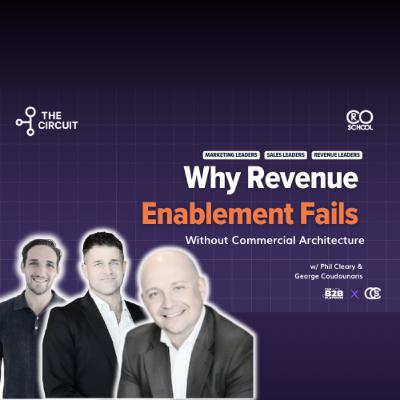
Your Pipeline Isn’t Unpredictable. It’s Unvalidated.Revenue leaders across SaaS and enterprise sales are describing the same tension:Pipeline coverage looks fine.CRM stages are full.Forecast calls still run.Yet confidence feels thinner than it used to.Close dates slip.Deal sizes shrink late.Forecast conversations rely more on narrative than proof.In a recent discussion, Phil Cleary, who spent over two decades leading revenue enablement at Salesforce, described the issue clearly:“The realness of the pipeline… how much of it is fabricated.”Fabricated doesn’t mean dishonest.It means structurally unvalidated.Deals can progress through stages without being stress-tested for viability. Confidence rises faster than evidence. Stage movement becomes a substitute for truth.That gap is where predictability erodes.When validation isn’t enforced by the system, pipeline can look stable while remaining fragile.Coverage ratios stay healthy.Forecasts still get submitted.Leaders still feel exposed.As Phil Cleary surfaced, the uncertainty many leaders feel isn’t coming from effort or intent — it’s coming from a validation gap. The system allows opportunities to advance without consistently proving they deserve to.At scale, this creates what many leaders call fake pipeline.Not invented deals — unproven ones.A viable deal has evidence behind it.Not enthusiasm.Not activity.Not good discovery calls.Viability requires clear answers to simple questions:Who is driving this internally — and do they have influence?What triggered urgency?What alternatives are being considered?What could stop this?What defines success post–go-live?What is the real decision path?Why now?When is the renewal or contract event?When those answers are missing, the opportunity may be real.It just isn’t forecastable.This is where Adem Manderovic and George Coudounaris introduced cataloguing within Closed Circuit Selling™.Cataloguing isn’t CRM hygiene.It’s capturing buyer truth in plain language so the organisation stops guessing.It doesn’t speed buyers up.It stops probability inflation.Phil Cleary also highlighted a critical shift in buyer psychology:Fear of Messing Up now outweighs Fear of Missing Out.When buyers fear personal or reputational risk, decision cycles lengthen, committees expand, and scrutiny intensifies.From the outside, this looks like unpredictability.Inside the system, it exposes weak validation and poor continuity.Better questioning frameworks don’t solve that.Visible commercial continuity does.Revenue volatility isn’t a skills problem.It’s a system design problem.Closed Circuit Selling™ is not a sales methodology.It is a commercial architecture.When validation, handover, delivery, and retention aren’t governed by a unified system, volatility is inevitable.When they are, confidence compounds.Your pipeline isn’t unpredictable.It’s unvalidated.Pipeline Volatility Is a Validation ProblemWhat Viability Actually MeansFOMO vs FOMUThe Bottom LineThe bookhttps://www.amazon.com.au/Closed-Circuit-Selling-Predictable-Unpredictable/dp/B0GQ2YV52Y/Partner pagehttps://theb2bplaybook.com/ccs-resourcesMore about our programshttps://theb2bplaybook.com/cro-school

Comments

Download from Google Play

Download from App Store
 United States