


 Claim Ownership
Founder Thesis
Subscribed: 35Played: 1,539
Subscribe

© Copyright 2022 ThePodium.in
Description
Dickens said, it was the best of the times, it was the worst of the times. The words have never been truer. Best because there’s never been a better time to be an entrepreneur. Worst because the clutter is mind-numbing. Founder Thesis breaks through the noise to bring you stories of success & failure, grit & struggle, bouquets & brickbats from some of the most brilliant entrepreneurs in India.
463 Episodes
Reverse
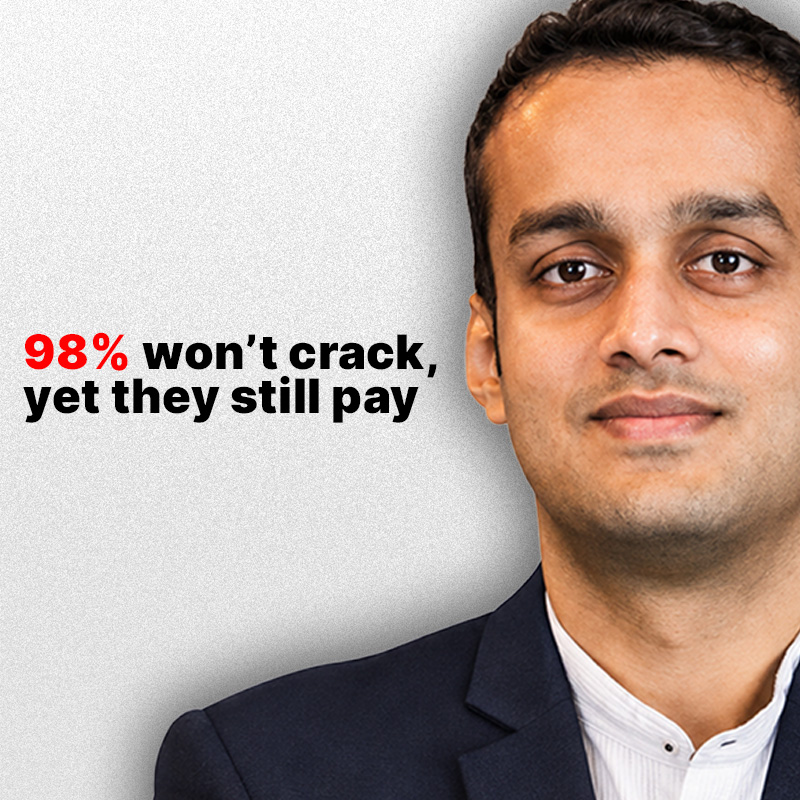
Why did a billion dollars of venture money fail to beat Kota's coaching factories? Unacademy's former COO explains what really went wrong with edtech in India, and why his new company trains nurses and hotel staff inside colleges instead of around them. Vivek Sinha was homeschooled in a flood-hit block of Bihar. He then studied at NIT Jamshedpur and ISB, and lost his first startup, Buildzar, to the 2016 funding winter. He went on to build MobiKwik's offline payments arm, OYO's luxury hotels business and Unacademy's test prep empire. Now he runs Emversity, a skilling startup that has raised $46 million to train grey collar workers for hospitals, hotels and data centres. It works across 50+ locations, and every course starts only after an employer commits to hire. In this conversation with host Akshay Datt, he argues three things. Test prep sells discipline, not education. Indians pay only for a degree or a job. Raising too much capital forces you into markets you have no right to win. It lands just as upGrad absorbs Unacademy at a fraction of its peak valuation and India rethinks graduate employability. 👉Why parents send children to Kota for discipline and FOMO, and why Unacademy, Vedantu and others raised over a billion dollars yet couldn't unseat Allen, Aakash, Sri Chaitanya or Narayana. 👉How PhysicsWallah won by disrupting book publishers and distance learning, serving the 8 lakh JEE aspirants who never enter a coaching centre. 👉What Vivek means by "capital won't change your reality", and why a $3.6 billion price tag pushed Unacademy into adjacent categories it couldn't win. 👉How Emversity flips the skilling model: employers like Taj sign up to hire before a course launches, and Taj's first batch earned a ₹15,000 monthly stipend against a ₹10,000 to ₹11,000 EMI. 👉Why Emversity skips white-collar and unskilled roles and trains only licensed grey collar jobs, such as OT technicians, lab technicians, nurses and data centre crews. 👉How AI runs a non-tech business. Subscribe to Founder Thesis for weekly founder conversations and follow Akshay Datt on LinkedIn [podm.in/ad] for daily insights. #FounderThesis #AkshayDatt #VivekSinha #Emversity #Unacademy #EdtechIndia #SkillingIndia #GreyCollarJobs #IndianStartups #StartupPodcast #WhyEdtechFailed #KotaCoaching #AlliedHealthcare #NursingJobsIndia #JobsAICantReplace #GraduateUnemployment #PhysicsWallah #StartupLessons #AIinEdtech #careerafter12th Disclaimer: The views expressed are those of the speaker, not necessarily the channel.

A broker earns every time you trade, yet this one built a kill switch that tells you to stop. Former Swiggy CTO Dale Vaz explains how stock trading works in India, why your broker doesn't get to keep your money, and what an AI trading app should refuse to do.
Dale Vaz joined Amazon in 2007, rose to CTO at Swiggy, and has traded the markets since 2008. Sahi, the broker he built with fewer than 10 engineers, charges ₹10 an order where most charge ₹20, and has onboarded about 6 lakh demat accounts in 18 months.
In this conversation with host Akshay Datt, Dale walks through how stock trading works in India, from the exchange that matches buyers and sellers to the depository and clearing house that keep your shares and cash out of your broker's hands. He explains options trading with a pizza coupon, shows why the odds sit against option buyers, and refuses to call retail traders gamblers. The timing matters: margin funding has taken off in the last two years, SEBI's own data shows retail F&O traders struggling, and Sahi is betting its AI agent Cairo can help them make better decisions.
👉What actually happens after you tap buy, from NSE and BSE matching your order to sellers getting paid on T+1 and NSDL or CDSL holding your shares even if your broker shuts down.
👉Why Dale priced Sahi at ₹10 an order, borrowing Jeff Bezos's rule that a customer should feel financially irresponsible not to choose you.
👉How options trading works through a ₹10 pizza coupon, and why a 10% move in the underlying can double an option's price while the odds still favour the seller.
👉How margin trading facility loans let traders buy three times their capital, and how brokers cap leverage by stock volatility and by customer.
👉Why Dale thinks a general AI like Claude can't replace your broker, and how Sahi's Cairo handles "should I buy Reliance?" without giving a stock tip.
Subscribe to Founder Thesis for weekly founder conversations and follow Akshay Datt on LinkedIn [https://www.linkedin.com/in/akshaydatt/] for daily insights. #DaleVaz #Sahi #SahiTradingApp #FounderThesis #AkshayDatt #IndianStockMarket #StockTradingIndia #HowStockMarketWorks #OptionsTrading #OptionsTradingForBeginners #FnOTrading #MarginTrading #DematAccount #DiscountBroker #AITrading #TradingDiscipline #Fintech #IndiaStartups #ExSwiggyCTO
Disclaimer: The views expressed are those of the speaker, not necessarily the channel.

India banned real money gaming in 2025. Anuj Tandon of BITKRAFT Ventures never backed a single RMG company, even when it was the only bet paying off in Indian gaming. In this episode, he explains how gaming venture capital in India really works, why micro dramas (microdramas) could beat Netflix and OTT, and why Indian game studios still struggle to build global hits. Anuj has seen Indian gaming from almost every seat. He co-founded a mobile game studio in 2010, ran game publishing at Nazara, and led the India business of a listed Chinese gaming company. At KRAFTON, the maker of PUBG and BGMI, he led investments into startups like Kuku FM, FRND and Nodwin Gaming. Today he's a Partner at BITKRAFT Ventures, a gaming and interactive media fund that manages $1.05 billion, and he leads its early-stage bets across India and the Middle East. In this conversation with host Akshay Datt, he explains why micro dramas could become the Candy Crush of long-form video, and why Istanbul is beating Bangalore at mobile games. He also talks about why India produced a wave of TikTok clones within six months of the 2020 app bans, but almost no games. If you're building, funding or just following Indian gaming startups after the RMG ban, this is where he thinks the money goes next. 👉 Why Anuj passed on every real money gaming deal at KRAFTON and BITKRAFT, and what working for a Chinese gaming company taught him about how regulators treat cash-in, cash-out games. 👉 How micro drama apps make money through in-app unlocks and subscriptions, and why he believes they could out-earn traditional OTT drama. 👉 What separates a game studio from a publisher, and why studios that land a hit, like PlaySimple with its half-a-billion-dollar exit to MTG, end up doing both. 👉 How a gaming VC values a startup, including why a studio with $10 million in revenue asking for a $100 million valuation might get an offer closer to $15 million. 👉 What puts investors off, from Claude-built pitch decks (an orange flag) to passing off GMV as revenue, which ends the deal. 👉 Why not every business is venture investable, and why a 10 crore business making 2 crore with five to seven people is a great outcome. BITKRAFT Ventures: https://www.bitkraft.vc Subscribe to Founder Thesis for weekly founder conversations, and follow Akshay Datt on LinkedIn for daily insights: https://www.linkedin.com/in/akshaydatt/ #indiangaming #MicroDrama #VentureCapital #AnujTandon #FounderThesis Disclaimer: The views expressed are those of the speaker, not necessarily the channel.

The cloud and AI giants earn more when you spend more, so who makes sure you aren't overspending?
Ez Natarajan built CoreStack into an AI governance company approaching $100M in annual recurring revenue, on the bet that the referee has to be independent. Ez spent years in the partner ecosystem that helped build Microsoft Azure before it even had a name, watching enterprises stall because the cloud rewrote every rule for cost, security and operations. CoreStack, now in its 10th year, is a multi-cloud governance platform. It connects to a company's AWS, Azure and Google Cloud accounts, finds every workload, and fixes cost and compliance problems automatically. Its largest customer spends about $1 billion a year on cloud.
In this conversation with host Akshay Datt, Ez explains why hyperscalers welcome software that cuts their customers' bills, and why the world has less than one GPU per person. He also argues that every software company, CoreStack included, will move to token-based pricing. With AI budgets rising and per-seat SaaS under pressure, his case for independent AI governance and cloud cost optimization comes at a good time.
👉Why AWS and Microsoft treat CoreStack as a top partner even though it cuts their customers' cloud bills: a CFO's budget freeze would hurt them far more.
👉How CoreStack lets customers decide when it acts on its own, taking automatic action in dev and test environments while keeping a human in the loop for production.
👉What the GPU shortage really looks like: less than one GPU per human today, while Ez estimates each person needs 10 and Sam Altman needs 1,000.
👉How AWS and Anthropic split token revenue differently by region, and why Google, Amazon and Microsoft are hedging across OpenAI, Anthropic, Gemini and Nvidia at once.
👉Why Ez plans to take CoreStack public instead of selling to a cloud or AI giant, arguing that AI governance has to sit outside the companies it polices.
Subscribe to Founder Thesis for weekly founder conversations and follow Akshay Datt on LinkedIn [https://www.linkedin.com/in/akshaydatt/] for daily insights.
#CoreStack #EzNatarajan #FounderThesis #AkshayDatt #AIGovernance #CloudGovernance #FinOps #CloudCostOptimization #MultiCloud #GPUShortage #TokenPricing #AIAgents #AgenticAI #EnterpriseSaaS #AIInfrastructure #HowCloudComputingWorks #BootstrappedStartup #IndianFounders #StartupPodcast
Disclaimer: The views expressed are those of the speaker, not necessarily the channel

India's animal welfare laws look world-class on paper, yet a Bangalore court once tried to auction a rescued bear as "perishable goods." Jayasimha Nuggehalli, co-founder & COO of Global Food Partners, explains why he stopped betting on laws alone and started building a market for cage-free eggs. Jayasimha Nuggehalli has spent 26 years fighting for animals, first as a PETA undercover investigator inside slaughterhouses and factory farms, then drafting animal law and leading Humane Society International in India. Seven years ago he co-founded Global Food Partners, which helps food companies keep their cage-free egg promises and trains medium and large egg farmers across China, Indonesia, the Philippines and Thailand to move hens out of battery cages. In Indonesia alone, over 100 farms are now transitioning.
In this conversation with host Akshay Datt, he makes a contrarian case: awareness campaigns rarely change what people buy, animal welfare only survives when it pays, and philanthropy deserves the same tolerance for failure we give startups. With global food brands struggling to meet their cage-free pledges, his effective altruism lens on building an animal welfare business has never been more relevant.
👉Why a Bangalore court treated a rescued dancing bear as perishable goods, and how that day pushed Jayasimha into law.
👉What a failed humane slaughter pilot between Pollachi and Coimbatore taught him: if animal welfare is not economically viable, it never lasts.
👉How food companies decide to go cage-free, using his cost-of-welfare versus cost-of-ignoring formula and a 20 to 30% jump in egg costs.
👉Why Save the Tiger is one of the least effective causes for an impact career, and how scale, neglectedness and tractability help you pick a better one.
👉How India's focus on quantity of life over quality of life leaves dairy cows tethered in tabelas and hens confined in cages.
Subscribe to Founder Thesis for weekly founder conversations and follow Akshay Datt [https://www.linkedin.com/in/akshaydatt/] on LinkedIn for daily insights.
00:00 - The lawyer who chose animals over Infosys
05:56 - A dancing bear sparks animal law
09:32 - India's animal welfare paradox
14:34 - Why India has so many stray dogs
18:46 - From PETA to Global Food Partners
21:55 - How animal welfare public policy works
24:59 - Why animal laws stall in Asia
27:25 - Why markets beat laws for animal welfare
28:04 - Gen Z, Labubu and ethical food spending
30:21 - Sab Ka Sapna Money Money explained
31:15 - What effective altruism really means
36:13 - How to pick a nonprofit cause
40:07 - Why cash beats in-kind charity
44:37 - Why charities deserve startup-style risk
46:16 - Product-market fit for a nonprofit
51:44 - Has Global Food Partners found PMF
55:44 - Does anyone pay for cage-free eggs
59:30 - The cost of ignoring animal welfare
01:03:00 - Cage-free consulting as reputation risk insurance
01:05:16 - How Global Food Partners makes money
01:08:18 - Why India is hard for cage-free eggs
01:10:50 - Inside a nonprofit co-founder's week
#JayasimhaNuggehalli #GlobalFoodPartners #CageFreeEggs #AnimalWelfare #FounderThesis #AkshayDatt #EffectiveAltruism #IndiaStartups #ImpactEntrepreneurship #Philanthropy #NonprofitLeadership #SustainableFood #FoodSupplyChain #FactoryFarming #WhatIsEffectiveAltruism #CageFreeVsCagedEggs #HowNonprofitsMakeMoney #AnimalWelfareIndia #socialenterprise
Disclaimer: The views expressed are those of the speaker, not necessarily the channel

Comments

Download from Google Play

Download from App Store
 United States