


 Claim Ownership
Faster, Please! — The Podcast
Subscribed: 19Played: 744
Subscribe

© James Pethokoukis
Description
Welcome to Faster, Please! — The Podcast. Several times a month, host Jim Pethokoukis will feature a lively conversation with a fascinating and provocative guest about how to make the world a better place by accelerating scientific discovery, technological innovation, and economic growth.
fasterplease.substack.com
fasterplease.substack.com
111 Episodes
Reverse
Welcome to Faster Please!—The Podcast, the audiovisual companion to my Faster Please! newsletter. I am your host, Jim Pethokoukis.My guest this episode is Dr. Kevin Cannon. Kevin is the principal at Starbench Analysis, a platform that provides research and analysis on space exploration, emerging technologies, and the future of humanity in space. Previously, he was a professor at the Colorado School of Mines, where he taught planetary geology and space resources.Today, we dive into the growing competition between SpaceX and Blue Origin, the possibility of AI data centers in orbit, the race back to the moon, and humanity’s prospects for settling Mars. Hope you enjoy it.In this episode:* Space after the midterms (0:00)* Orbital data centers and the night sky (8:47)* In search of a killer app (17:35)* The coming launch crunch (20:18)* The race back to the moon (26:53)* Mars and bigger rockets (30:36)* Planetary defense and asteroid mining (35:35)A lightly edited transcript of our conversation will appear in my Week in Review issue on Saturday. (Another option is using the Substack auto transcript function.)But here are some edited highlights from the chat:On space after the midterms…Space itself and NASA has enjoyed very good bipartisan support. It always has. And even under this administration where the OMB has tried to cut back on NASA programs, particularly the science programs, Congress has been very good about restoring that funding. So I think you’re going to see kind of continued broad support for NASA and for the Artemis program. I don’t think we’re going to see any kind of radical shift in direction going back to Mars or asteroids as we did in previous administrations.But I think there are questions about kind of the enthusiasm, like the overall enthusiasm you talked about for kind of settlement, things like that. There’s always a question of how enthusiastic the president and the vice president are, and then also who they put in as administrator, right? So we’ve kind of seen NASA flourish under Jim Bridenstine and now under Jared Isaacman. And so that can really have a huge effect on just the workforce and the overall morale of the agency.On orbital data centers…The other thing though, I think the more interesting debate though is the societal acceptance of these data centers. And this is something that I haven’t seen too many people talking about. The one person who’s been doing really interesting work on this is this guy, Shane Ross, who’s a professor at Virginia Tech. And what he’s been doing is making these very accurate simulations of what these orbital data centers would actually look like to the naked eye in space. So if we take the SpaceX AI-1 satellite, that’s kind of their pathfinder. It’s a 250 kilowatt AI data center satellite. And one of those satellites would be as bright in the sky as Venus is.Now it gets kind of worse from there. So if you want to put these satellites in orbit, there’s really only one type of orbit in low Earth orbit that makes sense, and it’s called a sun-synchronous orbit. So if you have a satellite orbiting around the Earth, it can have a different inclination. So the orbit can be inclined relative to the pole of the Earth. And if you get that inclination up to about kind of 97, maybe 100 degrees, you get into these sun-synchronous orbits that perfectly track the terminator, which is the dividing line between night and day. And they get basically 100% sunlight all the time, which is what you want if you’re doing compute in space.On the search for a killer app… The whole lunar thing. There’s a little bit there, but there’s still not really a lunar economy per se. So yeah, I think that’s why orbital data centers have attracted so much interest from the space industry. The appeal there is that you’re selling into an existing market, right? So there’s already an existing market for compute. We know how much people will pay for inference for AI models. And so if you can kind of get set up, you can just tap into that existing market.That’s kind of the same argument that AstroForge just made for asteroid mining. So there were all these other people saying, well, we’re gonna go out and get water from these asteroids and bring them back and sell it into this kind of water-based orbital economy. And the problem there is that it’s kind of a chicken and egg. Like you don’t really have this kind of cislunar development where you could find a customer to sell water to in space. And so they say, we’re just gonna go get metals from asteroids. There’s already the London metals market. We can just sell our products into an existing market.On the coming launch crunch…So if you’re trying to do any of these other things, tourism, mining, whatever, right? If you don’t have your own rockets, you’re paying the price, and so you’re paying very healthy margins to SpaceX in this case because they don’t really have robust competition. So the price for that Falcon 9 might be 80, 90 million dollars, whereas the internal cost to SpaceX is only 10 or 15.So this is really just a question of when is there going to be robust competition to get those prices down, kind of eat into those margins and start to commoditize launch. I think Blue Origin and ULA with their Vulcan, they’re kind of like the next best hope. Obviously Blue had that very tough incident on the pad. They’re scrambling to try to get back to flight. And then you do have a new slate. I think these high prices, these high margins are going to attract a lot of people coming in with new concepts for medium-lift, heavy-lift vehicles. Some of them are very promising, like Stoke Space. So they’re going straight for a fully reusable rocket. There’s others that are entering the market with medium lift, heavy lift.On the race back to the moon…And then on the flip side, you’ve got Blue Origin, right? They obviously care deeply about this. Jeff really wants to be the one to land American astronauts. But they’ve just kind of been hamstrung by these kind of failures and engineering incidents. So for them it’s more of a technical question: can they kind of get this program together and make things happen? But I would say right now it’s not looking great for a US landing by 2029. So I think there is the potential that China does get there first.The next question though is what happens after? China’s kind of going for this one-off Apollo recreation. There’s a lot of question marks about their ability to kind of build up a sustained presence. So on the US side, I think that’s kind of the hope, is that even if that first landing comes a year or two after the Chinese, that the US is putting into place all of these things: the landers, the CLPS program, power infrastructure, fission surface power, mining, that even if they kinda get there after, they’re kind of setting up for kind of a long-term presence and a long-term success with the moon base.On Mars and bigger rockets…To me the question is how does our technical capability of doing something like Mars missions improve with very, very strong AI? So if we just kind of look at the capabilities and look at the exponential trends it’s starting with coding and math, it’s now kind of moving into the physical sciences, it’s gonna move into hardware engineering, right? Anything an engineer can do on a computer, CAD modeling, simulations.So do we kind of get that kind of exponential uplift in our ability to kind of do these very hard technical things? And does that kind of start to bend that timeline towards something more optimistic? So I think right now if you just have kind of normal NASA incentives, maybe kind of SpaceX more focused on low Earth orbit, data, AI, communications around Earth, then that kind of seems like a reasonable estimate. But if you kind of equip a startup who really cares about this, who really wants to do this, with kind of incredible technical capabilities, then that’s where I could see that kind of come down into maybe the mid-late 2030… This is a public episode. If you'd like to discuss this with other subscribers or get access to bonus episodes, visit fasterplease.substack.com/subscribe
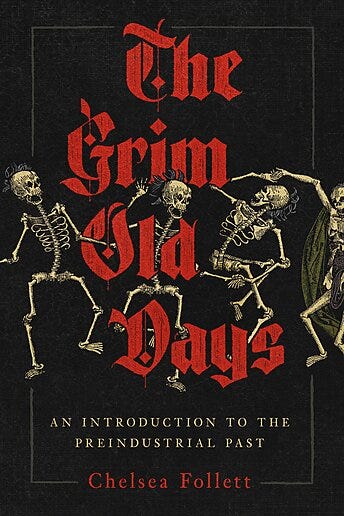
My guest this episode is Chelsea Follett. Chelsea is a research fellow at the Cato Institute’s Center for Global Liberty and Prosperity, where she works with HumanProgress.org. She is also the author of the Past Imperfect Substack and her new book, The Grim Old Days: An Introduction to the Preindustrial Past, which challenges our tendency to romanticize the past by revealing the harsh realities of life before industrialization.Today, we’ll discuss the book, exploring a world that technological progress and economic growth have allowed us to escape.In this episode:* Romanticizing the pre-industrial past (0:54)* Life before the great enrichment (5:05)* But what about the royalty? (13:27)* Nostalgia and the case against growth (21:52)* Making the case for growth (26:52)* How we treated people, animals, and nature (32:04)* The beauty of the past without its horrors (36:39)A lightly edited transcript of our conversation will appear in my Week in Review issue on Saturday. (Another option is using the Substack auto transcript function.)But here are some edited highlights from the chat:On misconceptions about the Industrial Revolution…Even if you ignore the extremes and just look at the broad center of the political spectrum, if you ask the average person, what was the effect of the Industrial Revolution on the living standards of an average person? The picture they will paint for you is not a pretty one. They will probably tell you that the Industrial Revolution caused terrible living conditions, worker exploitation, pollution, and all manner of other hardships.Not that long ago, on the Joe Rogan podcast, our vice president JD Vance made the comparison, like everyone else does, it’s cliche at this point, between the AI revolution and the Industrial Revolution. And he claimed that if we want to avoid what was worst, his word, of the Industrial Revolution from recurring during the AI revolution, we need strong labor unions, anti-monopoly measures, essentially more government intervention into the economy. And I don’t think he is expressing an unusual view when he thinks of the Industrial Revolution and his mind immediately goes to these terrible working and living conditions that no modern person would accept. But we have to remember those conditions were largely preexisting.On the improvement of diets…The diets of the past, which are so romanticized both by the MAHA movement and other people, this idea that in the past people ate these wholesome, chemical-free diets, all organic. Unfortunately, this romanticized view would shock our ancestors, whose food was so bland that they fought wars and would kill and die over spices that we now take for granted. And that’s when they had food at all.Every three or four years, a famine could occur and the years of famine were terrible even in the relatively well off areas of the world, such as Western Europe. For example, in Burgundy, France, at one point, a famine occurred that was said to have taken the lives of 10,000 families, and those that survived were said to have turned to eating grass and wild plants in the fields, and even to eating human flesh of those who had already succumbed to malnourishment. In fact, we see again and again accounts of famine-induced cannibalism in different parts of the world.On the hardships of royalty…You alluded to the lives of the wealthy. Even if you were a member of the small elite, and remember again, 80 to 90 percent of the population would have been subsistence farmers. But even if you managed to win the lottery and be born among the nobility, you still would have wine freeze at your table. You still would lose half of your children because being a prince or princess would not spare you from the astronomical rates of childhood death in the past. You would still face a higher mortality rate at every age, indeed.There is another myth that rates of mortality in the past were only so much higher because of high rates of child mortality. In reality, in the pre-industrial past, mortality rates were higher at every age group. Although it is true that children face the worst odds of anyone. And if you were a member of the nobility or even the royalty, we must recall again that even the palace of Versailles lacked restrooms. Human waste would accumulate in the corridors. There is a firsthand account of the Queen’s gentleman usher letting go of her hand to go urinate on a wall hanging.On the case against growth…Sadly, if you look at polling of the general population, you will see that a majority of people, for example, oppose data center construction in their community. And in the DC area where we both reside, regulation has been preventing the entry of self-driving cars that are operating just fine in other areas of the country and that hold the potential to save many of the nearly 40,000 lives that are lost every year to traffic accidents. Progress is being held back by these government barriers because, as you point out, many people do not see economic growth as a particularly important goal.If the AI revolution is a new industrial revolution, that is incredible. What that would mean, if true, is that our descendants, our great-grandchildren, will look back at the 2020s with the same kind of horror and disgust and disbelief with which we look back on the pre-industrial age because their own standard of living will be so much higher.On recent technological jumps…That’s actually going to be my next project, trying to deromanticize the latter half of the 20th century, whether they want to go back to the good old days of the 50s or the 60s or the 70s or the 80s or the 90s in some cases.I think that if you ask the average person, how much money would you have to receive in order to give up every piece of technology that has been invented since 1990? The answer would be quite a high number. You couldn’t use a smartphone, you would have to use a paper map. If you needed to look up someone to come help out around the house, a handyman, you’d have to use an actual phone book. I mean, it was a different era, and the amount of money that people would have to receive in order to give up all of that technology is usually pretty high. On the treatment of animals…Now we may critique modern treatment of animals in various ways, but the fact that people have discussions of animal welfare today at all shows that we live in a completely different world from one where torture was legally required of animals. And we have to remember also before modern transportation, milk would spoil if you tried to transport from the countryside into the city. And so cows were kept in the city for their milk, in these small dark stalls where they could hardly move, and the creature’s milk was called blue milk for its sickly color because these creatures were so mistreated.Farm animals would be kept in the cities, pigs roaming the streets. This was not a healthy situation for the human beings involved either. Environmental degradation was rampant. Deforestation was so severe in parts of Europe that when the colonial era did occur, numerous trees or wood was brought over from North America, from the colonies, because England had deforested itself so much, stripped many of its forests bare, and then there was the pollution of the rivers and the water supply. People were dumping human waste into the same rivers from which they drew their own water and from which they fished.On the beauty of the past…I am not against resurrecting the aesthetics of the past. I am a fan of many of the aesthetics of the past. Old paintings, old styles of architecture. I think that they’re lovely. But today, with our modern prosperity, we are better able to preserve and recreate the artistic and architectural styles of the past than ever before.When Notre Dame Cathedral burned, people thought that we lacked the know-how in this day and age to recreate it and restore it to its former glory. But it turned out that we could. In fact, apparently, because a part… This is a public episode. If you'd like to discuss this with other subscribers or get access to bonus episodes, visit fasterplease.substack.com/subscribe

My guest this episode is journalist and author Art Tavana. Art is currently a PhD researcher at the University of Southern California, focusing on Disney and fan studies. He also teaches courses on Disney and technology and serves on the editorial board of the International Journal of Disney Studies.Today’s conversation centers on Tomorrowland, a subject close to my heart. (The introduction to my book is titled “America’s Tomorrowland Problem.”) We’ll talk about its history and Disney’s new plan to reimagine the theme land, which we both hope will make Tomorrowland once again what the plaque at its entrance promised back in 1955:In this episode…* Walt Disney: America’s futurist (0:53)* The evolution of Tomorrowland (4:47)* How Tomorrowland lost its future (9:48)* Bringing tomorrow back to Tomorrowland (16:27)* Balancing Disney’s past and future (26:45)* Disneyland’s hidden gems (33:36)A lightly edited transcript of our conversation will appear in my Week in Review issue on Saturday. (Another option is using the Substack auto transcript function.)But here are some edited highlights from the chat:On the legacy of Walt Disney…He’s definitely a futurist. His innovations in audio-animatronics, his innovations in animation, his innovation in roller coaster technology. We really don’t have the jet-age aesthetic that Disneyland captured in ways that nobody had up until that point.There’s a really good book on this called The Jet Age Aesthetic by Vanessa Schwartz. And she talks about how Disneyland took that mid-century modern, retrofuturistic aesthetic of movement and jets and transportation and turned it into an attraction-centered experience that really changed the way we as Americans view technology and experience.So I think that is a foundational accomplishment: He revolutionized blending technology with experience in a way that I think is literally our society today.On the evolution of Tomorrowland…In the early 70s–mid-70s, Tomorrowland goes away from the practical, realistic future to more of a Jules Verne [style future]. Disney starts narrativizing the future as more fantasy-based. And so that’s when we move from Tomorrowland as a space to exhibit the future to a space to exhibit the fantasies of the future, which sometimes are the future.Like, sci-fi is kind of a prediction of where we’re going in our society often. But anyway, so that happens in the 70s, and it carries over into the 80s and 90s and even the 2000s. And then that’s when IP becomes the feature. So now what we have is, like, IP and a fantasy of a sci-fi future.But I truly believe, the new Tomorrowland that we’ll probably see in the next four to five years is gonna be more of what people saw in the early Tomorrowland, which is a bit more like a technological exhibition hall, World’s Fair-style park. Now, that’s me being optimistic and hoping for things, but I don’t know if that’s gonna happen.On Tomorrowland’s lost techno-optimism…We’ve become a very techno-negative kind of culture. Techno-optimism, I think, should be focused on tomorrow. I don’t think Tomorrowland should be skeptical of technology.I think Tomorrowland should embrace technology and should be narrativizing it into really fun, engaging, and interesting experiences. Now, educational rides—or attractions, sorry, I always say rides, and you’re never supposed to do that in Disney-speak. But seriously, I think that educational attractions don’t necessarily work anymore. I don’t think they really connect with people.But you can narrativize them in interesting ways and build technology and optimistic, sort of, you know, experiences at the parks. And I think Tomorrowland should be focusing on a view of the future that is embracing the things that are interesting right now, which I think a mission to Mars or some sort of Mars-centric experience should be part of Tomorrowland.On using storytelling to showcase innovation…Well, see, Disney’s magic is going to be—and I think they can do this, and they’ve done this before—they have to really be able to narrativize that world without making it sort of feel dystopian or feel like something that needs to be critiqued.A WALL-E sort of—the Olaf animatronic, the free-roaming Olaf in Paris that uses a lot of AI tech. That’s the sort of way you do it, where you bring it in through the kind of characters people love and experiences people really love, and you showcase the sort of innovation without didacticism.The problem is, the moment you do something where we’re trying to teach you or educate you through ideological sort of baseline preferences and things, that’s when it becomes, I think, a problem for the parkgoer. You know, Disney doing didacticism doesn’t work. It doesn’t work in its movies. It sort of worked in the park in the early era of the park, but it doesn’t really work anymore. They can kind of do that with their story department, but they haven’t done a good job.On balancing nostalgia and progress in Tomorrowland…But in terms of nostalgia, I think when you go to Tomorrowland, the first thing I think of, at least, is Space Mountain. And I think that will be there, and it will be there as it is for the most part. Maybe expanded, but yeah, it’s hard.Retrofuturism is part of Disney’s identity, and the jet age and the mid-century sort of... But how do you keep that without being too old-fashioned? Because Tomorrowland has to be the future. That’s the one part of the park, to me, that doesn’t need to be sort of too preservationist.That’s the one part of the park, to me, that needs to move forward aggressively. And of course, Autopia, one of the original attractions. That is not going away, right?On underappreciated Disney attractions…Autopia, to me, is so underappreciated now, especially since it’s sort of become a dated feature of the park. But I think the fact that you can get in an automobile, a small automobile, and drive on a freeway with kind of free rein to do what you want is special. I mean, it’s not complete free rein because you’re on a track, but you’re smelling the gasoline, you’re smelling the freeways. This attraction, to me, is still the closest thing to the original Disneyland feel.I think that’s such an underappreciated attraction. It isn’t on anyone’s list. If you look at a list of favorite attractions, Autopia is rarely on it, but it’s on mine. I love the smell of it. I love the energy of it. I love that it’s in a corner of the park that not everyone really accesses. I think that’s really underappreciated.I hope that when Tomorrowland relaunches, Autopia is centered as an important part of its future, not just a side attraction or an old nostalgia point.On sale everywhere: The Conservative Futurist: How To Create the Sci-Fi World We Were Promised This is a public episode. If you'd like to discuss this with other subscribers or get access to bonus episodes, visit fasterplease.substack.com/subscribe
My guest this episode is Stephanie Wakefield. Stephanie is an assistant professor of Urban Planning and Environmental Design at Florida Atlantic University. She is also the author of a wonderful recent article in Palladium magazine titled “Frontier Panic,” which examines how the apocalyptic thinking surrounding the climate change movement has now been transferred to artificial intelligence. Today’s conversation will discuss this article as well as some of her other scholarship, diving into how an excessive focus on resilience could hold us back from building a world shaped by innovation and adaptation to a changing environment.In this episode* From climate panic to AI panic (0:53)* Who gets to govern AI? (6:15)* Discovery, experimentation, and the frontier (11:06)* Why we fear change (20:28)* Climate adaptation as experiment (23:02)* Aesthetics, infrastructure, and the future (26:17)A lightly edited transcript of our conversation will appear in my Week in Review issue on Saturday. (Another option is using the Substack auto transcript function.)But here are some edited highlights from the chat:On parallels between AI and climate change…It’s as if you took climate change documentaries and transposed them onto AI. It’s very much the same script and lens. You see people saying our children might not make it to high school because of AI, that we’re all going to die.And, like with climate change, this discourse of apocalyptic projections based on models and media is tied to what are then said to be the appropriate responses. So it’s a discourse that authorizes a particular set of voices to make a claim to governing this new phenomenon, this new technology, and this new environment that we’re in.With climate change, that led to this concept of resilience, which we could talk about more. And now it’s underwriting the idea of pacing the frontier or the AI pause—slowing or even forbidding the development of frontier models.On who gets to govern AI…In these moments, it is often the case that some figures step in to be the moral authority and position themselves as the ones with the right answer, to guide the mass of the population.And I personally find that to be a really cynical operation because a lot of these discourses are deployed in the name of humanity and the good of humanity, or even ordinary Americans concerned about data centers or something. And I think they actually play on the fears of these people—that they’re using them as a tool in this broader play for power, rather than actually being concerned with them.On fear surrounding AI…I think there are certain factions within society that are obsessed with that (what can go wrong) and forwarding that way of thinking and trying to spread it. It’s a contagion, it’s a virus, like other ones that we have experienced. It spreads through mimetic contagion, through repetition, through feedback loops.We are in a cybernetic society, and if you are trying to influence the culture and the discourse and the mood, you understand that. And you are an operator of feedback, trying to push the swarm, let’s say, in a particular direction and not others.But I would say I don’t think that’s just us in general. These moments of technological inflection—the same was the case in the early 20th century—always involve multiple factions and perspectives. Every time we’re in this space of upheaval, it’s actually like a war, really, a war situation or a game situation. It’s a contest for putting forward other visions and other attitudes.On the AI frontier…The famous Turner essay on it—it’s kind of cliché to bring it up, but actually reading it again is amazing. What he’s describing is a specific experience in a material world, in a real reality, of certain people that was complex, it was fraught, it involved conflict, yes, but also experimentation—an experience that ultimately reshaped those people who had it, who forged out into the unknown.The frontier spirit is one of an individual who is excited by going into the unknown, wants to explore it, find out what is possible there, test reality there, test the new environmental conditions, but also is willing to be reshaped by it. I think that’s a thing that is lost.On resistance to change…Politically, we’ve gone through the past few decades with an extreme discomfort with political categories and binaries and frames. We’ve just been in this endless series of cascading transformation.And so I think that there is, among some types of people, a desire—a conservative desire—to stop time, stop this movement, hold on to something familiar, to build a wall ultimately against all this change rushing at us, or that we’re rushing toward, however you want to think about it.On climate adaptation…If it really is true that we are going through such a time of massive transformation, including environmental transformation, then wouldn’t that be an occasion to try really audacious, totally new kinds of visions and designs and experiments?Shouldn’t this be a time for a civilization in experiment mode rather than a conservative mode? The seawall kind of becomes a metaphor, like building a wall against that change.On 21st-century aesthetics…Infrastructure and the aesthetics of our environment are actually one of the ways in which we create meaning in our lives and create a sense of where we’re going as a society. And I think that’s a massive project that we could and should be embarking on again.There are a lot of calls for a return to classical architecture, which are fine, but I think this can also be combined with a thrust toward the future. What are the new styles, the new aesthetics? What is the new built environment that we want to make that’s adequate to our time and our momentum at this point in history, the 21st century?On sale everywhere by James Pethokoukis The Conservative Futurist: How To Create the Sci-Fi World We Were Promised This is a public episode. If you'd like to discuss this with other subscribers or get access to bonus episodes, visit fasterplease.substack.com/subscribe
My guest this episode is Ramez Naam. Ramez has spent years thinking, writing, and investing around technological progress in energy and artificial intelligence. He is the founder and managing partner of Planetary VC, where he invests in emerging technologies across areas including clean energy, electrification, and AI. He is also the author of The Infinite Resource, More Than Human, and the Nexus science-fiction trilogy.Today’s conversation will focus on the pace of AI progress, the roadblocks that could stand in the way, and what all of this could mean for long-term economic growth.In this episode* The state of AI growth (00:38)* Roadblocks to an intelligence explosion (06:11)* AI in the short term (13:34)* AI’s economic impact (19:00)* Balancing AI safety and exploration (22:04)* What will power the AI economy? (31:04)The state of AI growth (00:38)AI capabilities are likely to be jagged for the foreseeable future. I believe in superintelligence, I believe it’s already here. We already have superintelligence playing Go. We’re crossing into superintelligence in formal math. That doesn’t mean we’ll have super capable persuaders, politicians or city planners.Pethokoukis: Where are we right now? As we’re recording this, OpenAI just released all these mathematical proofs and people are being wowed by that. Wherever you think we are at in the world of AI progress, does that result change your opinion?Naam: It’s amazing. It’s very impressive. I’m not sure I thought we would be here right now. Math is a very special domain. I think about the different types of domains that AI is good or bad at in terms of how highly verifiable they are. And AI first got really good at things like chess and then the game of Go, and now parts of math, formal math, because these have some interesting characteristics. You can generate an unlimited amount of data, and AI is very data hungry. You can get to a very firm yes or no with one-hundred percent accuracy. You can verify it as absolutely correct or not correct.But like human persuasion, politics, policy, and so on you can’t. You can do all of that at the speed of compute. You’re limited only by the speed of your computing to figure out if you won the game of Go or if the math proof is correct, which is not how it is in biological research or new material science, which are messy real world. So math is a domain that is pretty far over on the highly verifiable, symbolic, perfect training data, absolutely correct yes or no. All of it happens in software. Where something like curing aging is messy.We don’t have the training data at all. We’re going to need new instruments, new science, you need experiments, and your lag to verify anything is years, decades. And so that’s something that AI is not going to be as inherently good at, in my view.I made you leap over my first question, which is sort of where we are. There are certainly people who think that, by the end of 2027, there will be no debate that everything is changing in a profound, rapid way that changes all aspects of life. And then there are those who say “that doesn’t seem to be happening right now.” The world is a messy place.The world of carbon based life forms is a messy place. And whatever the capabilities in the lab of this technology, how it emerges into the real world is going to be a much slower and uneven process. On those two poles, where are you?Yeah, I mean I’d say look, I’m an AI optimist and I’m also an AI realist. And I think there’s two separate issues we’re dealing with in your question and the one before that. One is speed of diffusion, right? And if you look at expectations of how much impact AI will have on the economy, and you ask people in AI labs, some of them say it’s going to take us to 20 percent annual growth. I mean there’s one chart out there that says it’ll get us to 100 percent annual growth. Then you ask economistsMove the decimal point over.Yeah, just get rid of it even.You ask economists and the consensus to you is that, yeah, maybe it’s half a point of annual GDP growth. The economists have just seen too many past technologies run into friction in being absorbed into real life work. The diffusion rate, the dissemination rate, and the bottlenecking on the long pull on the last thing that can be automated.So in computer science we talk about something called Amdahl’s law, which is usually in terms of performance optimization. And if you have a piece of code and you can take 90 percent of it and speed it up dramatically, well the 10 percent you can’t speed up becomes the bottleneck. And sometimes that means you get very little actual speed up if it’s the thing that you’re waiting on.So in things that AI can do entirely on its own, I think we should expect incredible breakthroughs and incredible speed of progress. In things where the task is messy, as you said, and a human still needs to be involved where judgment is involved, where it’s a relational task, as one of Google’s post AGI economists, Alex Imas has this theory about relational tasks being a growth area for humans. In all of those I think diffusion will be slow.And that’s on top of my view that weekly held, but current view, that AI capabilities are likely to be jagged for the foreseeable future. I believe in superintelligence, I believe it’s already here. We already have superintelligence playing Go. We’re crossing into superintelligence in formal math. That doesn’t mean we’ll have super capable persuaders or super capable politicians or super capable city planners or whatnot.Roadblocks to an intelligence explosion (06:11)New ideas get harder to find. Right? You pick the low hanging fruit first. So I fully believe AI is going to have more and more of a role of helping to build itself, but each step will get more challenging.Certainly there are economists. You mentioned economists who study AGI. There are certain economists who think that’s a ridiculous thing to focus your scholarship on. A science fictional reality which may never occur. And even if it should, it doesn’t need a special economics. We have economics and the tools will be perfectly fine for whatever advances we get.But certainly the technologists will say, “you ain’t seen nothing yet.” You either you don’t understand the technology or you’re willfully blinding yourself that everything is absolutely about to change. Is that what they really think? Have I described what technologists think, even the ones who are worried about “it’s going to kill us all” still think this is going to be an amazingly capable technology and even they think it’s a ten percent chance it’s going to kill us all, the ninety percent will change every aspect of our lives and will be an inflection point in human civilization.Yeah, I mean I think we should expect that AI helps us increase our rate of progress in things that we care about. There are many things that we care about where progress is much slower and much more difficult than we’d like. In pharma, we have this thing called Eroom’s Law. Eroom’s law is the opposite of Moore’s Law. Moore’s Law says computing power doubles roughly per dollar every eighteen months. Eroom’s law says that over some period of time, the amount of money you have to spend to design and develop a new drug gets ten times more costly.So we already have these steep diminishing returns to research. And so AI should help bend some of those curves and accelerate how fast we find cures to diseases, develop new materials, etc. So I see it as finally very good for humanity. But I think there’s a particular assumption in the “my gosh, the singularity is scheduled for next Tuesday” forecast or for, March third, 2027, I can tell you it’s the singularity, whatever viewpoint you have. And that is the generality of AI going to one hundred percent.That is that AI will just be able to do every single thing that humans can do better than humans. And I don’t see strong evidence of that.What we see is more like logistic curves where AI, at… This is a public episode. If you'd like to discuss this with other subscribers or get access to bonus episodes, visit fasterplease.substack.com/subscribe

Comments

Download from Google Play

Download from App Store
 United States