



 Claim Ownership
The Energy Impacts with David Blackmon
Subscribed: 9Played: 327
Subscribe

© Copyright Sandstone Media 2024
Description
Discussions are a two-way street. This podcast is for all sides to have an open forum and share their opinions on fossil, renewable, nuclear, and all things energy.
219 Episodes
Reverse

In this episode of the Energy Newsbeat podcast, host Stu Turley sits down with David Blackmon (Forbes contributor and Energy Impacts podcast host) and Mike Umbro (energy innovator and founder of California for Energy and Science) to explore a groundbreaking solution to California's energy crisis. The conversation centers on Geologic Thermal Energy Storage (GeoTES)—a revolutionary technology that harnesses solar energy to heat oil reservoirs, enabling zero-emission, dispatchable power generation while simultaneously producing oil from existing fields. Against the backdrop of California's soaring electricity prices, refinery closures, and grid instability, the hosts examine how this innovative approach could reshape the state's energy landscape. They also delve into the regulatory obstacles, climate policy contradictions, and the broader implications of energy independence, revealing how domestic energy production—far from being incompatible with environmental goals—may be essential to achieving them.Connect with Mike Umbro on his LinkedIn here: https://www.linkedin.com/in/mikeumbro/Check out Californians for Energy & Science: https://www.energyandscience.com/Connect with David Blackmon on his LinkedIn: https://www.linkedin.com/in/david-blackmon-2325189/1. Geologic Thermal Energy Storage (GeoTES) TechnologyThe core focus of the discussion is Mike Umbro's innovative GeoTES project—a novel energy technology that uses solar arrays to heat water, which is then injected into oil reservoirs to create synthetic geothermal systems. This allows for zero-emission, dispatchable power generation while simultaneously producing oil from existing fields.2. California's Energy CrisisThe hosts extensively discuss California's severe energy challenges:Electricity prices are among the highest in the nation (second only to Hawaii)The state imports 25-30% of its electricity and crude oilRecent grid instability caused spot prices to spike to $200-250 per megawatt hourGasoline prices are inflated by state taxes and climate programs (adding ~$1.40 per gallon)3. Refinery Closures and Their ImpactA critical issue highlighted is California's loss of refinery capacity:The state had 40+ refineries in the 1980s; now only 7 remain with 5 slated to closeEach refinery closure adds approximately $2 per gallon to gas pricesThis forces reliance on floating storage (tanker ships) and imports, increasing emissions4. Regulatory and Permitting ChallengesMike discusses the 7-year permitting process in California:GeoTES wells are classified as oil and gas operations, not geothermalObtaining aquifer exemptions and underground injection approvals has been extremely slowContrast with Texas, where similar permits take weeks or months5. Climate Policy CritiqueThe hosts critique California's climate programs:Cap-and-Invest and Low Carbon Fuel Standard programs generate billions but fund questionable projects (like the over-budget high-speed rail)These policies create "environmental leakage"—exporting emissions to other states while importing more expensive, dirtier powerThe programs don't achieve their environmental goals while burdening consumers6. Jones Act Waivers and Energy IndependenceDiscussion of recent Jones Act waivers allowing foreign tankers to supply California:These waivers have prevented $10 gasoline pricesMore product has been shipped in recent months than the previous 20 years combinedHighlights the importance of domestic energy production7. Investment and Tax IncentivesMike explains the financial structure:The project is self-funded with $4-5 million raised privately$6 million DOE grant through the Critical Minerals and Energy Innovation OfficeTax incentives available through the Inflation Reduction Act, geothermal tax credits, and solar creditsPotential for private investors through intangible drilling costs (IDCs)8. Future Potential and ScalabilityThe broader implications of GeoTES:Could be applied across the U.S. wherever oil and gas drilling has occurredMassive potential in Texas, Louisiana, and the Gulf CoastFull field development could yield a 400-megawatt power plantCould generate $2 billion in infrastructure investment9. Environmental Benefits and ContradictionsA key theme is the environmental paradox:California's policies shut down domestic oil production, forcing imports from less regulated regionsThe GeoTES project produces carbon-negative power while utilizing existing oil fieldsCalifornia's oil is already among the cleanest in the world by carbon intensity
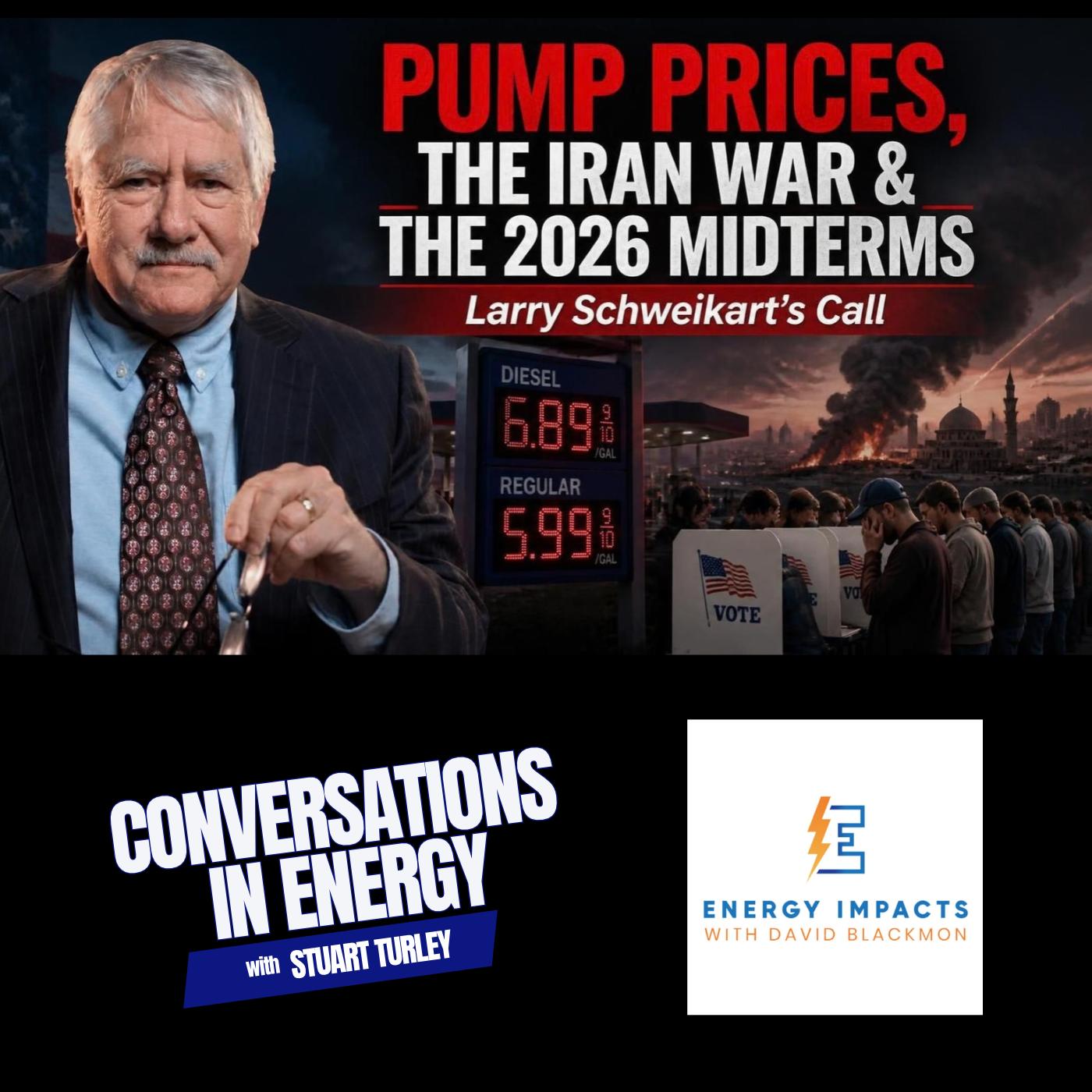
Larry Schweikart is well known as a historian and author. You may recognize him from his books, news interviews, and reputation for being right. We can't trust the polls, so we need accurate sources. In this wide-ranging political and energy analysis podcast, hosts David Blackmon and Stu Turley sit down with renowned political analyst and historian Larry Schweikart to discuss the critical issues shaping the 2026 midterm elections and beyond. With just 27 days until election day, Schweikart—who famously predicted Donald Trump's exact 312 electoral votes in 2024—breaks down Senate and House race projections, exposes the flaws in mainstream polling, and reveals four major factors that pollsters are missing.The conversation extends beyond politics to tackle the intersection of energy policy and elections, examining how Democratic governance has driven electricity and fuel costs 38-42% higher in blue states.The trio also explores emerging challenges including AI regulation, California's governance collapse, and speculation about the 2028 presidential race. Throughout the discussion, they emphasize a central theme: that voter registration data, not polls, tells the real story of where American politics is headed.Here is Larry's special for his book: https://www.wildworldofhistory.com/offers/zrFLCguW/checkoutHere is Larry's Website: https://www.wildworldofhistory.com/1. 2026 Midterm Election Predictions & AnalysisLarry Schweikart provides detailed electoral forecasts, predicting Republicans will hold the Senate with 52-54 seats (potentially up to 56-57) and gain control of the House with around 220 seats. He discusses key races in states like Georgia, Michigan, Minnesota, and Texas, emphasizing that Republicans are in a stronger position than polls suggest.I found the fact that there are so many illegal voters already removed from the country to be a huge potential win. But only if we show up and swarm the polling booths.I will be upfront and say we have to overload the polls and vote to keep the House and Senate so that we can vote all RINOs out.2. Polling Accuracy & BiasThe hosts extensively critique modern polling, arguing that mainstream polls are significantly biased against Republicans and undercount GOP voters by 7-10 points. They discuss four major factors skewing polls: deportations of Democratic voters, voter roll purges, voter registration changes, and the elimination of USAID’s influence on elections.3. Energy Policy & Gasoline PricesStu Turley highlights the impact of Democratic energy policies on electricity and fuel costs, noting that energy prices are 38-42% higher in blue states versus red states. The discussion covers California’s refinery closures, pipeline issues, and the need for energy independence.4. AI Development & RegulationThe hosts discuss AI’s rapid advancement and the need for Republican policy frameworks (similar to Newt Gingrich’s 1994 Contract with America) to regulate AI responsibly, particularly regarding data centers and their power consumption.5. California’s Governance CrisisThey critique California’s government dysfunction, including slow permit processing, the failed high-speed rail project, and the state’s shift toward communist-style policies (such as car seat requirements for 16-year-olds and quartz countertop bans).6. 2028 Presidential Election SpeculationDiscussion of potential 2028 Democratic and Republican nominees, including JD Vance vs. Marco Rubio for Republicans, and speculation about Democratic candidates like Gavin Newsom, Kamala Harris, and AOC.7. Voter Registration & Election IntegrityAnalysis of voter registration trends, mail-in voting patterns, and the importance of voter roll purges in determining election outcomes, particularly in states like Florida and Georgia.Vote Like Your Energy Bill Depends on It.We have seen what is happening in Virginia, Massachusetts, and other states, and only 10 states have voter ID laws. As Isaac Orr said yesterday, there is a real cost difference between the Blue States and the Red States. At least today, I got the states right in the discussion.

The Jones Act: America's Self-Inflicted Economic WoundIn this episode of the Energy Newsbeat Podcast, hosts Stu Turley and David Blackmon sit down with Colin Grabow, Associate Director of the Cato Institute's Herbert A. Stiefel Center for Trade Policy Studies, to examine one of America's most counterintuitive and costly laws: the Jones Act. Enacted in 1920 as the Merchant Marine Act, this legislation requires all goods transported by water within U.S. borders to use American-flagged, American-built, and American-crewed vessels. What was intended as a national security measure has instead become an economic anchor, artificially inflating shipping costs and forcing states to import energy from overseas rather than from nearby domestic sources. With the Trump administration's recent suspension of the Jones Act, Grabow presents compelling data showing that in just six months, more energy has been shipped domestically than in any single year over the past 25 years—a real-world experiment that validates decades of economic arguments against the law. The conversation reveals a troubling paradox: while the U.S. claims the Jones Act protects national security, American ships are regularly sent to Chinese shipyards for repairs, and the law has shrunk the merchant marine fleet from 257 ships in 1980 to just 92 today. Through concrete examples ranging from California's refinery crisis to Puerto Rico's energy shortages, this episode exposes how protectionist policies meant to help American workers and shipyards have instead harmed consumers, reduced economic efficiency, and undermined the very security they claim to protect.Check out the Cato Institute Jones Act Tracker: https://www.cato.org/jones-act-waiver-tracker#key-findingsConnect with Colin Grabow on LinkedIn: https://www.linkedin.com/in/colingrabow/Check out David Blackmon's work on Substack: https://blackmon.substack.com/Check out The Energy News Beat Substack: https://theenergynewsbeat.substack.com/1. The Jones Act: Definition & OverviewThe podcast opens by explaining the Jones Act (Section 27 of the Merchant Marine Act of 1920), which requires that goods transported by water within the U.S. must use vessels that are U.S.-flagged, U.S.-built, at least 75% American-owned, and crewed by Americans. This foundational explanation sets up the entire discussion.2. Impact of the Jones Act Waiver on Energy SupplyA major focus is the Trump administration's suspension of the Jones Act, which has dramatically increased domestic energy shipments:California's refinery crisis: With refineries shutting down, the waiver enabled tankers to transport crude oil from Gulf Coast refineries through the Panama Canal to California—preventing a major supply crisisRecord-breaking shipments: In just 6 months, more crude oil, gasoline, and jet fuel were shipped than in any single year over the past 25 yearsCost savings: The waiver has saved consumers millions by enabling efficient domestic shipping3. Economic Inefficiency & Cost to ConsumersThe hosts discuss how the Jones Act artificially inflates shipping costs:U.S.-built tankers cost $210-240 million vs. $52-53 million in AsiaOperating costs for U.S. ships are $8.5 million more per year than foreign-flagged vesselsThis forces states like California and New England to import energy from overseas rather than from nearby U.S. sources4. National Security ParadoxesThe conversation highlights contradictions in the national security argument:The U.S. exports LNG globally but can't ship it domestically to states like New York and MassachusettsPuerto Rico and Hawaii are forced to import energy from foreign sources despite U.S. production capacityU.S. military builds warships in allied countries (Turkey, Japan, South Korea, Finland), yet commercial ships must be U.S.-builtAmerican ships are regularly sent to Chinese shipyards for repairs and maintenance5. Merchant Marine Fleet DeclineColin Grabow presents data showing the Jones Act has failed to maintain a robust U.S. shipping fleet:The fleet has shrunk from 257 ships in 1980 to just 92 todayU.S. shipyards produce only 2.6 ships per year on average vs. 40+ per year in South KoreaThe law hasn't created jobs—it's reduced them6. Regional Energy Crises & SolutionsThe waiver has addressed multiple regional energy shortages:California: 8+ million barrels of crude, 2.4 million barrels of diesel, 1.8 million barrels of jet fuelPuerto Rico: Record propane shipments (2.89 million barrels in 6 months vs. historical averages)New England: LNG and propane imports that were previously impossibleMid-Atlantic: 12 million barrels of crude shipped to refineries7. Political & Lobbying ObstaclesThe hosts discuss why the Jones Act persists despite its costs:Concentrated benefits vs. dispersed costs: Shipyard owners and operators lobby heavily to maintain the law, while consumers bear the costsCongressional gridlock: Previous reform efforts (2006-2007) failed despite support from the U.S. Chamber of Commerce and APIState interests: Louisiana opposes changes due to port economy dependence8. Hypocrisy & ContradictionsThe podcast highlights the absurdity of current policy:Refineries in New York were buying Russian oil because it was cheaper than Texas oil due to Jones Act shipping costsThe U.S. is the world's leading LNG exporter but can't ship it domesticallyCompanies advocating for the Jones Act for "national security" send their ships to China for repairs9. Potential Solutions & ReformColin Grabow proposes incremental reforms:Allow Americans to buy foreign-built ships (aligning with policy for airlines and trucking)Restrict to allied shipyards (NATO countries, Japan, South Korea)Implement a second registry (like Norway's international registry)Use direct subsidies instead of protectionism for national security needs10. Data-Driven Evidence & Future ResearchThe Cato Institute's Jones Act Waiver Tracker provides concrete evidence:241 voyages, 190 unique vessels, 65 million barrels shippedPlans to update 2018 and 2019 research papers on the Jones Act's economic and national security impactsThe waiver serves as a real-world experiment validating free-market predictionsOverall Theme: The podcast argues that the Jones Act is a self-inflicted economic wound that harms consumers, reduces shipping efficiency, contradicts national security claims, and fails to maintain a competitive merchant marine—and that the current waiver proves reform is both necessary and beneficial.At Energy News Beat, we Make Appendices Great Again.Check out the World's Greatest Podcast Show Notes at EnergyNewsBeat.co or EnergyNewsBeat.com, and the Energy News Beat Substack at: https://theenergynewsbeat.substack.com/A shout-out to Steve Reese and the Reese Energy Consulting group for sponsoring the Podcast https://reeseenergyconsulting.com/.Data2 if you have any business systems, can you trust A? Well, they have the patent on validation. . https://data2.zoholandingpage.com/energyAnd we have WellDatabase rolling, and we use their tools for the Energy News Beat weekly Rig Reports: https://welldatabase.com/Also entering Sponsor Rey Trevino, Pecos Operating https://pecos.energy/

Welcome to Rate Payers First, where we cut through the noise on America's energy crisis. Join host David Blackmon, Stu Turley, and Frm Representative Jason Isaac as we expose the policies destroying your wallet, threatening national security, and crippling American energy independence. From windfall profit taxes to grid failures to Chinese equipment in our power lines—we're asking the questions Washington won't answer. Because affordable, reliable energy isn't a luxury. It's the foundation of prosperity, security, and freedom.This podcast is going out on both the Energy News Beat, and Energy Impacts Podcast and we highly recommend following Jason Isaac on his LinkedIn https://www.linkedin.com/in/jasonaisaac/, and also his website: https://americanenergyinstitute.com/Also check out David Blackmon's Substack https://blackmon.substack.com/, and The Energy News Beat Substack https://theenergynewsbeat.substack.com/1. Oil & Gas Pricing & Market DynamicsThe hosts debate President Trump's comments about oil companies "price gouging" on gasoline. They explain the "rocket and feather effect"—how prices spike quickly when supply concerns arise but take longer to fall. They note current gas prices are actually lower than during the Biden administration and lower than historical averages, despite public frustration.2. Windfall Profit Tax ConcernsDiscussion of proposed Democratic legislation (Ro Khanna and Bernie Sanders) to impose windfall profit taxes on oil companies. The guests argue this would ultimately harm consumers by raising costs and reducing investment, citing Texas as an example of how lower business taxes attract companies and economic growth.3. Data Centers & Critical Digital InfrastructureA major focus on the AI race against China and the importance of data centers. They contrast Governor Hokel's ban on data centers in New York with Governor Abbott's measured approach in Texas—a temporary halt to review environmental impacts. Key points include data centers' economic benefits (jobs, tax revenue, $1 billion to Texas education last year) and the need to protect water resources through responsible practices like desalination.4. Energy Grid Reliability & Market ReformExtensive discussion of Texas's grid challenges, including:Poor market design that doesn't reward reliabilityOver-reliance on intermittent wind and solar (53 GW added vs. only 3 GW of natural gas in 5 years)Rate payers bearing billions in costs to keep thermal plants on standbyLaunch of "Rate Payers First" coalition to advocate for consumer protection5. Supply Chain & National Security IssuesConcerns about Chinese equipment in the U.S. electrical grid, including:Chinese-made solar components and battery storage systemsRemote communication devices pinging back to ChinaThe incident at Camp Lejeune where a battery storage system was remotely restarted after being shut downNeed to bring manufacturing back to the U.S. and allied nations6. Wind & Solar Infrastructure ProblemsEnvironmental and practical concerns about renewable energy installations:Wind turbine graveyards in Sweetwater, Texas with disposal challengesOil leaking from turbine bases contaminating farmlandMassive concrete foundations making land unsuitable for future farmingPotential future "superfund sites" from damaged installations7. LNG & Energy ExportsCelebration of U.S. LNG production and exports as "freedom fuel" helping allies globally. Discussion of how American LNG is more affordable than alternatives and helps lift people out of poverty worldwide. Mention of major investments like Amazon's 7-gigawatt natural gas facility.8. Jones Act & Fuel SupplyThe importance of suspending the Jones Act (Merchant Marine Act of 1920) to allow cheaper fuel transport to California, Hawaii, Alaska, and Puerto Rico. Discussion of how the antiquated law drives up energy costs in these regions and harms industries like pharmaceuticals in Puerto Rico.9. California's Energy Crisis & National SecurityCalifornia's closure of refineries (down to 7 from 40) creates vulnerability for military bases and national security. The state's opposition to increased oil production threatens fuel supply for strategic military installations.10. Natural Gas Turbine ShortageA critical supply chain issue: 5-year waiting list for gas turbines, with old power plants being dismantled to salvage parts, limiting new natural gas generation capacity despite demand.The overarching theme is that affordable, reliable American energy is essential for economic prosperity, national security, and global stability—and that misguided policies (windfall taxes, renewable subsidies, Jones Act restrictions) undermine these goals.

When geopolitical chaos erupts—Iranian tankers in the dark fleet, Houthi attacks in the Red Sea, Russian refineries under fire—oil prices should skyrocket. Yet here we are in August 2024 with WTI crude at just $83 a barrel, and the market hasn't collapsed. Why? Because the U.S. is producing nearly 14 million barrels a day, pipelines are bypassing chokepoints, and refineries are running flat out. But there's a catch. In this episode of the Energy Impact Podcast, Trisha Curtis—CEO of PetroNode, Chief Economist of the American Energy Institute, and Senior Consultant at the U.S. Department of Energy—joins David Blackmon and Stu Turley to break down the real story behind oil markets. They debate whether prices reflect reality, expose the refining capacity crisis that's keeping gas prices high, and challenge the media narratives that get it wrong.From China's strategic stockpiling to Iran's fading leverage to why the oil industry desperately needs better PR, this conversation separates market hype from hard data—and reveals what's really at stake for American energy security.Connect with Trisha Curtis at https://www.linkedin.com/in/trisha-curtis-petronerds/ or @petronerds633 on YouTubeThis is also going out on David Blackmon's podcast, Energy Impacts.Connect with David on his LinkedIn here https://www.linkedin.com/in/david-blackmon-2325189/1. U.S. Oil Production & Global Market DominanceThe hosts emphasize that the U.S. produces nearly 14 million barrels per day, making it the world's largest oil producer. This production level hasn't received adequate attention in media coverage, despite its significant geopolitical and economic implications. The Permian Basin, particularly in Texas and New Mexico, is driving record output growth.2. Oil Market Resilience During Geopolitical DisruptionsDespite major disruptions—including attacks on the Strait of Hormuz, Red Sea blockades by Houthis, and the Ukraine-Russia conflict—the oil market has adapted remarkably well. The hosts credit market forces, refinery efficiency, and alternative supply routes (like the East-West Pipeline) for preventing catastrophic price spikes that many predicted.3. Current Oil Pricing ($83/barrel WTI)The discussion explores why oil prices have remained relatively moderate despite geopolitical chaos. They debate whether prices reflect reality, with consideration for tanker insurance costs, physical delivery premiums, and crack spreads (refinery profit margins).4. Refining Capacity CrisisA critical issue: the U.S. has 128 operating refineries with an average age of 75-80 years, and only one new refinery (Brownsville) is coming online by 2027. California is losing refining capacity (6 of 7 refineries slated to close), which will have serious economic consequences. Refining capacity is the key bottleneck limiting gasoline and diesel price relief.5. Strategic Petroleum Reserve (SPR) & ExportsThe hosts discuss the SPR release strategy and defend continued crude oil and refined product exports as essential to global energy security. They emphasize that allowing exports supports the market and benefits U.S. energy interests.6. China's Energy Strategy & StockpilingChina has significantly reduced oil imports (down 5 million barrels/day) and is drawing on massive strategic reserves. The hosts suggest China is using this period as a "test run" for potential future blockades (like closing the Strait of Malacca during a Taiwan conflict).7. Middle East Geopolitical ComplexityThe discussion covers Iran's leverage (tanker fleet, strait control), OPEC's fragmentation (UAE's departure), Iraq's alignment with Iran, and the role of alternative pipelines reducing dependence on the Strait of Hormuz.8. Turkey, Pakistan & Regional MediationThe hosts highlight emerging geopolitical tensions involving Turkey and Pakistan as mediators, with concerns about extremism funding and the potential for regional escalation.9. Industry Communication & LeadershipThe hosts criticize the oil and gas industry for poor public relations and not taking credit for market stability and affordable energy. They call for better industry leadership and advocacy.This podcast presents a nuanced view of global energy markets, emphasizing market adaptation, U.S. strategic advantages, and the critical importance of refining infrastructure and policy decisions around exports and reserves.Check out the Energy News Beat Substack at https://theenergynewsbeat.substack.com/Check out David Blackmon's Substack at https://blackmon.substack.com/

Comments

Download from Google Play

Download from App Store
 United States